Owen Bradley
 Walk down the air purifier aisle and you will see two phrases used almost interchangeably: True HEPA and HEPA-type. They look similar on a box, they often sit at similar price points, and manufacturers rarely explain the gap between them. Yet only one of those labels is tied to a measurable performance standard. The other is a marketing description that can mean almost anything. If you are buying a purifier to manage allergies, smoke, pet dander, or fine urban particulate, understanding that distinction is the single most useful thing you can learn before you spend money. This guide explains what the HEPA standard actually requires, why the 0.3 micron figure is so widely misunderstood, how to spot a filter that will underdeliver, and how to verify a machine before it reaches your living room.

What the HEPA Standard Actually Requires
HEPA stands for High Efficiency Particulate Air. It is not a brand and not a shape of filter. It is a performance threshold: a filter that qualifies must capture at least 99.97 percent of airborne particles at 0.3 microns in a controlled laboratory test. That single number is the whole definition. A filter either meets it or it does not.
The important consequence is that the standard describes an outcome, not a construction method. Two filters can look identical, use the same pleated glass-fibre media, and sit in the same plastic frame, yet only one of them may have been tested and certified to hit that efficiency. When a product carries the words True HEPA, the maker is claiming the filter clears that bar. When it says HEPA-type, HEPA-like, HEPA-style, or 99 percent HEPA, the maker is deliberately avoiding that claim while borrowing the recognition of the name.
Why 0.3 Microns Is the Test Size
Most people assume 0.3 microns is chosen because it is the smallest particle a HEPA filter can trap. The opposite is true. Filtration works through several mechanisms at once. Large particles are caught by simple interception and impaction, because they cannot swerve around the fibres. Very small particles, below roughly 0.1 microns, move erratically through Brownian motion and collide with fibres almost by accident, which makes them surprisingly easy to capture.
Around 0.3 microns sits the awkward middle ground where neither mechanism works well. Engineers call it the most penetrating particle size. Testing at the hardest point means efficiency at every other size is higher, which is why a genuine HEPA filter handles ultrafine smoke particles and larger pollen grains even better than its headline figure suggests. Anyone claiming HEPA filters let small particles straight through has the physics backwards.
What “HEPA-Type” Really Means
HEPA-type is an unregulated descriptor. In practice, filters carrying it typically capture somewhere between 85 and 95 percent of particles at 0.3 microns, though the figure is rarely published in a way you can verify. That may sound close to 99.97 percent, but the gap matters more than the arithmetic implies.
Consider the escape rate rather than the capture rate. A true HEPA filter lets three particles in ten thousand pass on each cycle. A 95 percent filter lets five hundred pass. That is over one hundred and sixty times as much material continuing to circulate, and because room air passes through the machine repeatedly, the difference compounds over hours. For a household without sensitivities, a HEPA-type filter may still improve conditions noticeably. For an allergy or asthma sufferer, the residual load is exactly the fraction that causes symptoms.
The Labels Worth Distrusting
Treat the following phrases as warnings rather than specifications: HEPA-type, HEPA-style, HEPA-like, permanent HEPA, washable HEPA, and any percentage claim quoted without a particle size attached. A claim of “captures 99 percent of particles” is meaningless unless you know whether it refers to 0.3 microns or 10 microns, since almost any filter media clears 99 percent at the larger size. If a listing quotes an efficiency without a micron figure beside it, the omission is usually intentional.
Washable and Permanent Filters
Genuine HEPA media is a dense mat of randomly arranged fine fibres. Rinsing it under a tap collapses that structure, opens channels through the mat, and permanently reduces efficiency, which is why authentic HEPA filters are always disposable. Any filter marketed as washable or permanent is, by definition, not true HEPA.
Washable pre-filters are a different matter and genuinely useful. They catch hair, lint, and large dust before it reaches the expensive media, extending the life of the HEPA stage considerably. Rinse and dry them monthly.
Filter Grade Is Only Half the Machine
A certified filter in an underpowered machine still leaves you with dirty air. The filter determines what is removed from the air that passes through it; the fan determines how much air passes through at all. Both must be adequate.
The figure that combines them is CADR, or clean air delivery rate, usually published as three numbers for smoke, dust, and pollen, measured in cubic feet per minute. A rough rule is that a purifier should deliver a smoke CADR of at least two thirds of your room’s floor area in square feet. A 300 square foot living room therefore wants a smoke CADR near 200. Manufacturers also quote a coverage area, but that figure often assumes a single air change per hour, which is too slow for allergy relief. Look for equipment rated to deliver four to five air changes per hour in the room you plan to use it in. Our broader air purifier buying guide works through CADR maths and room sizing in more depth.
Sealed Housings Matter as Much as Media
An excellent filter in a leaky chassis is a wasted purchase. If the housing allows air to bypass the filter through gaps around the frame, unfiltered air reaches the outlet regardless of what the media could have caught. Better designs use gaskets and a compression fit, and some are marketed as sealed systems. If you can feel airflow escaping from a seam rather than the intended vent, treat that as a red flag. Certified models such as those in our roundup of the best HEPA room air purifiers tend to get the sealing right because the certification test measures whole-unit output, not filter media in isolation.
How to Verify a Purifier Before Buying
Four checks separate a genuine machine from a hopeful one, and all four can be done from a product page.
- Find the exact efficiency claim. You want the phrase “99.97 percent at 0.3 microns” or better. Anything vaguer is a downgrade in disguise.
- Look for a published CADR. Independent certification programmes verify these numbers, so a listed CADR is strong evidence the maker submitted the unit for testing.
- Check replacement filter availability and price. If replacements are hard to find or cost close to the machine itself, the running cost may make a cheaper-looking purifier expensive.
- Read the filter stack. A good stack is a washable pre-filter, then true HEPA, then activated carbon for odours and gases. HEPA media does not remove smells or volatile organic compounds, so carbon is a separate and necessary layer.
When a HEPA-Type Filter Is Genuinely Fine
None of this makes HEPA-type filters worthless. In a low-stakes setting, they can be a reasonable economy. A guest bedroom used a few nights a month, a garage workshop where you mainly want to knock down visible sawdust, or a general-purpose machine in a household with no allergy sufferers can all be served adequately by mid-grade media at a lower price.
The calculation changes the moment someone in the home has asthma, a diagnosed dust mite or pet allergy, or ongoing sensitivity to wildfire smoke. In those cases the residual particles are the entire problem, and paying for certified media is the difference between a machine that helps and one that mostly makes noise. If air quality is a health issue rather than a comfort preference, start with proven performers like the best quality air purifiers rather than economising on the filter grade.
Cost Over Time, Not Cost on the Shelf
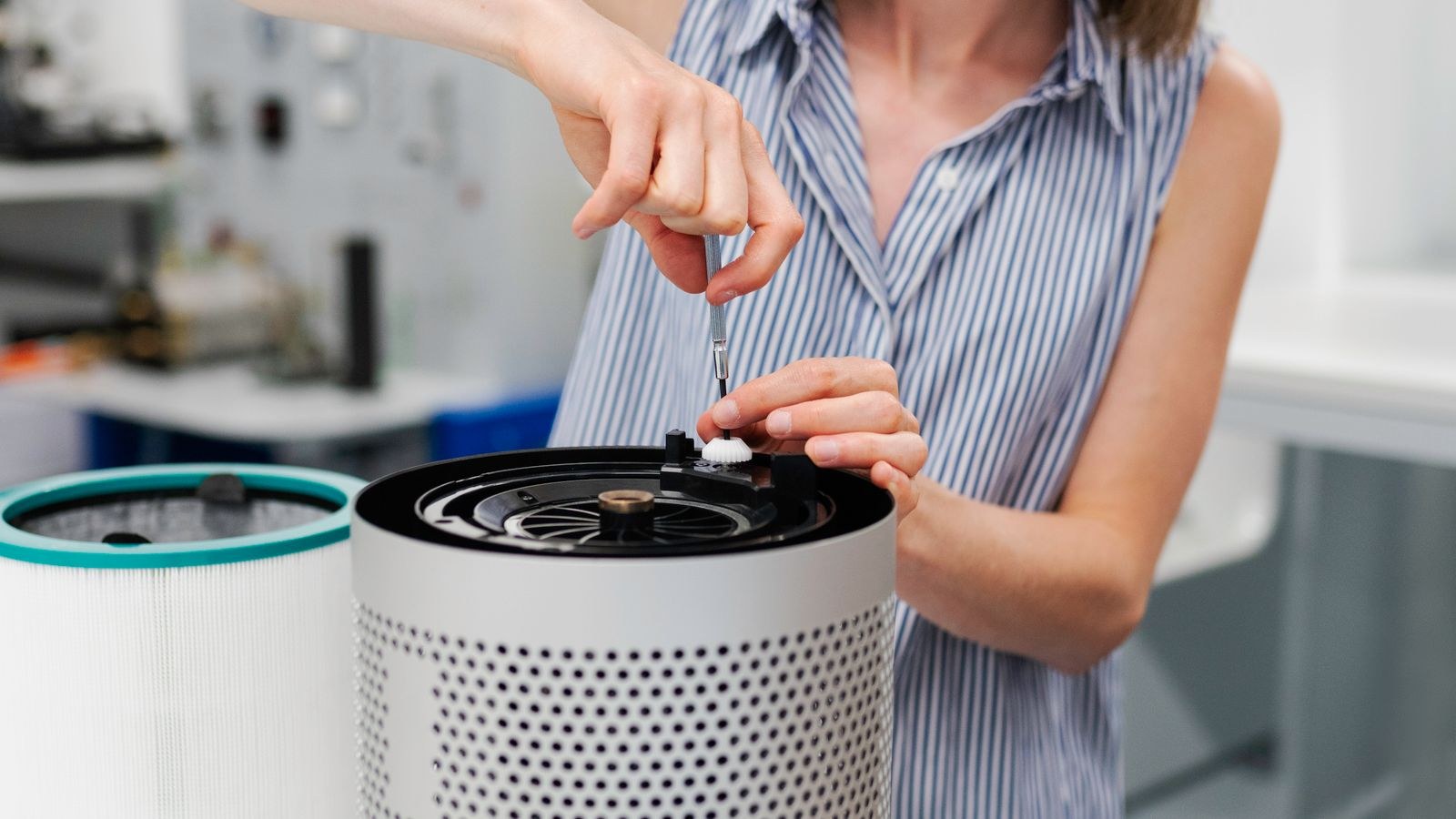
Filters are consumables. A true HEPA element typically lasts six to twelve months depending on how dirty your air is and how many hours a day the unit runs. Carbon layers saturate faster, often in three to six months.
Before buying, multiply the annual filter cost by the years you expect to keep the machine and add it to the purchase price. A cheaper unit with proprietary cartridges frequently costs more over three years than a pricier machine using widely stocked filters. Electricity is the smaller line item, since most purifiers draw between 15 and 60 watts.
Sizing per Room Beats One Big Machine
A single large purifier in a hallway rarely cleans the bedrooms leading off it, because air does not circulate freely enough between separated spaces. Filtration is strongly local. You will get far better results from a correctly sized unit in the room where you actually spend time, particularly the bedroom, where you may spend a third of the day breathing the same air. Compact, well-matched units such as the best one room air purifiers usually beat one oversized machine placed centrally.
HEPA Beyond Purifiers
The same standard and the same marketing games appear on vacuum cleaners. A vacuum with a true HEPA filter but a leaky body will push fine dust out through the seams and back into the room. Look for the phrase sealed system, meaning all air drawn in is forced through the filter before it exits. Models built around that principle are collected in our list of the best vacuums for allergies, and pairing one with a properly sized purifier addresses both the settled dust you disturb and the airborne fraction left behind.
Common Mistakes Buyers Make
The most frequent error is buying on filter stage count. A five-stage purifier sounds thorough, but stages are often counted generously, with a mesh screen and a thin carbon sheet padding the number. One certified HEPA stage plus real carbon outperforms five vague ones every time.
The second mistake is running the unit only when air seems bad. Particulate levels rise and fall constantly, and a purifier needs sustained runtime to hold a room clean. Running it continuously on a low, quiet setting almost always beats occasional bursts on high.
The third is placement. Pushing a purifier into a corner starves the intake, so leave clearance on all sides.
Frequently Asked Questions
Is True HEPA an official certification?
Not exactly. The HEPA efficiency threshold is defined by standards bodies, but the phrase True HEPA is a marketing convention used to distinguish compliant filters from imitators. It is a strong signal rather than a legally policed seal, so pair it with a published CADR figure for confidence.
Do HEPA filters remove odours or gases?
No. HEPA media traps particles, and smells, cooking fumes, and volatile organic compounds are gases far smaller than any particle. Removing them requires activated carbon, and the more carbon by weight, the longer it lasts.
Can I vacuum a true HEPA filter to extend its life?
It is not advisable. Vacuuming can tear the delicate pleats and dislodge trapped material. Clean the washable pre-filter regularly instead, and replace the HEPA element on schedule.
Will a HEPA-type filter help with pet dander?
Partially. Dander particles span a wide size range, and mid-grade media will catch the larger fraction. The fine portion that stays airborne longest is the part most likely to trigger symptoms, and that is where certified media pulls clearly ahead.
Final Thoughts
The difference between True HEPA and HEPA-type is not a subtle grading distinction. One phrase is anchored to a verifiable 99.97 percent efficiency at the hardest particle size to catch; the other is a description with no obligation behind it. Once you know to look for the exact efficiency claim, a published CADR, a sealed housing, and a realistic filter replacement cost, the marketing loses most of its power over you.
Decide first what you need the machine to do. If it is comfort and general dust in a low-traffic room, mid-grade media at a lower price is a defensible trade. If someone in the household reacts to what is in the air, buy certified media, size the unit to the room rather than the house, and run it continuously. That combination, more than any single feature on the box, is what turns a purifier from a reassuring appliance into one that measurably changes how a room feels to breathe in during 2026 and the years after.