Owen Bradley
 A small bathroom punishes bad decisions. Every square foot is visible at once, moisture has nowhere to go, and a curtain that would look elegant in a spacious primary bath can make a compact one feel like a closet. The curtain is also the largest single piece of fabric in the room, which means it drives the perceived size, brightness, and cleanliness of the entire space. Choosing well is less about picking a pattern you like and more about understanding how length, material, color, and hardware interact in a tight, humid room. This guide covers everything you need to know to buy the right curtain for a small bathroom in 2026 — from sizing and fabric to mildew resistance, layout tricks, and the mistakes that make cramped rooms feel even smaller.
Why Small Bathrooms Need a Different Approach
In a large bathroom, a curtain is a decorative accent among many. In a small one it is the dominant visual element, often occupying a third of the wall area you see from the doorway. That changes the calculus in three specific ways.
First, visual weight matters more. Dark, dense, heavily patterned fabric absorbs light and advances toward the viewer, shrinking the room. Second, air circulation is worse, so materials that hold moisture develop mildew faster than they would in a ventilated space. Third, physical clearance is genuinely tight — a bulky curtain that billows inward will brush against you in the shower, which is the single most common complaint in compact tubs and stalls.
Get the Measurements Right First
Standard curtains are 72 by 72 inches, but “standard” assumes a standard alcove tub and an average ceiling. Measure before you buy.
- Width — measure the rod length and multiply by 1.2 to 1.5. Too little and the curtain pulls flat and gaps at the ends; too much and it bunches into the shower space.
- Length — measure from the rod down to your target hem. For a tub, the hem should fall 2 to 4 inches inside the tub rim. For a walk-in stall, aim for about 2 inches above the floor so the fabric never wicks standing water.
- Extra-long options — 72 by 84 or 72 by 96 inches exist for high ceilings and are the key to the ceiling-height trick described below.
A curtain that puddles on the floor looks luxurious in photographs and disastrous in practice: it traps water, breeds mildew at the hem, and in a small room it eats the visual floor space that makes the bathroom feel open.
Fabric vs Vinyl vs PEVA
The material decision affects appearance, safety, and how often you will be scrubbing.
- Polyester fabric — the best all-round choice. It drapes softly, resists mildew reasonably well, and is machine washable. Choose it when you want the room to read as a finished space rather than a utility shower.
- Cotton and cotton blends — beautiful texture, but they absorb moisture and need a separate liner plus frequent washing. Better suited to well-ventilated bathrooms.
- Vinyl (PVC) — cheap and fully waterproof, but it can off-gas that distinctive plastic smell, stiffens over time, and looks utilitarian.
- PEVA and EVA — chlorine-free plastic alternatives that avoid the worst of the PVC odor while keeping the waterproof benefit. A sensible liner material.
- Nylon and microfiber — quick-drying and lightweight, a good pick if your room has poor ventilation.
In a small, poorly ventilated bathroom, drying speed is arguably more important than any other property. A fabric that is still damp at bedtime is a fabric growing mildew overnight. Comparison guides to the best fabric shower curtains are a useful starting point for narrowing down weight and weave.
Color and Pattern Choices That Open Up the Room
The design rules for compact spaces are consistent and effective. Light, cool colors recede visually — white, pale grey, soft blue, and sage all push the wall back. A curtain that closely matches your wall color blurs the boundary between the shower and the rest of the room, and that continuity is what makes a small bathroom read as one space instead of two cramped ones.
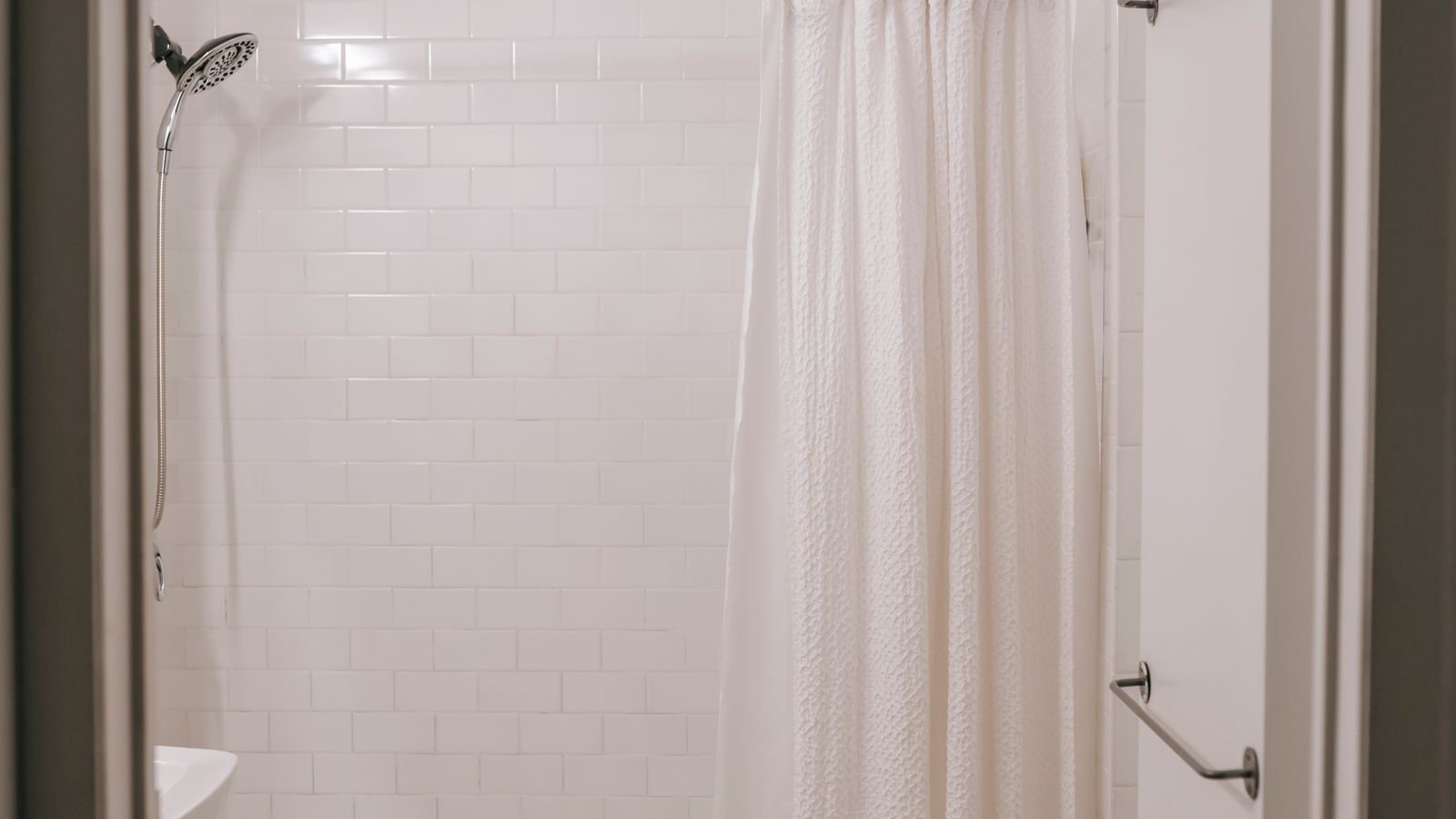
Vertical stripes draw the eye upward and add perceived ceiling height. Horizontal stripes do the opposite and are worth avoiding unless the room is unusually tall. Large-scale prints overwhelm a small wall, while small-scale or tonal patterns add interest without visual clutter. Solid textured fabric — waffle weave, subtle herringbone, ribbed cotton-look polyester — is the safest sophisticated choice, giving depth without adding busyness.
If you want a bold statement, put it somewhere other than the curtain: a single piece of art, a colorful towel set, or a patterned floor tile. Bold on the largest surface in a small room is a gamble that rarely pays.
Clear and Semi-Transparent Options
For genuinely tiny bathrooms — half-bath conversions, boat-sized ensuites, older apartment layouts — a clear or frosted curtain is a legitimate trick. Light passes straight through, the shower area stays visually part of the room, and the boundary disappears. Frosted PEVA gives partial privacy while still transmitting light, and a clear liner paired with a light fabric outer curtain gives you flexibility.
The trade-off is that a clear curtain shows every water spot and soap streak, so it demands more frequent wiping. It also exposes whatever is in the tub, meaning shampoo bottles and cleaning supplies become part of the decor. If you keep a tidy shower caddy, it works beautifully.
Liners: Almost Always Worth It
A liner is a second, waterproof panel that hangs inside the tub while the decorative curtain hangs outside. In a small bathroom it earns its place for several reasons: it keeps water off the fabric curtain so the outer panel washes far less often, it adds weight so the assembly does not billow inward, and it lets you use a good-looking fabric that would otherwise be impractical.
Look for a liner with magnets or weighted hems at the bottom, rustproof grommets, and a mesh window at the top if your bathroom has no exhaust fan — that ventilation panel makes a measurable difference to drying time. A well-chosen shower curtain liner costs a fraction of the outer curtain and roughly doubles its useful life.
Hardware Choices That Buy You Space
The rod is where a small bathroom can gain real, physical room rather than just the appearance of it.
- Curved rods — bow outward over the tub, adding several inches of elbow room at shoulder height without changing the footprint. The single best hardware upgrade for a compact tub.
- Tension rods — no drilling, great for rentals, but they can slip under a heavy wet curtain. Fine for lightweight fabrics.
- Fixed-mount rods — more secure and support heavier curtains and liners.
- Ceiling-mounted tracks — for irregular layouts or freestanding tubs, and they give the cleanest, most built-in look.
Mount the rod high. Positioning it near the ceiling rather than just above the tub surround, paired with an extra-long curtain, creates an unbroken vertical line that visibly lifts the room. It is the same trick interior designers use with window drapery, and it works just as well here. Compare options among the best shower curtain rods before you settle, since rod choice constrains curtain length.
Rings, Hooks, and the Small Details
Cheap plastic hooks snag, crack, and make the curtain hard to pull one-handed. Roller-ball hooks glide silently and are worth the modest upgrade. Look for rustproof materials — stainless steel, nickel, or coated metal — because a small humid bathroom rusts hardware quickly and rust stains transfer to the fabric permanently.
Double hooks let you hang the curtain and liner on a single set of rings, which reduces bulk at the top of the rod and makes removal for washing much simpler. Match the finish to your faucet and towel bar; in a small room, mismatched metals read as visual noise.
Mildew Resistance and Easy Cleaning
Small bathrooms with a single small window or a weak fan are mildew factories. Prioritize curtains labeled mildew-resistant or antimicrobial, and confirm the curtain is machine washable — many are, on a cold gentle cycle with a couple of towels to provide scrubbing action.
Habits matter as much as materials. Pull the curtain fully closed after every shower so it dries flat rather than folded, run the fan for 15 to 20 minutes afterward, and wash the curtain and liner monthly. Replace a liner rather than fighting it once mildew sets into the seams. Non-toxic and low-odor materials are increasingly available if plastic smell bothers you; the best non-toxic shower curtains use PEVA, EVA, or treated fabric instead of PVC.
Budget Guidance
- Under $20 — basic PEVA or lightweight polyester. Serviceable, replace annually.
- $25–$50 — the value sweet spot: quality polyester, weighted hem, rustproof grommets, real mildew resistance.
- $60+ — heavyweight woven fabric, hotel-style waffle textures, extra-long sizing, designer patterns.
Spend on the rod and liner first. A $30 curtain on a curved rod with a good liner outperforms an $80 curtain on a sagging tension rod every time. Shoppers who want a longer-lasting option can compare the best quality shower curtains for heavier constructions that hold their shape.
Common Mistakes to Avoid
- Buying standard length for a high ceiling, leaving an awkward gap that emphasizes how short the wall coverage is.
- Choosing a dark, heavy fabric that visually shrinks an already tight room.
- Skipping the liner and washing an expensive fabric curtain every two weeks.
- Letting the hem sit in standing water on the tub floor.
- Using a tension rod with a heavy fabric-plus-liner combination.
- Adding a busy pattern on the largest surface in the smallest room.

Frequently Asked Questions
Should a small bathroom curtain be light or dark?
Light, in almost every case. Pale colors reflect light and make the wall recede, which is exactly what a compact room needs. If you want depth, use a light base with subtle texture rather than a dark solid.
Do I need both a curtain and a liner?
If your outer curtain is fabric, yes. Fabric alone will soak, sag, and grow mildew. If you are using a waterproof PEVA or vinyl curtain on its own, a liner is optional — though many people still add one for extra weight and water containment.
How often should I wash a shower curtain?
Monthly is a reasonable rhythm for most households, more often in a poorly ventilated bathroom. Wash on cold with mild detergent, add a half cup of baking soda for soap scum, and hang it back on the rod to air dry rather than putting it in a hot dryer.
Will a curved rod fit a small bathroom?
Usually yes, and it is the best value upgrade available. The rod bows outward above the tub rim, so it does not consume floor space — it only adds volume at shoulder height, exactly where a small shower feels tightest. Check clearance to any adjacent wall, door swing, or vanity first.
Final Thoughts
The right small-bathroom curtain is quiet, light, correctly sized, and easy to keep clean. Measure your rod and drop before shopping, choose a pale or tonal polyester with real mildew resistance, pair it with a weighted liner, and mount the rod high on a curved bracket to gain both real and perceived space. Those four decisions do more for a compact bathroom than any pattern ever will. If you want a shortlist that already accounts for tight layouts and shorter tubs, start with the best shower curtains for small bathrooms and narrow from there — the difference a well-chosen curtain makes to a cramped room in 2026 is genuinely out of proportion to what it costs.