Owen Bradley
 Setting up an air purifier for the best airflow in a bedroom is the difference between a machine that quietly transforms your sleep and one that hums in a corner doing almost nothing. Air purifiers do not clean a room the way a filter cleans water; they clean the air that physically passes through them. That means placement, clearance, room sealing and fan speed matter every bit as much as the filter grade. This guide walks through choosing the right spot, sizing the unit to your room, and running it in a way that keeps the air moving without keeping you awake.

How Air Purifiers Actually Move Air
Nearly all home purifiers draw air in through one or more intake faces and push it out through a top or front vent. The clean air jet creates a circulation loop: it travels across the room, hits a wall, curls back along the floor or ceiling and returns to the intake. Your job during setup is to give that loop room to form. If the outlet fires straight into a wardrobe two inches away, or the intake is pressed flat against a headboard, the machine simply recirculates the same small pocket of air and the rest of the bedroom stays untouched.
The specification that tells you how much air the unit moves is CADR — clean air delivery rate — usually listed separately for dust, pollen and smoke. A useful rule is to aim for a CADR roughly two-thirds of your room’s floor area in square feet, which delivers around four to five air changes per hour. Anything less and the purifier will struggle to keep up with a closed bedroom overnight.
What You Need Before You Start
- The purifier, with all shipping plastic removed from the filters
- A tape measure to check clearances and room size
- A nearby wall outlet — never use an extension cord rated below the unit’s draw
- A vacuum with a brush attachment for pre-cleaning the area
- The manual, to confirm where the intake and outlet actually are on your model
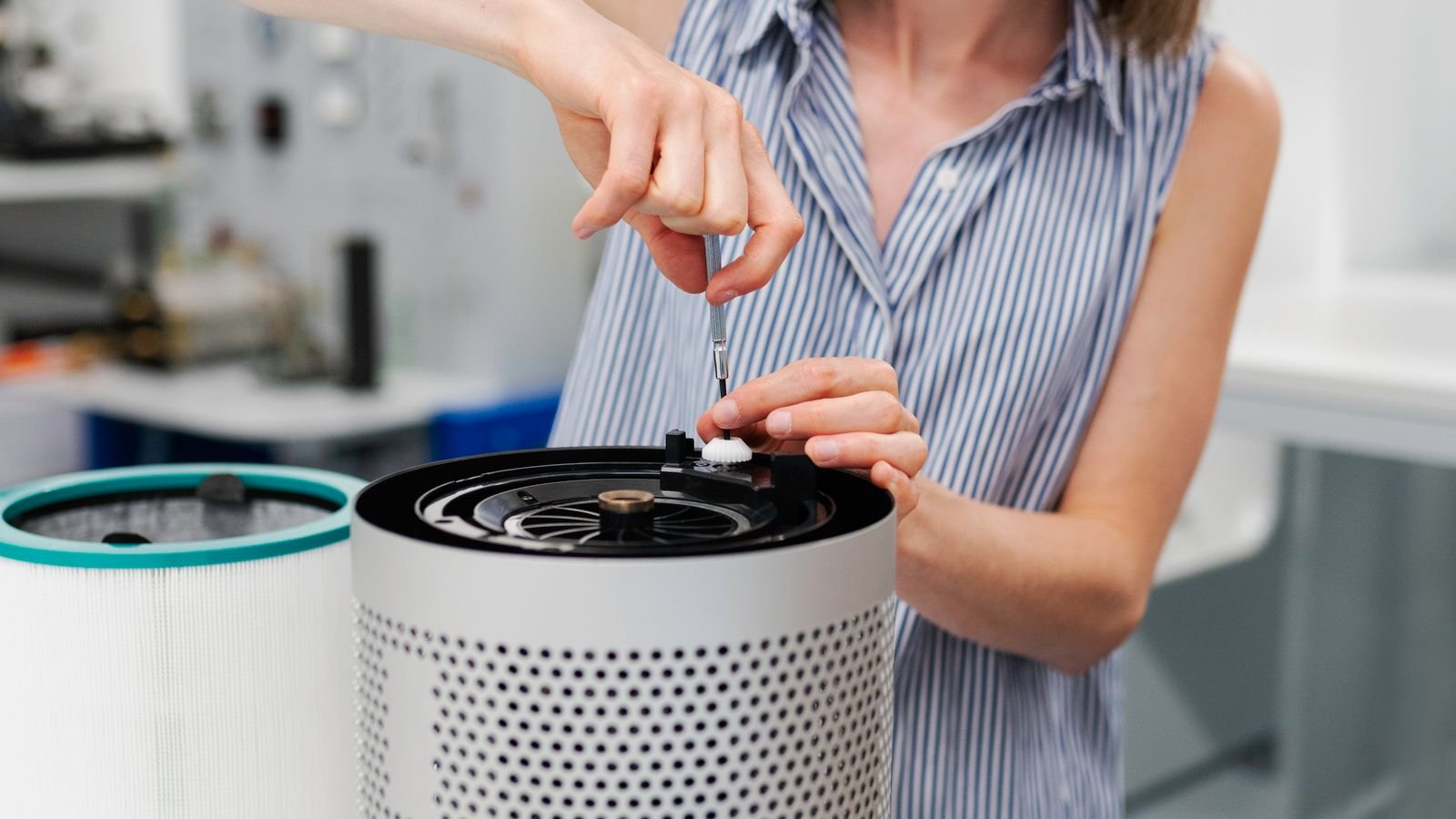
Unwrap every filter before the first run. Purifiers ship with the filters sealed in plastic bags, and running the machine with them still wrapped is the most common reason a new unit seems to do nothing while its fan sounds strained.
Step-by-Step: Positioning for Maximum Airflow
- Measure the room and confirm the unit is sized correctly. Multiply length by width, then check the manufacturer’s coverage rating. If the room is larger than the rating, plan to run the purifier on a higher speed permanently or move it to a smaller space.
- Give the unit clearance on every active face. Leave at least 12 inches around any intake and 18 to 24 inches in front of the outlet. Units with a 360-degree intake need space all the way around and should sit away from walls entirely.
- Place it 6 to 10 feet from the bed, not beside your pillow. Close enough that the clean-air plume reaches your breathing zone, far enough that you are not sleeping in a direct draught or listening to the fan at close range.
- Aim the outlet across the room, not into furniture. Point the discharge toward open floor or the ceiling so the circulation loop can develop. A jet fired into a wall dies within a foot.
- Raise it slightly off the floor if the design allows. Many pollutants — dust, pet dander, dust mite debris — are heavier and concentrate low, but very low placement can starve the intake with carpet fibres. A low stool or hard floor surface is often better than deep pile carpet.
- Put it near the pollutant source when there is one. If a pet sleeps in the room, or a window faces a busy road, siting the purifier between that source and the bed intercepts contaminants before they spread.
- Avoid corners and behind curtains. Corners are dead zones with little air movement, and curtains block intakes completely. This is where most purifiers end up and where they perform worst.
- Keep it away from heat, damp and electronics. Radiators, humidifiers and TVs all interfere: heat and moisture shorten filter life, and dense electronics disrupt the airflow path.
- Run it for an hour and check the airflow by hand. Hold your palm 18 inches from the outlet. You should feel a clear, steady stream. Then walk the room — you should feel gentle movement across the bed. If not, reposition.
Seal the Room So the Purifier Can Get Ahead
A purifier competes with everything leaking into the room. Close the bedroom door while it runs — a closed door can double the effective air-change rate simply by shrinking the volume being cleaned. Keep windows shut during high pollen or high pollution periods, and fit a draught excluder at the bottom of the door if hallway cooking smells reach the bedroom. If you have forced-air heating, do not block the supply register, but be aware it introduces unfiltered air; upgrading the furnace filter helps the purifier enormously. For persistent whole-home issues rather than a single bedroom, comparing the best air purifiers for bedrooms against larger-room units will tell you whether one machine per room or a single high-capacity unit makes more sense.
Choosing the Right Fan Speed and Schedule
The instinct is to run a purifier on low all night for quiet. That is usually a mistake. Clean air delivery scales almost linearly with fan speed, so low speed can deliver a third of the machine’s rated performance. A better pattern:
- Run high for 30 to 60 minutes before bed with the door closed. This front-loads the cleaning while noise does not matter.
- Drop to medium or the sleep setting once you are in bed. The room is already clean; medium simply maintains it.
- Never switch it off overnight. Particle levels rebound within an hour or two, and a purifier restarting from scratch each evening never gets ahead.
- Use auto mode if the sensor is decent, but check it does not dim to the lowest speed and stay there — some sensors are optimistic in still air.
Maintenance That Preserves Airflow
Airflow degrades as filters load. Vacuum the pre-filter every two to four weeks with a brush attachment — this single habit extends the life of the expensive HEPA layer dramatically. Replace HEPA filters every 6 to 12 months depending on use, and carbon filters more often if you are targeting odours, since carbon saturates faster than people expect. Wipe the intake grille and the outlet louvres, and check behind the unit for the dust shadow that shows where air is being drawn from. If your model has a filter-life indicator, reset it after every change so the readout stays meaningful.
Common Mistakes to Avoid
- Tucking it into a corner or under a desk. Restricted intakes can halve real-world performance.
- Leaving filter wrapping on. Obvious once you know, invisible until you check.
- Sizing for the wrong room. A small unit in a large bedroom never catches up, regardless of placement.
- Running only while you sleep. Continuous operation at a moderate speed outperforms eight hours on high.
- Choosing an ozone-generating “ionizer” mode. Ozone is a lung irritant. If a mode produces a sharp, clean-smelling odour, switch it off.
- Ignoring the noise floor. A purifier too loud to sleep beside gets turned off, and a purifier that is off cleans nothing. Check the decibel rating at the speed you intend to use.
Frequently Asked Questions
Where exactly should I put an air purifier in a bedroom?
On the floor or a low stand, 6 to 10 feet from the bed, at least a foot from any wall, with the outlet aimed across open floor. Between the bed and the main pollutant source is ideal.
Should the bedroom door be open or closed?
Closed. A smaller sealed volume means far more air changes per hour and much faster particle reduction.
Can I put the purifier under the bed or behind a nightstand?
No. Both positions block the intake and trap the clean air discharge in a dead pocket. Keep the machine in open air.
Is it safe to run an air purifier all night?
Yes, and it is recommended. Modern units are designed for continuous operation and draw very little power on medium settings.
How do I know it is actually working?
Check the airflow by hand at the outlet, watch dust accumulation on the pre-filter over a few weeks, and if you want hard numbers use an inexpensive particle meter to compare readings with the unit off and on.
Final Thoughts
A bedroom air purifier earns its keep when the air can actually reach it and leave it freely. Size the unit to the room, give it clearance on every face, aim the discharge across open floor rather than into furniture, close the door, and run it continuously at a speed you can live with. Add a monthly pre-filter vacuum and an honest filter replacement schedule, and you will get the full performance you paid for rather than the fraction most purifiers deliver from a forgotten corner.