Owen Bradley
 An extension cord is the most casually purchased electrical product in most homes and the one most often used beyond its limits. It looks like a simple length of wire, so people grab whatever is cheapest, run it to a heater or a circular saw, and never notice the cord growing warm behind the sofa. Gauge, length, and load are not marketing details; they are the three numbers that decide whether a cord delivers full power safely or slowly cooks its own insulation. This extension cord gauge guide explains how those numbers relate, how to match a cord to an appliance, the real differences between indoor and outdoor cords, and the daisy-chaining habits that cause overheating. Everything here applies just as much in 2026 as it did decades ago, because the physics has not changed.
What Wire Gauge Actually Means
Gauge describes the thickness of the copper conductors inside the cord, expressed on the American Wire Gauge scale. The scale runs backwards from intuition: a smaller number means thicker wire. A 12-gauge cord has substantially more copper than a 16-gauge cord, and that extra copper is what allows it to carry more current without heating up.
Thicker wire has lower electrical resistance. Resistance turns current into heat and causes voltage to drop along the length of the cord, so a thin cord carrying a heavy load does two bad things at once: it wastes energy as heat inside the insulation, and it delivers less voltage than the appliance expects. Motors respond to low voltage by drawing even more current, which produces more heat still. That feedback loop is why an undersized cord on a power tool can become genuinely dangerous rather than merely inefficient.
Reading the Markings on the Jacket
Every legitimate cord has its specification printed along the jacket, usually as something like 14/3. The first number is the gauge and the second is the number of conductors, with three meaning line, neutral, and a safety ground. Letter codes follow, indicating the jacket type and rating. You will also find an amp rating, a wattage rating, and a certification mark from an independent testing laboratory. If a cord carries no printed gauge and no certification mark at all, treat it as unknown and do not use it for anything demanding.
Matching Gauge to Load and Length
Gauge alone does not determine capacity; length matters just as much, because resistance accumulates over distance. A 16-gauge cord that comfortably runs a lamp at 7.5 metres may sag badly at 30 metres. The safe approach is to increase thickness as length grows, even when the appliance stays the same.
- 16 gauge: light duty up to roughly 10 amps, and only on short runs. Lamps, clocks, phone chargers, laptops.
- 14 gauge: medium duty to about 13 amps. Vacuum cleaners, small fans, corded drills on moderate runs.
- 12 gauge: heavy duty to about 15 amps. Space heaters, compressors, circular saws, longer outdoor runs.
- 10 gauge: extra heavy duty for long runs and high-draw tools where voltage drop must be minimised.
Calculate the load before choosing. Divide the appliance wattage by your supply voltage to get amps, then leave headroom rather than sitting at the cord’s exact limit. A 1,500W heater draws about 12.5 amps on a 120V supply, which rules out 16-gauge entirely and makes 12-gauge the sensible choice on anything but the shortest run. Continuous loads should ideally use no more than about 80 percent of a cord’s rating.
Length: Buy Only What You Need
The temptation is to buy one very long cord and use it everywhere, but every extra metre adds resistance and voltage drop even when the surplus sits coiled on the floor. A 30-metre cord used at 3 metres still behaves like a 30-metre cord electrically, because the current travels the entire loop.
Coiled cords carry an additional risk. A tightly wound coil traps the heat the cord generates and, on long runs, adds a small inductive effect. Cords rated for heavy loads should always be fully uncoiled before use, especially reels. If you routinely need different distances, owning a short heavy cord and a long heavy cord beats owning one long thin one that compromises on both.
Indoor Versus Outdoor Cords
The difference is the jacket, not just the colour. Outdoor cords use thicker, more flexible insulation formulated to resist ultraviolet light, moisture, temperature swings, and abrasion against concrete and gravel. Indoor cords use thinner jackets designed for clean, dry, stable conditions, and they crack and stiffen when exposed to sun and cold.
An indoor cord used outside is a shock hazard once its jacket degrades and moisture reaches the conductors. Outdoor cords also commonly include a grounded three-prong plug and sometimes a lighted end so you can see at a glance that power is present. When working outside, plug into a receptacle protected by a ground-fault circuit interrupter, which cuts power in milliseconds if current starts leaking to earth. Permanent exterior points designed for this job are covered in our roundup of the best outdoor outlets, and the accompanying outdoor outlet buying guide explains weatherproof covers and in-use enclosures in more detail.
Temporary Means Temporary
Extension cords are rated for temporary use, and that is a code requirement rather than a suggestion. Running a cord permanently under a rug, through a wall, across a doorway, or stapled along a skirting board defeats the ventilation and inspection the design assumes. Concealed cords cannot be checked for damage, and foot traffic gradually crushes the conductors inside an intact-looking jacket. If a cord has become a fixture, the correct fix is a new receptacle. Comparisons of the best power outlets and the best wall plugs show what a proper permanent installation looks like, and our broader wall plug and extension guide covers when to stop extending and start rewiring.
Daisy Chaining and Power Strip Mistakes
Plugging one extension cord into another is the classic overload mistake. Each connection adds resistance at the contact point, compounds voltage drop, and creates a junction that can loosen and arc. Two 15-metre cords joined together do not behave like a single 30-metre cord of the same gauge; they behave worse, because the coupling itself becomes a warm spot.
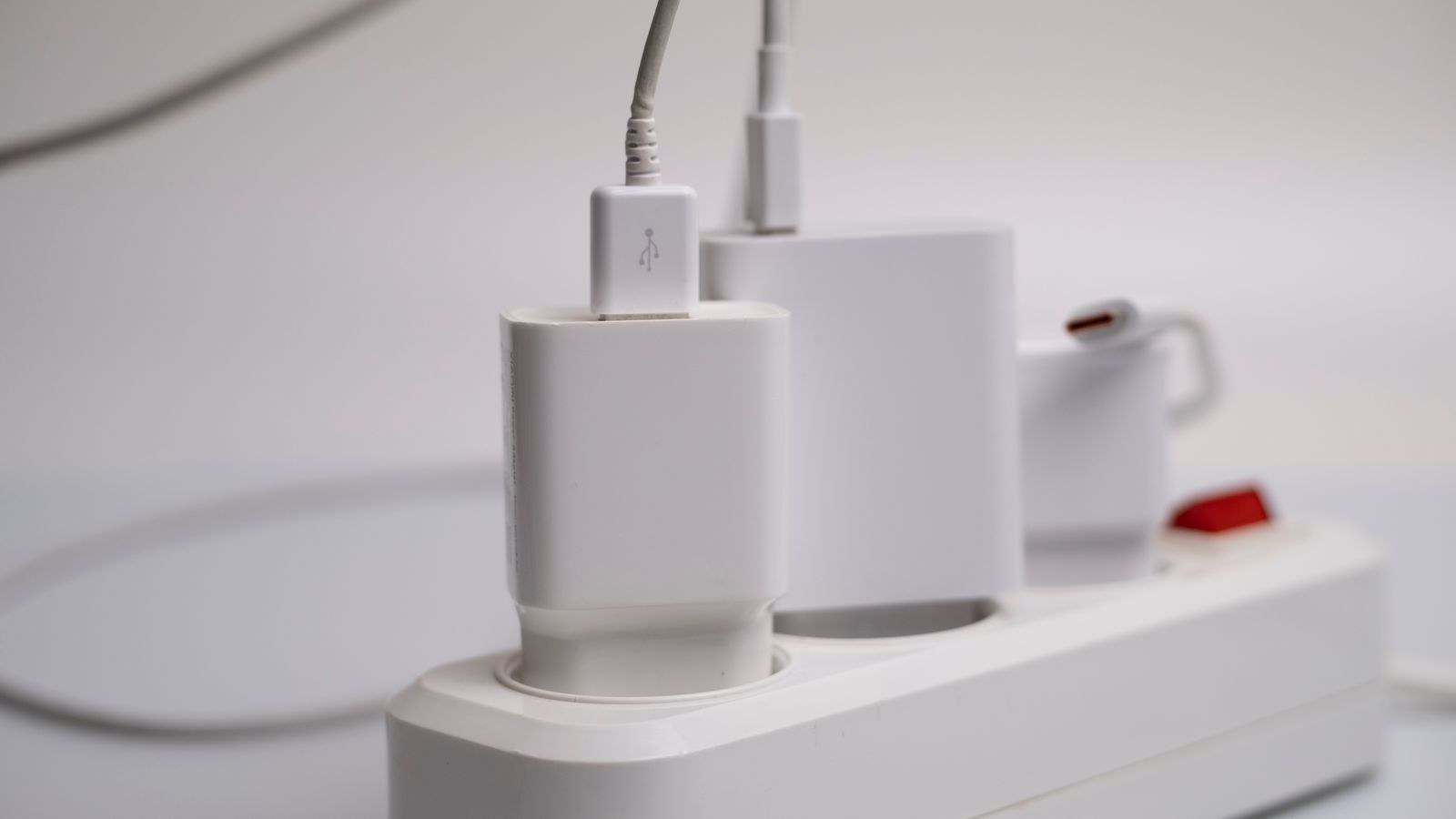
Power strips make the problem harder to see. A strip does not increase the circuit’s capacity; it only multiplies the number of places to plug in. Six devices on one strip fed by a thin cord can easily exceed what the cord can carry while every individual device looks harmless. Never plug a strip into another strip, never feed a strip from a light-duty cord, and never run a heater, air conditioner, kettle, or microwave through a strip at all. Those appliances draw near-continuous high current and should go straight into a wall receptacle.
Warning Signs a Cord Is Overloaded
- Warmth anywhere along the jacket or at the plug. A correctly sized cord stays close to room temperature.
- Discoloured or melted prongs and receptacle faces. This indicates arcing and demands immediate replacement.
- A burning or acrid plastic smell, which means insulation is already breaking down.
- Lights dimming when a tool starts, a classic sign of excessive voltage drop.
- Tools running slow or hot, since motors compensate for low voltage by drawing more current.
- Repeated breaker trips, which is the circuit protection doing exactly what it should.
Damaged cords are not repairable with tape. A nicked jacket, a crushed section, a bent prong, or a missing ground pin all mean the cord is finished. Cutting the ground pin off a three-prong plug to fit a two-slot outlet removes the protection that keeps a fault from energising an appliance casing, and it is one of the most dangerous shortcuts in home electrics.
Storage, Inspection, and Everyday Habits
Cords last far longer with basic care. Coil them loosely using an over-under wrap rather than tight loops around the elbow, which twists the conductors internally over time. Unplug by gripping the moulded plug body, never by pulling the cord, because tugging separates the wire from the terminals inside the plug where you cannot see the damage.
Store cords dry and off concrete floors, away from solvents and sharp edges. Inspect the full length before each heavy use, running it through your hand to feel for flat spots, stiffness, or cuts. Keep cords out of walkways or use a proper cord protector where crossing is unavoidable, and never run one through a doorway that closes on it. A cord that is inspected regularly and sized correctly will outlast several cheap replacements.
Frequently Asked Questions
What gauge extension cord do I need for a space heater?
A 12-gauge heavy-duty cord, and only if a cord is unavoidable. Heaters draw high continuous current and are safest plugged directly into a wall receptacle.
Is it safe to plug two extension cords together?
No. Daisy chaining increases resistance and voltage drop and creates a connection point that can loosen and overheat. Use one cord of the correct length instead.
Why does my extension cord feel warm?
Warmth means the cord is carrying more current than its gauge comfortably handles, or the run is too long. Reduce the load or move to a thicker cord immediately.
Can I use an indoor cord outside for a short job?
You should not. Indoor jackets are not rated for moisture or ultraviolet exposure, and a brief job in damp conditions is exactly when the shock risk is highest.
Does a longer cord reduce power even when partly coiled?
Yes. Current travels the entire length regardless of how it is arranged, and coiling additionally traps heat. Buy the length you need rather than the longest you can find.
Final Thoughts
Choosing an extension cord comes down to three linked decisions made in order: work out the appliance’s actual amp draw, pick the shortest length that reaches, then select a gauge with headroom for that current over that distance. Thicker wire and shorter runs solve almost every problem people blame on faulty tools or weak sockets. Keep indoor cords indoors, protect outdoor runs with ground-fault protection, refuse to daisy chain, and treat any warmth in a jacket as a warning rather than a quirk. When a cord has become permanent furniture, stop extending and install a proper receptacle instead. That habit is cheaper than a replacement appliance and far cheaper than a fire.