Owen Bradley
 A shower floor is the hardest-working surface in a house. It is soaked daily, walked on barefoot, coated in soap film, and expected to stay both safe and attractive for decades. That combination rules out a great many tiles that look superb on a shower wall or a bathroom floor. Choosing well means understanding slip resistance, water absorption, tile size relative to the drainage slope, and how much grout you are prepared to clean. This guide walks through the materials, the ratings that actually matter, the practical installation constraints, and the maintenance realities that decide how a shower floor looks in year five.
Slip Resistance Comes First
Everything else is secondary. A wet, soapy, sloped surface underfoot is the single most dangerous place in a home, and a beautiful tile that is slippery is simply the wrong product.
Two ratings are worth knowing. The coefficient of friction, usually quoted as DCOF for wet conditions, should be 0.42 or higher for wet areas; higher is better for a shower floor specifically. The R rating used in European specifications runs from R9 to R13, with R10 as a sensible minimum for a domestic shower and R11 preferable, particularly in a household with children or older adults.
Texture and grout lines contribute as much as the rating. Small tiles create a dense grid of grout joints, and those joints provide grip and channel water. This is precisely why mosaics dominate shower floors: a two-inch mosaic has many times the joint length of a large-format tile, and each joint is a slightly recessed, textured line for the foot to catch. Matte, honed, textured and structured surfaces all outperform polished finishes, and polished stone or polished porcelain should never be used on a shower floor whatever the showroom says.
Water Absorption and Why Porcelain Wins
Tiles are classified by how much water they absorb by weight. Impervious tiles absorb less than 0.5 percent, vitreous 0.5 to 3 percent, semi-vitreous 3 to 7 percent, and non-vitreous over 7 percent. For a shower floor, impervious is the target and vitreous is the practical minimum.
Porcelain is fired at high temperature from dense clay, absorbs under 0.5 percent, and is through-body coloured in many ranges so chips are far less visible. It resists staining and freezing, takes textured and matte finishes readily, and convincingly imitates stone, concrete and wood at a fraction of the maintenance. For most shower floors it is the correct default answer.
Ceramic is softer, more porous and cheaper. It is fine on walls and acceptable on a floor if properly glazed and rated for the application, but it is more prone to cracking and its glaze wears through to a paler body.
Natural stone — marble, slate, travertine, granite, limestone — is beautiful and demanding. It is porous, needs sealing every six to twelve months, and reacts badly to acidic cleaners. Slate is the best-behaved stone underfoot thanks to its natural cleft texture; polished marble is among the worst choices possible for a shower floor. Travertine’s natural voids need filling and refilling over time.
Glass mosaic is non-porous and visually striking, but slippery unless the specific product is textured and rated for floors. Use it on walls and shower niches, and only on floors when the manufacturer explicitly rates it for that use.
Pebble and river rock feels wonderful underfoot and drains well, but it is close to all grout by area, so it demands rigorous sealing and cleaning. Choose sliced flat pebbles rather than rounded whole ones for a more comfortable, more cleanable surface.
Tile Size, Slope and Drainage
A shower floor is not flat. It must slope toward the drain, typically at around a quarter inch per foot, and the tile has to follow that slope without lifting at the edges or leaving hollow spots underneath.
With a traditional centre drain, the floor slopes from four directions, so the tile must conform to a shallow inverted pyramid. Only small tiles can do that — mosaics on mesh sheets up to about 2×2 inches are the standard solution, and anything above 4×4 inches becomes difficult.
With a linear drain placed at one wall or along the entry, the floor slopes in a single plane, which permits large-format tiles and a seamless look continuing from the bathroom floor into the shower. This is why linear drains have become popular in modern and curbless designs, and it is the main route to using large tiles on a shower floor at all.
Whatever the layout, the floor must drain completely. Standing water is the source of most staining, mould and grout deterioration. Test with a bucket of water before tiling over the mortar bed rather than discovering the problem later.
Grout and Sealing: The Part That Fails First
Tile almost never fails. Grout and sealing almost always do.
Cement grout is inexpensive and easy to work with, but porous. It stains, harbours mould and needs sealing annually. Unsanded cement grout suits joints under an eighth of an inch; sanded is required for wider joints.
Epoxy grout costs several times more, is harder to install, and is essentially waterproof, stain-resistant and never needs sealing. In a shower floor with dense mosaic joints, epoxy is the upgrade that makes the biggest long-term difference, and it is worth paying for even if the rest of the bathroom uses cement grout.
Grout colour is a practical decision as much as an aesthetic one. Brilliant white shows every trace of soap scum and mould; very dark grout shows limescale and mineral deposits. A mid-tone grey or greige hides both and stays looking clean far longer.
Under everything sits the waterproofing membrane, and this is where the shower genuinely succeeds or fails. Tile and grout are not waterproof; they are a wearing surface over a membrane. A sheet or liquid-applied membrane, correctly detailed at the corners, the drain flange and the curb, is what keeps water out of the structure. Never allow a shower floor to be built without one.
Coordinating Floor, Wall and Fixtures
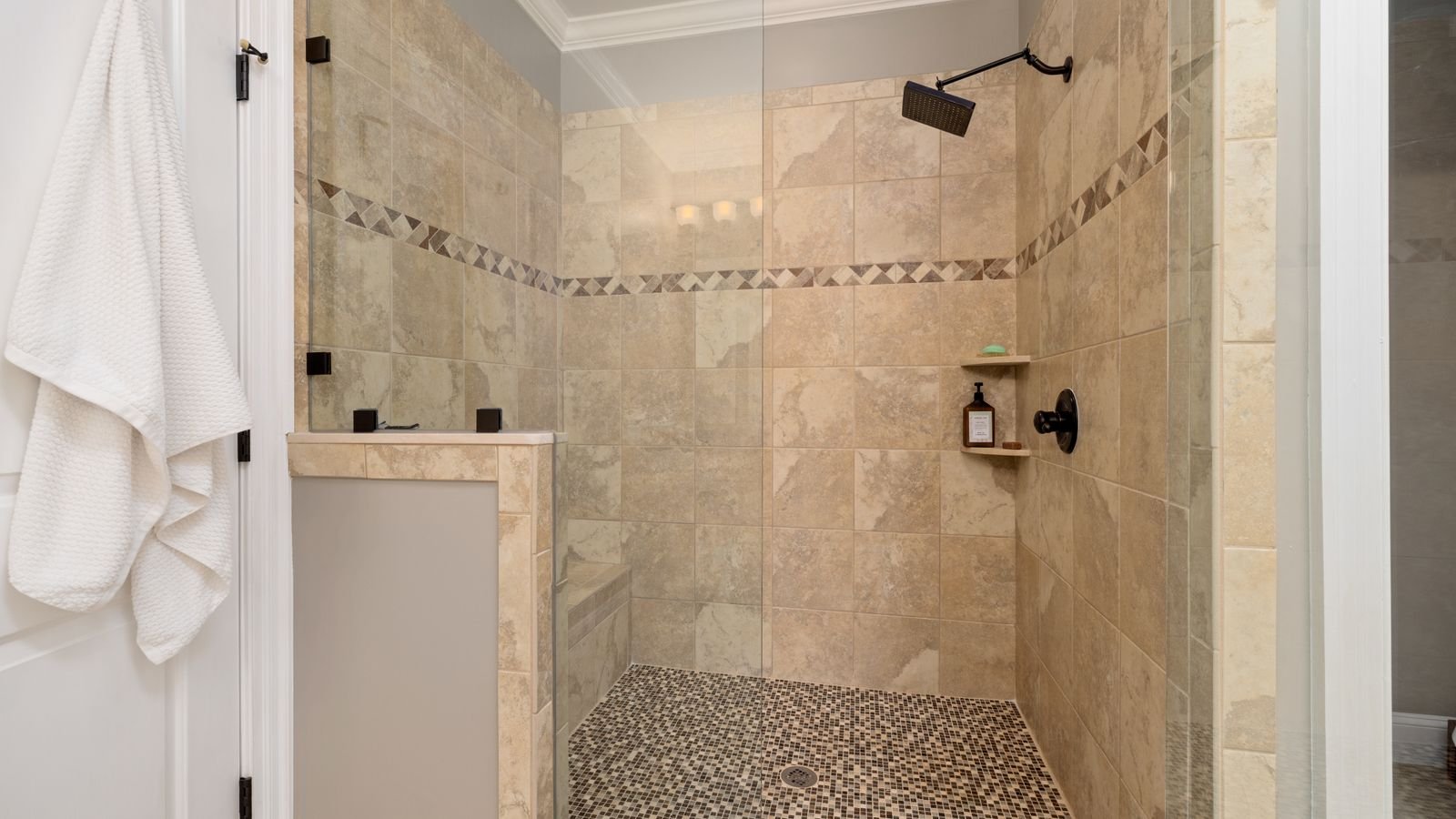
The usual approach is a small mosaic underfoot with larger tiles on the walls, which resolves both the slope problem and the slip problem while keeping the visual weight where you want it. Keeping floor and wall tiles in the same colour family, or using the mosaic version of the wall tile on the floor, produces a coherent result with almost no design effort.
Small showers benefit from lighter tiles, larger formats on the walls and fewer contrasting elements, since busy patterns shrink a space visually. Larger showers can carry a feature wall, a strong pattern or a dramatic stone without becoming oppressive.
Think about the fixtures at the same time. Matte black, brushed brass and chrome all sit differently against warm and cool tile tones, and choosing tile before fixtures often means compromising later. Water pressure and spray pattern also change how a floor behaves, since a wide rain head wets far more of the floor than a focused handset — comparisons of the best shower heads and the flow-focused best high pressure shower heads are worth reading before finalising the layout. Our roundup of the best tiles for shower floors compares specific mosaic, porcelain and stone options against slip ratings and absorption figures.
Budget and Where to Spend
Entry level. Standard ceramic or basic porcelain mosaic with cement grout. Perfectly serviceable if the slip rating is adequate and the waterproofing is done properly. Expect more cleaning and annual grout sealing.
Mid range. Quality through-body porcelain mosaic with epoxy grout over a proper membrane system. This is where most bathrooms should land: durable, low maintenance, and visually flexible.
Premium. Natural stone, large-format porcelain with a linear drain, or bespoke patterned mosaic, with epoxy grout and a high-end waterproofing system. Beautiful, and requiring a competent installer.
The most important budget principle in this category is that labour and waterproofing matter more than tile cost. An expensive tile installed over poor waterproofing is a future demolition job; a modest tile installed correctly lasts thirty years. Spend on the installer and the membrane before spending on the tile.
Cleaning and Long-Term Maintenance
A squeegee or a quick wipe of the floor after showering removes the standing water that causes most staining, and takes ten seconds. Ventilation matters just as much: an extractor run for twenty minutes after a shower does more to prevent mould than any cleaning product. In persistently damp bathrooms, one of the best dehumidifiers for bathrooms supplements weak ventilation effectively.
Use pH-neutral cleaners on stone and avoid vinegar, bleach and acidic limescale removers, all of which etch calcareous surfaces permanently. Porcelain tolerates a much wider range of cleaners. Reseal cement grout annually and stone every six to twelve months — a water droplet that soaks in rather than beading is the signal that sealing is due.
In hard water areas, mineral deposits build on both tile and glass faster than anything else, which is why fixture-level filtration is worth considering; the best shower heads for hard water reduce scaling at the source and cut cleaning noticeably.
Common Mistakes to Avoid
- Choosing a polished tile for the shower floor because it looked beautiful on a wall display.
- Using large-format tiles over a four-way sloped centre drain, which cannot be laid flat.
- Treating tile and grout as the waterproofing layer rather than the wearing surface.
- Selecting brilliant white grout and then fighting soap scum for a decade.
- Using natural stone without committing to a sealing schedule.
- Cleaning marble, travertine or limestone with acidic products.
- Buying tile without checking the DCOF or R rating at all.
Frequently Asked Questions
What size tile is best for a shower floor?
With a conventional centre drain, mosaics of 2×2 inches or smaller, because they conform to the slope and provide grip. With a linear drain and a single-plane slope, larger formats become possible, including tiles matching the main bathroom floor.
Is natural stone a bad idea in a shower?
Not bad, but demanding. Slate and honed granite perform well; polished marble is a poor choice underfoot. All stone needs regular sealing and gentle cleaners. If you want the look with none of the upkeep, stone-effect porcelain is convincing and far easier to live with.
Is epoxy grout worth the extra cost?
On a shower floor, yes. The joint density is high, the exposure is constant, and epoxy removes both the annual sealing chore and most staining and mould problems. It is the single most cost-effective upgrade in a shower build.
Can I tile over an existing shower floor?
Rarely a good idea. The existing waterproofing is unknown and probably compromised, the added height affects the slope and drain relationship, and any failure below the new tile is invisible until it appears on a ceiling downstairs. Strip back and rebuild properly.
How do I stop the floor going black around the drain?
That discolouration is almost always mould in grout kept permanently damp by poor drainage. Check the slope actually clears water, improve ventilation, squeegee after use, and if the problem persists, regrout with epoxy rather than repeatedly bleaching the symptom.
Final Thoughts
Choose the shower floor tile in this order: slip resistance, then water absorption, then size relative to the drain type, then appearance. Porcelain mosaic with epoxy grout over a properly detailed waterproof membrane is the answer that suits the widest range of bathrooms, and it is hard to regret. Reserve natural stone for people happy to seal it, keep polished finishes off the floor entirely, and spend the money on the installation rather than the tile. Done that way, the floor stays safe, stays clean with minimal effort, and still looks right long after the fixtures have been replaced.