Owen Bradley
 Sharing one desk between two people is a space problem disguised as a relationship problem. Elbows collide, one person’s paperwork drifts across an invisible border, monitors end up angled so neither person faces their own screen squarely, and the chair that suits one body is wrong for the other. None of that is inevitable. With enough width per person, a deliberate monitor arrangement, and separately adjusted chairs, two people can work at the same surface all day without irritating each other. This guide covers the measurements and the layout decisions that make it work.

How Much Width Each Person Actually Needs
Start with the number that decides everything else. A single seated worker needs roughly 30 inches of width to sit comfortably without feeling boxed in, and about 24 inches is the absolute minimum before elbows start hitting. That means a genuinely comfortable side-by-side desk for two is around 60 inches wide, and a workable but tight one is around 48 inches. Below that, someone is going to be uncomfortable every day.
Depth matters just as much and gets ignored. Both people need enough distance to sit an arm’s length from their screens, so aim for at least 27 inches deep, and 30 inches if either person uses a large monitor. A shallow shared desk forces both users to pull screens close, which causes eye strain that compounds over a workday.
If both people use a full-size keyboard plus a mouse arc, budget 34 to 36 inches each and plan for a 70-inch surface. That sounds enormous until you try 55 inches with two mice and discover that the middle becomes a contested no-man’s-land.
Choosing the Sharing Arrangement
Side by side is the most common and works well when the desk is wide enough. Both people face the same wall, cables run to a single point, and conversation is easy. The downside is that neither person has visual privacy, and screen glare from a shared window affects both.
Facing each other across a deep desk saves wall space and creates a natural boundary, but monitors block eye contact and it requires unusual depth, at least 48 inches, to keep both people at a proper viewing distance. It suits laptop work far better than dual-monitor setups.
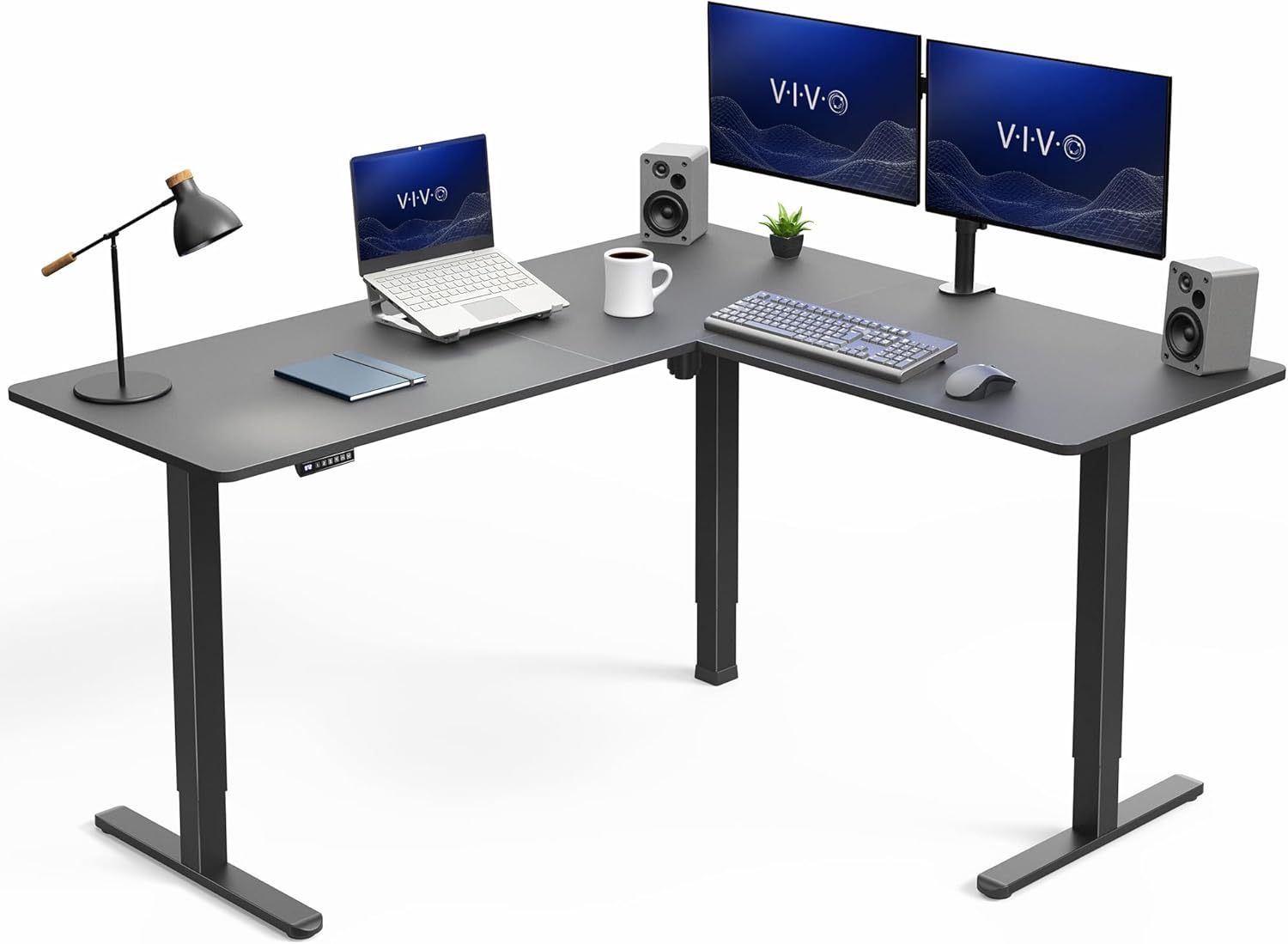
L-shaped or corner arrangements are often the best answer in a small room. Each person gets their own leg of the desk, which creates a real spatial boundary without needing a 70-inch straight run, and each user can angle toward their own wall. Our roundup of the best L-shaped desks covers configurations that split cleanly between two users.
Step-by-Step: Setting Up a Shared Desk
- Measure the room, not just the desk. Each person needs roughly 36 inches of clearance behind their chair to push back and stand without hitting a wall or each other. Two chairs backing into the same aisle is the most common daily friction point in shared setups.
- Divide the surface visibly. Mark a physical midline with a small divider, a plant, a lamp, or simply a consistent gap. An invisible boundary always erodes; a visible one holds. Each person is then responsible for their own half and nobody has to negotiate every week.
- Set both monitors before anything else. Each person’s primary screen must be centered on their own torso, not on their half of the desk and definitely not on the desk center. Angle each display slightly inward toward its user so neither person views their screen off-axis.
- Use monitor arms wherever possible. On a shared desk, arms are close to essential. Removing two stand bases returns a large amount of surface, and arms let each user set their own height independently, which matters because two people rarely have the same seated eye level.
- Give each person a dedicated mouse rectangle. Roughly 10 by 10 inches minimum, placed on each user’s dominant side. If both users are right-handed, the person on the left will have their mouse close to the divider, so shift the boundary slightly to give them room rather than splitting the desk exactly in half.
- Adjust each chair separately and leave it that way. Two bodies almost never share a correct seat height, depth, or armrest position. If the chairs are shared rather than assigned, note each person’s settings so the reset takes ten seconds. Assigned chairs are far better if you have the option.
- Set desk height for the taller user, then fix the shorter one. A single fixed surface cannot suit two different heights. Set it so the taller person’s forearms are parallel to the floor, then raise the shorter person’s chair to match and add a footrest so their feet are supported. Raising a chair without a footrest simply moves the discomfort to the legs.
- Split the power and cabling. Run two separate cable bundles, one per user, to a shared strip under the desk. Mixed bundles mean one person unplugging a charger drags the other person’s monitor cable, which is a small annoyance that repeats forever.
- Give each person their own storage. Two drawers, two trays, or two rolling cabinets. Shared storage always becomes one person’s storage, and shared surface clutter follows.
- Agree on the noise and call rules early. Decide in advance what happens when one person has a call, whether that means headphones, a signal, or one person relocating. This is a layout decision as much as a social one, because it determines whether you need a headset for each user.

Picking a Desk Built for Two
Width and stability are the two specifications that matter, and stability is easy to underestimate. A desk that feels solid with one user can visibly shake when a second person types, leans, or shifts weight, and a wobbling monitor is distracting for whoever is not causing it. Look for a crossbar, a thick top, or a heavier steel frame rather than the lightest available option.
For gaming or dual-PC households, the best gaming desks for 2 are built around the extra width two towers and two peripheral sets demand, and the best long desks for gaming stretch further still if you want genuinely separate zones. For general office use, our roundup of the best office desks covers wide, stable surfaces suited to two workers, while the best desks under 500 list is the practical starting point if you are furnishing a shared space on a budget.
Two Desks Pushed Together
Do not overlook this option. Two separate desks placed side by side or in an L give each person independent height adjustment, which no single shared surface can match, and they cost about the same as one large desk. The only real drawback is a visible seam and slightly less clean cable routing. If your two users differ significantly in height, this is usually the better answer.

Comfort and Safety Notes
The most common injury risk in shared setups is not dramatic; it is the shorter person sitting with dangling feet all day because the chair was raised to reach a desk set for someone taller. Always pair a raised chair with a footrest that keeps thighs roughly parallel to the floor. Without it, pressure on the back of the thighs restricts circulation and causes lower back strain within hours.
Check under-desk clearance for both users, since a shared desk often ends up with two towers, two power strips, and someone’s storage box occupying knee space. Each person needs clear room to sit square without twisting. Keep cables off the floor in the walkway behind the chairs, and make sure a shared power strip is not overloaded now that it feeds two full workstations.
Troubleshooting
Elbows still collide. Either the desk is too narrow or the keyboards are placed toward the center. Move both keyboards outward so each is centered on its user, and check that neither person’s mouse arc crosses the midline.
One person’s clutter keeps spreading. Add a physical divider and dedicated storage for that user. Spreading is almost always a storage shortage rather than a habit problem.
Screen glare affects only one user. Angle that monitor a few degrees or move the light source. A shared window usually hits one seat harder, and a side-mounted task lamp fixes it without changing the room.
The desk shakes when the other person types. Tighten all frame bolts, add a crossbar if possible, and shift monitor arm clamps onto supported sections rather than overhangs.
Mistakes to Avoid
- Splitting the desk exactly in half. Handedness and monitor sizes rarely make an even split correct.
- Centering monitors on the desk rather than on each person. This creates permanent neck twist for both users.
- Sharing one chair between two body types. Assign chairs or record each person’s settings.
- Raising a chair without a footrest. It trades a wrist problem for a leg and back problem.
- Skipping the divider. Boundaries that are not visible do not survive a busy week.
Frequently Asked Questions
How wide should a desk be for two people?
Sixty inches is a comfortable minimum for two side-by-side workstations, and 70 inches is better if both users run a full-size keyboard with a wide mouse arc. Forty-eight inches is workable only for laptop-based work.
Is an L-shaped desk better than a long straight one?
Often yes in a small room, because it gives each person a distinct zone without needing a very long wall. A straight desk is simpler for cable routing and looks tidier if you have the width.
What if the two people are very different heights?
Either use two separate desks with independent heights, or set the surface for the taller person and give the shorter one a raised chair plus a footrest. Never split the difference, which leaves both users slightly wrong.
Do we each need our own monitor arm?
If you can, yes. Independent height and depth adjustment is the main advantage of a shared desk that arms provide, and it removes both stand bases from a surface that is already tight.
Final Thoughts
Sharing a desk works when the space is divided deliberately rather than negotiated daily. Give each person at least 30 inches of width, center each monitor on its user instead of on the furniture, mark a visible boundary, adjust both chairs independently, and add a footrest whenever one person has to sit higher than the desk naturally allows. Get those five things right and the shared desk stops being a compromise, letting two people work side by side comfortably instead of quietly competing for the same few inches.