 Owen Bradley
 Some houses simply refuse to cooperate with Wi-Fi. You buy a well-reviewed router, place it sensibly, and the room on the other side of one wall still crawls. If that wall is brick, poured concrete, cinder block, or plaster over metal lath, the hardware is not the problem so much as physics. Getting Wi-Fi through concrete walls is a different exercise from covering an open floor plan, because dense masonry does not attenuate signal politely; it can swallow almost all of it. This guide covers how much each material actually costs you in signal, which band survives the trip, when a stronger router genuinely helps, and why wired backhaul is the answer far more often than another antenna.
How Much Signal Each Material Really Eats
Wi-Fi loss through a barrier is measured in decibels, and the scale is unforgiving. Every 3 dB of loss halves the received power, and 10 dB cuts it to one tenth. That means the difference between drywall and concrete is not a matter of degree, it is a matter of category.
- Drywall or wood panel: roughly 2 to 4 dB. Barely noticeable in a normal room.
- Interior hollow-core door: around 3 to 5 dB.
- Plaster over wood lath: 5 to 8 dB, and far worse if the lath is metal mesh.
- Solid brick, single wythe: roughly 8 to 15 dB.
- Cinder or concrete block: roughly 12 to 20 dB, depending on whether the cores are filled.
- Poured concrete: 15 to 25 dB, rising sharply with thickness.
- Reinforced concrete with rebar or wire mesh: 20 to 35 dB or more, because the steel forms a partial Faraday cage.
- Low-emissivity or foil-backed insulation: 20 to 30 dB, which is why some newly renovated homes are worse than old ones.
Stack two of these in a row and you are done. A router that leaves the antenna at a healthy level will arrive on the far side of two block walls somewhere near the noise floor, where the connection either drops or falls back to the slowest possible rate to stay alive.
Band Choice Changes Everything
Not all Wi-Fi bands cross masonry equally. Lower frequencies have longer wavelengths and diffract around and through obstacles more effectively.
2.4 GHz
This is your penetration band. Through brick or block it can deliver a usable link where 5 GHz shows nothing at all. The tradeoffs are real: only three non-overlapping channels, heavy interference from neighbors, microwaves, cordless phones, and Bluetooth, and much lower top speeds. For a garage, workshop, basement, or the far side of a masonry wall, a solid 2.4 GHz connection at 40 Mbps beats a 5 GHz connection that does not exist.
5 GHz
Far more capacity, far less patience with walls. Expect roughly 3 to 6 dB more loss than 2.4 GHz through the same barrier, which frequently pushes it below usability after one concrete wall. It is excellent within a room or across drywall, and the right band for anything bandwidth-hungry that sits reasonably close to a radio.
6 GHz
The newest band brings enormous clean spectrum and the shortest effective range of the three. In a masonry home, treat 6 GHz as a same-room or line-of-sight band, or as a backhaul link between nodes that can see each other through a doorway. Do not count on it to reach a room behind concrete.
The practical strategy is to run a single network name across all bands, let devices in open areas use the fast bands, and make sure 2.4 GHz is clean and properly configured so devices behind walls have something reliable to fall back to.
Angles Matter More Than Power
A signal that hits a wall straight on travels through the shortest possible path of material. A signal that hits at a shallow angle travels through a much longer diagonal slice of the same wall and can lose several times more energy. This is why moving a router two feet, or raising it a shelf, sometimes doubles throughput in the next room while turning up transmit power does nothing.
Look for the paths that are not masonry at all. Doorways, interior windows, stairwells, hallway openings, HVAC chases, and the gap above a partial wall are all low-loss corridors. Aiming coverage through an open door into a hallway and letting it turn the corner often works better than firing directly through the wall between two rooms.
Antenna orientation helps too. Devices couple best when their antennas share polarization, so on a router serving one floor, keeping antennas vertical is usually right; angle one outward only when you are deliberately trying to reach a level above or below.
Why a Stronger Router Is Only a Partial Fix
Transmit power is capped by regulation, so no consumer router is dramatically louder than another. What better hardware genuinely improves is receive sensitivity, antenna quality, beamforming, and the ability to hold a stable connection at low signal levels. Those are worth real money in a masonry home, but they buy you a few decibels, not fifteen.
There is also an asymmetry people forget. A big router with high-gain antennas can shout across a concrete wall, but your phone or laptop has a small antenna and modest power, so the return path fails first. You can see four bars and still get nothing, because the device cannot be heard. That asymmetry is the reason placing a receiver closer to the client, rather than a bigger transmitter farther away, is the reliable fix.
That said, radio quality is not nothing. Hardware chosen specifically for dense construction is collected in our roundups of the best routers for concrete walls and the best routers for thick walls, and if the house is also large, the best long range routers list focuses on models with the antenna arrays and sensitivity to hold a link at distance.
Wired Backhaul: The Actual Solution
If there is one honest conclusion in this whole subject, it is that you do not beat concrete with radio. You go around it with a cable. A wired link between the router and a second access point on the far side of the wall eliminates the barrier entirely and delivers full speed instead of a degraded fraction.
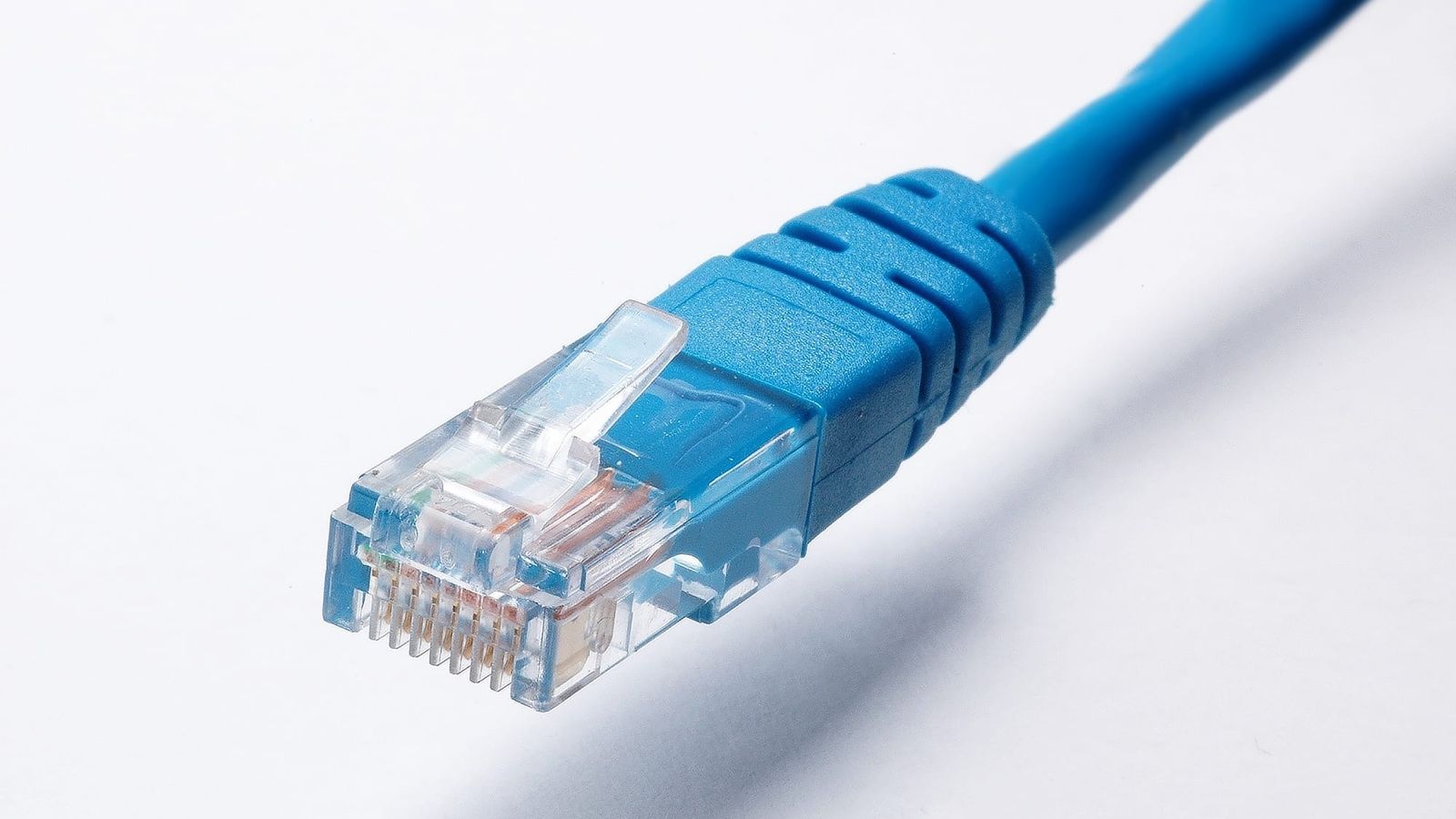
- Ethernet. A single Cat6 run through an existing conduit, along a baseboard, or through a floor register is the gold standard. Flat cable slipped under trim or around a door frame works when drilling masonry is off the table.
- MoCA. If the house has coax outlets, MoCA adapters turn that existing cable into a fast, low-latency wired link. In older brick homes wired for cable television, this is frequently the easiest win available.
- Powerline. Uses electrical wiring and works well when both outlets sit on the same circuit and same phase. Results vary widely in older buildings, so buy from somewhere with a return policy and test before committing.
- Outdoor path. In some homes, running a cable or placing a weatherproof access point outside to reach a detached garage or an addition beats fighting through a foundation wall.
Once a wire exists, feed a proper access point with it. Purpose-built units mounted on a wall or ceiling give cleaner coverage per room than a consumer router stuffed on a shelf; our guide to the best home Wi-Fi access points covers models sized for residential use.
When Wireless Mesh Still Makes Sense
Mesh is not useless in masonry homes, it just has to be deployed with the walls in mind. The rule is that each node must have a strong link to its parent, which usually means placing nodes so they see each other through doorways and hallways rather than through the wall you are trying to defeat.
Prefer tri-band systems with a dedicated backhaul radio, since a shared-band mesh already halves throughput on every hop and a weak masonry link makes that far worse. Avoid chaining node to node to node; arrange them so each hears the main router directly if you possibly can. Kits designed to hold multiple nodes together over distance appear in our list of the best mesh routers for large homes.
Simple repeaters that create a second network name are the worst option here. They halve bandwidth, they rebroadcast whatever weak signal they receive, and in a concrete house what they receive is already poor.
Settings Worth Changing
Before buying anything, spend fifteen minutes in the router interface.
- Lock 2.4 GHz to channel 1, 6, or 11. These are the only non-overlapping options, and auto selection often parks you on a partially overlapping channel that raises your noise floor.
- Set 2.4 GHz channel width to 20 MHz. Wider channels sound faster but are more fragile and more prone to interference, and reliability matters more than peak rate on your penetration band.
- Enable DFS channels on 5 GHz. They are far less crowded in dense neighborhoods, which improves range indirectly by lowering interference.
- Turn off legacy rates if the option exists. Very old data rates let distant devices cling on at speeds that hog airtime for everyone.
- Update firmware. Radio and roaming behavior improve meaningfully across firmware versions, and the fix is free.
- Keep one network name across bands so devices can fall back to 2.4 GHz automatically when they move behind a wall.
Measure Before You Spend
Use a Wi-Fi analyzer app and record signal strength in dBm on both sides of each problem wall. The difference between the two readings is that wall’s real attenuation in your house, which beats any table including the one above. Anything better than -60 dBm is comfortable, -67 dBm is a reasonable working floor, and past -75 dBm you are living on borrowed time.
Also test local throughput, not just internet speed, so you can tell a Wi-Fi problem from an ISP problem. If a laptop sitting next to the router is slow too, no amount of wall engineering will help. Change one variable at a time and retest, because in masonry homes small placement changes produce surprisingly large swings.
Common Mistakes
The biggest is buying a bigger router to punch through a wall that no consumer router can punch through, then buying a second one when the first disappoints. The second is putting a mesh node in the dead room, where its uplink is as bad as the coverage you are trying to fix; nodes belong where signal is still good, pointing into the dead zone. The third is relying on 5 GHz everywhere and disabling 2.4 GHz because it is slow, which removes the only band with a real chance of crossing block or concrete.
Frequently Asked Questions
Does foil-backed insulation really block Wi-Fi?
Yes, and severely. Foil facings and low-emissivity window coatings act like thin metal sheets, which can be worse than the masonry itself. Rooms added or renovated recently are often the hardest to cover for exactly this reason.
Will a high-gain antenna upgrade help?
Sometimes. High-gain antennas trade vertical coverage for horizontal reach, so they help across a single floor and hurt between floors. They also do nothing for the weak return path from your phone, so gains are usually modest.
Is 2.4 GHz worth using in 2026?
Absolutely, in a masonry home. It is the band that reaches the garage, the basement workshop, and the room behind the chimney. Keep it clean, keep it on a fixed non-overlapping channel, and treat it as your reliability band rather than your speed band.
Can I drill through the wall myself?
A masonry bit and a hammer drill will get a cable through brick or block, but never drill blind into concrete that may contain rebar, conduit, or post-tension cables. If you are unsure what is inside a structural wall, route the cable around it instead.
Final Thoughts
Brick and concrete are not a problem you solve with more transmit power, because the physics and the regulations both work against you. The winning approach is to respect the material, use 2.4 GHz where penetration matters, exploit doorways and hallways instead of fighting walls head on, and run a wire whenever a path exists so the far side of the house gets its own radio rather than a rumor of one. Choose hardware with genuinely good antennas and sensitivity, measure both sides of every wall, and you can make even a solid masonry home feel like it has ordinary Wi-Fi.