 Owen Bradley
 A surge protector is the cheapest insurance you will ever buy for expensive electronics, and it is also the product most people buy wrong. The strip on the shelf with eight outlets and a bargain price is often just an extension cord with a switch — no protection at all — and even genuine surge protectors quietly wear out and stop protecting long before they stop supplying power. This surge protector buying guide explains joule ratings, clamping voltage, response time, indicator lights and the difference between a power strip and real protection, so the gear plugged into it survives the next storm and the next appliance kicking on down the hall.
What a Surge Actually Is
A surge is a brief spike in voltage above the normal level your outlets supply. It can last microseconds and still be enough to damage sensitive components. Most people picture lightning, and a direct nearby strike is indeed the most dramatic cause, but it is far from the most common one.
The everyday surges come from inside your own home. When a motor-driven appliance switches off — an air conditioner compressor, a refrigerator, a washing machine, a power tool — the collapsing magnetic field pushes a voltage spike back onto the circuit. These small surges happen many times a day. Individually they rarely destroy anything; cumulatively they degrade power supplies, capacitors and control boards, which is why electronics sometimes fail for no apparent reason after a few years.
Utility switching, grid faults and power restoration after an outage produce larger transients. And a nearby lightning strike can induce a surge on the line even without hitting your house at all. A surge protector is designed to intercept all of these before they reach the equipment.
Power Strip vs Surge Protector
This distinction costs people thousands of dollars in ruined equipment. A power strip simply multiplies one outlet into several. It may have a circuit breaker to prevent overload, but it does nothing about voltage spikes. A surge protector contains components — usually metal oxide varistors — that divert excess voltage away from the connected devices and into the ground wire.
The way to tell them apart is the joule rating. A genuine surge protector always publishes one. If the packaging lists no joule rating, no clamping voltage and no safety certification, assume it is a plain power strip regardless of what the marketing copy implies.
Look for a recognized safety certification on the packaging as well. Uncertified strips are a fire risk as much as a protection failure, and cheap units with undersized internal wiring are a genuinely bad place to save money.
Joule Rating: How Much Protection You Are Buying
The joule rating tells you how much total surge energy the protector can absorb over its lifetime before its protective components are exhausted. It is a consumable budget, not a permanent capability. Every surge — including the small daily ones from appliances — spends a little of it.
Higher is better and the price difference is modest. As practical guidance: under 600 joules is suitable only for lamps, phone chargers and other cheap, easily replaced items. Between 1,000 and 2,000 joules is a reasonable middle ground for televisions, game consoles, routers and small appliances. Above 2,000 joules is what you want for a desktop computer, a home theater system, a home office or anything expensive and hard to replace.
Two protectors with the same joule rating are not necessarily equal, because that budget can be spent as one large hit or thousands of small ones. But between an otherwise identical 600-joule and 2,000-joule unit, the larger rating buys both more headroom against a big event and a longer useful life against everyday wear.
Clamping Voltage and Response Time
Clamping voltage is the level at which the protector begins diverting excess energy. Lower clamping voltage means the protector intervenes sooner, letting less of the spike through to your equipment. Common ratings are 330 V, 400 V and 500 V, and 330 V is the value to look for on anything protecting sensitive electronics.
There is a trade-off worth understanding: a lower clamping voltage means the protector activates more often, including on smaller transients, so it consumes its joule budget faster. The right combination is a low clamping voltage paired with a high joule rating, which gives you both tight protection and a long service life.
Response time describes how quickly the protector reacts once voltage exceeds the threshold. It is measured in nanoseconds, and faster is better, though most quality units are close enough that this figure rarely decides a purchase. Treat clamping voltage and joules as the primary numbers and response time as a tiebreaker.
Indicator Lights and Knowing When Protection Has Failed
Here is the part almost everyone misses. When a surge protector’s varistors are exhausted, most units keep delivering power exactly as before. The lights work, the devices turn on, and there is no protection at all. People happily use dead surge protectors for years.
That is why the protection status indicator is arguably the most important feature on the unit. It is a separate light — distinct from the power indicator — that stays lit while the protective components are intact and goes out when they are spent. Check it periodically, and never buy a protector without one.
Some higher-end units go further with automatic shutdown, cutting power entirely once protection fails. This is the safest behavior for critical equipment because it makes the failure impossible to ignore. A grounded indicator is also useful, since a surge protector cannot divert energy properly without a working ground connection — a common problem in older homes with two-prong wiring.
Outlet Layout, Cord Length and Ratings
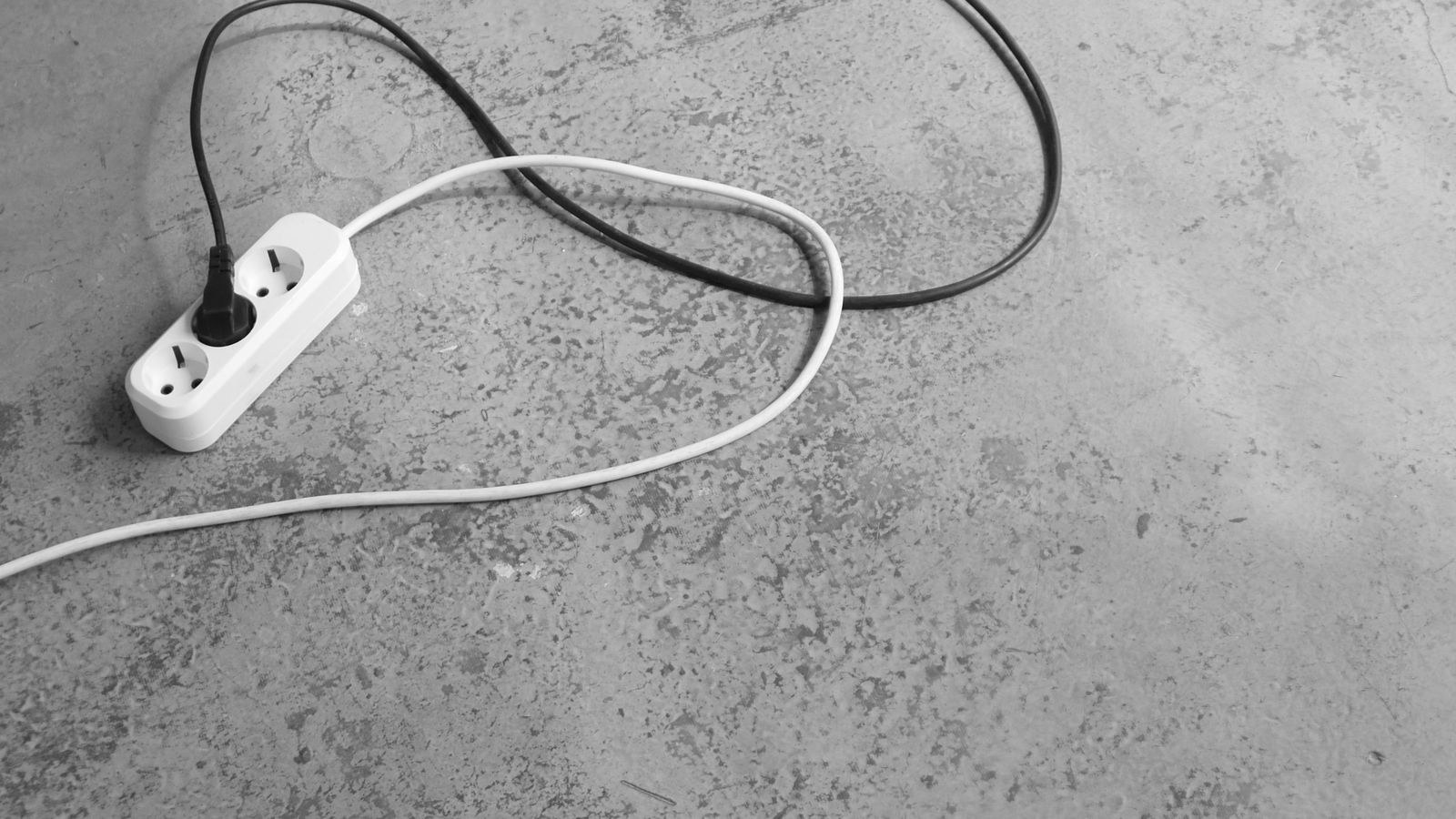
Count the devices you need to plug in, then add two. Entertainment centers and desks grow. More important than the raw count is the spacing: large power adapters block adjacent outlets, and a strip advertising twelve outlets can be effectively seven once you plug in a few bricks. Look for widely spaced outlets, rotating sockets or dedicated adapter-friendly slots.
Cord length matters more than expected. A cord that is too short encourages the single worst habit in home wiring — plugging a surge protector into an extension cord, or worse, daisy-chaining one strip into another. Buy the length you need so everything reaches a wall outlet directly.
Check the amperage rating against your load. Most household strips handle 15 A, which is plenty for electronics but not for space heaters, kettles or anything with a heating element. High-draw appliances should always go directly into a wall outlet. If your problem is really a shortage of accessible outlets rather than protection, replacing the receptacle is often the better fix — our guide to the best power outlets covers modern replacements with built-in USB charging, and the best outlets for home comparison looks at tamper-resistant and higher-capacity options for busy rooms.
Where Each Type of Protector Belongs
Standard Strips
The familiar multi-outlet strip suits desks, entertainment centers and workbenches. Choose one with a high joule rating and 330 V clamping for anything valuable.
Wall-Mounted and Tap Protectors
These plug directly into an outlet and expand it into several protected sockets without a cord. They suit bedside tables, kitchens and tight spaces. Ratings are usually lower, so reserve them for smaller loads. For simple charging duties, the best wall plugs roundup covers compact options that keep cords off the floor.
Whole-House Protectors
Installed at the electrical panel by an electrician, these intercept large surges coming from outside before they enter your circuits. They are excellent as a first line of defense but do nothing about surges generated inside the house, so they complement rather than replace point-of-use protectors.
Battery Backup Units
An uninterruptible power supply combines surge protection with a battery that keeps equipment running through an outage. This is the right choice for desktop computers, network gear and anything that can be damaged or corrupted by a sudden shutdown; the best UPS for gaming computers guide explains sizing and runtime. For a broader look at how strips, taps and extensions should be combined safely, our wall plug and extension guide covers load limits and layout.
Protecting Data and Coaxial Lines
Surges do not only travel on power lines. Cable television coax and, in some installations, telephone lines can carry a transient straight into a modem or television, bypassing the power protection entirely. Many surge protectors include coaxial pass-through jacks for exactly this reason.
If you have a cable modem, routing the coax through the protector closes a real gap. Note, though, that pass-through jacks add a small amount of signal loss, which is usually irrelevant but occasionally matters on a marginal connection. Ethernet pass-through is offered on some units too, though modern network equipment is fairly resilient and this is a lower priority.
Common Mistakes to Avoid
- Buying a power strip and assuming it protects. No joule rating means no protection.
- Never checking the indicator light. A dead protector looks identical to a working one.
- Daisy-chaining strips. It defeats protection, overloads circuits and is a genuine fire hazard.
- Plugging heaters or appliances into a strip. High-draw heating devices belong in a wall outlet.
- Ignoring the ground. Without a proper ground connection, a surge protector has nowhere to send the energy.
- Keeping one for a decade. Protection degrades with every surge absorbed, whether or not you noticed them.
Frequently Asked Questions
How many joules do I need?
Aim for at least 1,000 for general electronics and above 2,000 for computers, home theater systems and anything expensive to replace.
How often should I replace a surge protector?
Watch the protection indicator rather than the calendar, but replace any unit after a major surge event or a nearby lightning strike, and consider replacing general-purpose strips every few years.
Does a surge protector stop lightning?
It handles induced surges from nearby strikes. A direct strike on the house exceeds what any point-of-use device can absorb, which is why unplugging during severe storms is still the safest option.
Do I still need one with a whole-house protector?
Yes. Panel-level devices stop external surges but not the ones generated by appliances inside your home.
Is a UPS better than a surge protector?
For computers and network equipment, yes, because it adds outage protection and often voltage regulation. For a lamp or a television, a good surge protector is enough.
Final Thoughts
Buying a surge protector well takes about thirty seconds once you know what to read. Confirm there is a joule rating at all, aim for 2,000 or more on anything valuable, insist on 330 V clamping, and refuse to buy a unit without a separate protection status indicator. Then treat it as a consumable: check that indicator a few times a year, replace the unit after any serious surge event, and keep high-draw appliances out of it entirely. Layer a panel-level protector for storms and a battery backup for the computer and network gear, and the electronics you actually care about will be protected against both the dramatic events and the small daily spikes that quietly wear them out.