Owen Bradley
 A heat pump is not just a furnace that runs backwards, and a thermostat that treats it like one will quietly cost you money every winter. Heat pumps move heat rather than burning fuel, they reverse direction between seasons, and they lean on backup electric heat when outdoor temperatures fall. Any heat pump smart thermostat you buy must understand all three behaviours, or it will call expensive auxiliary heat far more often than necessary. This guide explains what makes heat pump control different, which specifications genuinely matter, how dual-fuel and multi-stage systems change the shortlist, and how to verify compatibility before you spend anything.
Why Heat Pumps Need Different Control Logic
A gas furnace produces a large burst of heat quickly, so a thermostat can let temperature drift a couple of degrees and then blast it back. A heat pump works best doing the opposite: running longer at lower output, holding a steady temperature rather than chasing swings. Force a heat pump into furnace-style control and it will either short cycle or fall back on resistance heat to catch up.
That difference shows up most clearly in recovery. When a setback schedule asks for a four-degree rise at six in the morning, a furnace simply fires. A heat pump either takes a long time or triggers auxiliary heat, which uses electric resistance elements that can cost several times more per unit of heat delivered. A thermostat that understands heat pumps ramps up gradually and starts recovery early enough that backup heat is never needed.
The Terminals That Matter
Heat pump wiring uses terminals that conventional systems do not. Learning them makes compatibility checks fast.
- O or B controls the reversing valve, which switches the system between heating and cooling. O energises in cooling, B energises in heating, and the wrong setting makes your system blow cold air when you asked for heat.
- AUX or W2 calls auxiliary heat, the electric strips or secondary source that supplements the compressor in cold weather.
- E calls emergency heat, which runs the backup source alone with the compressor off, typically used when the outdoor unit has failed.
- Y and Y2 are compressor stages, with two-stage systems needing both.
- L is a fault or system monitor input on some equipment.
If your existing thermostat has wires on O/B and AUX terminals, you definitively have a heat pump and you need a thermostat that lists heat pump support explicitly, not just heating and cooling.
Auxiliary Heat Lockouts: The Feature That Saves Money
The most valuable capability in a heat pump thermostat is control over when auxiliary heat is allowed to run. Two settings matter. A compressor lockout prevents the heat pump from running below an outdoor temperature where it becomes ineffective. An auxiliary lockout prevents backup heat from engaging above a temperature where the compressor could have managed alone.
Without lockouts, the thermostat calls backup heat whenever it decides the house is warming too slowly, which happens frequently during morning recovery. With them, you draw a line and the system respects it. Households that add proper lockout settings often see a noticeable drop in winter electricity use without any change in comfort, simply because the resistance elements stop running unnecessarily.
When comparing models, look for named settings such as aux lockout, compressor lockout or balance point. Thermostats built specifically around this problem appear throughout our roundup of the best heat pump thermostats, which is the right starting point if your system relies on auxiliary heat.
Dual-Fuel Systems Need Explicit Support
A dual-fuel or hybrid system pairs a heat pump with a gas furnace instead of electric strips. The thermostat must decide which source is cheaper at any given outdoor temperature and switch between them, a decision that depends on local gas and electricity prices as well as outdoor conditions.
This is not a feature every smart thermostat has. Some require an external outdoor sensor to make the decision, some rely on the furnace control board to handle switching, and some cannot manage dual fuel at all. If you have both a heat pump and a furnace, filter for dual-fuel support first and treat every other feature as secondary. Buying a thermostat that lacks it means either the furnace or the heat pump sits idle when it should be running.
Outdoor Temperature Sensing
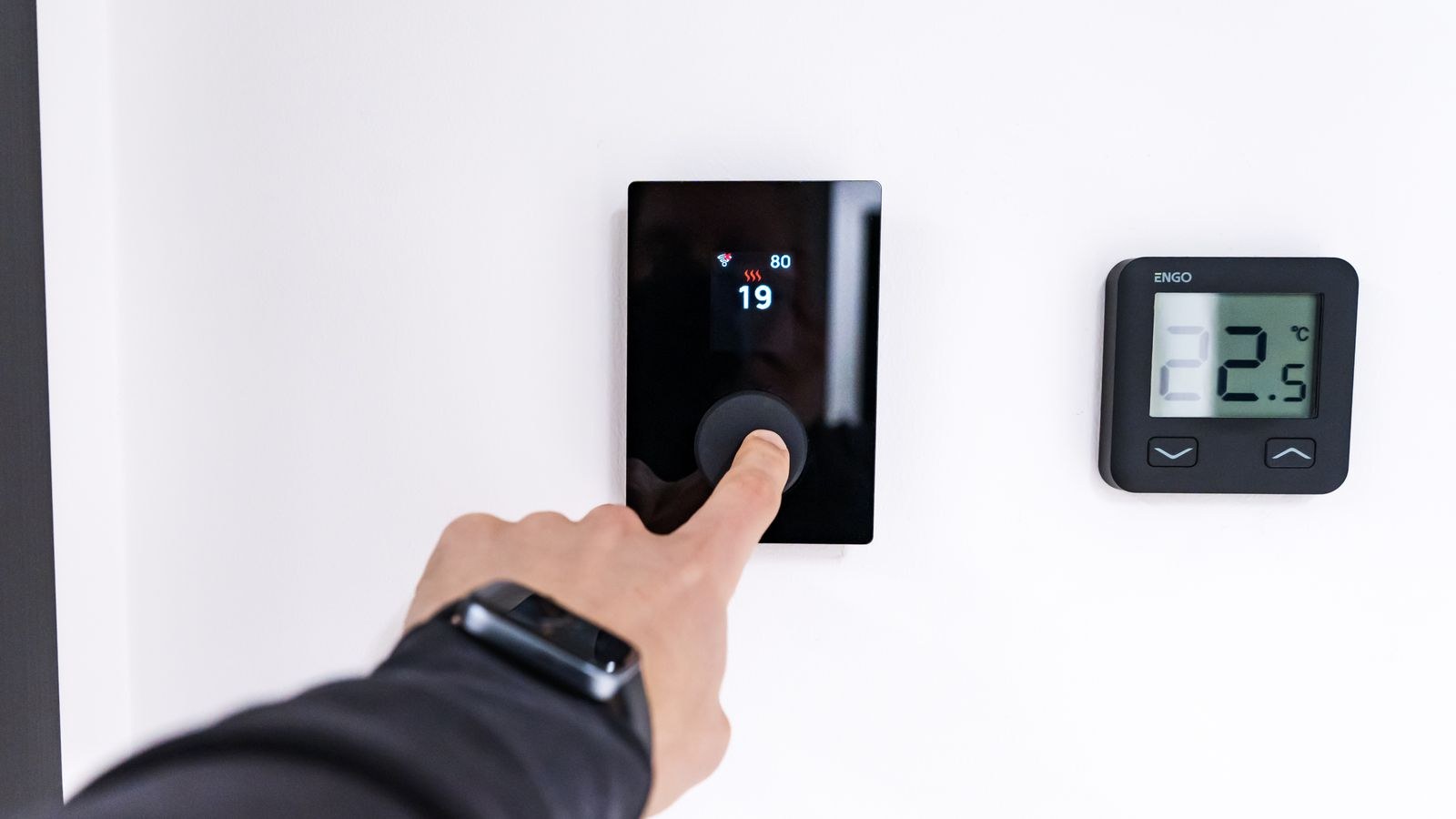
Lockouts and dual-fuel switching both depend on knowing the outdoor temperature. Thermostats get this either from an internet weather service tied to your postal code or from a wired outdoor sensor. Internet data is convenient and adequate for most homes, but it reflects a regional station rather than your property. If you live in a valley, at altitude, or somewhere microclimates differ sharply from the nearest reporting station, a wired sensor makes the lockouts far more accurate.
Staging: Single, Two-Stage and Variable Speed
Older heat pumps are single stage, meaning the compressor is either on or off. Two-stage units run at a low output most of the time and shift to high only when needed, which is quieter and more efficient. Variable-speed or inverter-driven systems modulate continuously across a wide range.
Your thermostat must match. A single-stage thermostat on a two-stage system will only ever use one stage, wasting the equipment’s efficiency advantage. Variable-speed systems are the strictest case: many are communicating systems that talk to a proprietary control over a data bus, and they simply do not accept third-party thermostats. Check your outdoor unit’s model documentation for the phrase communicating or the manufacturer’s own control system name before shopping.
Scheduling Strategy for Heat Pumps
Deep setbacks are counterproductive with heat pumps. Dropping the temperature eight degrees overnight sounds efficient, but the recovery almost always summons auxiliary heat, and the extra electricity consumed in that hour can exceed everything the setback saved.
Use shallow setbacks of two to three degrees, and rely on smart recovery so the system starts warming gradually well before you wake. Let the thermostat run longer cycles rather than sharp bursts. In cooling season heat pumps behave like conventional air conditioners, so normal setback logic applies and you can be more aggressive. Broader comparisons across cooling-focused models in our best AC thermostats guide are useful if summer performance is your main concern.
Room Sensors and Comfort Balance
Heat pumps deliver air at a lower temperature than furnaces, typically warm rather than hot. That makes even distribution more important, because a room at the end of a long duct run will feel the difference sooner. Remote room sensors let the thermostat average several rooms or prioritise occupied ones, which addresses the most common complaint about heat pump comfort.
Models with mature sensor ecosystems handle this best, and the best ecobee thermostats are a common recommendation for exactly this reason. If your home heats evenly you can skip sensors, but in a multi-storey house with a single zone they are usually the highest-value upgrade available.
Installation and Wiring Considerations
Heat pump systems use more conductors than conventional ones, which has a practical consequence: you are less likely to find a spare wire available to convert into a common wire. Between R, Y, G, O/B, AUX and C you may already be using every conductor in the cable.
Check your terminal block before buying. If there is no C wire and no spare, plan on either a power extender module installed at the air handler or new cable. Also confirm whether your system uses O or B for the reversing valve, since selecting the wrong one during setup produces the classic symptom of cooling when you asked for heating. Photograph the wiring before disconnecting anything and label each wire with its terminal letter.
Common Mistakes to Avoid
The most expensive mistake is leaving auxiliary heat unconstrained. The second is programming furnace-style deep setbacks, which trigger the first. The third is buying a thermostat that supports fewer stages than your equipment provides, effectively downgrading a two-stage system to single stage.
Two more deserve mention. Running the system in emergency heat mode all winter because it warms the house faster is a costly habit; emergency heat exists for compressor failure, not convenience. And ignoring filter and outdoor coil maintenance undermines everything, because a restricted airflow path makes the heat pump underperform and pushes the thermostat toward backup heat regardless of how well it is configured.
Frequently Asked Questions
Will any smart thermostat work with a heat pump?
No. It must support the reversing valve and auxiliary heat terminals and let you configure O versus B. Many mainstream models do, but confirm heat pump support is listed explicitly rather than assuming it.
Why does my auxiliary heat run so often?
Usually because setbacks are too deep, no aux lockout is configured, or airflow is restricted. Start by shortening the setback and setting a lockout temperature, then check the filter and outdoor coil.
Should I use emergency heat in cold weather?
Only if the heat pump has failed. Modern units continue producing useful heat well below freezing, and running emergency heat by choice means paying resistance-heating prices for the whole season.
Do I need an outdoor sensor?
Not usually. Internet weather data drives lockouts accurately enough for most homes. A wired sensor is worth it if your local conditions differ noticeably from the nearest weather station or you run a dual-fuel system.
Can I control a mini-split with a wall thermostat?
Often not directly. Ductless mini-splits typically use their own infrared or proprietary control, and adding a wall thermostat requires a compatible interface module. Check with the manufacturer before assuming a standard thermostat will work.
Final Thoughts
Choosing a thermostat for a heat pump comes down to four checks: correct terminals for your reversing valve and backup heat, matching stage support, auxiliary lockout control, and dual-fuel handling if you have a furnace as well. Get those right and comfort and running costs both improve. Get them wrong and the system will work, but expensively.
Take the photograph of your terminal block, list your stages, then compare candidates. Our wider selection of the best smart thermostats covers every system type, and the complete smart thermostat buying guide explains the remaining features once compatibility is confirmed. Verify first, then buy, and your heat pump will run efficiently through 2026 and beyond.