Owen Bradley
 A ceiling fan with an integrated light does two jobs from one ceiling box, which is why it dominates bedrooms, living rooms and dining spaces in homes without dedicated lighting circuits. It is also the reason so many rooms end up with mediocre airflow and worse lighting. Combining the two functions forces engineering compromises: the light housing takes up motor space, the blades chop the beam, and the fixture is usually mounted where the fan wants to be rather than where the light should be. This guide explains how to choose a combined unit that does both jobs properly rather than neither.
What You Gain and What You Give Up
The case for a combined fixture is straightforward: one ceiling outlet, one installation, one switch run, and a coordinated appearance instead of a fan and a pendant competing for the same ceiling. In rooms with a single central box, it is often the only way to get both airflow and light.
The compromises are real too, and worth knowing before you buy.
- Light output is usually modest. Integrated fixtures rarely match a dedicated ceiling light, so the fan light often needs supplementing with lamps.
- Flicker and strobing. Blades passing under the light source create a moving shadow pattern that some people find genuinely uncomfortable.
- Height cost. A light housing hangs below the motor, reducing headroom in rooms that may not have much to give.
- Airflow compromise. Motor and blade design is constrained by the need to accommodate a light module.
- Repairability. An integrated LED array that fails often cannot be replaced without swapping the whole light kit.
None of these is disqualifying, but each one points to a specification you should check. Comparisons across the category are in our best ceiling fans with lights guide.
Light Kit Types: Integrated, Modular and Uplight
- Integrated LED: the LED array is built into the fixture, often behind a frosted lens in the housing. Slim, efficient, evenly diffused, and usually dimmable. The drawback is that the array cannot be replaced by a bulb swap, so lifespan is the fixture’s lifespan.
- Modular bulb kits: conventional sockets taking standard, candelabra or globe bulbs behind a glass shade. Less sleek, but you control colour temperature, brightness and CRI simply by choosing the bulb, and any failure is a cheap fix.
- Uplight and downlight combinations: some fixtures add an upward-facing light that bounces off the ceiling, producing soft indirect ambient light with no glare and no blade shadow. Excellent for bedrooms.
- Bowl and drum shades: a diffusing enclosure below the motor. Good even light, but adds several inches of drop.
- Spotlight-style kits: individually aimable heads. Flexible but shadow-prone and visually busy.
Modular kits deserve more credit than they get. Being able to fit a 2700K high-CRI bulb of your choosing is a real advantage over a fixed integrated array, and the best light bulbs for ceiling fans guide covers the shapes and bases that fit these fixtures.
Airflow: Do Not Let the Light Distract You
It is easy to shop a combined fixture on looks and light output and forget that the primary job is moving air. The number to compare is CFM, cubic feet per minute, ideally alongside the efficiency figure of CFM per watt.
Rough guidance by room size:
- Up to 100 square feet: a 29 to 36 inch fan, around 1500 to 3000 CFM.
- 100 to 200 square feet: 42 to 48 inches, roughly 3000 to 4500 CFM.
- 200 to 400 square feet: 52 to 56 inches, roughly 4500 to 6000 CFM.
- Over 400 square feet: 60 inches or larger, or two fans.
Blade pitch matters too. A pitch between 12 and 15 degrees moves air effectively; shallower blades look elegant and move very little. Motor type is the other big variable: DC motors are quieter, more efficient, offer more speed steps and usually reverse at the touch of a button, while AC motors are cheaper and simpler.
Blade Flicker and How to Avoid It
The most common complaint about lit fans is the strobing shadow as blades cross the light. It is caused by a small, bright, concentrated light source directly above rotating blades.
Four things reduce or eliminate it:
- A large diffused emitting surface. A wide frosted lens casts soft-edged shadows instead of hard ones.
- A light source below the blade plane. If the light sits under the blades, nothing passes in front of it.
- Uplighting. Light bounced off the ceiling arrives from everywhere and cannot strobe.
- More blades. Five blades produce a higher shadow frequency that is less perceptible than three.
Avoid clear glass shades and exposed decorative bulbs on a fan for this reason. They produce the sharpest, most noticeable strobing of any configuration.
Room Height, Downrods and Clearance
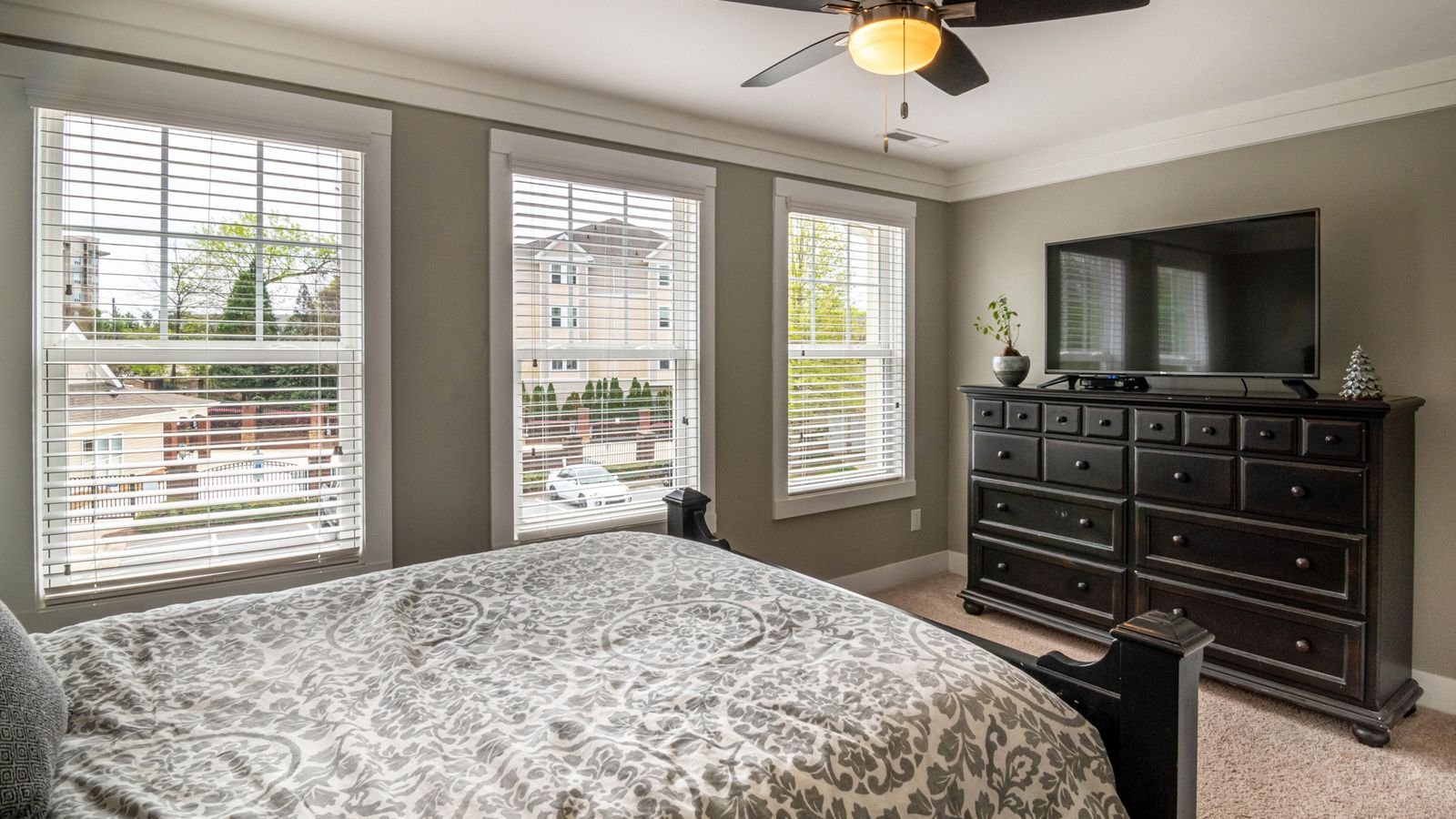
A light kit adds drop, so ceiling height planning matters more with a combined fixture. Blades should sit at least 7 feet above the floor, and ideally 8 to 9 feet for best airflow, with at least 10 inches between blades and ceiling so air can be drawn in from above.
- Under 8 foot ceilings: use a flush-mount or low-profile fan, and prefer an integrated slim light or an uplight over a hanging bowl shade.
- 8 to 9 feet: a standard short downrod works with most light kits.
- 9 to 12 feet: a longer downrod brings the fan into the occupied zone, where both airflow and light do more good.
- Above 12 feet: a long downrod and a fan with enough output to reach the floor.
Where headroom is tight, a hugger fan with a slim integrated light is usually the only sensible configuration, and the best low profile ceiling fans guide covers how much clearance different mounting styles need.
Bathrooms and Damp Locations
Bathroom fans with lights are a different product from a bedroom fan with a light. Two categories get confused: an air-circulating ceiling fan with a light kit rated for damp locations, and an extractor fan with a built-in light that ducts moist air outside.
If the goal is removing humidity, you need an extractor rated in CFM for the room volume, ducted outside rather than into the loft, and ideally with a humidity sensor. If the goal is air movement in a large bathroom, a circulating fan works but must carry a damp-location rating, or a wet-location rating anywhere near a shower. Never fit a standard dry-rated fan in a bathroom; the motor bearings and light housing are not sealed for it. See the best bathroom ceiling fans with lights guide for rated options.
Controls: Pull Chains, Remotes and Smart Fans
- Pull chains: cheapest and most reliable, but require reaching the fan and offer no dimming.
- Handheld remotes: the most common arrangement, giving separate fan speed and light dimming. Keep the receiver accessible for future replacement.
- Wall controls: a dedicated plate controlling both functions. Tidier and harder to lose than a remote, but needs the right wiring.
- Smart fans: app and voice control, schedules, and temperature-triggered speed changes. Convenient, though it adds a dependency on a hub or network.
One wiring caution: many combined fixtures use a single switched supply with the fan and light separated electronically inside. If you want independent wall switching for each, check the fixture supports it before buying, because retrofitting a second switched line means running new cable.
Budget Tiers
- Entry level: an AC motor fan with a basic integrated light and pull chains. Moves air adequately, light is functional, expect some noise at high speed.
- Mid range: a better AC or entry DC motor, a diffused dimmable light kit and a remote. The sensible tier for a main bedroom or living room, with noticeably lower noise.
- Premium: a DC motor with many speed steps, a high-CRI dimmable or tunable light, smart control and a quiet reversible operation. Efficient enough to run continuously and quiet enough to sleep under.
If noise is your main concern, the best and quietest ceiling fans comparison covers motor choices, and for sleeping spaces specifically the best ceiling fans for bedroom guide weighs airflow against sound.
Frequently Asked Questions
Do ceiling fan lights give enough light for a whole room?
Often not on their own. Treat the fan light as the ambient layer and add lamps or wall lights for task and accent lighting.
Can I replace the light kit on my fan?
Modular kits with standard sockets, yes, easily. Integrated LED arrays usually cannot be replaced individually, though some manufacturers sell a matching replacement module.
Why do the lights flicker when the fan is running?
Blade shadows crossing a concentrated light source. A wider diffuser, an uplight configuration or a light mounted below the blade plane all reduce it.
Are DC motor fans worth the extra cost?
In a bedroom or a fan that runs for long periods, yes. They are quieter, use noticeably less power and offer finer speed control.
Can I use a regular dimmer on a ceiling fan light?
Only if the manufacturer says so. Many fans use their own dimming electronics, and adding a wall dimmer upstream causes buzzing or damage.
Final Thoughts
Choose a combined fan and light by settling the airflow question first, because that is the part you cannot fix later. Size the blade span to the room, check the CFM figure, then pick a light kit that is well diffused, dimmable, and either below the blades or bounced off the ceiling. Respect the damp and wet ratings in bathrooms, plan the drop against your ceiling height, and accept that you will probably still want a lamp in the corner. Get those decisions right and one fixture will handle both jobs comfortably through 2026 and many summers after.