
 Sofia Marchetti
 Finding the best bathroom ceiling fans with lights means solving two problems at once: clearing moisture and odors from a small, humid room while providing bright, even illumination. A combination unit does both from a single ceiling opening, saving space and simplifying installation. Whether you are upgrading a noisy old exhaust fan or outfitting a new bathroom, choosing the right two-in-one model has a big impact on comfort, air quality, and your energy bills.
This buying guide explains what to look for in the best bathroom ceiling fans with lights, including airflow ratings, noise levels, lighting features, and installation considerations. Instead of rating individual units one by one, we focus on the specifications and features that determine whether a fan will actually keep your bathroom fresh and well-lit for years.

Pros
- Pick-A-Flow switch selects 50, 80, or 110 CFM airflow to match room size without buying a different model
- Flex-Z Fast Bracket mounts with a single hinge, so installation does not require attic access in most cases
- Built-in 10W LED light includes a low-power night-light mode alongside full brightness
- Energy Star-certified DC/ECM motor design targets lower running power than older AC-motor fans
- Compatible with both 4-inch and 6-inch ducting, giving flexibility for existing vent runs
Cons
- Ceiling cutout is fixed at 10.25 x 10.25 inches, so it will not drop into openings sized for smaller legacy fans without cutting drywall
- LED light is dimmable but not color-temperature adjustable, limited to whatever tone the fixture ships with
- Airflow tops out at 110 CFM, under the 150+ CFM some fans offer for larger bathrooms
The WhisperFit's Pick-A-Flow switch lets you set the fan to 50, 80, or 110 CFM at install time, matching output to the size of the bathroom it is venting rather than locking in one fixed CFM setting. A 10.25 x 10.25 x 5.6 inch housing sits above the ceiling, connecting to either 4-inch or 6-inch ductwork depending on what is already run through the attic or wall cavity.
- Selectable 50/80/110 CFM airflow via a single switch
- 10.25 x 10.25 x 5.6 inch housing dimensions
- Works with 4-inch or 6-inch duct sizes
Bathrooms larger than a typical half-bath may still want to size up, since 110 CFM is the ceiling on this unit.
Panasonic's Flex-Z Fast Bracket uses a single hinge point to position the housing, designed so installers can set the fan without climbing into the attic to access it from above in most retrofit situations. The bracket adjusts to fit standard ceiling joist spacing, and the housing accepts either duct size on hand, reducing the need to special-order fittings before starting the job.
- Single-hinge Flex-Z bracket simplifies positioning
- Designed for retrofit installs without full attic access
- Accepts 4-inch or 6-inch ducting on the same housing
The fixed 10.25-inch housing footprint means replacing a smaller existing fan cutout will likely require enlarging the ceiling opening.
A built-in 10W LED handles both general bathroom lighting and a dedicated low-power night-light mode, so the fixture can stay on overnight without the draw of a full-brightness bulb. The light is dimmable but runs at a single fixed color temperature. Combined with the fan's DC/ECM motor, designed for quieter, lower-power operation than older AC-motor units, the fixture carries Energy Star certification for its overall energy profile.
- 10W dimmable LED with a separate night-light mode
- DC/ECM motor for quieter, lower-draw operation
- Energy Star-certified as a combined fan and light unit
The light's color temperature is fixed, so it won't match fixtures elsewhere in the bathroom that use a different tone.

Pros
- Moves 110 CFM at just 1.0 Sones, quiet enough not to drown out conversation while running
- ENERGY STAR certified for efficient continuous operation in bathrooms up to 105 sq. ft.
- TrueSeal Damper Technology cuts air leakage by up to 50% versus competitive models, reducing cold air backdrafts
- Retrofit installation works entirely from the room side, so no attic access is needed
- Backed by a three-year limited warranty on the unit
Cons
- Single speed only, so there is no low setting for quick touch-ups versus a full humidity-clearing run
- Rated for rooms up to 105 sq. ft., so larger primary bathrooms may need a higher-CFM model or a second fan
- Housing depth of 5.75 inches requires enough ceiling joist clearance, which can complicate installs in shallow ceiling cavities
This exhaust fan moves 110 CFM of air while running at just 1.0 Sones, a noise level low enough to stay in the background rather than dominate the room.
- ENERGY STAR certification confirms the fan meets efficiency benchmarks for continuous bathroom ventilation.
- Rated to serve rooms up to 105 sq. ft., covering most full bathrooms in a single unit.
- TrueSeal Damper Technology reduces air leakage by up to 50% compared with competitive models, which cuts down on cold air pushing back through the vent.
Because it runs at a single speed, the 110 CFM output is fixed rather than adjustable for lighter touch-up jobs.
The fan is designed for retrofit, remodel and replacement installs, with the entire process handled from the room side so there is no need to access the attic.
- The SnapFit Flange Kit gives a self-trimming finish that covers a rough ceiling cutout cleanly.
- An EzDuct connector and FoldAway mounting ears are built in to handle a range of duct and joist configurations.
- Housing measures 12.25 x 12.25 x 5.75 inches, so the ceiling cavity needs to clear that depth before mounting.
Because it is UL listed for use over tubs and showers only when wired to a GFCI-protected circuit, that circuit requirement is worth checking before installation.
The fan carries UL listing for installation over bathtubs and showers on a GFCI-protected circuit, plus UL listing for use in insulated ceilings (type I.C.) and HVI-2100 certification for safety.
- ENERGY STAR certification applies to the fan's continuous power draw during normal operation.
- Coverage is rated for bathrooms and similar rooms up to 105 sq. ft., which fits most standard-size bathrooms.
- A three-year limited warranty backs the unit against defects.
Larger primary bathrooms or combined bath-and-closet spaces beyond 105 sq. ft. may need a higher-CFM model or a second fan to keep clearing air effectively.

Pros
- HIGH-QUALITY BATH FAN, LIGHT, AND HEATER COMBO: Exhaust Fan, light,
- DESIGN: White grille and modern design complement virtually any
- LED : Integrated, dimmable LED light with CCT color control can be
- HEATER: Equipped with a powerful 1300-watt heater provides
- Dimensions of 8.25"D x 14.25"W x 5.87"H engineered for optimal spatial fitting
Cons
- Requires verifying placement clearance for 8.25"D x 14.25"W x 5.87"H prior to installation
- Requires gentle maintenance routines to preserve the Alloy Steel finish
Integrating thoughtful design principles, the Broan-NuTone Broan-NuTone Bathroom Exhaust Fan with Heater Quiet 1.5 enhances daily routines within Ventilation Fans areas. From an operational perspective, this model emphasizes key capabilities such as HIGH-QUALITY BATH FAN, LIGHT, AND HEATER COMBO: Exhaust Fan, light, and heater function independently or together to provide superior comfort in your bathroom at 80 CFM and 1.5 sones. The 80 CFM bathroom exhaust fan will remove excess moisture and humidity while keeping the room warm and comfortable while in use.. Additionally, the integration of DESIGN: White grille and modern design complement virtually any decor. This durable modern look will be a reliable bath fan for years to come. Keep your bathroom smelling and looking fresh with reduced moisture and clear mirrors. enhances overall usability during continuous activity. Measurements of 8.25"D x 14.25"W x 5.87"H provide clear dimensional boundaries for precise space planning.
Structural analysis confirms an emphasis on long-term mechanical resilience and component stability. Designed for lasting service, the structure leverages LED : Integrated, dimmable LED light with CCT color control can be used as a convenient nightlight and allows you to choose between 3 color options. Warm white (2700K), Bright White (3500k) or Daylight (5000k) gives you a variety of practical options. You will be able to adjust the color tempurature to match the lighting. to minimize mechanical stress. Advanced joint reinforcement guards against structural sagging or premature joint wear. Constructed using quality Alloy Steel, outer surfaces withstand routine contact without losing visual appeal.
Following practical maintenance guidelines ensures the unit retains its performance properties. Highlighting HEATER: Equipped with a powerful 1300-watt heater provides efficient heating throughout any room. This bathroom exhaust fan will quickly heat your space when you desire. Feel the hear, the instant you flip the switch. The heat will be delivered consistently and you will be able to enjoy your shower in a warm and peaceful environment!, initial assembly and positioning remain straightforward using basic tools. Gentle surface cleaning with non-abrasive tools keeps outer materials looking clean and pristine. Robust physical construction provides verified peace of mind during heavy daily usage.

Pros
- 【Easy Room-Side Installation — Fits 11.81" × 11.02" Ceiling
- 【Automatic Humidity Control After Every Shower】The built-in
- 【160 CFM & Ultra-Quiet 1.0 Sone】Powerful 160 CFM airflow quickly
- 【1500LM 3CCT Light & Night Light】Bright 1500lm LED light
- Dimensions of 13.1"D x 13.1"W x 8"H engineered for optimal spatial fitting
Cons
- Requires verifying placement clearance for 13.1"D x 13.1"W x 8"H prior to installation
- Requires gentle maintenance routines to preserve the Metal, Plastic finish
Tailored for residential and professional settings, the OREiN OREiN 3-in-1 Bathroom Exhaust Fan with Light Humidity addresses routine requirements effectively. Technical integration focuses on functional efficiency, incorporating 【Easy Room-Side Installation — Fits 11.81" × 11.02" Ceiling Opening】Please measure your existing ceiling opening before ordering to ensure a proper fit. Designed for easy replacement of existing bathroom exhaust fans entirely from inside the room—no attic access required. Fits 11.81" × 11.02" ceiling openings and is compatible with 6" or 4"duct systems (contact us if you need a 6" to 4" adapter). Includes a quick-mount bracket and step-by-step installation guide.. Its balanced engineering incorporates 【Automatic Humidity Control After Every Shower】The built-in humidity sensor automatically activates ventilation when humidity rises above 60%, helping remove excess moisture after every shower. Enjoy a fresher bathroom, clearer mirrors, and hands-free ventilation without worrying about forgetting to turn the fan on or off. A green LED indicator confirms humidity sensing mode is.
Evaluating build quality and structural execution reveals strong manufacturing standards across components. The physical build incorporates 【160 CFM & Ultra-Quiet 1.0 Sone】Powerful 160 CFM airflow quickly removes steam and odors while operating at just 1.0 sone for quiet everyday comfort. Ideal for bathrooms up to 160 sq.ft. and provides faster moisture removal in smaller spaces., providing essential protection against surface wear. High tolerance assembly prevents unexpected mechanical looseness during daily operation. Constructed using quality Metal, Plastic, outer surfaces withstand routine contact without losing visual appeal. Robust physical construction provides verified peace of mind during heavy daily usage.
Long-term operational satisfaction is supported by adhering to standard installation and cleaning practices. Thanks to 【1500LM 3CCT Light & Night Light】Bright 1500lm LED light illuminates the entire bathroom. Choose between 3000K, 4000K, or 5000K using the built-in switch. A soft 2200K night light provides comfortable low-level illumination for nighttime use. Dimmers and timer switches are not compatible., spatial alignment and initial setup progress smoothly for homeowners. Simple preventative care maintains mechanical responsiveness and aesthetic value over extended use. Robust physical construction provides verified peace of mind during heavy daily usage. Thoughtful spatial layout allows versatile placement across modern living environments.

Pros
- Rated 110 CFM, enough for bathrooms up to about 110 square feet per the sizing guide
- Runs at 2 sones, quieter than the 3-4 sone range typical of standard builder-grade fans
- 1000-lumen 5000K LED is bright enough for grooming tasks without a separate vanity light
- Installs from inside the bathroom with no attic access, using a 7.36 x 7.68-inch ceiling cutout
Cons
- Light is fixed at 5000K daylight, with no warm-white or adjustable color temperature option
- Fan and light need two separate wall switches, so single-switch bathrooms require added wiring
- 3-inch duct systems need the included reducer fitted first, since the housing's native outlet is 4 inches
Sized for small to mid-size bathrooms, this fan is rated at 110 CFM, which the manufacturer maps to spaces up to roughly 110 square feet, while running at a comparatively quiet 2 sones.
- Airflow: 110 CFM handles moisture removal for bathrooms up to about 110 sq ft.
- Noise level: rated at 2 sones, quieter than the 3-4 sone range common on standard builder-grade exhaust fans.
- Certifications: independently listed under HVI/FCC/ETL testing standards, with an energy-efficient LED and motor design.
Matching CFM to room size matters for actual performance: undersized fans in larger bathrooms will remove steam more slowly regardless of how low its sone number is.
Unlike fans that require attic access, this model installs entirely from inside the bathroom, which simplifies retrofits in homes where the attic space above the bathroom is finished, cramped, or otherwise hard to reach.
- Ceiling cutout: requires a 7.36 x 7.68-inch opening.
- Duct outlet: a standard 4-inch outlet is included, along with a 4-to-3-inch reducer for narrower duct runs.
- Switch wiring: fan and light operate on two separate switches, so single-switch bathrooms need an additional wiring run.
Because the reducer is included, both 4-inch and 3-inch duct systems are covered without buying separate adapter hardware, though the extra wiring for two switches is worth planning for ahead of installation.
Built into the same housing as the fan, the LED delivers 1000 lumens at a fixed 5000K daylight color temperature, bright enough for everyday grooming and makeup tasks without a dedicated vanity light.
- Brightness: 1000 lumens from the integrated LED panel.
- Color temperature: fixed at 5000K daylight white, with no dimming or color-adjustable option on this model.
- Control: the fan and light run on independent circuits, wired to two separate wall switches for separate on/off control.
Because the color temperature is not adjustable, anyone wanting a warmer tone for evening use will need to rely on a supplemental light elsewhere in the room.
Pros
- Rated at 70 CFM and 4.0 sones, covering bathrooms up to roughly 70 square feet
- Fan and light circuits wire separately, so either function can run independently of the other
- 4-inch round duct collar includes a built-in damper to block cold-air backdrafts when the fan is off
- Backed by a 1-year limited warranty
Cons
- Light bulbs are not included, requiring 2 separate type A19 bulbs up to 60W each
- 4.0 sone noise level is audible rather than silent, louder than premium bath fans rated closer to 1.0 sone
- Nickel finish and ribbed glass lens are the only style offered, with no alternate finish color
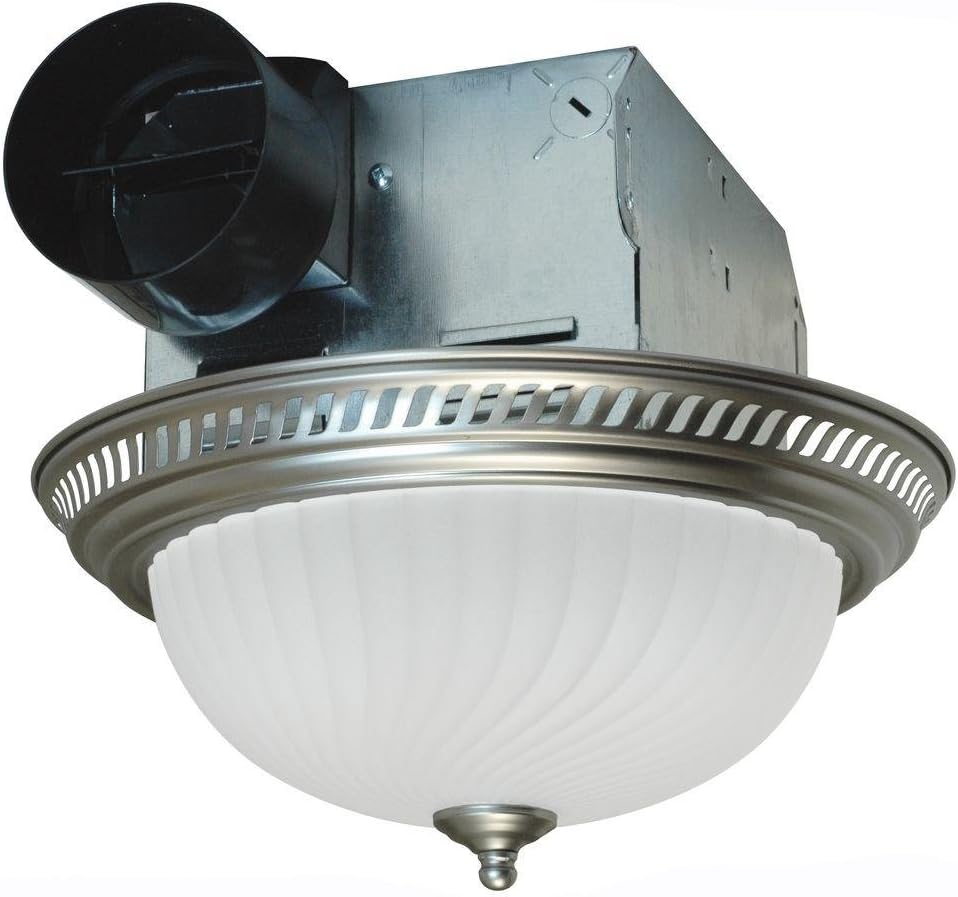
This fan moves air at 70 CFM with a 4.0 sone noise level, sized for bathrooms up to approximately 70 square feet. The 13-1/2 inch diameter nickel grill and frosted ribbed glass light lens are designed to look decorative rather than purely functional.
- 4.0 sones is audible during operation, not a whisper-quiet level
- Fan and light wire separately, so either can run on its own
- Includes a 4-inch round duct collar with a built-in damper
The built-in damper closes when the fan is off, helping block cold outside air from drafting back into the bathroom.
Installation uses either the included adjustable hanging brackets or the housing's mounting tabs, giving flexibility depending on your ceiling joist layout. Overall housing dimensions run 13.5 inches deep by 13.5 inches wide by 12 inches high, so confirming ceiling clearance beforehand is worthwhile.
- Adjustable hanging brackets accommodate different joist spacing
- Housing mounting tabs offer a second installation method
- Backed by a 1-year limited warranty on the unit
Because the fan and light are on separate circuits, wiring during installation needs two runs rather than one shared switch line, unless a single combined switch is used deliberately.
The fixture takes two type A19 medium-base bulbs up to 60 watts each, which are not included in the box. Light passes through a ribbed frosted glass lens for even, diffused illumination across the room rather than a harsh direct beam.
- Bulbs sold separately; standard A19 medium base fittings required
- Frosted ribbed glass lens diffuses light rather than casting a spotlight
- Nickel finish grill is the only color option in this listing
Since the light circuit runs independently from the fan, the bathroom light can stay on without the exhaust fan running at the same time.

Pros
- Runs at just 0.7 sones while moving 50 CFM, quieter than many exhaust fans rated closer to 1.5 to 3 sones
- Integrated LED delivers 900 lumens at 4000K with a rated 30,000-hour lifespan, well beyond a standard incandescent bulb
- No-cut ceiling mount design simplifies installation into an existing ceiling opening
- Backed by a 3-year limited warranty
Cons
- Rated for rooms up to roughly 50 square feet, so larger bathrooms need a higher-CFM model in the same product line
- Galvanized steel housing resists corrosion but is not rated for direct outdoor installation
- LED color temperature is fixed at 4000K cool white, with no warm white or adjustable tone option
This fan is rated at 0.7 sones while moving 50 CFM, positioning it toward the quieter end of the exhaust fan category, and it is sized for bathrooms up to approximately 50 square feet. The AC motor drives airflow through a 13 x 13 x 7 inch housing that connects to a 4-inch round duct.
- 0.7 sone level is noticeably quieter than many standard bath fans
- 50 CFM airflow suits small to mid-size bathrooms specifically
- Galvanized steel housing resists corrosion from ongoing moisture exposure
For larger bathrooms, Homewerks offers the same series in higher-CFM versions, so matching fan capacity to actual room square footage is worth checking before installation.
The no-cut design is built to install into a standard ceiling opening measuring 7.5 x 7.25 x 5.75 inches, without requiring an enlarged cutout. A 13-inch round grill covers the housing once mounted, and the unit connects to a 4-inch round duct for venting.
- No-cut ceiling mount simplifies swapping an existing fan
- 13-inch round grill matches the housing footprint for a clean finish
- Backed by a 3-year limited warranty on the unit
Because it is a ceiling-mount design rated for indoor use, it is not intended for exterior or unconditioned space installation.
The integrated LED delivers 900 lumens at a 4000K cool white color temperature, rated for a 30,000-hour lifespan that outlasts standard incandescent bulbs by a wide margin. This fixed color temperature suits detailed tasks like shaving or applying makeup that benefit from crisp white light.
- 900 lumens output at 4000K, with no warm white option available
- 30,000-hour rated LED lifespan reduces future bulb replacement
- Light and fan functions operate together as part of one fixture
Anyone preferring warmer ambient lighting in the bathroom should note the fixed 4000K tone, since this fixture does not offer an adjustable or swappable color temperature.

Pros
- [Easy Installation] Please confirm the dimensions first:
- [Whisper Quiet Fan] Running at just 0.9 sone (≈37dB), this fan
- [Custom Color Choice] Choose from 5 fixed color temperatures
- [Smooth Dimmable Light] Brightness adjusts smoothly from 10% to
- Dimensions of 8.5"D x 8.5"W x 5.5"H engineered for optimal spatial fitting
Cons
- Requires verifying placement clearance for 8.5"D x 8.5"W x 5.5"H prior to installation
- Requires gentle maintenance routines to preserve the Metal finish
Crafted with attention to functional details, the Amico Amico Bathroom Exhaust Fan with LED Light 80 CFM 0.9 Sones brings efficient performance to your Ventilation Fans. Daily usage reveals robust utility supported by [Easy Installation] Please confirm the dimensions first: 12.1”x12.1” grille, 8.8”x8.8” ceiling cutout, 4” duct (duct not included). No attic access is required for replacement, saving you valuable time and effort.. Complementing its primary framework, the design also incorporates [Whisper Quiet Fan] Running at just 0.9 sone (≈37dB), this fan delivers ultra-quiet performance for undisturbed relaxation and peaceful daily use. Enjoy consistent comfort and tranquility each time you use your bathroom. to optimize routine handling. Measurements of 8.5"D x 8.5"W x 5.5"H provide clear dimensional boundaries for precise space planning.
Focusing on material selection, this hardware is constructed to resist ongoing physical fatigue. Reinforced internal elements like [Custom Color Choice] Choose from 5 fixed color temperatures (2700K, 3000K, 3500K, 4000K, 5000K) before installation. Select the tone that best suits your decor and creates your desired bathroom ambiance. maintain steady operational balance under continuous use. Solid structural engineering allows the unit to maintain physical stability under load. Constructed using quality Metal, outer surfaces withstand routine contact without losing visual appeal. This balanced configuration fits smoothly into existing interior designs while maximizing efficiency. Quality craftsmanship supports long term satisfaction for residential and professional settings.
Maintaining optimal hardware conditions involves simple periodic inspection and spatial planning. Featuring [Smooth Dimmable Light] Brightness adjusts smoothly from 10% to 100% for complete flexibility. Use a soft nightlight for late-night visits or full brightness for makeup application, with no harsh transitions or flickering., ongoing operation remains intuitive across varied household routines. Wiping surfaces periodically with a soft cloth prevents dust accumulation in functional crevices. This balanced configuration fits smoothly into existing interior designs while maximizing efficiency. Quality craftsmanship supports long term satisfaction for residential and professional settings. User centered design choices streamline routine interactions and enhance practical convenience.

Pros
- Rated at just 1.5 sones, quiet enough to run continuously without dominating the room's ambient noise
- 80 CFM airflow covers bathrooms up to 75 sq ft, matching a standard-sized bathroom
- Integrated LED light is rated for 50,000 hours at 3500K, so it won't need a bulb change for years of typical use
- No-cut roomside installation means it can go into a retrofit without cutting drywall or accessing the attic
- ENERGY STAR certified, cutting energy consumption by about 50% versus standard bath fans, per the manufacturer
Cons
- Rated coverage tops out at 75 sq ft, so larger bathrooms would need a higher-CFM model to ventilate effectively
- LED color temperature is fixed at 3500K, with no warm or cool alternative built into this model
- SlideClip cover attachment is a proprietary design, so replacement covers likely need to come from Broan-NuTone rather than a generic universal part
This fan balances airflow capacity against sound output, both spec'd clearly by Broan-NuTone.
- Airflow: 80 CFM
- Noise level: 1.5 sones, described by the manufacturer as whisper-quiet
- Coverage: rated for rooms up to 75 sq ft
- ENERGY STAR certified, using roughly 50% less energy than a standard bathroom exhaust fan
At 1.5 sones, the fan is quiet enough to leave running for a while after a shower to fully clear moisture without becoming an annoyance, rather than the louder drone of many standard-grade bath fans. For a bathroom larger than 75 sq ft, a higher-CFM Broan-NuTone model would be the better match for effective moisture and odor clearing.
Broan-NuTone built this specifically around retrofit installs where attic access is limited or unavailable.
- No-cut roomside installation avoids cutting drywall or reaching the fan from above
- Housing dimensions: 7.5"D x 7.25"W x 5.75"H; cover dimensions: 9.5" x 9.5"
- SlideClip springless attachment lets the cover snap on and off without spring clips, simplifying both install and later cleaning
- CleanCover grille sits flush for a floating appearance against the ceiling
This installation approach is aimed squarely at renovation and replacement jobs in older homes, apartments, or any space where getting into the attic above the bathroom isn't practical — it trades some of the flexibility of a full attic-accessible install for a faster, less invasive retrofit process.
Both the fan and its integrated LED light are built around long service intervals rather than routine part replacement.
- LED light: rated for 50,000 hours at 3500K color temperature
- HVI certified for verified airflow and sound performance
- SlideClip cover design allows the cover to be removed for cleaning without tools or spring-clip fiddling
Because the LED is integrated rather than a swappable bulb, there's no ongoing bulb-replacement cost over the fan's working life, though it also means the light itself can't be upgraded or changed to a different color temperature later. Regular grille removal for dust cleaning, made easier by the springless SlideClip design, is the main maintenance task to keep airflow performance from degrading over time.

Pros
- 110 CFM airflow at 1.0 Sones noise level handles moisture removal in 110 sq ft bathrooms
- 1200 Lumens LED light with three selectable color temperatures (3000K–5000K) provides full-spectrum lighting
- No attic access required—ceiling mount installation fits standard 7.75×7.5-inch openings
- Galvanized steel construction resists corrosion from constant bathroom humidity
- Customizable dimming and auto-save feature retains last color temperature preference
Cons
- 4-inch duct diameter requires compatible ducting installation
- Color temperature settings only control via wall switch, no app or smart home integration
Fitop integrates bathroom ventilation and LED lighting into a single ceiling fixture for maximum space efficiency. The 110 CFM fan moves humid air efficiently while the 1200 Lumen LED floods the space with shadow-free illumination. Users adjust color temperature and brightness with a convenient wall switch control without fumbling for separate control panels. The quiet 1.0 Sones noise level permits normal conversation and undisturbed sleep despite continuous operation.
- 110 CFM airflow handles 110 sq ft bathrooms effectively and quickly.
- 1.0 Sones noise level allows normal conversation while fan operates.
- 1200 Lumens brightness provides uniform lighting without dark corners.
- Three color temperature options suit different times of day moods.
- Galvanized steel construction resists bathroom humidity corrosion.
Combined fixture saves ceiling space compared to separate fan and light installations.
The Fitop bathroom exhaust fan requires only standard ceiling cutout dimensions without any attic modifications or complications. Pre-assembled housing fits directly into 7.75×7.5-inch openings common in existing homes nationwide. Nail or screw directly to ceiling joists for secure permanent mounting within minutes of unboxing. The installation process remains simple enough for homeowners without professional HVAC experience.
- Ceiling opening requires only 7.75×7.5-inch square cutout dimensions.
- 4-inch duct diameter connects to standard flexible or rigid ducting materials.
- No need to cut roof sheathing or access difficult attic spaces.
- Lampshade measures 10.25×10.25 inches for complete ceiling coverage.
- Includes all mounting hardware and flexible ducting connectors.
Assembly takes under 30 minutes for homeowners comfortable with basic carpentry skills.
Three selectable LED color temperatures (3000K soft white, 4000K bright white, 5000K daylight) adapt lighting to any bathroom need or activity. The auto-save feature remembers your last selection, so the fixture returns to that color temperature automatically. Turning off for more than 7 seconds triggers automatic settings save without requiring manual adjustment each time. This intelligent feature prevents frustration from repeated setup after each shower cycle.
- 3000K soft white creates relaxing evening atmosphere and moods.
- 4000K bright white provides balanced visibility for morning grooming tasks.
- 5000K daylight simulates natural outdoor light for maximum clarity.
- Auto-save prevents repeated adjustment after every shower session.
- ETL certification confirms safety for wet bathroom environments.
Color temperature adjustment happens instantly without delays or warm-up cycles.
Why Ventilation and Light Belong Together
Bathrooms generate more moisture than any other room. Hot showers create steam that lingers on walls, mirrors, and ceilings, and over time that moisture leads to mold, mildew, peeling paint, and musty odors. A quality exhaust fan pulls that humid air outside, protecting both your health and your bathroom finishes.
Pairing the fan with an integrated light makes the fixture do double duty. Instead of separate ceiling penetrations for a fan and a light, one combination unit handles ventilation and general lighting together. That is especially valuable in smaller bathrooms and powder rooms where ceiling real estate is limited. The best bathroom ceiling fans with lights blend strong airflow, quiet operation, and clean, bright light into a single tidy fixture.
Understanding CFM: Sizing the Fan to Your Bathroom
The most important spec for any exhaust fan is CFM, or cubic feet per minute, which measures how much air the fan moves. Too little airflow and your bathroom stays humid; too much and you waste energy. The standard guideline is one CFM per square foot of bathroom floor space, with a minimum of 50 CFM.
- Small bathrooms (under 50 sq ft): A 50 CFM fan such as the Homewerks 50 CFM is usually enough.
- Standard bathrooms (50–100 sq ft): Look for 80 to 110 CFM. Models like the Broan-NuTone 80 CFM or the Fitop 110 CFM fit this range well.
- Large bathrooms (over 100 sq ft): Consider 110 CFM or higher, or an adjustable unit. The OREiN 160 CFM offers robust airflow for bigger spaces.
For bathrooms with a separate enclosed toilet or shower, add roughly 50 CFM for each fixture. Some newer fans offer selectable CFM, letting you dial in 50, 80, or 110 at installation, which is handy if you are unsure of your exact needs. A flexible model like the Panasonic WhisperFit lets you match airflow to the room after mounting.
Noise: Understanding Sones
Fan noise is measured in sones, and lower numbers mean quieter operation. A sone rating gives you a practical sense of how intrusive the fan will be.
- 0.5–1.0 sones: Very quiet, barely noticeable. Ideal for master bathrooms and en suites next to bedrooms.
- 1.0–2.0 sones: Quiet to moderate, fine for most bathrooms.
- 2.0+ sones: Noticeably louder; acceptable for guest baths but less pleasant for daily use.
If a peaceful bathroom matters to you, prioritize fans rated at or below 1.0 sone. Models like the Broan-NuTone 1 Sone keep noise low without sacrificing airflow. Interestingly, quieter fans often encourage people to actually run them long enough to clear the moisture, since a loud fan is one you switch off too soon.
Lighting Features to Look For
Since these units light your bathroom, the lighting quality deserves as much attention as the fan.
Brightness and Color Temperature
Look at the light output in lumens; roughly 800 to 1,500 lumens covers most bathrooms. Color temperature matters too. Many people prefer a bright, neutral-to-cool light around 4000K to 5000K for grooming tasks, while others like a warmer tone. Adjustable color temperature, sometimes labeled CCT or 3CCT, lets you switch between warm and cool. A selectable-color model like the Amico 5CCT Fan Light or the Broan-NuTone 3CCT with Heater gives you that flexibility.
Dimmability and Night Lights
Some fixtures offer dimmable lighting, so you can lower the brightness for a relaxing bath or a late-night visit. Others include a built-in night light for gentle overnight illumination. A dimmable option like the Panasonic WhisperFit adds welcome control over the mood of the room.
Bonus Features Worth Considering
Humidity and Motion Sensors
Smart fans can turn themselves on when humidity rises and off once the air clears, so you never have to remember. A humidity-sensing model like the OREiN 3-in-1 with Humidity Sensor is especially useful in shared or high-traffic bathrooms where moisture control might otherwise be neglected.
Built-In Heaters
In colder climates, a fan with an integrated heater takes the chill off stepping out of the shower. The Broan-NuTone with Heater combines ventilation, light, and warmth in one fixture, which can be a comfortable upgrade for winter mornings.
ENERGY STAR Certification
An ENERGY STAR rating signals the fan meets efficiency standards, moving more air per watt. Over years of daily use, that efficiency translates into lower electricity costs and a quieter, better-built motor in most cases.
Run-On Timers and Delay Features
Some fans include a delayed shut-off that keeps the fan running for several minutes after you flip the switch, ensuring all the lingering steam clears out even after you leave the room. This small feature makes a real difference for moisture control, because much of the humidity from a shower stays airborne after you finish. A timer-equipped or humidity-sensing model removes the guesswork of how long to run the fan, protecting your walls, paint, and grout from the slow damage that damp air causes over time. For households where family members tend to shut the fan off too early, this kind of automation is one of the most practical upgrades you can choose.
Installation: Retrofit vs. New Construction
How you install the fan depends largely on your ceiling access. This is where many shoppers get tripped up, so plan before you buy.
Easy Retrofit Models
If you are replacing an existing fan and have no attic access above the bathroom, look specifically for retrofit-friendly units designed to install from below the ceiling. Models advertised as needing no attic access, like the Broan-NuTone Easy Retrofit or the Broan-NuTone Retrofit, are designed to fit into existing housings or mount without crawling into the attic.
Ductwork and Venting
Check the duct size the fan requires, commonly 4 inches, and make sure it matches or can adapt to your existing ductwork. Critically, the fan should vent to the outdoors, not into an attic or wall cavity, where dumped moisture would cause the very mold problems you are trying to prevent. A traditional round unit like the Air King Round Bath Fan can be a good fit when you are matching an existing circular opening.
Electrical Considerations
Fans with heaters or multiple functions may need dedicated wiring or additional switches. If your unit has separate controls for the fan, light, and any heater, you will want a compatible switch plate. When in doubt, especially with heater models or new wiring, hire a licensed electrician.
Coordinating With the Rest of Your Home
A bathroom fan is one piece of a larger comfort picture. If you are also thinking about airflow in living and sleeping areas, our guides to the best ceiling fans with lights and the best bedroom ceiling fans with lights cover full-size combination fans for larger rooms. For a focused look at ventilation options specifically, our roundup of the best bathroom ceiling fans dives deeper into exhaust performance, and our best ceiling fans overview helps you compare styles across the house.
Frequently Asked Questions
What CFM do I need for my bathroom?
Use about one CFM per square foot of floor area, with a 50 CFM minimum. A typical 8-by-10-foot bathroom needs around 80 CFM, while larger bathrooms or those with enclosed toilets benefit from 110 CFM or more.
How quiet should a bathroom fan be?
Aim for 1.0 sone or lower if you want near-silent operation. Anything under 1.5 sones is comfortable for most bathrooms, while ratings above 2.0 sones can feel intrusive during daily use.
Can I install one of these without attic access?
Yes. Many modern units are specifically designed for retrofit installation from below the ceiling, requiring no attic access. Look for that language in the product description, and confirm the housing and duct size match your setup.
Do I need a fan with a heater or humidity sensor?
Those are optional upgrades. A heater is worthwhile in cold climates, and a humidity sensor is convenient in busy bathrooms where the fan might otherwise be forgotten. Neither is essential if you are diligent about running the fan after showers.
Final Thoughts
The best bathroom ceiling fans with lights combine adequate CFM for your room size, quiet operation under 1.5 sones, and bright, ideally adjustable lighting. Beyond those essentials, features like humidity sensors, built-in heaters, and easy retrofit installation can make a good fixture great for your specific situation. Measure your bathroom, check your ceiling access and ductwork, and match the fan’s airflow and noise rating to your needs. Do that, and you will end up with a fixture that keeps your bathroom bright, dry, and comfortable for many years.


