Owen Bradley
 A premium office chair that cost well over a thousand dollars new can often be found secondhand for a fraction of that, which makes buying a used office chair one of the best value moves in home office furnishing. It is also one of the easiest ways to inherit somebody else’s problem. Chairs wear in predictable places, and some of that wear is a cheap fix while some of it means the chair is finished. The difference between a bargain and a mistake comes down to a fifteen-minute inspection you can run in a warehouse, a garage, or someone’s driveway. This guide gives you that checklist, explains which faults are worth fixing, and shows how to judge a fair price in 2026.

Why the Used Market Is Worth Your Time
Commercial office chairs are built to survive a decade or more of daily eight-hour use by rotating occupants. When a company downsizes, relocates, or refits, hundreds of those chairs enter the secondhand market at once, often after only two or three years of service. That is early in the life of a chair engineered for ten. The same money that buys a mediocre new consumer chair frequently buys a genuinely high-end used one with most of its service life intact.
The catch is that the used market has no quality control. You are looking at chairs that were abused in a call center next to chairs that sat in a rarely used meeting room, and the price often does not distinguish between them. Your inspection is the quality control, which is why it pays to know exactly what to check. If you want a sense of what the high end looks like when it filters down, the models covered in our roundup of the best executive office chairs are exactly the sort that appear secondhand at heavy discounts a few years after release.
Test the Gas Cylinder First
The gas lift cylinder is the single most common failure on a used chair, and it is the first thing to check because a bad one is obvious in thirty seconds. Raise the seat to its highest position, then sit down firmly and stay there for a minute or two. A failing cylinder sinks slowly under body weight, sometimes so gradually that you notice only when the seat is suddenly two inches lower than where you set it.
Also check the reverse: press the lever with no weight on the seat and confirm the chair rises smoothly and fully. A cylinder that will not lift, or that lifts only partway, has lost gas pressure. Look at the exposed chrome shaft for oil residue, pitting, or scoring, all of which point to a leaking seal. The good news is that cylinders are a standardized part on most chairs and are inexpensive to replace, so a sinking seat is a bargaining point rather than a deal-breaker, as long as you confirm the model uses a standard taper fitting.
Assess the Foam and Upholstery
Seat foam is where a chair’s comfort lives and dies, and it degrades invisibly. Press down hard on the center of the seat with the flat of your hand. Good foam resists, compresses partway, and springs back promptly. Dead foam compresses almost to the hard base with little resistance and returns slowly or not at all. Then sit on it for several minutes and see whether you can feel the seat pan through the cushion, particularly at the sitting bones.
Look for a visible depression or “dishing” in the seat surface, which indicates thousands of hours in the same spot. Check the front edge too, since that is where foam collapses first from users perching forward. On the backrest, press into the lumbar area and check for the same collapse. Reupholstery and refoaming are possible but usually cost enough to erase the savings unless you do the work yourself. Treat significantly dead foam as a reason to walk away or to negotiate hard.
For upholstery, distinguish cosmetic from structural. Stains and light scuffs are cosmetic. Splits along seams, torn mesh, worn-through fabric at the front edge, or cracked and flaking leather are structural, because they will spread. A mesh seat or back with any tear is effectively finished, since mesh cannot be patched and replacement panels are rarely available.
Work Through Every Mechanism
The tilt mechanism is the expensive part of a chair and the hardest to replace, so test it thoroughly.
- Recline. Lean back through the full range. It should move smoothly with no grinding, sticking, or sudden give.
- Tension. Turn the tension knob from minimum to maximum and confirm the resistance actually changes. A knob that spins freely or has no effect indicates a stripped or broken adjuster.
- Tilt lock. Lock the recline in each available position and lean back hard. It must hold without slipping.
- Seat height lever. Operate it several times; it should engage crisply, not require wiggling.
- Seat depth slider. If fitted, move it through the full travel and check it locks at each stop.
- Lumbar adjustment. Move it up, down, and forward if it adjusts, and confirm it stays where you put it rather than sliding under pressure.
Listen while you do all of this. Creaks and clunks sometimes mean a loose bolt you can tighten, but a metallic grinding from inside the mechanism housing usually means worn internal parts, and mechanisms are rarely sold separately. A chair with a failing tilt mechanism is worth only its parts value.
Check the Base, Casters, and Armrests
Turn the chair over. The five-star base takes enormous stress and cracks fail suddenly. Inspect each arm of the base, especially where the arms meet the central hub and where the casters insert, looking for hairline cracks in nylon bases or bends and weld failures in metal ones. A cracked base is dangerous and should end the inspection.
Casters are trivially cheap and almost always replaceable, so worn or seized wheels are a non-issue on price. Do check that they are all the same type and that none are missing.
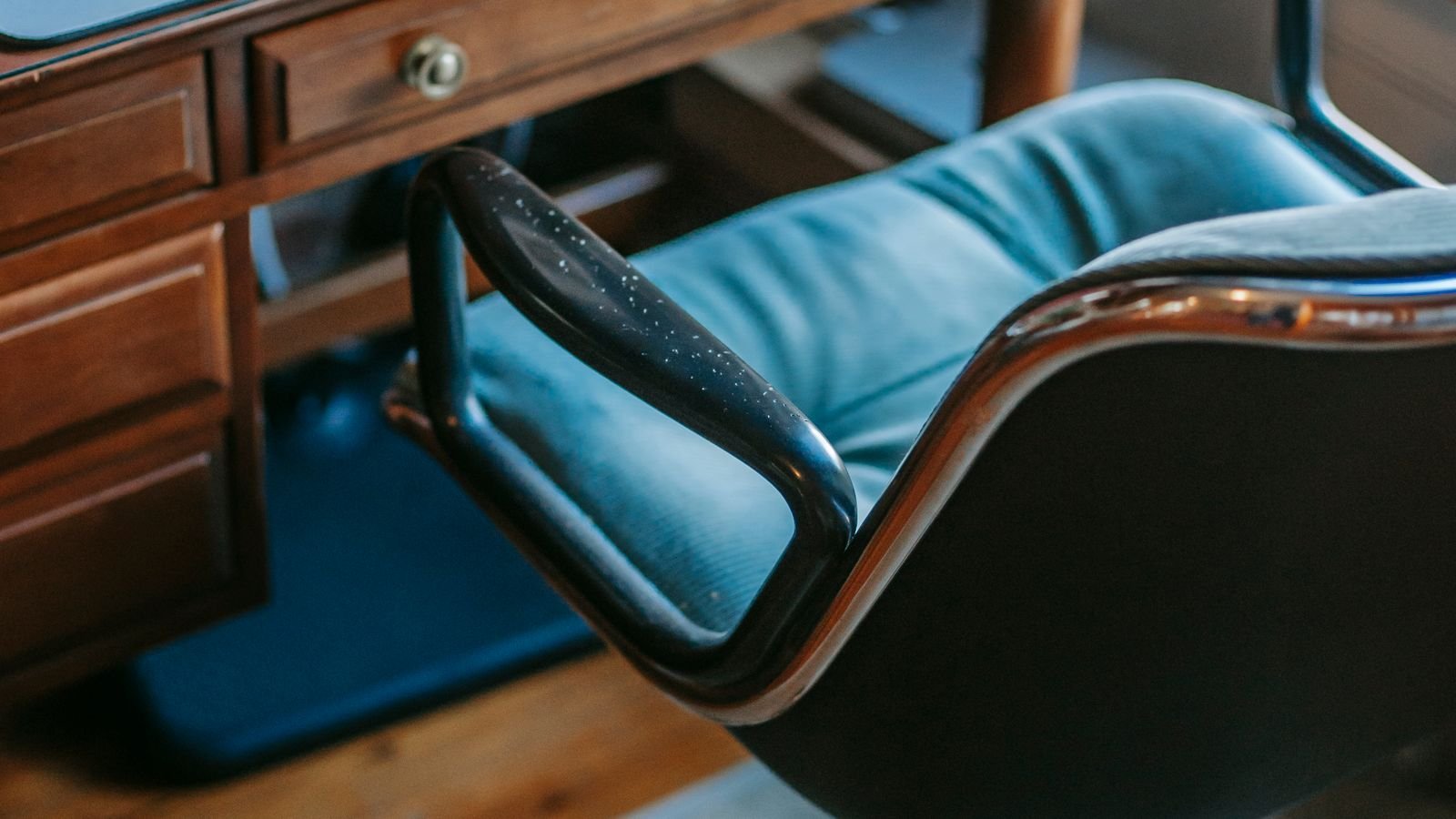
Armrests are a different story. Press down and pull up on each one, then push sideways. Excessive flex, a wobbling column, or a pad that will not hold its height means worn internal guides, and arm assemblies are often model-specific and expensive when available at all. Cracked or heavily worn arm pads are cosmetic but replacement pads for older models can be difficult to source, so factor that in.
Faults Worth Fixing Versus Faults Worth Avoiding
- Worth fixing: failing gas cylinder, worn or seized casters, loose bolts, dirty upholstery, missing arm pads on a common model, a sticky height lever.
- Negotiate hard: partially collapsed seat foam, stained but intact fabric, a stiff but functional tilt mechanism, scuffed but sound base.
- Walk away: cracked base, torn mesh, grinding or slipping tilt mechanism, deeply collapsed foam with a hard base underneath, a bent seat pan, or any structural weld failure.
The rule of thumb is simple: standardized bolt-on parts are cheap and easy, while anything molded, welded, upholstered, or model-specific is not. Price the repair before you buy, not after.
Where to Buy and What to Expect
Office liquidators and used furniture dealers offer the widest selection, usually inspect and clean their stock, and sometimes provide a short warranty. Prices are higher than private sales but the risk is lower. Private sales through classified listings offer the lowest prices and the highest risk, since you get one look and no recourse. Insist on running the full checklist before money changes hands. Refurbished chairs from specialist sellers sit in between: they have had cylinders, casters, and sometimes foam replaced, and cost more than raw used stock but far less than new. The same trade-off appears across other categories of used equipment, and our look at the real difference between refurbished and new desktop computers covers how professional refurbishment changes the risk calculation.
What a Fair Price Looks Like
As a rough framework, expect to pay around 20 to 35 percent of the original retail price for a well-known premium chair in good working order with normal cosmetic wear, and 35 to 50 percent for a professionally refurbished example with a warranty. Anything below 20 percent usually means an unverified condition or a chair needing parts. Above 50 percent, you should ask why you would not simply buy new with a full warranty.
Always look up what the model sold for new and what a replacement cylinder and set of casters cost for that specific chair, since those two figures determine your real total. It also helps to know what your money buys new at the same budget, and our desk chair budget guide is a useful benchmark for that comparison before you commit to the used route.

Cleaning and Refreshing What You Bring Home
Budget an hour of work on arrival. Vacuum the upholstery, treat fabric with an upholstery cleaner, and let it dry fully. Wipe hard surfaces with mild detergent, clear wound hair from the caster axles, then tighten every accessible bolt, since most creaking on a used chair comes from loosened fasteners rather than worn parts.
Common Mistakes Buyers Make
- Buying without sitting in it. Photos hide dead foam, sinking cylinders, and slipping mechanisms completely.
- Ignoring the base. It is the one component whose failure can injure you, and it takes ten seconds to check.
- Assuming parts are available. Cylinders and casters usually are; arms, mechanisms, and mesh panels often are not.
- Paying premium prices for a premium name. A worn-out top-tier chair is worth less than a sound mid-range one.
- Forgetting the size question. A chair built for a taller user will not suit a shorter one no matter how good the deal is.
- Skipping the tension test. A tilt tension adjuster that does nothing is a mechanism fault hiding in plain sight.
Frequently Asked Questions
How old is too old for a used office chair?
Age matters less than use and condition. A ten-year-old chair from a lightly used meeting room can be in better shape than a three-year-old one from a shift-work call center. Judge foam, cylinder, and mechanism condition rather than the year of manufacture, but be aware that parts availability drops sharply past about fifteen years.
Can I replace the gas cylinder myself?
Usually yes. Most office chairs use a standard taper fitting, and removal typically needs a rubber mallet and some patience. Confirm the diameter and stroke length match your chair before ordering, and check whether the model uses a proprietary cylinder before committing to the purchase.
Is a used premium chair better than a new budget one?
Often, yes, provided the used chair passes inspection. Commercial-grade frames, mechanisms, and adjustment ranges are considerably better than what a low new budget buys. Comparing against the field in our roundup of the best ergonomic office chairs makes the gap clear, since the used market puts those adjustment features within reach of a budget that would otherwise buy a fixed-arm task chair.
Should I worry about hygiene?
Not unduly. A thorough vacuum, an upholstery clean, and a wipe-down of hard surfaces handles ordinary office use. Avoid chairs with visible mold, persistent odors, or water damage, since those problems live in the foam and cleaning the surface will not remove them.
What if I cannot test the chair in person?
Buy only from a seller offering returns or a warranty, and ask for photos of the base underside, the cylinder shaft, the seat surface under angled light, and each armrest. If the seller cannot or will not supply those, treat the purchase as a gamble and price it accordingly.
Final Thoughts
Buying a used office chair rewards patience and a systematic eye. Test the cylinder, press the foam, work every mechanism, check the base, and price the parts you would need before you agree on a number. Chairs that fail on cylinders or casters are cheap fixes and good bargains; chairs that fail on the base, the mechanism, or the foam are somebody else’s problem and should stay that way. Do the fifteen-minute inspection every time, compare the asking price against what the same budget buys new, and the secondhand market will hand you a commercial-grade chair for a home-office price. Approached carefully in 2026, it remains the single best value in office furniture, and our overview of the best office chairs is a useful reference for knowing which models are worth watching for when they appear.