 Sofia Marchetti
This page is for anyone who sits at a desk most of the day and wants proper adjustment without paying premium-chair prices. Most of the picks are under $200. One costs a few dollars more. The cheapest is under $30.
On a budget, two things matter most. The first is lumbar support you can move to where your lower back actually curves. The second is a seat height range that lets your feet rest flat while your elbows sit level with the desk. Extras like headrests, rocking modes and flip-up arms come after those two.
The same advice applies whether you call it an ergonomic office chair or an ergonomic desk chair. The labels are interchangeable. The spec sheet is what tells them apart.
How we chose
- Lumbar type: adjustable lumbar ranked above a fixed curve, and two-way adjustment ranked above up-and-down only.
- Seat height range: we favored listings that publish a range, so you can check it against your desk before buying.
- Weight rating: every pick lists a maximum weight. Most are rated at 300 lb or more.
- Price tier: mostly under $200, with one stretch pick just above it for people who want more adjustment.
- Warranty and certifications: a stated warranty or BIFMA/SGS claim counted in a chair’s favor.
These picks are based on manufacturer specs and owner reviews, not hands-on testing. You can read more about how we research chairs.
Quick picks
- Best overall on a budget: XXISHE Ergonomic Desk Chair — height-adjustable lumbar, a published 17.72–22.44 in seat height range and a 300 lb rating.
- Best with a headrest: CASASIO 2307H — 3D headrest, two-direction lumbar and a 350 lb rating.
- Best warranty: Zeonsit 8188 — adjustable lumbar, 330 lb rating and a listed 5-year warranty.
- Most adjustable: ELABEST 1096M — 3D armrests, three-position recline lock and adjustable lumbar.
- Best under $100 with a headrest: HAPPYMONT Desk Chair — headrest adjusts for height and angle.
- Best basic mesh chair: Sweetcrispy Mid-Back — 18.5–22.2 in seat height and flip-up arms.
- Lowest cost: PayLessHere Mesh Chair — 300 lb rating and recline tension control at the lowest price here.

Pros
- SGS certified and BIFMA tested with a 300 lb weight capacity
- Seat height adjusts 17.72 in. to 22.44 in. measured cushion to floor
- 90 deg flip-up armrests let the seat tuck fully under a desk apron
- PU leather cushion wipes clean while the mesh back vents heat during long sessions
- 3-stage gas cylinder with a tilt tension knob for rocking or upright lock
Cons
- Lumbar support slides up and down only, with no depth adjustment toward the spine
- No headrest, so the back stops at shoulder level and necks tire on long shifts
- Listed in black only, with no alternative finish offered
The seat pad is 18 in. deep with a PU leather face over thickened high-resilience foam, while the mesh back handles ventilation. Height adjusts from 17.72 in. to 22.44 in. measured cushion to floor, which suits desks in the common 28 to 30 in. band.
- Capacity 300 lb, SGS certified and BIFMA tested
- 3-stage gas cylinder under the seat
- Nylon base running on quiet casters
- Lumbar pad slides up and down the backrest
Check the 17.72 in. minimum seat height against your desk apron before ordering, since a low drawer box can stop the chair sliding under. Taller sitters should note that the backrest ends around shoulder level with no head support above it.


Pros
- SGS-certified gas lift cylinder drives the height adjustment mechanism
- Flip-up armrests free up desk width when raised out of the way
- Adjustable lumbar pad shifts to follow the spine's curve rather than sitting in one fixed position
Cons
- Recline is a rocking/tilt function only - there is no multi-position lock for a fixed recline angle
- No headrest is included, which matters for anyone leaning back for extended periods
- Frame footprint is 19.6x19.6 inches, a narrower base than some heavy-duty task chairs
This chair is built with a 330 pound weight capacity, above the roughly 250 pound ceiling common on entry-level mesh task chairs. The frame measures 19.6 x 19.6 x 40 inches, with a breathable mesh backrest and a foam-cushioned seat.
- 330 lb rated weight capacity
- Frame materials: alloy steel, foam, mesh and nylon
- SGS-certified gas lift cylinder for height adjustment
The seat height and lumbar pad are both adjustable, letting the chair be tuned to different body sizes within that stated capacity.

Pros
- Certified to BIFMA 5.1, the commercial furniture test standard, with a stated capacity of 300 lb
- Synchro-tilt locks in 3 positions with a tension dial you set to your own body weight
- 3D armrests move for height, width and angle, so elbows sit level with a 29 in desk
- Lumbar pad slides vertically to meet the curve of your own lower back
- Mesh across the seat as well as the back, keeping airflow under the thighs in a warm room
Cons
- Offered in black only, with no other finish listed
- The mesh seat pan feels firmer at the front edge than a foam cushion over a long session
- 28.5 in across the arms, so it will not slide between closely spaced desk pedestals
The chair measures 26.4 in deep by 28.5 in wide with an overall height of 45.3 in, and it is certified to BIFMA 5.1, the commercial furniture test standard rather than a self-declared figure. Stated capacity is 300 lb.
- BIFMA 5.1 covers drop tests, backrest strength and stability, so the certification is meaningful for daily eight-hour use
- 28.5 in across the arms means it will not slide between two closely spaced desk pedestals
- 45.3 in of height gives a back tall enough to support the shoulder blades rather than stopping at the mid-spine
Check under-desk clearance before ordering. A 45 in back will not tuck under a low desk return, which matters in small rooms where the chair gets pushed away at night.

Pros
- Physical footprint measures 20.08"D x 20"W x 53"H for spatial placement
- Rated load capacity of 250 Pounds
Cons
- Requires checking room space for Ergonomic Office Chair prior to installation
- Routine cleaning needed to maintain Mesh, Metal appearance
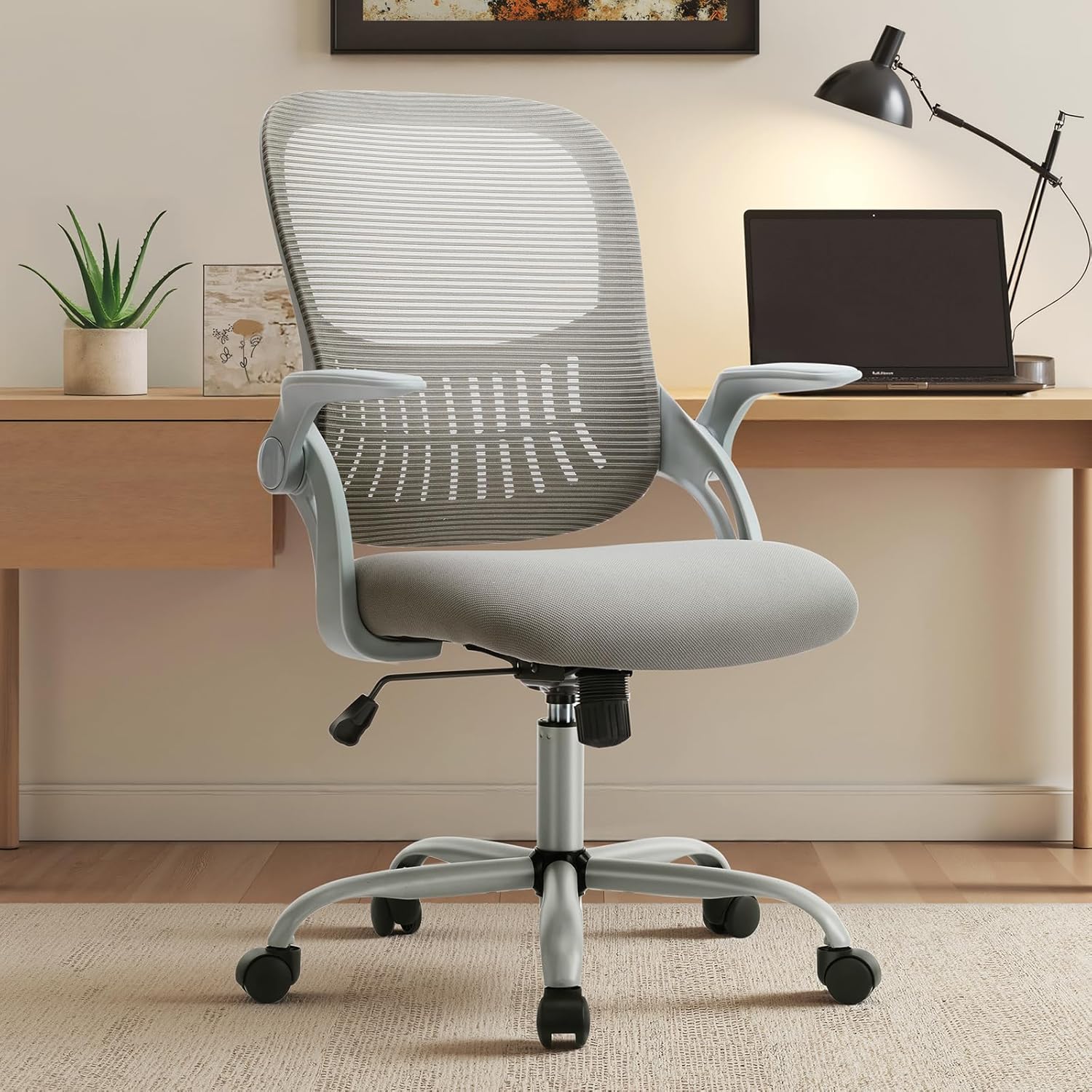
Pros
- Seat height travels across a 18.5 to 22.2 in range on a pneumatic lever
- Armrests flip vertical so the seat slides fully under a 29 in desk apron
- Elastic mesh backrest over a moulded lumbar curve, with a high-density sponge seat pad
- Five-star metal base rated to 250 lb, with multi-direction casters for tile and wood floors
- Rocking mechanism releases for a recline during reading breaks
Cons
- Mid-back shell with no headrest, so necks tire past roughly two hours of seated work
- Armrests fold up but offer no height or width adjustment
Seat height travels from 18.5 in to 22.2 in on a pneumatic lever, covering desks from roughly 28 in to 31 in high. The five-star metal base spreads load across multi-direction casters suited to tile, wood and low-pile carpet.
- Stated capacity: 250 lb
- Backrest: elastic mesh over a moulded lumbar curve
- Seat: high-density sponge under a breathable mesh cover
Mid-back geometry means the shell finishes around shoulder-blade height rather than at the neck. That keeps the chair visually low in a bedroom or small study, and lets the backrest clear a shelf or desk hutch behind it. The rocking mechanism releases for a recline, useful for reading breaks, but it does not lock at a set angle the way a full synchro-tilt chair would.

Pros
- 300 lb weight capacity on a 19 in. deep by 18 in. wide seat
- Tension knob under the seat sets how much force the recline needs
- High-density mesh over foam vents heat in rooms without air conditioning
- Adjustable lumbar cushion follows the natural curve of the lower spine
- 360 deg swivel and gas-lift height adjustment on a 38 in. tall frame
Cons
- Armrests are fixed, with no height or width adjustment
- 38 in. overall height leaves no headrest, so tall sitters get no neck support
- Listed in black only
The chair measures 19 in. deep by 18 in. wide with an overall height of 38 in., which places it in mid-back territory rather than a full executive frame. Weight capacity is 300 lb through the base and gas cylinder.
- High-density mesh back over foam padding
- 360 deg swivel on smooth-rolling casters
- Gas lift height adjustment
- Adjustable lumbar cushion in the lower back
An 18 in. seat width is standard for a task chair, so hip room is normal rather than generous. The 38 in. total height means the backrest ends around shoulder-blade level for most adults, which works for upright typing but gives nothing to lean a head against when reclining.
Comparison
| Chair | Lumbar | Headrest | Arms | Seat height | Max weight |
|---|---|---|---|---|---|
| XXISHE Ergonomic Desk Chair | Adjustable (up/down) | Not listed | Flip-up | 17.72–22.44 in | 300 lb |
| CASASIO 2307H | Adjustable (two-way) | Adjustable (3D) | Flip-up | Not listed | 350 lb |
| Zeonsit 8188 | Adjustable | Not listed | Flip-up | Not listed | 330 lb |
| ELABEST 1096M | Adjustable | Not listed | 3D adjustable | 19.6–23.6 in | 300 lb |
| HAPPYMONT Desk Chair | Built-in (no adjustment listed) | Adjustable | Flip-up | 18.5–22.2 in | 250 lb |
| Sweetcrispy Mid-Back | Built-in (no adjustment listed) | Not listed | Flip-up | 18.5–22.2 in | 250 lb |
| PayLessHere Mesh Chair | Adjustable cushion | Not listed | Standard (no adjustment listed) | Not listed | 300 lb |
The picks in detail
XXISHE Ergonomic Desk Chair
This chair covers the basics that matter most. The lumbar pad slides up and down. The seat height runs from 17.72 to 22.44 in, measured from cushion to floor. The listing claims SGS certification and BIFMA compliance and a 300 lb capacity. Arms flip up 90 degrees so the chair can slide under a desk. The seat is PU leather over thick foam, with a mesh back. It holds a 4.5-star average across more than 3,000 reviews.
Good fit if you want adjustable lumbar and a known seat height range for under $200.
Skip it if you want lumbar depth adjustment or a headrest. Neither is listed.
CASASIO 2307H
The CASASIO adds two things most budget chairs skip. Its headrest adjusts for height, depth and angle. Its lumbar cushion adjusts in two directions. The mesh back sits over a foam seat with a 20 in seat depth. Arms flip up, and the rocking tilt has adjustable tension. It is rated to 350 lb, the highest capacity on this page.
Good fit if you lean back often and want neck support, or you need a higher weight rating.
Skip it if you have shorter thighs. A 20 in seat depth can press behind the knees, and the listing does not give a seat height range to check against your desk.
Zeonsit 8188
The Zeonsit lists adjustable lumbar, seat height adjustment, flip-up arms and a rocking function. The seat has memory foam fill and a 20 in seat depth. Capacity is 330 lb. The listing claims an SGS-certified gas lift and parts checked against BIFMA standards. It also states a 5-year warranty, the clearest warranty term among these picks. Review volume is still small, so long-term durability is less proven than with older listings.
Good fit if warranty length matters to you and you want adjustable lumbar under $200.
Skip it if you want a headrest, a recline lock or a published seat height range. None is listed.
ELABEST 1096M
This is the stretch pick, priced just over $200. It has the most adjustment here. Armrests move in height, width and angle. The synchro-tilt locks in three positions with adjustable tension. The lumbar is adjustable. Both seat and back are mesh. Seat height runs 19.6 to 23.6 in, and the seat is 20 in wide. The listing gives the seat depth as both 17.3 and 17.7 in. It claims BIFMA 5.1 compliance and a 300 lb rating.
Good fit if you type all day and want arm height and width set exactly to your desk.
Skip it if you prefer a foam seat or need to stay strictly under $200.
HAPPYMONT Desk Chair
The HAPPYMONT is the only chair under $100 here with a headrest. The headrest adjusts for height and angle. The lumbar is a built-in curve rather than a movable pad. Seat height runs 18.5 to 22.2 in, the seat depth is 18.1 in, and the arms flip up. The rocking range is listed as 107° to 144°. Capacity is 250 lb.
Good fit if you want head and neck support on a tight budget.
Skip it if you weigh close to 250 lb, or your lower back needs a pad you can reposition.
Sweetcrispy Mid-Back
This is a simple mid-back mesh chair. The seat height adjusts from 18.5 to 22.2 in, the arms flip up, and a rocking mode allows a light recline. The lumbar is a fixed curve in the mesh back. The seat is a high-density sponge with an 18.5 in depth. Capacity is 250 lb. It has a 4.5-star average from over 2,000 reviews.
Good fit if you need a light, compact chair for a bedroom desk or shorter work sessions.
Skip it if you sit eight hours a day and want adjustable lumbar or arm height.
PayLessHere Mesh Chair
This is the lowest-cost chair on the page. The listing describes an adjustable lumbar cushion and a tension knob that sets how hard the recline pushes back. The seat depth is 19 in, the overall height is 38 in, and capacity is 300 lb. The arms are not described as adjustable. At this price it is a stopgap more than a long-term chair.
Good fit if you need a chair this week and the budget is very tight.
Skip it if you are tall or want neck support. The short 38 in frame has no headrest listed.
How to choose an affordable ergonomic chair
Start with your desk. Measure from the floor to the top of the desk surface. Then sit with your feet flat and your knees at roughly a right angle, and measure from the floor to the back of your knee. The chair’s seat height range should include that number. If your desk is high and you are short, you may need a footrest as well.
Next, check seat depth. You want a small gap between the front edge of the seat and the back of your knees. Deep seats around 20 in suit longer thighs. Shallower seats near 17–18 in suit shorter people.
Then look at the lumbar. On a budget, adjustable lumbar is the single most useful upgrade. An up-and-down pad lets you match the curve of your back. Two-way adjustment also lets you set how firmly it pushes. A fixed curve works only if it happens to line up with your back. If lower-back support is your main concern, see our guide to chairs with stronger lumbar support.
Armrests matter more than people expect. Flip-up arms help small desks and let the chair slide in close. Adjustable arms let you rest your forearms at keyboard height, which can help keep your shoulders relaxed.
Finally, read the fine print:
- Weight rating: choose a chair rated comfortably above your weight.
- Warranty: a stated term, such as Zeonsit’s 5 years, beats a vague promise of support.
- Certifications: BIFMA and SGS claims are the manufacturer’s own statements, but they at least name a standard.
- Materials: mesh backs run cooler. Foam and PU leather seats feel softer but trap more heat. Our mesh office chair guide covers that trade-off in more detail.
If your budget is firmly under $100, our list of office chairs under $100 goes deeper on that tier.
FAQ
Is a cheap ergonomic chair worth it?
It can be, if it adjusts to your body. A low-cost chair with adjustable lumbar and the right seat height range is a better choice than a pricier one that does not fit. Where budget chairs usually fall short is durability and the amount of fine adjustment.
What is the minimum adjustment an ergonomic desk chair needs?
Seat height and some form of lumbar support. Adjustable lumbar, adjustable arms and a recline lock are the next upgrades, roughly in that order.
Mesh or foam for a budget chair?
Mesh backs breathe better in warm rooms. Foam seats feel softer at first. Several picks here combine a mesh back with a foam seat, and that is a reasonable middle ground.
How long should an affordable office chair last?
It varies widely, and listings rarely say. A stated warranty is the best signal you have. Check whether it covers the gas lift and base, since those parts carry the most load.