 Sofia Marchetti
A mesh office chair suits people who run warm, work in rooms without much air conditioning, or simply dislike the feel of foam and leather on a long day. Mesh lets air move through the backrest, and on some chairs through the seat as well.
Not all mesh chairs are alike, though. Some use mesh only on the back and put a foam cushion underneath you. Others are mesh front to back. The two things that matter most are where the mesh is and whether the chair still gives you adjustable lumbar support. A thin, flat mesh panel with no lumbar pad can leave your lower back unsupported.
This guide covers mesh office chairs and mesh desk chairs from under $100 to the price range.
How we chose
- Mesh coverage: we noted whether mesh covers the back only or the back and seat.
- Lumbar support: adjustable lumbar ranked higher, and two-way adjustment higher still.
- Armrests and recline: adjustable arms and a recline lock counted for more than a simple rocking tilt.
- Weight rating and warranty: we favored listings that state both.
Picks are based on manufacturer specs and owner reviews, not hands-on testing. See how we research our picks for details.
Quick picks
- Best overall: MOLENTS ML230 — mesh seat and back, lumbar that moves up, down, forward and back, and 3D arms.
- Best all-mesh value: ELABEST T96 — mesh seat and back with a three-position recline lock and adjustable lumbar.
- Best with a headrest under $200: CASASIO 2307H — headrest, adjustable lumbar, 350 lb rating and a 5-year warranty.
- Best for reclining: ELABEST X100 — headrest, 5D arms and an 18 in extendable footrest.
- Best for tall users: CleverSeat — the listing says it is built for users up to 6.5 ft, with 4D arms.
- Best budget adjustable lumbar: ALLGOD Mesh Chair — adjustable lumbar and a 300 lb rating near $100.
- Best simple mesh-back chair: Vomena Mid-Back — 4 in foam seat, flip-up arms and a 300 lb rating.
- Lowest cost: OLIXIS Mid-Back — 18.5–22.2 in seat height range for under $50.

Pros
- Lumbar support adjusts both up-and-down and forward-and-backward for a customized lower back fit
- Backrest reclines through a 90° to 120° range across three lockable positions
- Seat height adjusts from 19.5 to 23.3 inches, and overall chair height spans 38.6 to 42.4 inches
- 3D armrests move to support varying arm and shoulder positions through the workday
Cons
- Sold only in this ML230 grey mesh finish, with no alternate colorway listed
- Assembly requires removing the base leg piece packed inside the seat before starting, an extra step versus fully pre-attached chairs
- No headrest is included, so extended reclining sessions leave the neck and head unsupported
This chair is built around a 300 lb weight capacity, higher than the roughly 250 lb ceiling common on many mesh office chairs in its category.
- Overall chair height: 38.6" to 42.4"
- Overall chair width: 27.6"
- Seat height from floor: 19.5" to 23.3"
- Seat depth: 18.9", seat width: 19.8"
The seat height range of nearly 4 inches gives flexibility for taller or shorter users and for pairing with either a standard or standing-height desk, while the 300 lb capacity gives more margin than lighter-duty mesh chairs before reaching the frame's limit.
With a 300 lb capacity, adjustable lumbar support and a 90°-120° recline range, this chair targets long desk sessions in a home office, company office or study space.
- Breathable mesh back suits warmer rooms or all-day sitting without heat buildup
- 3D armrests adjust to reduce shoulder strain during typing-heavy work
- Tilt lock lets the chair hold a relaxed recline position rather than only upright
Users who specifically want a headrest for reclined breaks won't find one on this model, since the design focuses on lumbar and armrest adjustment rather than head and neck support, making it a better fit for upright desk work than extended lounging.

Pros
- Rated to 300 pounds on a five-star base, at the upper end for a mesh task chair
- Seat height adjusts from 19 to 22.8 inches, suiting desks from 28 to 31 inches tall
- Three-position recline lock plus a separate tension dial for body weight
- Adjustable lumbar block slides up and down to meet the curve of your own spine
- Seat measures 20.5 inches wide by 17.3 inches deep with a mesh surface
Cons
- Overall height stops at 45.5 inches with no headrest, so the back ends at shoulder level
- 17.3 inch seat depth is short for sitters much over 5 ft 10
- Listed in a grey frame with grey mesh, with no other colourway shown
Published figures make this chair straightforward to plan for before it arrives.
- Overall 41.7 to 45.5 inches tall, 28.5 inches wide and 26.4 inches deep
- Seat height 19 to 22.8 inches from the floor
- Seat 20.5 inches wide by 17.3 inches deep
- 300 pound capacity across the five-star base
Seat depth is the figure to measure against your own leg length. At 17.3 inches it supports sitters up to roughly 5 ft 10 well, while taller users will find the front edge stops short of the knee and thigh support suffers. The 28.5 inch overall width also determines whether the chair rolls under a desk with fixed side panels.
This is a full-size mesh task chair aimed at long desk sessions rather than at gaming posture.
- Warm rooms: an all-mesh back moves air behind the spine in a way padded PU chairs cannot
- Lower back complaints: the lumbar block slides to meet your curve instead of sitting at one fixed height
- Sitters up to 300 pounds, which covers most adults with margin left over
It suits less well if you like to lean right back and rest, since there is no headrest and the shell stops at shoulder height, leaving necks unsupported on long reclines. Anyone over about 6 ft should also check the 17.3 inch seat depth against their thigh length before committing to it as a daily chair.

Pros
- Supports loads up to 350 pounds for long-term durability
- Fully adjustable design customizes comfort to individual preferences
Cons
- Neck support not included, requiring separate headrest purchase

Pros
- 18-inch extendable footrest with 2-position angle adjustment supports a reclined break without leaving the chair
- 5D flip-up armrests adjust height, width, angle, and rotation, then fold flush to tuck under a desk
- 3D lumbar support adjusts up to 1.6 inches in depth and 2 inches in height to track different seated postures
Cons
- Footrest and 5D armrest mechanisms add moving parts that increase what there is to adjust and maintain over a simple fixed-arm chair
- Mist Black is the only finish offered, with no other color option
- Larger footprint at 26 x 24 inches needs more floor clearance than a compact task chair
The X100 measures 26"D x 24"W x 41"H and carries a 300 lb weight capacity, built for bigger frames than a standard mesh task chair. The 3D lumbar system adjusts depth by up to 1.6" and height by up to 2", with 15 degrees of rotation to track the spine's natural curve rather than pressing at one fixed point.
- Footprint: 26"D x 24"W x 41"H
- Weight capacity: 300 lb
- Lumbar adjustment: up to 1.6" depth, 2" height, 15-degree rotation
An 18" extendable footrest with 2-position angle adjustment pulls out from under the seat, adding leg support once the backrest is reclined for a break.
Pros
- 4D armrests adjust up, down, forward-back and pivot, so elbow height lines up with almost any desk
- 3-position backrest tilt locks the recline angle instead of leaving it free-floating
- Blade-shaped casters are engineered to roll quietly across hard flooring
Cons
- Frame combines chromium-plated and plastic components rather than a full steel shell, so it may flex more than an all-metal frame under aggressive rocking
- Backrest tilt is limited to 3 fixed positions rather than a continuous recline lock
- No separate seat-depth figure is listed beyond the 21-inch footprint, so users near the 6.5 ft sizing ceiling may find the seat pan short
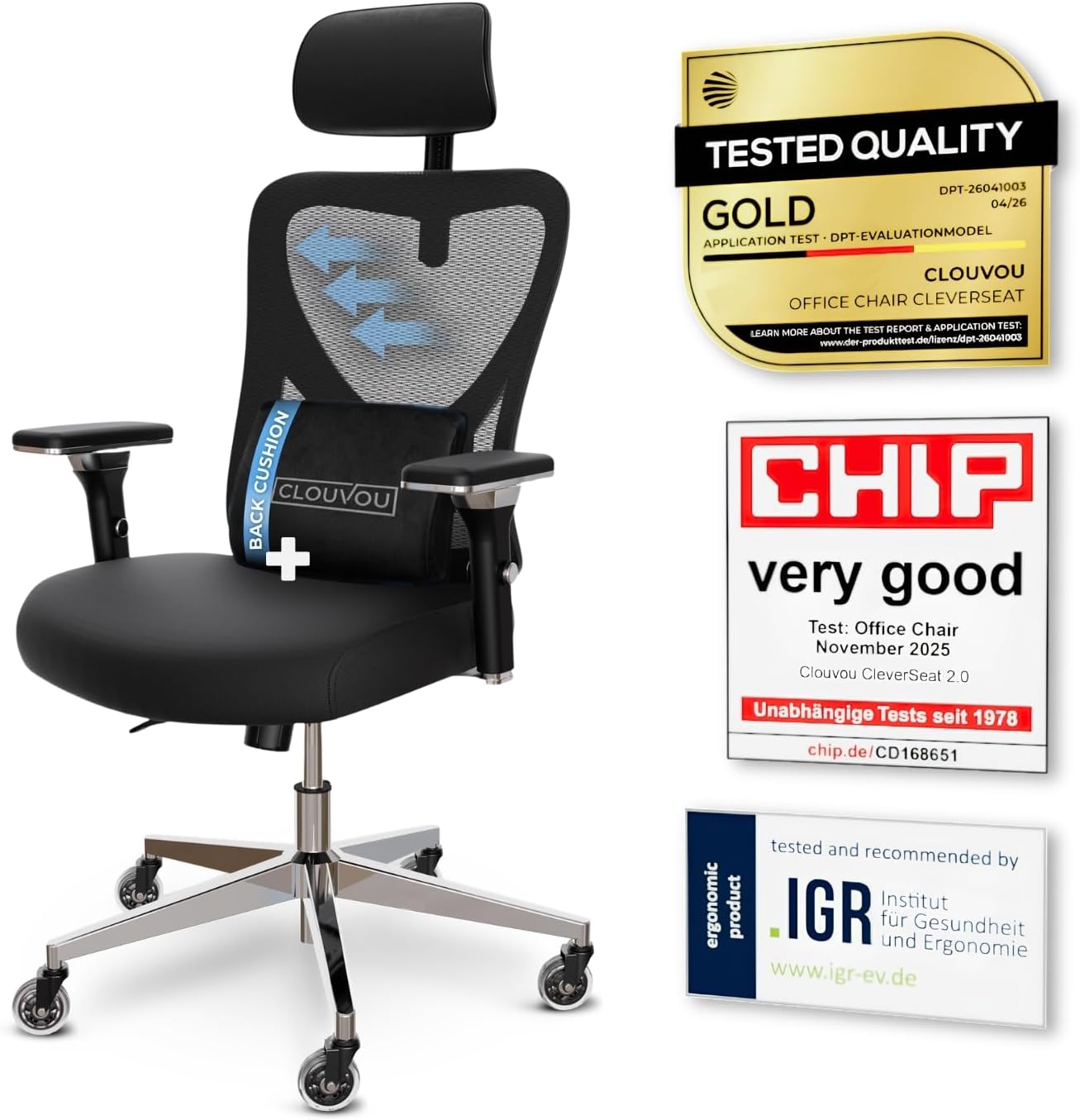
The chair measures 21"D x 21"W x 39"H in its assembled footprint, a compact base built for desks in home offices and shared workspaces. Backrest support is rated for users up to 6.5 ft tall, wider than the sizing window most mesh task chairs advertise.
- Frame combines chromium-plated steel components with plastic housings for the armrests and base shroud
- 3-position backrest tilt locks the recline angle rather than floating freely
- 4D armrests adjust height, width, depth and pivot angle independently
Because the footprint stays close to 21 inches square, the chair fits under standard desks without needing extra clearance, while the taller backrest window suits users who outgrow shorter task chairs.

Pros
- Rated to support up to 300 pounds via a reinforced steel frame and tear-resistant mesh
- Rocking range spans 90 to 135 degrees, wider than the roughly 90 to 120 degree tilt on many desk chairs
- Armrests flip up a full 90 degrees, letting the chair tuck fully under low desks for storage
- 360-degree swivel casters are built to roll across tile, hardwood and carpet without special floor mats
- Lumbar support pad adjusts independently to fit different seated heights and postures
Cons
- Mesh backrest offers less cushioned padding than a foam high-back chair, some users may find lower back contact firmer
- Sold in black only in this listing, with no other color option
Built around a reinforced steel frame with tear-resistant mesh, this desk chair carries a load capacity of up to 300 pounds. Its assembled footprint measures 23.23 inches deep by 11.02 inches wide by 20.67 inches high, sizing it for standard home office desks rather than oversized executive setups.
The seat uses a high-density foam cushion designed to keep its shape under repeated sitting and reduce pressure on the pelvis and legs during longer sessions. The breathable mesh backrest promotes airflow across the back, a contrast to the fully upholstered foam backs found on many executive chairs.
- Rated to support up to 300 pounds
- 23.23"D x 11.02"W x 20.67"H footprint
- High-density foam seat cushion
- Breathable mesh backrest for airflow
The manufacturer describes this chair as simple to assemble without requiring extra tools beyond what is included in the box. Once built, the adjustable lumbar support can be repositioned to match different spinal curvatures or seated heights, aimed at easing lower back strain during long desk sessions.
Armrests flip up a full 90 degrees, which frees up desk clearance or lets the chair slide fully under a low desk for storage in small rooms. A rocking function spanning 90 to 135 degrees allows users to shift from an upright working posture to a more reclined position for short breaks without leaving the chair.
- Tool-light assembly process
- Lumbar support adjusts to seated height and posture
- 90-degree flip-up armrests for storage
- Rocking range of 90-135 degrees

Pros
- Physical footprint measures 18.5"D x 20"W x 44.3"H for spatial placement
Cons
- Requires checking room space for Ergonomic Office Chair prior to installation
- Routine cleaning needed to maintain Mesh office chair appearance
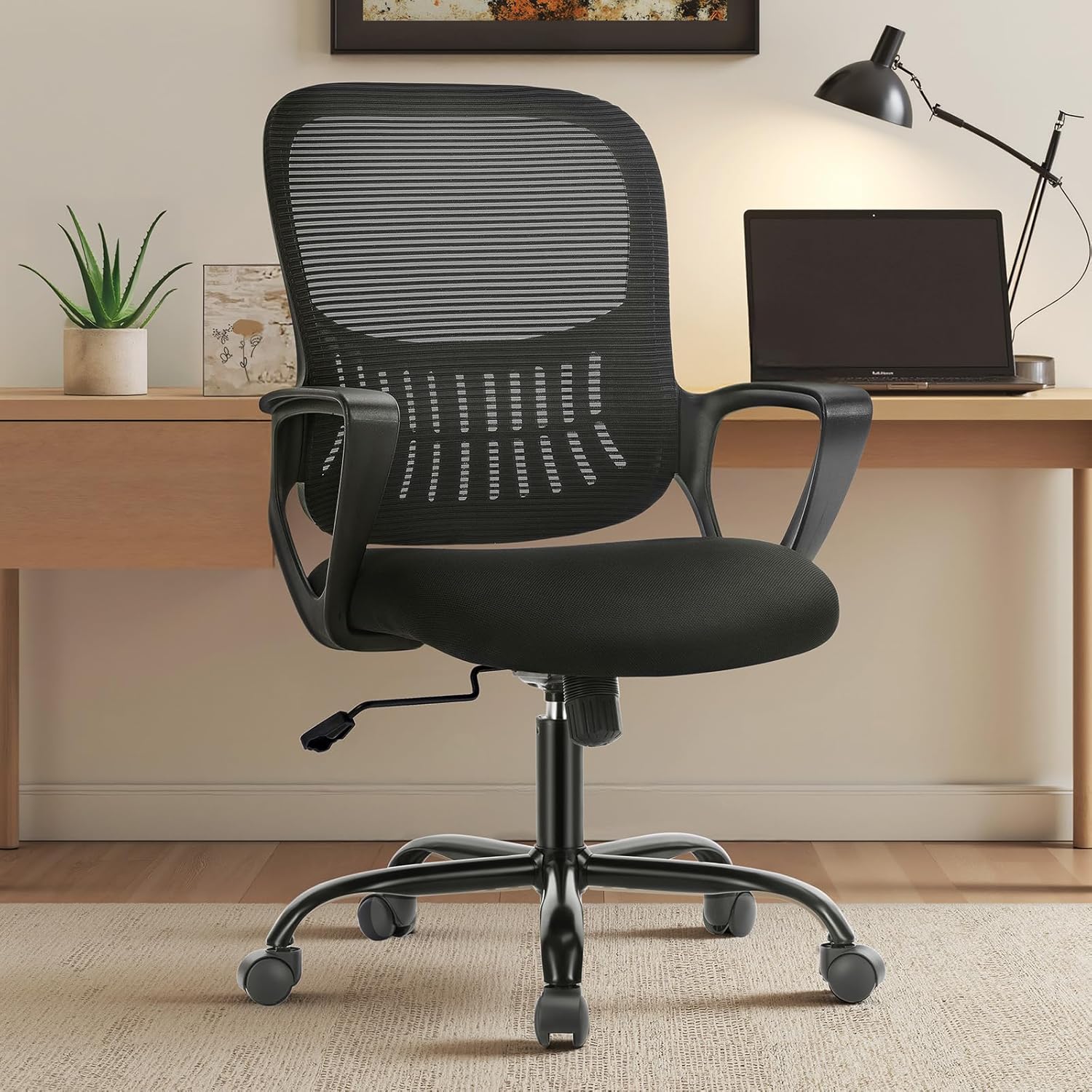
Pros
- Physical footprint measures 18.5"D x 20.08"W x 41.5"H for spatial placement
- Crafted with Mesh, Metal materials
Cons
- Requires checking room space for OLIXIS Home Office Cha prior to installation
- Routine cleaning needed to maintain Mesh, Metal appearance
Comparison
| Chair | Mesh on | Lumbar | Headrest | Arms | Max weight |
|---|---|---|---|---|---|
| MOLENTS ML230 | Back and seat | Adjustable (height and depth) | Not listed | 3D | 300 lb |
| ELABEST T96 | Back and seat | Adjustable | Not listed | Not listed | 300 lb |
| CASASIO 2307H | Back (foam seat) | Adjustable | Yes | Flip-up | 350 lb |
| ELABEST X100 | Back and seat | Adjustable (height, depth, rotation) | Yes | 5D flip-up | 300 lb |
| CleverSeat | Not listed | Built-in, with back cushion | Yes | 4D | Not listed |
| ALLGOD Mesh Chair | Back (foam seat) | Adjustable | Not listed | Flip-up | 300 lb |
| Vomena Mid-Back | Back (foam seat) | Not listed | Not listed | Flip-up | 300 lb |
| OLIXIS Mid-Back | Back; mesh-covered seat | Built-in curve | Not listed | Not listed | Not listed |
The picks in detail
MOLENTS ML230
The MOLENTS uses mesh on both the back and the seat, with shaped sponge under the seat mesh. Its lumbar pad moves up and down and forward and back. The listing calls the armrests 3D, and says the arm pads slide forward and back and rotate. The backrest locks in three positions from 90° to 120°. Seat height runs 19.5 to 23.3 in and the seat is 19.8 in wide. It is rated to 300 lb, and the listing mentions a 2-year warranty that you activate by contacting the maker.
Good fit if you want an all-mesh chair with real lumbar adjustment.
Skip it if you want a headrest. None is listed.
ELABEST T96
The T96 is mesh on the seat and back. It has recline tension adjustment, a three-position recline lock and adjustable lumbar. Seat height runs 19 to 22.8 in. The seat is 17.3 in deep and 20.5 in wide, and capacity is 300 lb. The relatively shallow seat suits average and shorter thighs. It averages 4.5 stars from more than 1,000 reviews.
Good fit if you want a cool seat as well as a cool back, and a recline that holds its position.
Skip it if you need adjustable armrests. The listing does not describe any arm adjustment.
CASASIO 2307H
This version of the CASASIO combines a mesh back with a molded foam seat that has a waterfall front edge. The S-shaped back has adjustable lumbar, and the chair includes a headrest. Padded arms flip up so the chair can tuck under a desk. Capacity is 350 lb, the listing claims BIFMA compliance, and it states a 5-year warranty.
Good fit if you want mesh airflow on your back but prefer a cushioned seat, plus neck support.
Skip it if you have short legs. The 20 in seat depth runs long, and no seat height range is listed.
ELABEST X100
The X100 is the most feature-heavy chair here. The listing describes lumbar that moves about 2 in up or down and 1.6 in in depth, a 3D headrest, 5D flip-up arms and a three-stage recline. An 18 in footrest pulls out from under the seat. Seat height runs 18.3 to 23 in. Mesh covers the seat and back, and capacity is 300 lb. The listing also makes percentage claims about airflow and neck strain. Treat those as marketing.
Good fit if you want one chair for focused work and leaning back on breaks.
Skip it if you will never use the footrest. You pay for it either way.
CleverSeat
The CleverSeat listing focuses on fit for taller people. It says the chair suits users up to 6.5 ft. It lists 4D armrests, a headrest, targeted lumbar support with a back cushion, a three-position backrest tilt and quiet blade-style wheels. The spec sheet does not give a weight rating, seat height or seat depth. Check those with the seller before buying. It has a 4.8-star average from more than 3,000 reviews.
Good fit if you are tall and standard chairs leave your head above the backrest.
Skip it if you need a confirmed weight rating. None is listed.
ALLGOD Mesh Chair
The ALLGOD pairs a mesh back with a high-density foam seat. The lumbar adjusts for different heights and postures. Arms flip up 90° to save space. The rocking function runs from 90° to 135°, and capacity is 300 lb. The listing mentions a warranty but does not give its length.
Good fit if you want adjustable lumbar in a mesh chair for close to $100.
Skip it if you want a recline lock or a headrest. The listing describes a rocking tilt only.
Vomena Mid-Back
The Vomena is a straightforward mid-back chair. It has a mesh back, a seat the listing describes as 4 in of high-density foam, flip-up arms and a class-3 gas lift. The seat depth is 18.5 in and capacity is 300 lb. The listing says it is SGS certified. It does not describe an adjustable lumbar pad.
Good fit if you want a firm foam seat and a breathable back for a home office.
Skip it if lower-back support is your top need. Pick a chair with adjustable lumbar instead.
OLIXIS Mid-Back
The OLIXIS is the budget option. It has a mesh back, a sponge seat covered in mesh, and a built-in lumbar curve. Seat height adjusts from 18.5 to 22.2 in. The tilt rocks from 90° to 120°, with a tension knob under the seat. The spec sheet is thin, and no weight rating is listed.
Good fit if you need a basic mesh desk chair for a dorm or spare room.
Skip it if you sit all day or need a confirmed weight capacity.
How to choose a mesh chair
Back-only or full mesh? A mesh back with a foam seat is the most common design. It keeps your back cool and gives you a softer seat. A full-mesh seat stays cooler under your thighs, but some people find the front edge firmer. If you sit cross-legged or shift around a lot, a foam seat may feel more forgiving.
Lumbar matters more on mesh. A mesh back is a stretched panel. Without a separate lumbar pad, support depends on how tight the mesh is and where its curve falls. Look for a pad you can move up and down. Depth adjustment is a bonus.
Check seat height and depth. Your feet should rest flat with your thighs roughly level. Seat depth should leave a small gap behind your knees. The picks above range from 17.3 in deep (ELABEST T96) to 20 in (CASASIO), which is a meaningful difference if you are shorter or taller than average. Taller readers should also see our guide to chairs for tall people.
Arms and space. Mesh desk chairs for small rooms often use flip-up arms so the chair slides under the desk. If you type for hours, height-adjustable arms (3D, 4D or 5D) let you set them at keyboard level.
Care. Mesh does not crack or peel the way bonded leather can, and dust brushes or vacuums out. If you prefer the look of leather, compare these with our executive office chair picks. If budget is the main limit, our affordable ergonomic chair guide includes more mesh-back options.
FAQ
Are mesh office chairs comfortable for long hours?
Many people find them comfortable, especially in warm rooms. Comfort over a full day depends more on lumbar adjustment, seat depth and arm height than on the mesh itself.
Does mesh sag over time?
Mesh can loosen with heavy use. Listings rarely give durability data, so a stated warranty and weight rating are the best guides you have.
Is a mesh seat better than a foam seat?
A mesh seat runs cooler. A foam seat usually feels softer. Neither is better for everyone, which is why this list includes both.
What is the difference between a mesh chair and a mesh desk chair?
Nothing meaningful. Retailers use the terms interchangeably. Focus on the adjustments and measurements, not the name.