 Sofia Marchetti
Eight or more hours in a chair is a different test from a quick email session. Small fit problems add up: a seat edge pressing behind your knees, a back that does not meet your lower spine, armrests that push your shoulders up. This page is for remote workers, students and anyone else who sits at a desk for most of the day.
For long hours, two things matter most. First, a chair you can adjust and then change position in, such as a lockable recline or adjustable tilt tension, so you are not frozen in one posture. Second, materials that hold up over a full day: a breathable back and a seat cushion that keeps its shape.
How we chose
- Adjustable lumbar support, so your lower back stays supported as you settle in.
- Recline control: lockable angles or tension, which let you switch between upright work and leaning back.
- Breathable back: mesh backs were favored for all-day use.
- Weight rating and warranty, because daily long use wears gas lifts, casters and tilt mechanisms.
- Headrest availability for people who recline during calls or reading.
Picks are based on manufacturer specs and owner reviews, not hands-on testing. See how we research products.
Quick picks
- Best for most long workdays: Casasio 2307H — two-direction lumbar, 3D headrest and adjustable tilt tension.
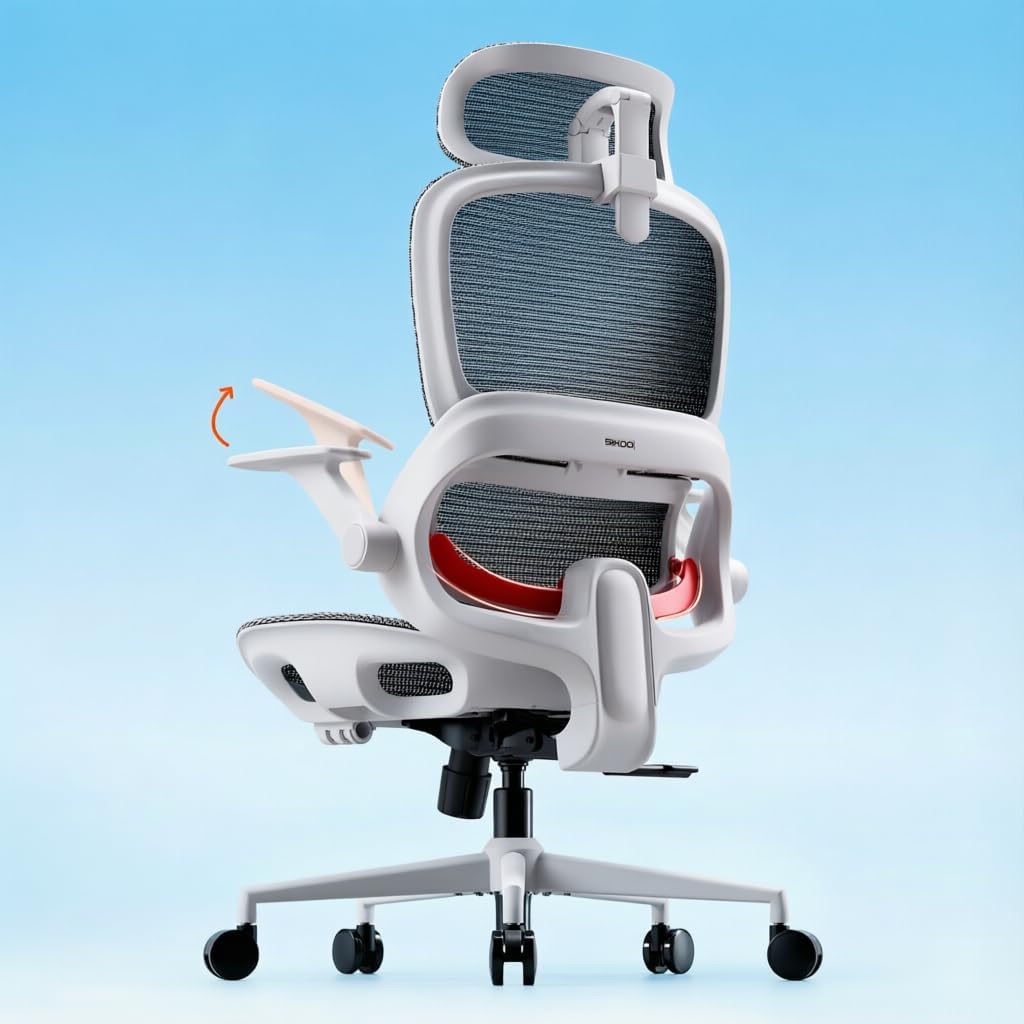
- Best for changing positions: SIHOO B100 — three lockable recline angles and a dynamic lumbar.
- Best for breaks without leaving the chair: ELABEST X100 — pull-out footrest and 3D lumbar.
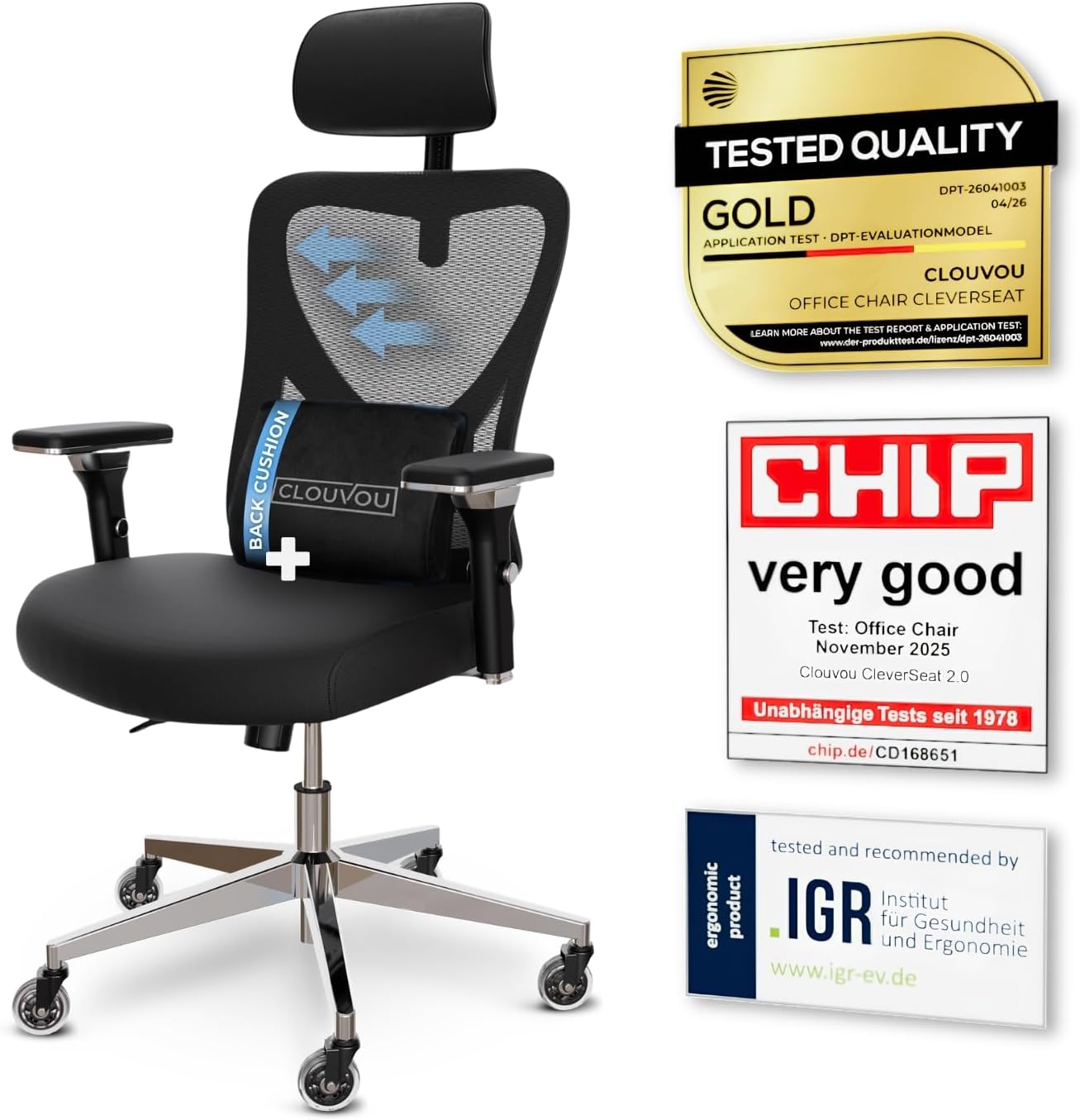
- Best for tall users: CLOUVOU CleverSeat — listed for users up to 6.5 ft, with 4D armrests.
- Best warranty for the money: QLTPLUS OC-5189 — adjustable lumbar and a 5-year warranty.
- Best mesh chair with headrest under $200: Zeonsit 8188 — adjustable lumbar and headrest, 5-year warranty.
- Best budget option: XXISHE LDL-929 — mesh back, adjustable lumbar and tilt tension.

Pros
- Adaptive lumbar support follows the spine's curve as you shift between leaning forward and sitting upright
- Seat height adjusts from 18.3" to 21.9", covering a wide range of body heights and desk setups
- Three lockable recline angles at 110°, 125° and 135° let you switch from focused work to a reclined break
- Full-mesh backrest keeps air moving to reduce heat buildup during long afternoons
Cons
- Ships without a footrest, so buyers wanting leg support during recline need to add one separately
- Flip-up armrests adjust vertically but are not detailed as depth or width adjustable
- Grey is the color shown, limiting choice for buyers wanting to match a specific office palette
This chair is built for long desk sessions with adjustment ranges aimed at fitting a variety of body types.
- Seat height adjusts from 18.3" to 21.9", accommodating different desk heights
- Overall footprint of 28.3" D x 27.6" W x 51.6" H
- Weight capacity rated to 300 pounds
- A widened seat cushion spreads weight more evenly across the hips and thighs during long sits
Because the seat height range is fairly wide, most desk heights should be accommodated, though very tall or very short users should double-check the range against their specific desk before ordering.
Getting the chair set up involves standard task chair assembly plus a few adjustment points once built.
- Flip-up armrests move out of the way when not needed, useful for sliding fully under a desk
- Backrest recline locks at 110°, 125° or 135° depending on whether you want upright focus or a relaxed break
- An adjustable headrest supports the neck during typing, calls, or leaning back to think
- The chair ships without a footrest, so that accessory is not included in the box
Because assembly instructions typically ship in the box with labeled hardware, most buyers should expect a single-person build using basic tools.

Pros
- 18-inch extendable footrest with 2-position angle adjustment supports a reclined break without leaving the chair
- 5D flip-up armrests adjust height, width, angle, and rotation, then fold flush to tuck under a desk
- 3D lumbar support adjusts up to 1.6 inches in depth and 2 inches in height to track different seated postures
Cons
- Footrest and 5D armrest mechanisms add moving parts that increase what there is to adjust and maintain over a simple fixed-arm chair
- Mist Black is the only finish offered, with no other color option
- Larger footprint at 26 x 24 inches needs more floor clearance than a compact task chair
The X100 measures 26"D x 24"W x 41"H and carries a 300 lb weight capacity, built for bigger frames than a standard mesh task chair. The 3D lumbar system adjusts depth by up to 1.6" and height by up to 2", with 15 degrees of rotation to track the spine's natural curve rather than pressing at one fixed point.
- Footprint: 26"D x 24"W x 41"H
- Weight capacity: 300 lb
- Lumbar adjustment: up to 1.6" depth, 2" height, 15-degree rotation
An 18" extendable footrest with 2-position angle adjustment pulls out from under the seat, adding leg support once the backrest is reclined for a break.
Pros
- 4D armrests adjust up, down, forward-back and pivot, so elbow height lines up with almost any desk
- 3-position backrest tilt locks the recline angle instead of leaving it free-floating
- Blade-shaped casters are engineered to roll quietly across hard flooring
Cons
- Frame combines chromium-plated and plastic components rather than a full steel shell, so it may flex more than an all-metal frame under aggressive rocking
- Backrest tilt is limited to 3 fixed positions rather than a continuous recline lock
- No separate seat-depth figure is listed beyond the 21-inch footprint, so users near the 6.5 ft sizing ceiling may find the seat pan short
The chair measures 21"D x 21"W x 39"H in its assembled footprint, a compact base built for desks in home offices and shared workspaces. Backrest support is rated for users up to 6.5 ft tall, wider than the sizing window most mesh task chairs advertise.
- Frame combines chromium-plated steel components with plastic housings for the armrests and base shroud
- 3-position backrest tilt locks the recline angle rather than floating freely
- 4D armrests adjust height, width, depth and pivot angle independently
Because the footprint stays close to 21 inches square, the chair fits under standard desks without needing extra clearance, while the taller backrest window suits users who outgrow shorter task chairs.

Pros
- Rated to support 350 Pounds
- Dimensions measure 20inchD x 20inchW x 40inchH
- Construction uses Foam for durability
- Adjustable components allow customized positioning
- Includes extended manufacturer warranty coverage
Cons
- Requires professional assembly or installation service
- Limited in monochrome color options available
- Some optional accessories sold separately

Pros
- Weight capacity of 330 pounds, above the 250-275 lb range typical of many mesh-back home office chairs
- Adjustable lumbar support follows the spine's curve independently from the headrest, so each adjusts without affecting the other
- Flip-up armrests free up desk space when raised, then lower back down for wrist support while typing
- Frame combines alloy steel with nylon components, built for a mid-size 20 x 20-inch footprint
Cons
- Rocking/tilt function has no separate tension lock mentioned, so recline resistance may not be adjustable to personal preference
- Mesh-and-nylon build favors airflow over the plush cushioning of an all-foam executive chair
- Exact seat height adjustment range is not specified, making it harder to confirm fit for very tall or short users beforehand
This office chair measures 20 inches deep by 20 inches wide by 45 inches tall, a compact footprint suited to smaller home office corners compared to bulkier executive chairs with wider seat pans. Weight capacity is rated to 330 pounds, supported by an alloy steel frame beneath the mesh backrest and nylon components used across the base and armrest hardware. The seat cushion uses virgin foam, chosen for its ability to hold shape and resist compression over repeated daily sitting better than reprocessed foam fillers. A breathable mesh back panel is built into the backrest specifically to promote airflow and reduce heat buildup that solid, fully upholstered backs tend to trap during long desk sessions.

Pros
- SGS certified and BIFMA tested with a 300 lb weight capacity
- Seat height adjusts 17.72 in. to 22.44 in. measured cushion to floor
- 90 deg flip-up armrests let the seat tuck fully under a desk apron
- PU leather cushion wipes clean while the mesh back vents heat during long sessions
- 3-stage gas cylinder with a tilt tension knob for rocking or upright lock
Cons
- Lumbar support slides up and down only, with no depth adjustment toward the spine
- No headrest, so the back stops at shoulder level and necks tire on long shifts
- Listed in black only, with no alternative finish offered
The seat pad is 18 in. deep with a PU leather face over thickened high-resilience foam, while the mesh back handles ventilation. Height adjusts from 17.72 in. to 22.44 in. measured cushion to floor, which suits desks in the common 28 to 30 in. band.
- Capacity 300 lb, SGS certified and BIFMA tested
- 3-stage gas cylinder under the seat
- Nylon base running on quiet casters
- Lumbar pad slides up and down the backrest
Check the 17.72 in. minimum seat height against your desk apron before ordering, since a low drawer box can stop the chair sliding under. Taller sitters should note that the backrest ends around shoulder level with no head support above it.
Comparison
| Chair | Back | Lumbar | Recline | Headrest | Max weight | Warranty |
|---|---|---|---|---|---|---|
| Casasio 2307H | Mesh | Two-direction | Tilt, adjustable tension | 3D | 350 lb | Not listed |
| SIHOO B100 | Mesh | Dynamic | 110°/125°/135° lock | Adjustable | 300 lb | 3 years parts |
| ELABEST X100 | Mesh | 3D | 3 positions + footrest | 3D | 300 lb | 5-year “satisfaction care” |
| CLOUVOU CleverSeat | Mesh | Built-in, adjustment not listed | 3 positions | Yes | Not listed | Not listed |
| QLTPLUS OC-5189 | Mesh | Adjustable cushion | Tilt, adjustable tension | No | 350 lb | 5 years |
| Zeonsit 8188 | Mesh | Adjustable pad | Rocking tilt | Adjustable | 330 lb | 5 years |
| XXISHE LDL-929 | Mesh back, PU leather seat | Height | Tilt, tension knob | No | 300 lb | Not listed |
The picks in detail
Casasio 2307H
This chair has the main adjustments a full workday calls for. The lumbar cushion adjusts in two directions, the 3D headrest moves in height, depth and angle, and the tilt tension is adjustable so the back moves with you. It has a mesh back over a foam seat, a 350 lb rating and flip-up arms. It holds a 4.7 rating from about 150 reviews.
Good fit if you want lumbar and neck support plus a tilt you can tune. Skip it if you need height-adjustable armrests; these only flip up.
SIHOO B100
Long days go better when you can change position. The B100 back locks at 110, 125 or 135 degrees, and the listing describes a lumbar that adapts as you lean forward or sit upright. The headrest adjusts. Seat height runs 18.3 to 21.9 inches, seat depth is 17.1 inches and capacity is 300 lb. SIHOO lists 3 years of free parts replacement, which matters for daily heavy use.
Good fit if you alternate between focused work and leaning back on calls. Skip it if you prefer to set lumbar depth by hand.
ELABEST X100
The X100 is built around taking breaks in place. An 18-inch footrest pulls out, the back reclines to three positions and the lumbar adjusts about 2 inches in height and 1.6 inches in depth. Seat height runs 18.3 to 23 inches. Capacity is 300 lb, and the 5D armrests flip up. The listing’s claims about hours of fatigue reduction come from the brand, so read them as marketing.
Good fit if you want to recline with your feet up between tasks. Skip it if your space is tight; the base is listed at 26 x 24 inches.
CLOUVOU CleverSeat
The CleverSeat is listed for users up to 6.5 ft, which helps if most chairs stop short of your shoulders. It has a headrest, a three-position backrest tilt, 4D armrests and quiet blade casters. The back is mesh, and the listing pitches it for extended use in warm rooms. It has the largest review base here, at over 3,000 reviews.
Good fit if you are tall and want armrests you can place exactly. Skip it if you need a stated weight rating or adjustable lumbar pad; neither is listed.
QLTPLUS OC-5189
A no-frills chair with the features that matter for daily use: an adjustable lumbar cushion, a mesh back, a molded foam seat and a tilt with adjustable tension. It lists a 350 lb capacity on a metal base and a 5-year warranty. The arms flip up to clear the desk, and the listed seat depth is 20 inches.
Good fit if you want long warranty coverage without paying for a headrest. Skip it if you recline often and want neck support.
Zeonsit 8188
This mesh chair pairs an adjustable lumbar pad with an adjustable headrest, a memory foam seat, flip-up arms and a rocking tilt. The listing gives a 330 lb rating and mentions a 5-year warranty. Listed seat depth is 20 inches, though that matches the whole chair’s depth. The brand also lists an SGS-certified gas lift.
Good fit if you want a headrest and lumbar on a mid budget. Skip it if you want adjustable tilt tension spelled out; the listing only mentions a rocking function.
XXISHE LDL-929
The XXISHE combines a mesh back with a thick PU leather seat. The lumbar adjusts up and down, and seat height runs 17.72 to 22.44 inches. The tilt has a tension knob, the arms flip up 90 degrees and capacity is 300 lb.
Good fit if you want adjustable lumbar and a wide height range at a low price. Skip it if you want a high back or headrest. A leather seat can also feel warmer late in the day than mesh.
How to choose a chair for all-day sitting
Breathability
Over a long day, heat builds up where your body meets the chair. Mesh backs let air through. Leather and faux leather look smart but hold more heat. If you sit in a warm room, start with our mesh office chair guide.
Movement, not just support
A chair that locks you in one perfect position is less useful than one that supports you in several. Look for lockable recline angles or a tension knob. These let you lean back during calls and come upright for typing.
Durability signals
Check the listed weight rating, gas lift certification and warranty. A longer warranty on a chair you sit in every day is worth more than an extra adjustment you will rarely use.
Fit checklist
- Feet flat on the floor with thighs about level.
- Two to four fingers between the seat edge and the back of your knees.
- Lumbar pad meeting the inward curve of your lower back.
- Elbows near desk height with shoulders relaxed.
If you are a larger user, gaming-style and leather chairs with higher ratings are covered in our big and tall chair guide. If your back already aches, see our guide to chairs for back pain.
What a chair can’t fix
Even the right chair is only part of a long workday. Set your desk so your elbows sit near keyboard height, and keep the top of your monitor at or slightly below eye level. Get up, walk and stretch regularly. Sitting still for hours is hard on the body no matter the chair. The OSHA computer workstations guide covers the full setup. If pain or numbness persists, see a clinician.
FAQ
Is mesh or foam better for sitting all day?
Mesh backs breathe better. Many people prefer a mesh back with a foam seat, which several chairs here use.
Do I need a headrest for long hours?
It helps if you recline during calls or reading. If you sit upright most of the day, lumbar and seat fit come first.
How often should I adjust my chair?
Set it up carefully once, then fine-tune over the first week. Change the recline or tension during the day as your tasks change.
What warranty should I look for?
For daily long use, longer is better. Several chairs here list 3 to 5 years of coverage.