 Daniel Okafor
Why the Best Balance Boards for Standing Desks Are Worth It
If you have made the switch to a standing desk, you already know that standing all day is not the magic fix it is often made out to be. Locking your knees and staying still for hours can be just as fatiguing as sitting. This is where the best balance boards for standing desks come in. A balance board turns passive standing into active standing, keeping your ankles, calves, and core gently engaged while you work. The result is better circulation, more focus, and far less of that stiff, heavy feeling at the end of a long day.
This guide is not a product-by-product review. Instead, it is a practical buying guide designed to help you understand what actually matters when choosing a board, how the different styles compare, and how to match a board to your desk setup, your fitness level, and your budget. By the end, you will know exactly what to look for and be able to pick a board with confidence.
Below is a curated shortlist of popular options to browse while you read, so you can see real prices and features as we cover each buying factor.

Pros
- Compact 15.75 x 15.75 x 3.15 inch footprint stores flat under a desk, bed or closet shelf
- Non-slip textured surface holds footing through push-ups, planks and single-leg balance poses
- Backed by a 1-year limited warranty against manufacturing defects
Cons
- Warning label restricts use to dry, non-slip surfaces, so tile or polished hardwood needs a mat underneath first
- Fixed dome curvature offers one tilt difficulty, with no way to dial resistance up or down
- Solid wood build has no cushioned rim, so bare feet can feel the edge during longer sessions

Pros
- Lauan hardwood plywood construction rated to support up to 350 pounds
- Textured, non-slip surface designed for secure grip during bare-foot use
- Compact 17.5"L x 13.5"W x 3"H size suited to use beside a standing desk
Cons
- No adjustable resistance or incline settings beyond switching between the two built-in difficulty modes
- 350-pound weight capacity is a hard ceiling, unsuited to users or combined loads above that limit
- Textured surface is designed for bare feet, so grip and feel may differ when used in shoes
The board measures 17.5 inches long, 13.5 inches wide, and 3 inches tall, built from Lauan hardwood plywood sourced from sustainable, plantation-grown trees rather than the birch or pine used in many competing boards. It is rated to support users and combined loads up to 350 lbs.
- 17.5"L x 13.5"W x 3"H compact size
- 350 lb weight capacity
- Lauan hardwood plywood construction
The compact footprint is sized to sit beside a standing desk or fit into a gym bag, positioning the board for both office use during work breaks and dedicated training or rehab sessions.
Pros
- 350 lb weight capacity supports sustained foot pressure through a full workday
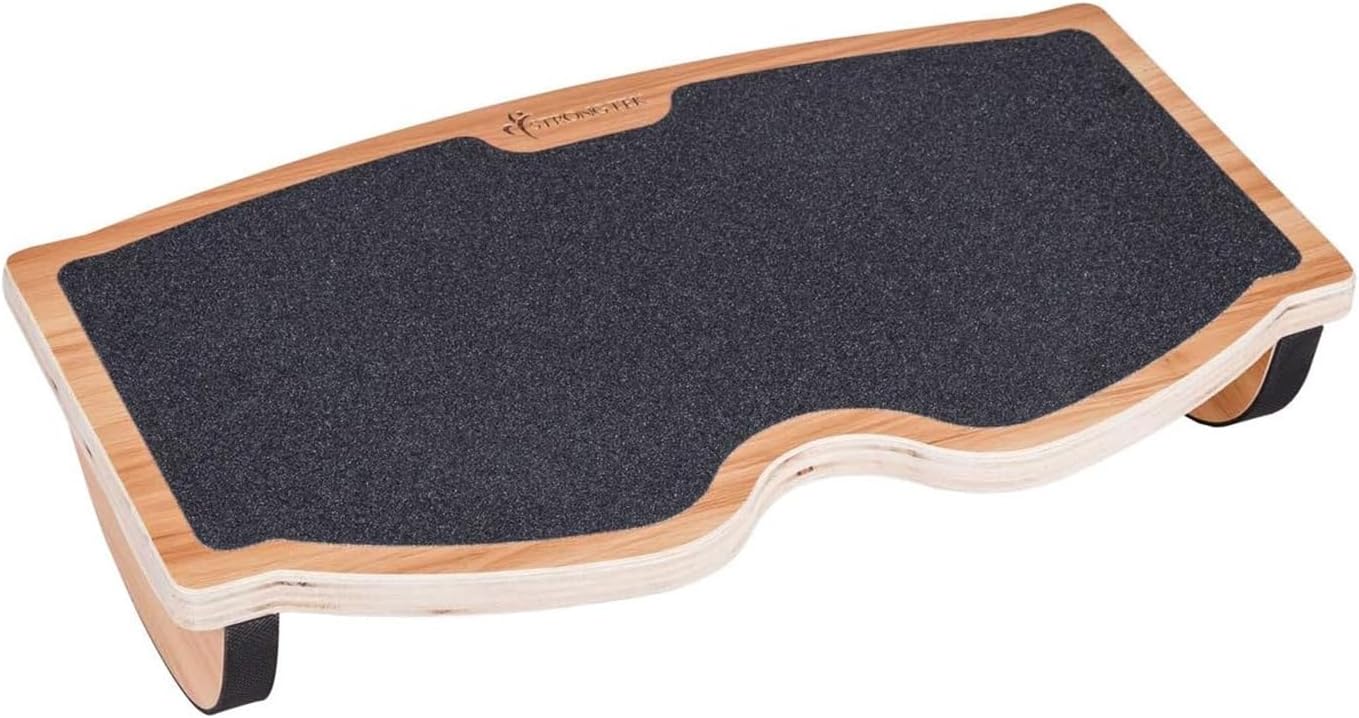
- 18-inch-wide rocking platform lets feet roll forward and back for active sitting
- Anti-slip rubber grips on the base plus a non-slip top surface hold position on hard flooring
- Solid wood construction ships fully built, with no assembly steps before use
- Curved rocker profile works under both seated desks and standing-desk setups
Cons
- Wood construction is heavier than plastic footrests, making it less convenient to carry desk to desk daily
- Fixed rocking curve only, with no adjustable height or angle-lock setting
- Bare wood surface has no fabric or gel padding layer for direct barefoot use

Pros
- Supports up to 320 lbs, enough for most adult users to stand, rock or exercise on without concern
- 8.5-degree tilting angle keeps movement concentrated below the hips, so typing accuracy isn't disrupted while standing and rocking
- Doubles as a workout surface for push-ups, squats and planks, not just a standing mat
- No-assembly design means it's ready to step on immediately out of the box
- Built-in carry hole and a compact 20 x 12 x 2.2 inch footprint make it easy to move between desks or rooms
Cons
- Wood core construction adds rigidity but also means it can't be folded flat for storage like a soft foam mat
- 360-degree wobble motion takes some initial balance adjustment, which may not suit users wanting a completely stable standing platform
The board measures 20 in long, 12 in wide and 2.2 in tall, with a rated capacity of 320 lbs. A natural hardwood middle layer provides the rigid structure, topped with a high-density latex deck for grip and cushioning during standing or exercise.
- The 8.5-degree tilting angle keeps most of the wobble motion concentrated from the hips down.
- A non-slip natural rubber base keeps the board steady on hardwood, tile or carpet without scratching the floor.
- The compact footprint fits under most standing desks without extending far beyond typical foot placement.
Because tilt is limited to 8.5 degrees rather than a wider range, accurate typing and mousing stay largely unaffected even while rocking.

Pros
- Built from birch wood with 7 selectable challenge modes for progressive difficulty
- 4 magnetic, removable stoppers let the tilt distance be adjusted to the user's skill level
- Includes both a roller and a 2.8-inch solid rubber ball for varied balance training styles
- Solid rubber ball construction avoids the slow leaks that can affect air-filled balance balls
Cons
- Wood construction means the board itself should stay dry, ruling out consistent outdoor or poolside use
- 450 lb capacity is a board-wide limit, not a per-point limit, so uneven stances or jumping movements should be avoided
- 7-mode adjustment requires manually repositioning the magnetic stoppers rather than a tool-free instant switch
The board is built to hold up to 450 pounds, made from birch wood, and offers 7 distinct challenge modes controlled by repositioning 4 magnetic, removable stoppers underneath.
- Weight capacity: 450 lb
- Frame material: birch wood
- Challenge modes: 7, adjusted via 4 magnetic stoppers
Moving the stoppers changes how far the board can tilt before hitting a stop point, letting a beginner limit the range for stability practice and an advanced user open it up for a fuller wobble range. The 450 lb capacity sits above what many entry-level balance boards list, giving room for larger users or for combining the board with additional weighted exercises like squats or presses.

Pros
- 400 lb capacity holds adult body weight plus movement force, well above boards rated for children's play alone
- Canadian maple deck measures 28\"L x 10\"W, wide enough to fit under most standing desks without hanging over the edge
- Full 360-degree spin motion goes beyond the single-axis tilt of typical rocker balance boards
- 4-inch base height keeps the platform low enough for all-day desk use without excess strain climbing on and off
- Doubles as fitness equipment for snowboard, surf, and core-balance training outside of office hours
Cons
- 4-inch curved base means it needs a clear floor radius around the desk, not ideal for tight cubicles
- Wood construction requires keeping it away from standing water or wet-mopped floors to avoid warping
- Constant micro-motion under the feet is a learning curve, not something every desk worker will want during focused typing tasks
The board measures 28"L x 10"W x 4"H and is built from solid Canadian maple, with a stated capacity of 400 lbs.
- The 10-inch width is sized to fit under most standing desks without extending past the desk's footprint.
- A 400 lb capacity covers adult body weight plus the added force of active movement, not just static standing.
- The 4-inch curved base keeps the standing surface low, reducing the step-up height compared to taller balance trainers.
- Maple construction adds weight and rigidity versus lighter plastic wobble boards.

Pros
- Supports maximum weight load capacity up to 150 Kilograms
Cons
- Requires gentle maintenance routines to preserve the PP TPE finish
- Load weight limits should not exceed 150 Kilograms during active operations

Pros
- 360 Degree - Designed for 360 degree rotation making you can use this
- Strengthen Exercise - This 360 degree ratation balance board is great
- Non-Slip - Filled with anti-slip pads on the top of the wobble board
- Physical footprint measures 16.5"L x 13"W x 3.1"H for spatial placement
Cons
- Requires checking room space for Wooden Wobble Board fo prior to installation

Pros
- Rated to a 250 lb weight capacity, above the 220 lb capacity of some competing balance boards for standing desks
- Rubber bumpers provide natural stopping points at the edge of the board's rocking range, reducing the chance of overbalancing off the edge
- Top deck is made from 100% recycled, low-emitting tire treads rather than virgin plastic
- Compact footprint of 24"L x 12"W measures small enough to slide under a desk when not in use
- The majority of balancing movement is designed to come from the hips down, so typing accuracy isn't meaningfully affected while standing on it
Cons
- Adds roughly 2.5 to 3 inches of height underfoot, which may require an adjustable standing desk to keep the desk surface at a comfortable working height
- Using it directly on carpet is not ideal; the manufacturer recommends adding a base mat or chair mat on carpeted floors for a firmer surface
- Continuous all-day standing on the board isn't recommended by the manufacturer, which suggests a mixed sitting/standing/moving routine instead of full-day use
The Plane balance board measures 24 inches long by 12 inches wide by 2.5 inches tall, with a weight capacity rated to 250 pounds. The compact footprint is sized to fit under a standing desk when not in use, without requiring a dedicated storage spot elsewhere in the room.
- 24"L x 12"W x 2.5"H
- 250 lb weight capacity
- Top deck made from 100% recycled tire tread material
Standing on the board adds roughly 2.5 to 3 inches of height compared with standing directly on the floor, so an adjustable-height desk helps keep the work surface at a comfortable level once the board is factored in.

Pros
- Rated to hold up to 350 pounds on a one-piece hardwood plywood platform
- Measures 17.5"L x 13.5"W x 3"H, arriving fully assembled with no hardware to attach
- Non-slip silicone edge and textured surface are built to grip carpet, tile, and hardwood floors alike
- Made from hardwood plywood rather than birch or pine, aimed at holding up under repeated flexing
Cons
- Fixed 17.5 x 13.5-inch platform size, so it is sized for one user at a time rather than side-by-side use
- No adjustable tilt resistance, so the board's wobble range cannot be dialed down for beginners
- Wood construction means it is not intended for outdoor storage exposed to rain or humidity
This wobble board measures 17.5 inches long, 13.5 inches wide, and 3 inches tall, built as a one-piece hardwood plywood platform rather than an assembled kit. It carries a 350-pound weight capacity, which covers most adult users in addition to the kids and teens it is also marketed toward.
- Platform size: 17.5"L x 13.5"W x 3"H
- Weight capacity: 350 pounds
- Ships fully assembled, one solid piece with no attached hardware The one-piece design also means there are no bolts or panels to loosen over time, which keeps the platform's flex characteristics consistent from the first use onward.
What a Balance Board Actually Does for Desk Workers
A balance board sits between your feet and the floor, introducing controlled instability. Your body responds with small, constant micro-adjustments to stay centered. These tiny movements are the whole point. They keep blood flowing, prevent the muscle stagnation that comes from standing rigidly, and encourage you to shift your weight naturally throughout the day.
The Everyday Benefits
- Reduced fatigue: Gentle motion keeps leg muscles from locking up, so you feel fresher for longer.
- Better posture awareness: An unstable surface makes slouching uncomfortable, nudging you to stand tall.
- Core and ankle engagement: Stabilizing muscles stay lightly active without any dedicated workout time.
- Improved focus and energy: Many users report that subtle movement helps beat the mid-afternoon slump.
Boards like the FluidStance rocker board and the FEZIBO standing desk board are built specifically with desk workers in mind, prioritizing smooth, quiet motion over aggressive balance training.
The Main Types of Balance Boards
Not all boards behave the same way. Understanding the categories is the single most important step in choosing well, because the “best” board depends entirely on how much movement you want under your feet.
Rocker Boards
Rocker boards tilt along a single axis, usually front-to-back or side-to-side. They are the most beginner-friendly and the most desk-appropriate. The movement is predictable, so you can stay productive without thinking about your feet. A wide, stable rocker such as the StrongTek foot rest rocker doubles as a footrest and is a great entry point for anyone new to active standing.
Wobble Boards
Wobble boards tilt in every direction, thanks to a rounded dome underneath. They demand more control and engage more stabilizing muscles, which makes them excellent for building balance but slightly more distracting for focused typing. The Amazon Basics wobble trainer, the PROIRON wobble board, and the Juoe wobble board are classic examples that work well for both desk use and off-desk exercise.
360-Degree and Convertible Boards
Some boards blend styles or offer adjustable difficulty. The StrongTek 2-in-1 board switches between a basic rocker and an advanced 360-degree wobble, letting you scale up as your balance improves. Wide spinning boards like the Whirly Board wide board add a rotational element that feels playful and is popular with people who cross-train for board sports.
Adjustable-Resistance Boards
A few boards let you dial in how much movement you get. The Sportneer multi-mode board uses adjustable stoppers to offer several difficulty levels, so a single board can grow with you from gentle desk sway to a serious stability challenge.
How to Choose the Best Balance Board for Your Standing Desk
With the categories clear, here are the factors that separate a board you will actually use every day from one that ends up in a closet.
1. Match the Difficulty to Your Goal
Be honest about what you want. If your priority is comfortable, distraction-free standing while you work, lean toward a rocker or a low-motion board. If you want to actively train your balance and core, a wobble or 360-degree board makes sense. If you are unsure, a convertible model gives you both without buying twice.
2. Consider the Deck Size and Stance
A wider deck gives your feet room to move and shift stance, which matters a lot over an eight-hour day. Boards around 18 inches wide, like the StrongTek rocker, offer a roomy platform. Narrower trainers are more portable but can feel cramped for all-day standing.
3. Check the Weight Capacity
Most quality boards support at least 250 pounds, and many handle far more. The StrongTek rocker and the Juoe board are both rated to 350 pounds, giving a comfortable safety margin and a sturdier feel underfoot.
4. Prioritize a Non-Slip Surface
Grip is a safety essential. Look for a textured or rubberized top so your feet stay planted, and a non-slip base so the board does not slide on hard floors. Nearly every board on our shortlist, from the wooden wobble board to the PROIRON board, emphasizes anti-slip surfaces for exactly this reason.
5. Think About Material and Build
Wooden boards tend to look at home in an office and feel solid and premium. Cushioned or mat-style boards, such as the FEZIBO anti-fatigue board, add comfort underfoot and are gentle if you like to slip your shoes off. Premium USA-made options like the FluidStance board focus on refined motion and durable construction.
6. Factor In Noise and Floor Protection
If you share a space or take a lot of calls, a quiet board matters. Rubberized bases and smooth rockers make far less noise than a hard wobble dome tapping the floor. A soft base also protects hardwood and laminate from scuffs.
7. Budget Realistically
Balance boards range from budget-friendly to premium. Affordable picks like the Amazon Basics board, the wooden wobble board, and the Juoe board prove you do not need to spend a lot to get started. Higher-end boards justify their price with better materials, smoother motion, and extra features. If you are testing whether active standing suits you at all, a low-cost rocker is a smart way to try the concept. Once you know you love it, upgrading to a premium board with refined motion and a more durable build often feels well worth the investment.
Getting the Most Out of Your Balance Board
Buying the board is only half the equation. A few simple habits will help you build the routine and get real benefits.
Start Slow
Use the board in short sessions at first, maybe 15 to 20 minutes at a time, and alternate with flat standing and sitting. Your feet and calves need time to adapt, and easing in prevents soreness.
Set the Right Desk Height
Remember that standing on a board raises you by an inch or two. Adjust your desk so your elbows stay at roughly 90 degrees and your monitor is at eye level, otherwise you will trade good legs for a sore neck.
Mix Movement Throughout the Day
The best setup rotates between sitting, flat standing, and board standing. Convertible boards like the StrongTek 2-in-1 board and multi-mode boards like the Sportneer board make it easy to vary intensity as the day goes on. A common mistake is trying to stay on the board for the entire day, which quickly leads to fatigue and a board that gets abandoned. Treat active standing as one tool in a rotation rather than a fixed posture, and you will stick with it far longer.
Use It Beyond the Desk
Many boards double as fitness tools. Wobble and spinning boards such as the Whirly Board are great for balance drills, ankle rehab, and off-season training for surfing, skating, and snowboarding, giving you more value from a single purchase.
Frequently Asked Questions
Are balance boards safe to use all day?
Yes, when used sensibly. Choose a board with a stable, non-slip surface, ease into longer sessions, and keep the movement gentle for work. Rocker and low-motion boards are the safest bet for extended desk use.
Will a balance board help me lose weight?
A board is not a cardio machine, but the constant micro-movement burns slightly more energy than flat standing and keeps you more active overall. Think of it as a small, steady boost rather than a workout replacement.
Which board is best for beginners?
Start with a wide rocker or a convertible board set to its easiest mode. These give you the benefits of active standing without a steep learning curve, and you can progress to full wobble motion later.
Final Thoughts
The best balance boards for standing desks are the ones that fit seamlessly into your workday and actually get used. Focus on matching the movement style to your goal, pick a board with a roomy, non-slip deck and enough weight capacity, and consider noise and floor protection for shared spaces. Whether you want a simple, quiet rocker or an adjustable board that doubles as a training tool, there is an option on the shortlist above to keep you moving, focused, and comfortable from your first hour of standing to your last.