Owen Bradley
 If you wake up congested every spring, sneeze whenever the cat jumps on the bed, or feel your chest tighten when the pollen count spikes, an air purifier is one of the few interventions that measurably changes the air you breathe at home. It is also one of the easiest appliances to buy badly. Marketing leans on allergy claims while burying the two numbers that actually predict results: clean air delivery rate and how many times per hour the machine can turn over the volume of your room. This buying guide for an air purifier for allergies explains how to read CADR, why true HEPA media matters, how to size a unit for pollen, dust, and pet dander, and what to expect once it is running in 2026.
What an Air Purifier Can and Cannot Do for Allergies
Airborne allergens are particulates: tree and grass pollen ranging from about 10 to 100 microns, mold spores from 3 to 40 microns, dust mite fecal debris around 10 to 40 microns, and cat and dog dander often below 5 microns. All of these are well within the capture range of a proper filter, which is why purifiers work at all.
What a purifier cannot do is remove allergens that have already settled. Dust mite allergen lives mostly in mattresses, bedding, and carpet, and only becomes airborne when disturbed. A purifier catches it while it is in flight and shortens how long it lingers, but it will not clean your mattress. Similarly, it cannot stop pollen entering through an open window, and it does nothing about humidity, which is the real driver behind both mold and dust mite populations.
Set expectations accordingly. A well-sized purifier running continuously in a bedroom typically reduces airborne allergen concentration substantially and many people notice easier mornings within a week or two. It works alongside allergen-proof bedding, regular vacuuming with a sealed HEPA vacuum, and humidity control, not instead of them.
CADR: The Number That Matters Most
Clean Air Delivery Rate is a standardized measure of how much filtered air a unit produces, expressed in cubic feet per minute. Certified units carry three separate CADR figures, for tobacco smoke, dust, and pollen. For allergy purposes the pollen and dust numbers are the ones to read.
The classic rule of thumb, sometimes called the two-thirds rule, says the pollen CADR should be at least two-thirds of the room’s square footage assuming an 8-foot ceiling. A 300-square-foot bedroom therefore wants a pollen CADR of about 200 or higher. That rule produces roughly five air changes per hour, which is the benchmark allergy sufferers should aim for.
Be aware that manufacturers quote CADR at maximum fan speed, which is often loud enough that you will never use it in a bedroom. The practical fix is to buy a unit rated for a room two to three times larger than yours, then run it on a low, quiet setting where it still delivers enough clean air. This one adjustment is the single most useful piece of advice in this guide.
Air Changes Per Hour and Room Sizing
Air changes per hour, or ACH, tells you how many times the machine can theoretically process the entire volume of the room in an hour. Two ACH is adequate for general freshening. Four is a reasonable minimum for a home with pets. Five or more is the target for genuine allergy or asthma relief, and some clinicians suggest six for severe cases.
To estimate ACH, multiply CADR by 60 and divide by the room volume in cubic feet. A unit with a pollen CADR of 250 in a 12-by-14-foot bedroom with 8-foot ceilings gives roughly 11 air changes per hour at full speed, which comfortably leaves room to run it on medium or low.
Remember that ratings assume a closed room. Open doorways, high ceilings, and open-plan layouts all increase the effective volume, sometimes dramatically. If your bedroom opens onto a hallway you keep open at night, size up. For a shortlist already grouped by coverage, our roundup of the best room air purifiers for allergies sorts models by the room sizes they realistically handle at usable fan speeds.
Insist on True HEPA Media
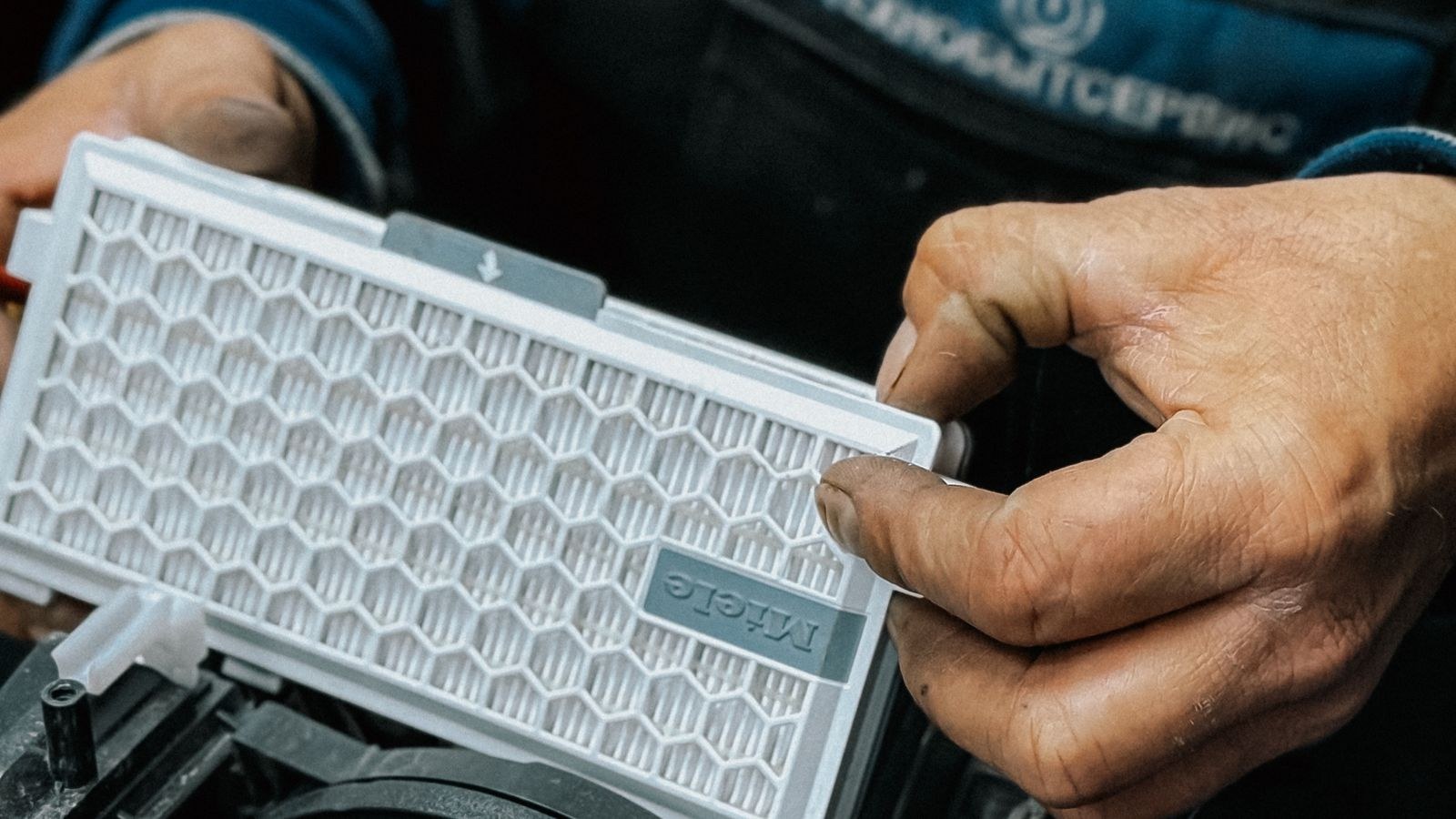
True HEPA captures at least 99.97 percent of particles at 0.3 microns, the hardest size to trap, and performs even better above and below that. Every allergen listed earlier is comfortably within its capability, so a true HEPA element is non-negotiable for allergy use.
Reject anything labeled “HEPA-type,” “HEPA-like,” or “99 percent HEPA.” Those phrases exist precisely because the filter does not meet the standard, and their capture rate for fine dander can be far lower. H13 grade media, sometimes marketed as medical grade, tightens performance further and is worth having if the price difference is modest, but adequate airflow matters more than chasing the last fraction of a percent.
Sealing is the quiet spec nobody advertises. A purifier with excellent media but a leaky housing lets unfiltered air bypass the filter through gaps around the edges. Look for descriptions of a sealed filtration system, and be suspicious of very cheap units with loose-fitting filter trays. For a deeper comparison of media grades and replacement pricing, see our guide to the best HEPA room air purifiers.
Do You Need Activated Carbon?
For pure allergy relief, no. Carbon adsorbs gases and odors, not particulates, so it contributes nothing against pollen or dander. It becomes worth paying for when your triggers include smoke, when pet odor is a concern alongside dander, or when chemical sensitivity accompanies your allergies.
If you do want carbon, look for real weight of granular or pelletized material rather than a thin impregnated sheet, which saturates within weeks. Otherwise, put the money toward higher airflow instead. A larger fan and more HEPA area will do more for allergies than a token odor layer.
Skip ionizers, plasma generators, and any feature that produces ozone. Ozone is a respiratory irritant that worsens asthma, which is exactly the population buying these machines. If a purifier includes an ionizer, make sure it can be switched off permanently, and check for certification confirming low ozone output.
Noise: Buy for the Setting You Will Actually Use
An allergy purifier only helps while it is running, and the room where it matters most is the bedroom where you spend eight consecutive hours. That makes noise a functional specification, not a comfort preference. A unit that is only effective at a 55 dB high setting will be switched off at bedtime and deliver nothing.
Look for published decibel figures at each speed. Under 30 dB on low is genuinely unobtrusive; 35 to 40 dB reads as soft white noise many sleepers like; above 45 dB is disruptive. Check whether display lights dim or turn off, since a bright panel is as bad for sleep as a hum. Sleep modes that drop the fan and kill the lights are a meaningful feature here rather than a gimmick.
Because bedroom placement matters so much, it is worth looking at units chosen specifically for overnight use; our picks for the best air purifiers for bedrooms weight quiet operation and night modes heavily.
Placement and Practical Use
Give the unit at least a foot of clearance on all sides, more if it draws air from the back. Pushing a purifier into a corner or against a headboard strangles airflow and can cut effective CADR substantially. Place it near where you spend time and near where allergens enter, which usually means somewhere between the bed and the door rather than in a far corner.
Run it continuously rather than in bursts. Airborne particles are constantly replenished by movement, pets, and infiltration, so a purifier only holds a room clean while the fan is moving. Keep windows and doors closed during high pollen periods, since an open window undoes hours of filtration in minutes. Vacuum and dust before, not after, running the unit on high, so it captures what you stir up.
Change filters on schedule. A clogged HEPA element restricts airflow and drops clean air delivery long before the machine sounds different. Rinse the washable pre-filter monthly, particularly in homes with pets, to keep the main filter from loading prematurely.
Budget Tiers
Below roughly $100 you can get a small true HEPA unit adequate for a home office or a small bedroom under 150 square feet. Expect modest CADR, basic manual controls, and cheaper filters that need frequent replacement.
The $150 to $300 band is where most allergy sufferers should shop. Here you find CADR figures in the 200 to 350 range, genuinely quiet low speeds, sealed housings, auto modes driven by a particle sensor, and filters that last a year. This tier covers a typical bedroom or living room with comfortable margin.
Above $400 you buy high-capacity coverage for open-plan spaces, heavier carbon, better sensors, and quieter operation at high output. If a single machine has to cover a great room or multiple connected areas, the best large room air purifiers compares that class directly. For the underlying specs common to every category, our general air purifier buying guide is a useful companion read.
Common Mistakes
The most common error by far is buying a purifier rated exactly to the room’s square footage, then running it on low for noise reasons and receiving a fraction of the advertised performance. Size up and run quietly instead.
Other frequent mistakes include choosing a filterless ionizing unit to avoid replacement costs, which relocates allergens to surfaces rather than removing them; putting one purifier in a hallway and expecting it to serve three bedrooms, when doors block airflow almost completely; running the machine with a window cracked during pollen season; and ignoring humidity, since dust mites and mold both collapse when the room is held below 50 percent. A purifier and a humidity strategy solve different halves of the same problem.
Frequently Asked Questions
How long before I notice a difference?
Airborne particle counts drop within an hour of running a correctly sized unit, but symptom relief usually takes one to two weeks because settled allergens in bedding and carpet continue to be re-suspended.
Should I get one purifier or several?
Several smaller units, one per room you actually use, outperform a single large machine in a hallway. Air does not move usefully between rooms with the doors closed.
Does it help with pet allergies?
Yes, meaningfully. Dander is fine and stays airborne for hours, which is exactly what HEPA filtration handles well. Combine it with frequent washing of pet bedding for the best result.
Is an air purifier worth it if I have central air with a good filter?
Often yes. A furnace filter only cleans air while the blower runs, and a portable unit in the bedroom delivers far more air changes in that specific room.
Can it replace allergy medication?
No. It reduces exposure, which can reduce how much medication you need, but it is a complement to medical advice rather than a substitute for it.
Final Thoughts
Buy for the room you sleep in first, check the pollen CADR against two-thirds of that room’s square footage, then deliberately size up so the unit hits five air changes an hour on a setting quiet enough to leave running all night. Insist on true HEPA in a sealed housing, skip the ozone-producing extras, and add carbon only if odors are part of your problem. Get those decisions right, keep the filters fresh, and the machine will do exactly what you bought it for.