Owen Bradley
 Active seating covers everything that deliberately refuses to hold you still. Wobble stools that tip in every direction, exercise balls that make you balance, saddle seats that split your legs and open your hips, leaning perches that put you halfway to standing. The pitch is appealing: instead of a chair doing the work of supporting you, your body does small continuous work supporting itself. The reality is more nuanced, because the same instability that keeps you engaged for an hour becomes fatigue by hour four. This guide compares the main active seating options, explains what each one is genuinely good at, and shows how to add them alongside a normal chair without creating new aches.
What Active Seating Is Trying to Solve
The problem is not sitting. The problem is sitting in exactly the same position for hours. Static loading compresses the same spinal discs, keeps the same muscles lengthened and the same ones shortened, and reduces the small pumping movements that circulate blood and spinal fluid. This is why people who sit in an excellent ergonomic chair without moving still feel stiff by evening.
Active seating attacks that by removing the option to stay still. An unstable or unsupported seat produces constant micro-adjustments in the trunk and hips, sometimes called postural sway. Those tiny corrections keep muscles firing at low levels, keep blood moving, and vary the load on the spine minute by minute. That is a genuine benefit, and it is measurable.
What active seating does not do is make sitting free of consequence. It swaps the fatigue of stillness for the fatigue of effort. Both have limits, which is why the successful approach is nearly always rotation rather than replacement.
Wobble Stools and Balance Stools
A wobble stool has a rounded or gimballed base that lets the seat tilt in any direction. You stay upright by making constant small corrections through your hips and trunk. Most are height adjustable through a gas lift, and better ones offer a tilt range you can tune or lock.
Best for: short to medium sessions of 20 to 60 minutes, standing desks used at sitting height, anyone who fidgets naturally, and workspaces where a full chair does not fit. They are also excellent for meetings and shared hot desks because they are light and roll out of the way.
Watch out for: no backrest at all, so tired core muscles mean a slumped upper back. Cheap models with an aggressive tilt range are exhausting rather than engaging; a moderate wobble is far more usable. Height range matters too, since a stool that will not reach standing-desk height loses most of its purpose. Models designed to pair with a raised work surface are covered in our roundup of the best standing desk stools.
Exercise Ball Chairs
A ball chair uses a stability ball, either loose or captured in a frame with a base and sometimes castors and a small backrest. The ball compresses and rolls slightly under you, producing continuous micro-movement, and the round shape naturally encourages a slightly forward pelvic tilt.
Best for: people who want the most movement per minute, short focused blocks, and anyone who likes being able to use the seat for stretching between tasks. Framed versions are far more practical for desk work than a bare ball, since they do not roll away when you stand.
Watch out for: ball size must match your height so your hips end up slightly above your knees, and the ball needs re-inflating every few weeks as it softens. A soft ball drops your hip height and quietly ruins the posture it was bought for. Bare balls also have no height adjustment at all, which makes them a poor match for a fixed-height desk. Our roundup of the best exercise ball chairs concentrates on framed designs that solve most of these practical issues.
Saddle Seats
A saddle seat is shaped like a horse saddle, so you straddle it with your thighs angled down and apart. That position holds the pelvis in a neutral or slightly forward tilt automatically, opening the hip angle to around 135 degrees without you having to think about it. Dentists, hygienists, jewellers and surgeons have used them for decades, which tells you something about their endurance for close, precise work.
Best for: anyone working over a surface who needs to lean in, people with tight hip flexors, and users who slouch in conventional chairs. Split-saddle designs relieve pressure in the middle and are worth the premium for many people.
Watch out for: a genuine adjustment period of two to three weeks, during which the inner thighs and seat contact areas complain. Saddles also sit high, so the desk usually needs to rise with them, and they can feel exposed in an open-plan office. Clothing choice becomes a real consideration too.
Leaning Stools and Perches
A perch or sit-stand stool sets you at 24 to 33 inches, so you are propped rather than seated, with a good share of your weight still on your feet. The hip angle stays wide open and the spine stays close to its standing shape.
Best for: standing desk users who need to take load off their feet without fully sitting, and anyone alternating between standing and seated work through the day. They are the easiest active option to adopt because they feel intuitive immediately.
Watch out for: a footprint that needs an anti-fatigue mat or a stable floor, since a perch on a slippery surface is genuinely unsafe. Weight still goes through the legs, so they do not solve foot fatigue entirely. Options that bridge the gap between a perch and a full chair appear in our roundup of the best standing desk chairs.
Kneeling Chairs
Kneeling chairs sit at the calmer end of the active spectrum. The forward-sloped seat rolls the pelvis forward and restores the lumbar curve, while a shin pad carries part of your weight. There is no instability to manage, so they are less tiring than a wobble stool while still asking your back muscles to hold the position.
Best for: chronic slouchers, people with tight hips, and sessions of 45 minutes to 2 hours. They have a small footprint and pair well with a conventional chair in a two-seat rotation.
Watch out for: shin pressure and knee flexion, which rules them out for anyone with knee problems. Fixed-angle budget models are a lottery, so adjustable seat angle and shin pad height are worth insisting on. Our guide to the best kneeling chairs focuses on models where both adjust properly.
Where Drafting Chairs Fit
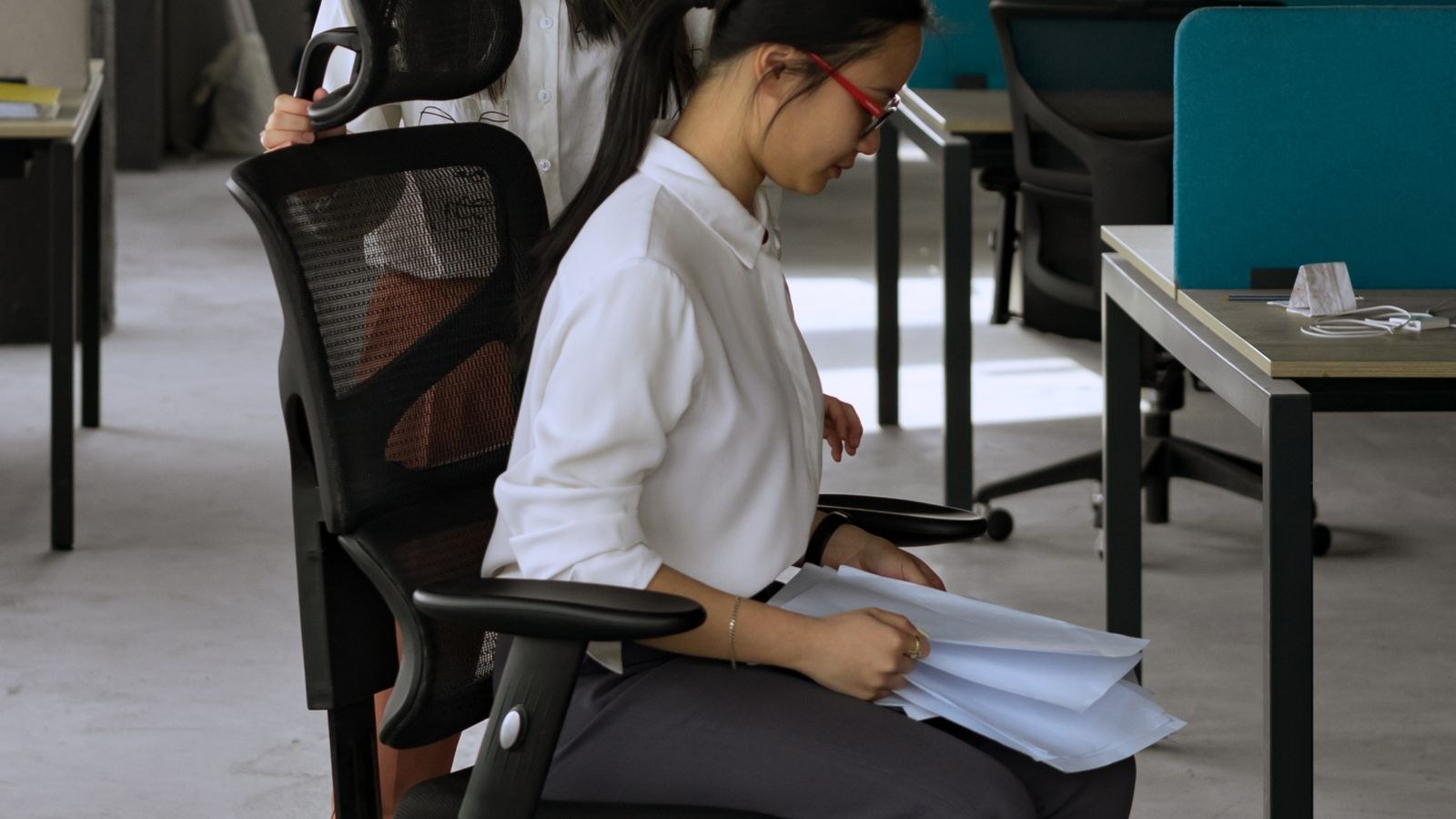
Drafting chairs are the compromise option and often the most practical purchase of the lot. They are essentially tall office chairs with a full backrest, adjustable arms and a foot ring, raised to suit a counter or standing desk. They are not active seating in the strict sense, since they support you fully, but they let you work at a raised surface with proper back support and use the foot ring to change leg position frequently.
For anyone who wants the height flexibility of a stool without giving up a backrest, this is the sensible middle ground, and it will comfortably support a full working day in a way that no wobble stool can. Our roundup of the best drafting chairs covers the models with the widest height ranges and the most usable foot rings.
Comparing the Options Honestly
- Most movement: exercise ball, then wobble stool. Both maximise micro-adjustment and both tire you fastest.
- Longest comfortable session: saddle seat and drafting chair, both capable of several hours once adapted.
- Easiest to adopt: leaning perch, which needs no adjustment period at all.
- Best for slouchers: kneeling chair and saddle seat, because both make slumping physically awkward.
- Smallest footprint: wobble stool, which also stows under a desk.
- Lowest cost: exercise ball, though framed versions cost as much as a decent stool.
- Worst for existing joint problems: kneeling chairs for knees, ball chairs for anyone with balance concerns.
None of them supports your arms, and only drafting chairs support your back. That single fact explains most of the disappointment people report after buying active seating expecting a full-day replacement.
How to Add Active Seating Without Creating New Pain
- Keep your supportive chair as the primary seat. Active options are additions, not replacements.
- Start with 15 to 20 minutes at a time, once or twice a day, for the first week.
- Build up by about 10 minutes a week. Most people plateau at 60 to 90 minutes per block, which is fine.
- Set the height so your hips sit slightly above your knees on every option, and raise the desk if needed rather than dropping the seat.
- Watch your upper back rather than your lower back. Backless seating fails first in the thoracic spine, and a rounding upper back is the signal to switch seats.
- Stop at the first sign of a new ache. Soreness in the trunk after a few days is adaptation; joint pain is not.
- Rotate deliberately. A useful pattern is 90 minutes supported, 30 to 45 minutes active, then a standing block.
Common Mistakes
Buying one to replace a proper chair. The most expensive mistake, because it usually ends with an unused stool and a return to a bad chair.
Going too hard too early. Four hours on a wobble stool on day one produces a sore back and a permanent conclusion that active seating does not work.
Ignoring desk height. Every active option changes your seat height, and a desk that stays put turns a good posture into a shrugged, reaching one.
Letting a ball go soft. An under-inflated ball drops your hips below your knees and reverses the pelvic tilt it was meant to create.
Choosing maximum instability. A moderate wobble keeps you engaged; an extreme one keeps you distracted and tires you within minutes.
Frequently Asked Questions
Does active seating strengthen your core?
It produces low-level continuous activation rather than the higher loads that build strength. Think of it as maintaining endurance and circulation, not as a substitute for training.
Can I use a wobble stool all day?
Very few people can. Without a backrest, the upper back fatigues and you begin to slump, which undoes the benefit. Treat 60 to 90 minutes as a realistic block.
Is a ball chair better than a stool?
A ball gives more continuous movement; a stool gives height adjustment, better stability when standing up and a longer service life. For desk work at a fixed-height desk, the stool is usually more practical.
Are saddle seats worth the adjustment period?
For people doing close, leaning work or those with tight hips, generally yes. The first two to three weeks are genuinely uncomfortable, so commit to the trial period or do not start.
What if I only want to buy one thing?
Buy a good supportive chair first. If you already have one, a height-adjustable stool with a moderate tilt is the most versatile single addition, since it works at both desk and standing-desk heights.
Final Thoughts
Active seating works best when you stop thinking of it as a chair and start thinking of it as one position among several. Wobble stools and ball chairs deliver the most movement and the shortest comfortable sessions; saddle seats and drafting chairs go the distance but ask more of your setup; perches slot naturally into standing desk routines. Whichever you add in 2026, keep a properly adjusted supportive chair as the anchor, raise the desk to match the new seat height, and build up slowly. Rotation between good positions beats any single seat, however clever the seat happens to be.