Owen Bradley
 Smart plugs look interchangeable. They are small, they cost less than a takeaway meal, and the packaging rarely draws attention to the one number that determines whether the device is safe for what you are about to plug into it. Every smart plug has a wattage limit, and exceeding it does not produce a polite error message — it produces heat, discolouration, melted plastic, and occasionally fire. The good news is that staying safe requires nothing more than reading two figures on the plug and one on the appliance. This guide explains what those numbers mean, why heaters and dryers are permanently off limits, and how to check any load in under a minute.
Watts, Amps, and Volts in Sixty Seconds
Three quantities describe every electrical load. Volts measure the electrical pressure your outlet supplies — nominally 120V in North America and 230V across most of Europe and much of Asia. Amps measure the current flowing. Watts measure the actual power consumed, and the relationship is simply watts equals volts multiplied by amps.
That formula is the whole story. A smart plug rated 15A on a 120V supply can handle 15 multiplied by 120, or 1800W. The same 15A rating on a 230V supply corresponds to 3450W. This is why identical-looking plugs are sold with wildly different wattage claims in different regions, and why a wattage figure quoted without its voltage is meaningless. When in doubt, work from the amp rating, because amps are what actually heat the contacts.
Typical Ratings You Will Encounter
Most consumer smart plugs fall into a narrow band. On 120V supplies, ratings of 10A (1200W), 12A (1440W), and 15A (1800W) are standard. On 230V supplies, 10A (2300W), 13A (2990W), and 16A (3680W) are common. Some compact plugs are rated far lower — 6A or even 3A — because the miniaturised relay and internal traces simply cannot carry more. Small does not mean equivalent, and a slim plug that fits neatly beside its neighbour may carry half the current of a chunky one.
Where to Find the Rating
The rating is printed on the plug body itself, usually on the back or side in small text, alongside the certification marks. Look for a line like “125V~ 15A 1800W MAX”. The manual and product listing repeat it, but the moulded text on the device is authoritative and survives long after the box is recycled. If you cannot find a rating anywhere on the plug, on the packaging, or in the listing, that is a red flag serious enough to justify returning the product.
Certification marks matter as much as the number. Look for the relevant safety mark for your region on both the plug and the packaging. An uncertified plug’s printed rating is an unverified claim, and the internal relay may be a component with no realistic margin. Our roundup of the best smart plugs covers certified models across price ranges, which is the simplest way to avoid the bottom of the market entirely.
Continuous vs Peak Ratings
Some manufacturers quote a maximum that is really a short-duration peak. A widely used electrical convention holds that a circuit should carry no more than 80 percent of its rating continuously, where continuous means three hours or more. Applying that to a 1800W plug gives a comfortable working limit of about 1440W for anything that runs for hours. Treat the printed maximum as a ceiling you approach briefly, not a target you sit at all evening.
Why Heaters and Dryers Are Off Limits
Resistive heating appliances are the most common cause of smart plug failure, and the reason is straightforward: they draw close to the maximum a household circuit can supply, continuously, for hours. A portable space heater on high typically pulls 1500W. A hair dryer draws 1200W to 1875W. A kettle, a portable air conditioner, an electric grill, or a garment steamer sit in the same territory.
Plug a 1500W heater into an 1800W-rated plug and the arithmetic looks fine. In practice, the plug spends the entire evening at 83 percent of its rating, well above the continuous-duty guideline. The relay contacts warm, the contact resistance rises slightly, that resistance generates more heat, and the cycle compounds. Over weeks the housing discolours and the contacts pit. Many manufacturers explicitly void the warranty for heating appliances, and several print “not for use with space heaters” directly on the device.
Large appliances on dedicated circuits — clothes dryers, ovens, electric water heaters, EV chargers — are further out of reach entirely. They frequently run on 240V dedicated circuits at 20A to 50A, orders of magnitude beyond any plug-in smart device. There is no consumer smart plug that safely switches these, and adapters that appear to make it possible are dangerous. Control at that level belongs to a hardwired smart relay or breaker installed by a qualified electrician.
Motor Loads and Inrush Current
Wattage on the label describes steady running power. Motors do something the label rarely mentions: at the instant of starting, they draw a surge — inrush current — that can be three to seven times the running current for a fraction of a second. A vacuum cleaner rated 900W may momentarily pull several times that.
Relays cope with brief surges better than sustained overload, but repeated inrush is what welds contacts shut. A welded relay is a plug that can no longer switch off, which is both useless and genuinely unsafe if it is controlling something you expect to stop. Compressor-driven devices are the worst offenders: refrigerators, freezers, dehumidifiers, and window air conditioners all cycle their compressors many times a day. If you plan to switch a motor load, give yourself far more headroom than the running watts suggest — roughly half the plug’s rating is a sensible ceiling — and look for a plug that specifically advertises motor or inductive load compatibility.
How to Check a Load in Under a Minute
- Find the appliance rating. It is on a label near the power cord, on the base, or on the back panel. It will show watts, amps, or both.
- Convert if needed. If only amps are shown, multiply by your supply voltage to get watts. If only watts are shown, divide by voltage to get amps.
- Read the plug’s rating from the moulded text on its body, not from memory or the listing.
- Apply the 80 percent rule for anything running more than a few hours, and a 50 percent rule for motors and compressors.
- Compare. If the appliance exceeds your adjusted limit, it does not go on that plug. There is no partial credit here.
Where multiple devices share the plug through a power strip, add all their wattages together and compare the total. This is the step people skip most often, and it is how a plug rated for a desk lamp ends up carrying a monitor, a laptop charger, a printer, and a small fan.
Devices That Are Always Fine
The great majority of household electronics sit far below any plug’s limit. LED lamps draw under 15W each. A television typically runs 60W to 150W. Laptop chargers land between 45W and 100W. Fans, phone chargers, speakers, routers, coffee grinders, and holiday lights are all comfortable. These are the natural home for smart plugs, and there is no need to overthink them. If you want a straightforward comparison of models suited to this kind of everyday switching, our list of the best smart home plugs is a good starting point.
When You Need More Than a Plug
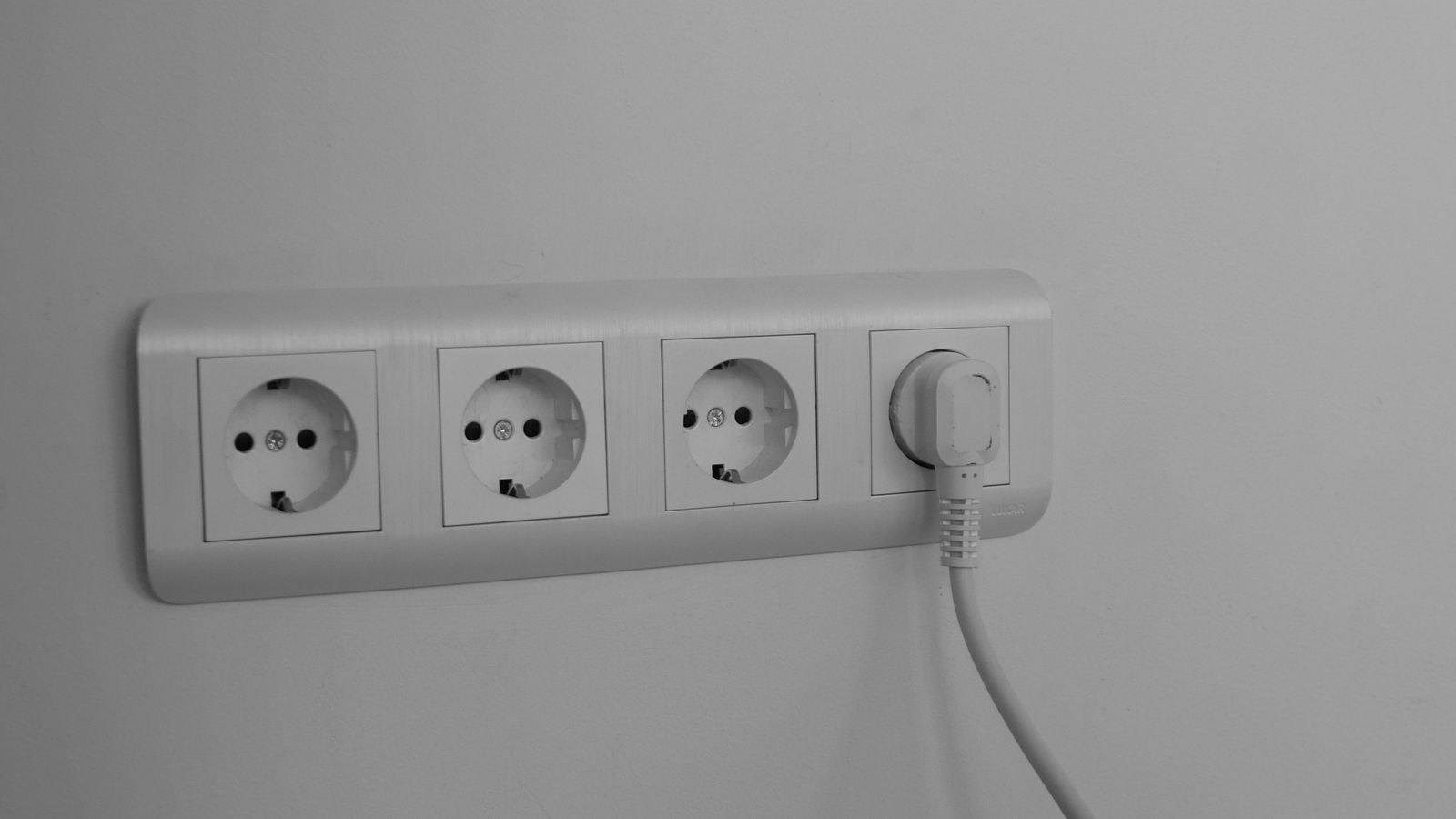
If the load is genuinely too large, the answer is not a bigger plug — it is different hardware. In-wall smart outlets replace the receptacle itself and are wired directly to the circuit, so they carry the full 15A or 20A the circuit is rated for without an extra set of contacts in the path. They also disappear behind a normal faceplate, which many people prefer aesthetically. Our overview of the best smart outlets compares in-wall options and their installation requirements.
For truly heavy loads, smart circuit breakers and hardwired contactors are the correct tool. These live in the panel, are installed by a licensed electrician, and switch dedicated circuits safely. They cost more and require professional work, but they are the only legitimate way to put app control on a water heater or an EV charger. If you are simply upgrading standard receptacles around the house, comparing the best power outlets will show you what modern receptacles offer.
Warning Signs You Have Overloaded a Plug
- Heat. A smart plug should feel barely warm. Uncomfortable to touch means stop using it now.
- Discolouration. Yellowing or browning around the socket openings indicates sustained overheating.
- Smell. Any acrid or burning-plastic odour means unplug immediately and dispose of the device.
- Buzzing or crackling. Audible arcing from the relay area is a serious fault.
- Failure to switch off. A relay that no longer opens has likely welded and must be replaced.
- Tripping breakers. Repeated trips suggest the circuit, not just the plug, is overloaded.
None of these are things to monitor and see how they develop. Every one of them means the device is removed from service permanently.
Common Mistakes
The mistakes cluster into a handful of patterns. People stack a power strip behind a smart plug and forget to add the loads. They assume a plug rated for one region’s voltage carries the same wattage everywhere. They read the peak rating and use it as a continuous target. They treat “1800W max” as permission to run a 1500W heater indefinitely. And they buy uncertified plugs where the printed rating was never independently verified in the first place. Avoiding all five is mostly a matter of doing the arithmetic once rather than trusting the shape of the device. For a wider view of features, certifications, and control options, the smart plug buying guide covers what else to weigh once safety is settled.
Frequently Asked Questions
Can I use a smart plug with a space heater if the wattage fits?
No. Even when the arithmetic works, heaters run continuously at near-maximum load, which is exactly the condition that degrades relay contacts. Most manufacturers prohibit it explicitly.
What happens if I exceed the limit?
Better plugs include thermal or overcurrent protection and shut down. Cheaper ones simply overheat, and the failure mode is melted plastic or welded contacts rather than a clean cutoff.
Is it safe to plug a power strip into a smart plug?
Only if the combined draw of everything on the strip stays well under the plug’s continuous limit. It is safe for a cluster of small electronics and unsafe the moment anything heating joins the strip.
Do smart plugs handle refrigerators?
A modern refrigerator’s running draw is modest, but the compressor inrush is punishing and the consequence of a failed relay is spoiled food. If you do it, use a plug rated well above the load and one that resumes its last state after a power cut.
Are higher-rated plugs physically bigger?
Generally yes. Higher current requires a larger relay and heavier internal conductors, which is why the slimmest plugs tend to carry the lowest ratings.
Final Thoughts
Smart plug wattage limits are not a suggestion from a cautious legal department; they describe the point at which the internal relay stops being able to carry current safely. Read the amp rating on the plug body, read the rating on whatever you intend to connect, keep continuous loads under 80 percent and motor loads under about half, and put heaters, dryers, and anything on a dedicated circuit permanently out of scope. Do that and a smart plug is one of the most reliable devices in the house. Ignore it and it becomes the most dangerous.