Owen Bradley
 Not every kitchen has a spare 60cm of cabinet run and a plumbing connection waiting to be used. Flats, older terraces, student houses, campervans, and rentals with strict alteration clauses all share the same problem: the dishes still pile up, but a built-in dishwasher is not an option. Two formats solve that, and they are frequently confused. A portable dishwasher is a freestanding unit on castors that rolls to the sink and hooks onto the faucet. A countertop dishwasher is a small box that sits on the worktop and either connects to the tap or fills from an internal tank. This guide compares portable vs countertop dishwashers on capacity, hookup, water use, storage, and noise, and finishes with a clear recommendation for renters and genuinely tiny kitchens.
What Each Format Actually Is
A portable dishwasher is essentially a full dishwasher mechanism in a freestanding cabinet, usually around 45cm to 60cm wide and roughly waist height, mounted on wheels. It has a finished top that doubles as a small work surface, and a quick-connect hose that clamps to a kitchen tap when you want to run a load. When it is not in use you roll it against a wall or into a corner.
A countertop dishwasher is much smaller, typically around 42cm to 55cm wide and 44cm tall, sized to sit on a worktop under standard wall cabinets. It holds a fraction of the load and generally offers two ways to fill: a faucet adapter like the portable, or a manual fill reservoir you pour water into, which removes the need for any plumbing connection at all.
The Shared Constraint: Draining
Both formats drain the same way, into the sink via a hose that hangs over the edge or clips to the tap assembly. That means both must live within hose reach of a sink when running, which is typically about 1.5 metres. Neither is truly free of the sink; they are free of permanent plumbing, which is a different and much more useful kind of freedom for a renter.
Capacity: The Decisive Difference
Capacity is where the two diverge most sharply, and it is usually the factor that settles the choice. A portable dishwasher generally handles eight to twelve place settings, which is close to a slimline built-in machine and enough for a couple or a small family to run once a day. A countertop model typically manages two to six settings, which realistically means the dishes from one or two people for a single meal, plus a few glasses.
Just as important is item size. Portable machines take dinner plates, mixing bowls, and most saucepans without complaint. Countertop machines are height-limited inside, so large dinner plates often will not stand up, tall pots will not fit at all, and a single frying pan can consume most of the basket. If your cooking generates pans and serving dishes rather than just plates and mugs, that limitation bites daily. For a broader look at how compact appliances handle real household volumes, our roundup of the best compact washing machines covers the same capacity trade-offs in the laundry context.
Faucet Hookups and Whether Your Tap Will Cooperate
Both formats attach to a kitchen tap using an adapter that replaces the tap’s aerator. This is the single biggest practical stumbling block, and it is worth checking before you buy anything. Standard threaded taps accept the supplied adapter easily. Problems arise with pull-out spray taps, taps with hidden or non-standard aerator threads, and many modern designer taps that have no removable aerator at all.
If your tap will not take an adapter, your options are to fit a replacement tap, use a Y-splitter on the supply where accessible, or choose a countertop model with a manual fill tank and sidestep the connection entirely. Renters unable to change the tap should treat the tank-fill capability as close to essential. If you are already planning to replace the tap, it is worth reviewing the best smart faucets to pick one with a conventional aerator thread, and checking the connection hardware in our guide to the best washing machine hoses, since fill and drain hose quality determines whether a temporary connection stays leak-free.
Tank Fill in Practice
Manual fill sounds like a compromise and largely is, but it works. You pour roughly four to five litres of water into a reservoir with a jug before starting the cycle. It removes every plumbing question and means the machine can run anywhere with a power socket, including a bedroom, an office kitchenette, or a campervan. The costs are the small chore of filling before each load and, on some models, a shorter or less thorough cycle because the water volume is fixed rather than replenished.
Water and Energy Use Compared
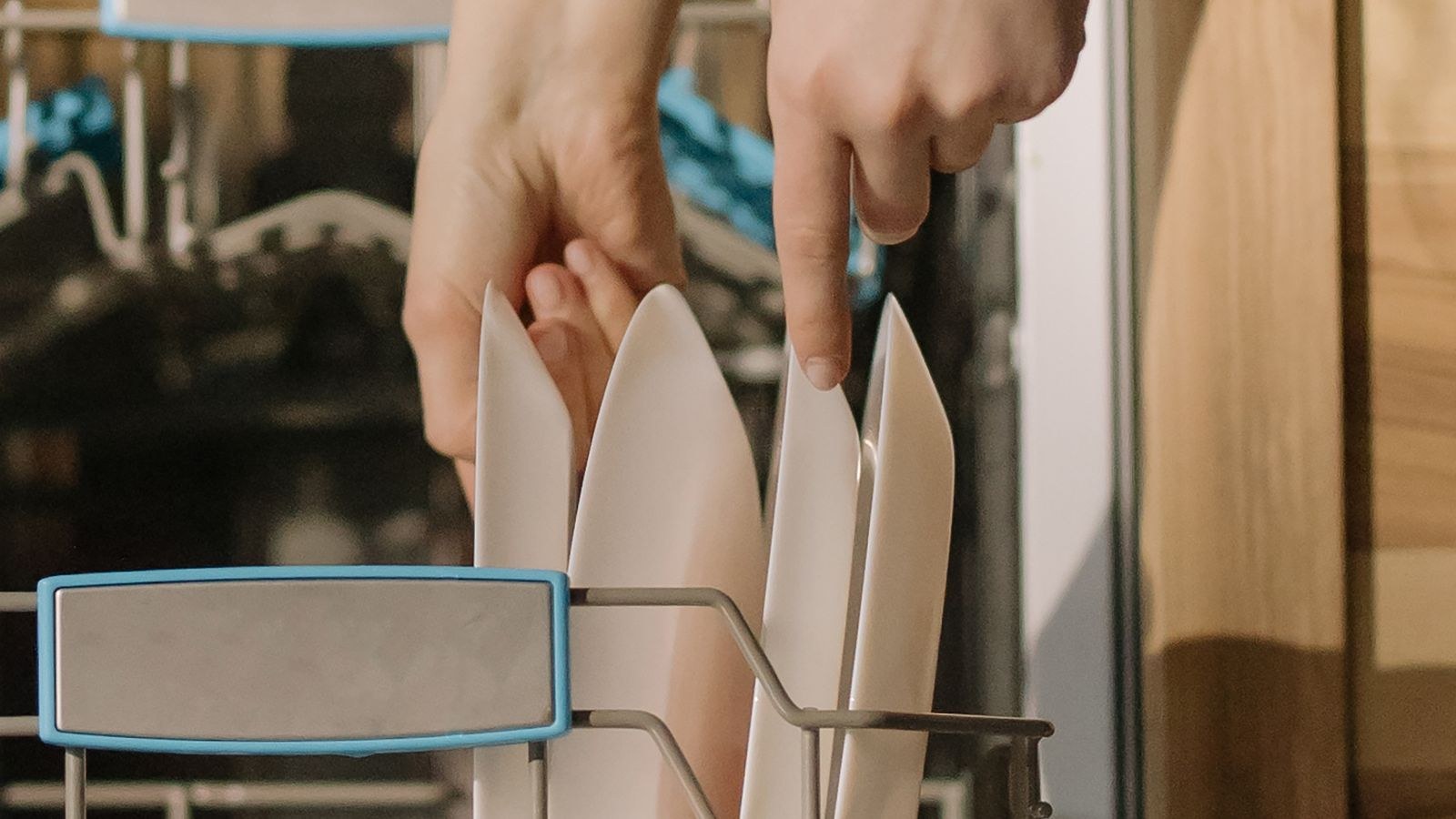
Countertop machines use less water and less electricity per cycle, simply because they heat and circulate a smaller volume. Typical figures land in the region of five litres per cycle for a countertop and eight to twelve litres for a portable. On paper the countertop looks dramatically more efficient.
Per load, though, the picture changes. Because a countertop holds so much less, a household producing a portable-sized pile of dishes will run the small machine two or three times to clear it. Multiply the small figure by that frequency and the efficiency advantage narrows sharply, sometimes disappearing entirely, while the time cost rises because each cycle takes an hour or more. Countertop machines are genuinely more efficient for genuinely small households; for anyone else they mostly relocate the cost.
Both Beat Hand Washing
Worth stating plainly: either format uses less water than washing the same quantity of dishes under a running tap. Hand washing is only competitive if you fill a bowl and are disciplined about it. So the efficiency comparison that matters is between the two machine formats and the way you currently wash, not against an idealised sink routine nobody actually follows.
Space, Storage, and Where It Lives
This is where the two formats trade places. A countertop machine needs no floor space at all, but it permanently occupies a chunk of worktop roughly the size of a large microwave. In a kitchen with two metres of counter, that is a serious sacrifice, because worktop is the scarcest resource in a small kitchen. It can be stored in a cupboard between uses, but a 20kg box that has to be lifted out and plumbed in each time will quickly stop being used.
A portable machine takes no worktop at all and adds a small usable surface on its lid, but it needs a floor footprint roughly equivalent to a kitchen base unit and a clear path to roll to the sink. In a galley kitchen where two people cannot pass, wheeling an appliance across the floor twice a day is genuinely irritating. The honest question is which resource you have more of: floor or counter.
Weight and Mobility
Portables are heavy, often 40kg or more, but the castors make that irrelevant on hard flooring. On thick carpet or over a threshold strip they are much harder to move. Countertop units are light enough to carry, typically 20kg to 25kg, which matters if you move house often or need to stow the machine away between uses.
Noise and Cycle Times
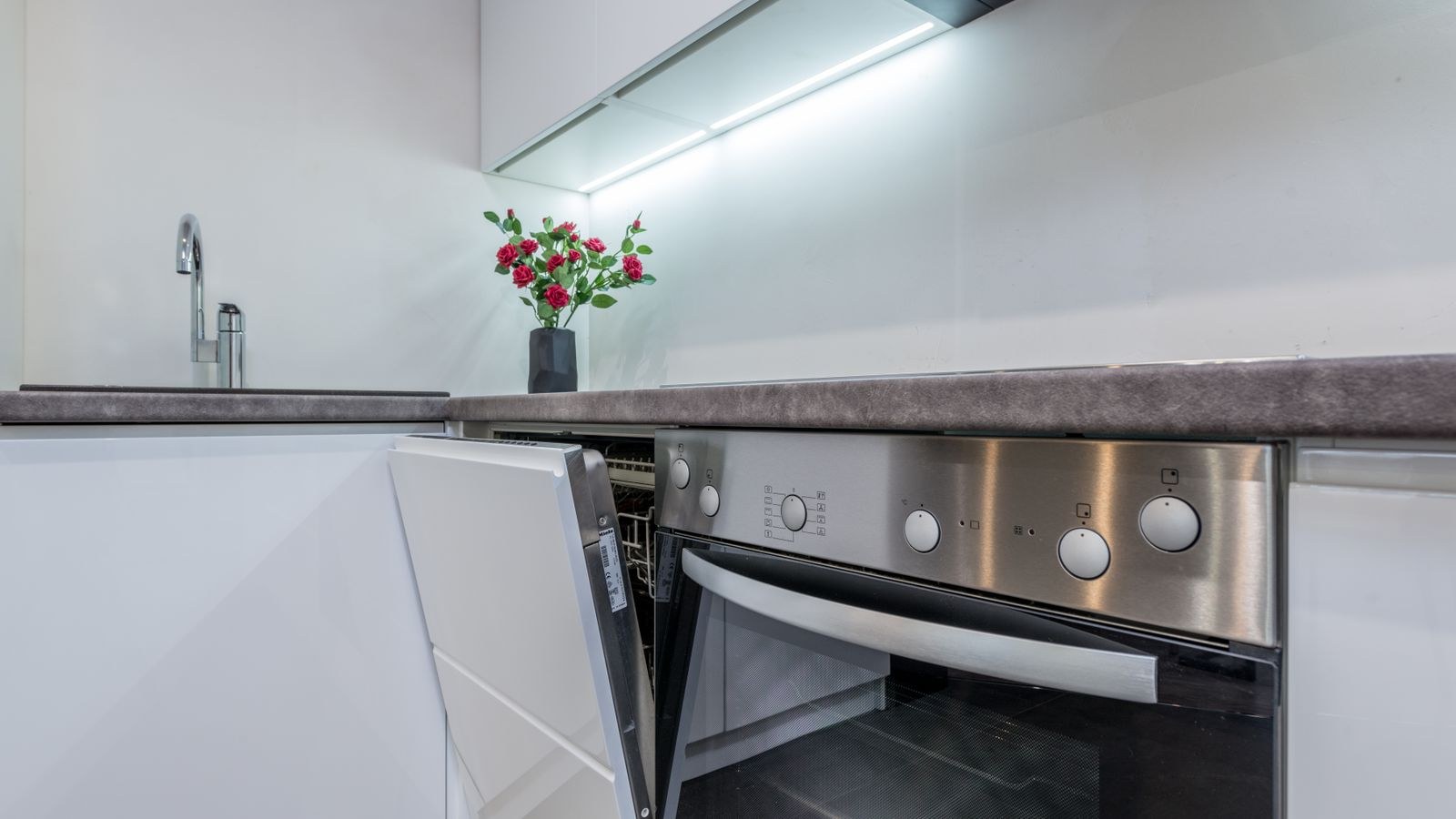
Neither format is quiet by built-in standards. An integrated dishwasher benefits from cabinet panels and surrounding units damping the sound; a freestanding or countertop unit radiates noise directly into the room. Expect somewhere in the region of 52dB to 62dB for both, with portables often slightly better insulated than countertops because there is more cabinet to line.
Countertop machines have an extra disadvantage: sitting at ear height on a worktop, the same decibel figure sounds louder and more intrusive than it would from floor level. In a studio flat or open-plan space, run the machine when you are out of the room. Cycle times run roughly one to two hours for both, with countertop quick programmes often around thirty to fifty minutes for lightly soiled loads.
Cost and Long-Term Value
Countertop machines are the cheaper purchase, typically sitting well below portables. Portables cost more but deliver capacity closer to a real dishwasher, and they hold their usefulness if you later move to a home with space. Neither can usually be converted into a built-in unit, so treat both as appliances suited to a phase of life rather than permanent kitchen infrastructure.
Factor in consumables too. Both need dishwasher tablets, rinse aid, and in hard water areas some form of softening, and both need the filter cleaning regularly. Small machines are less forgiving about filter neglect because their spray systems are lower powered to begin with.
Which One Should You Buy
- Choose a countertop if you live alone or as a couple, cook simply, have no floor space at all, and can spare a permanent block of worktop.
- Choose a countertop with a fill tank if your tap will not take an adapter, or if you need to run the machine somewhere without a sink nearby.
- Choose a portable if there are three or more of you, if you cook with pans and large dishes, or if worktop space is more precious than floor space.
- Choose a portable if you expect to move to a larger kitchen soon, since the capacity remains useful where a countertop quickly feels token.
For renters specifically, the portable is usually the better appliance and the countertop the better fit. If you have any floor space at all, take the portable. If you truly do not, a tank-fill countertop is the format that asks nothing of the landlord’s plumbing. Similar reasoning applies across small-space appliances generally, as our guides to the best portable washing machines for apartments and the best mini washing machines explain in the laundry context.
Common Mistakes
The most frequent error is buying before checking the tap. An adapter that does not fit turns a new appliance into a returns problem. The second is underestimating how small a countertop interior really is; read the maximum plate diameter, not just the place setting count. The third is buying a countertop to save space and then losing more usable worktop than the dishwasher saves in effort.
Two more are worth avoiding. Do not leave the drain hose loosely balanced in the sink, because a hose that jumps out mid-cycle floods a floor; secure it properly. And do not disconnect the faucet adapter by yanking the hose, since repeated stress on the coupling is the most common source of leaks in both formats.
Frequently Asked Questions
Can either type be used without any plumbing?
Only a countertop model with a manual fill tank. It still needs somewhere to drain, but that can be a bucket or a sink within hose reach. Portables always require a tap connection.
How many people can a countertop dishwasher serve?
Realistically one or two. Anything more means running it several times a day, which costs more time than it saves and wears the machine faster.
Do portable dishwashers clean as well as built-in ones?
Broadly yes. They use the same spray arm and filtration principles and often the same cycle range. The main differences are noise and the inconvenience of hooking up each time, not cleaning quality.
Will a countertop dishwasher fit under wall cabinets?
Most are designed to, at around 44cm tall, but measure your own gap. You also need clearance above to open the door or lid, which some designs require, so check the opening mechanism before buying.
Final Thoughts
Portable and countertop dishwashers solve the same problem from opposite directions, and the right answer follows from your kitchen’s geometry rather than the spec sheet. Count the people you feed, look at what you cook, then decide whether you can spare floor space or worktop space, and confirm your tap will accept an adapter before anything else. A portable gives you a real dishwasher’s capacity at the cost of a base-unit footprint; a countertop gives you a genuinely tiny machine that asks nothing of your plumbing. Both are far better than a permanently full sink, and either can be moved out when you finally get a kitchen with room for the built-in version.