Owen Bradley
 The dream of a cinema-sized picture at home has never been more affordable, and yet the projector vs TV decision trips up almost everyone who faces it. A projector can throw an image three times the width of a large television for similar money, which sounds like an obvious win until you switch on a lamp and watch the picture wash out. A television delivers brilliant, effortless images in any light, but caps out at a size that a projector reaches easily. This guide compares them on the things that actually decide movie night: screen size, brightness, room conditions, sound, running cost and day-to-day convenience.
Screen Size: The Projector’s Unbeatable Advantage
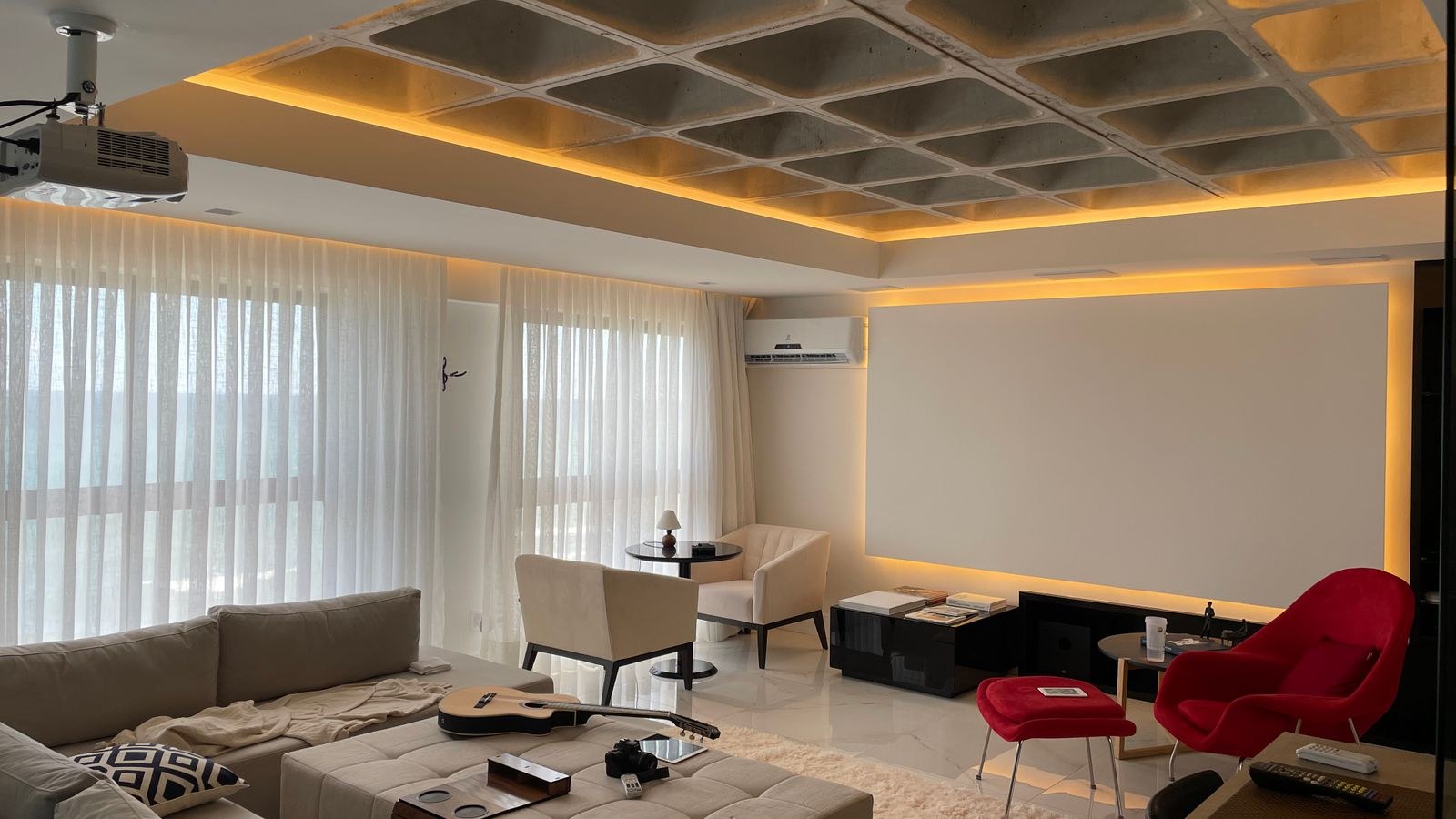
Nothing else in home entertainment scales the way projection does. Moving a projector back a metre or adjusting its zoom can take an image from 90 inches to 120 inches at no extra cost. Televisions, by contrast, get dramatically more expensive with every size class, and the very largest panels remain a serious investment.
Size is not vanity. A larger image fills more of your field of view, which is precisely what creates the immersive sensation people associate with cinemas. There is a practical threshold where a film stops being something you watch on a screen in the corner and becomes something surrounding you, and projection reaches it far more cheaply.
There are limits. Every projector has a throw ratio dictating how far it must sit from the wall for a given width, and a small room may not allow the distance you need. Short-throw and ultra-short-throw designs solve this by sitting close to the wall, though they cost more. Measure your room before you fall in love with a screen size.
Brightness and Ambient Light: The TV’s Trump Card
This is where most projector disappointment originates. A television produces its own light, and modern panels are bright enough to look excellent in a sunlit room. A projector reflects light off a surface, so any ambient light in the room adds to the black areas of the image, lifting them toward grey and crushing contrast.
In a genuinely dark room, a good projector delivers a large, contrasty, cinematic picture that is hugely satisfying. Open the curtains and the same image can look washed out and flat. This is why the honest first question is not which technology is better, but whether you can make your room dark when you want to watch.
If you cannot, the answer is not automatically a television. Brighter projectors combined with an ambient-light-rejecting screen can produce a very watchable image with lamps on, and shortlists of the best projectors for light rooms focus on exactly that scenario. Expect to spend more for that capability, and expect it to remain a compromise compared with a bright panel.
Understanding Brightness Claims
Projector brightness is quoted in lumens, and the figures on budget listings are often measured in ways that flatter the product. Look for standardised measurements where possible, and treat unusually high claims at very low prices with scepticism. Brightness also drops as lamps age, so a projector three years into its life will not match its first week.
Picture Quality Beyond Size
Televisions win on measurable image quality almost across the board. They achieve deeper blacks, higher peak brightness, better colour volume and more convincing high dynamic range, simply because they emit light directly and can control it pixel by pixel. Projected black is only as dark as the room and the screen material allow.
What projection offers instead is scale and a gentler, more film-like quality that many viewers find easier on the eyes over a long session. Reflected light is less fatiguing than staring into a bright emissive panel in a dark room, which is part of why cinemas feel comfortable for hours.
For fast content there is another consideration. Televisions have pulled far ahead on refresh rate, response time and input lag, which matters enormously if you game. A large panel from a roundup of the best large screen gaming TVs delivers the responsiveness that most projectors still cannot match, and if you want maximum scale on a panel, the best 85 inch gaming TVs narrow the size gap considerably.
Sound: Both Need Help
Neither option sounds good on its own. Televisions have become so thin that there is no room for speakers capable of real bass, and their drivers usually fire downward or backward. Projectors are worse still, since their small built-in speakers compete with the noise of a cooling fan sitting near the audience.
Budget for audio from the start rather than treating it as an upgrade later. For most living rooms a soundbar is the pragmatic answer, adding clear dialogue and real low end without a rack of equipment or cables across the floor. Comparing the best soundbar speakers is the simplest route to a dramatic improvement.
If you are building a dedicated room and want the full effect, discrete speakers give you genuine surround placement and much greater output. A set from the best home theater speakers transforms a projector setup in particular, because the large image finally has sound to match its scale.
Installation and Living With Each
A television is close to effortless. Unbox it, place it on a stand or bracket, plug it in, and it works. It occupies a fixed footprint, and its remote turns it on in seconds. For casual viewing, background television and quick sessions, that convenience is worth a great deal.
A projector requires more thought. It needs mounting or a stable surface at the right distance, alignment with the screen, and consideration of cable routing. Ceiling mounting looks tidy but is a real job. Many people compromise with a coffee table placement, which works but means realigning occasionally and living with someone walking through the beam.
Then there is the screen. Projecting onto a white wall is possible and many people do it, but a proper screen improves contrast, colour accuracy and uniformity noticeably. Retractable screens keep the room ordinary when not in use, which matters if your cinema is also your living room.
Noise and Heat
Projectors run hot and use fans, and in a quiet scene that fan noise is audible. Quieter models exist and cost more. Placing the unit behind the seating rather than above it helps. Televisions are silent, which in a dedicated cinema room is a meaningful advantage nobody mentions until they have lived with a projector.
Running Costs and Longevity
The purchase price is only part of the picture. Lamp-based projectors need replacement bulbs after a few thousand hours, and those bulbs are not cheap. Laser and LED light sources last far longer, often the practical life of the unit, which is why they now dominate the mid and upper market despite a higher initial price.
Televisions have no consumable parts and typically run for many years without intervention. They also draw less power than a bright projector in most cases. If you watch several hours a day, that difference accumulates.
Consider replacement cycles too. Television technology moves quickly and panels get better and cheaper each year, so many people upgrade every five to seven years. A good projector paired with a quality screen can last longer, because the screen never needs replacing and the improvement curve is flatter.
Which One Fits Your Room
- You can black out the room: a projector delivers scale a television cannot touch at the price.
- The room is bright and used all day: a television is the reliable choice.
- You game competitively: a television, for input lag and refresh rate.
- You watch a few films a week, not daily television: projection suits event viewing better.
- The screen must vanish when not in use: a projector with a retractable screen.
- You want it simple and permanent: a television, every time.
- Space is tight and viewing distance is short: a television or an ultra-short-throw projector.
Plenty of households run both: a television for everyday viewing and a projector for weekend films. If budget allows, that combination sidesteps the compromise entirely and is more common than you might expect.
Mistakes People Regret
The most frequent error is buying a very cheap projector expecting cinema results, then blaming the technology when a dim, low-contrast image disappoints in a normal room. Entry-level projection is genuinely limited, and a mid-range television will outperform it in every way except size.
The second is forgetting the screen and the audio in the budget. A projector without a proper screen and decent speakers delivers perhaps half the experience it is capable of. The third is ignoring throw distance and discovering the unit cannot produce the image size the room was chosen for. Measure first, then shop.
Frequently Asked Questions
Can I use a projector in a room with windows?
Yes, with the right combination. A brighter projector, blackout curtains for evening viewing, and an ambient-light-rejecting screen make daytime use workable. Without those, expect a washed-out picture whenever light enters the room.
Is a projector cheaper than a large television?
For very large images, generally yes, especially beyond the sizes where panel prices climb steeply. Once you add a screen, mounting and speakers, and factor in lamp replacement on older designs, the gap narrows considerably.
Do projectors work for gaming?
Casual gaming works well and the scale is genuinely enjoyable. Competitive play is harder, since input lag and refresh rates typically trail modern televisions. Check for a dedicated low-latency game mode if this matters to you.
How dark does the room need to be?
Darker is always better, but you do not need total blackout for evening viewing with a decent projector. Controlling direct light falling on the screen matters most, so aim lamps away from it and cover any window facing the screen.
Final Thoughts
There is no universal winner, only a better match for your room and your habits. A television gives you brightness, simplicity, responsiveness and picture quality that projection cannot equal, in any lighting, with no setup and no consumables. A projector gives you scale, and scale is the single ingredient that makes home viewing feel like an event rather than a routine. Be honest about how dark your room gets, how you actually watch, and whether you will budget for a screen and proper sound. Answer those three questions before you shop in 2026 and the choice will make itself.