Owen Bradley
 A ceiling fan is one of the few home upgrades that improves comfort, cuts energy bills and changes the look of a room all at once. But the fan that transforms a bedroom can be an expensive disappointment in a kitchen, and the one that moves air beautifully across an open living room may be dangerously wrong above a shower. Room type dictates blade span, mounting method, motor style, moisture rating and even how the fan should be controlled. This guide walks through every space in a typical home, explains what changes from room to room, and gives you a practical framework for choosing so you are not left guessing in the lighting aisle.

How a Ceiling Fan Actually Cools a Room
The first thing to understand is that a ceiling fan does not lower air temperature. It moves air across your skin, which speeds evaporation and makes you feel several degrees cooler than the thermostat reads. That distinction drives almost every decision that follows. A fan only helps people it can reach, so coverage matters more than raw power, and running a fan in an empty room wastes electricity without cooling anything.
The number that describes real performance is CFM, or cubic feet per minute of airflow. A capable full-size fan moves somewhere between 4,000 and 7,000 CFM on its highest setting. Efficiency is expressed as CFM per watt, and this is where good motors separate themselves: two fans can push identical air while one draws three times the power. When you compare models, look at high-speed CFM first, then check what it costs in watts to get there.
Direction matters too. Nearly all modern fans have a reversing switch. Counterclockwise in summer pushes air straight down for the cooling breeze. Clockwise in winter, on the lowest speed, pulls air up gently and pushes the warm layer trapped at the ceiling back down the walls without creating a draught. Using that winter mode properly can meaningfully reduce heating runtime in rooms with tall ceilings.
Bedrooms: Quiet Comes First
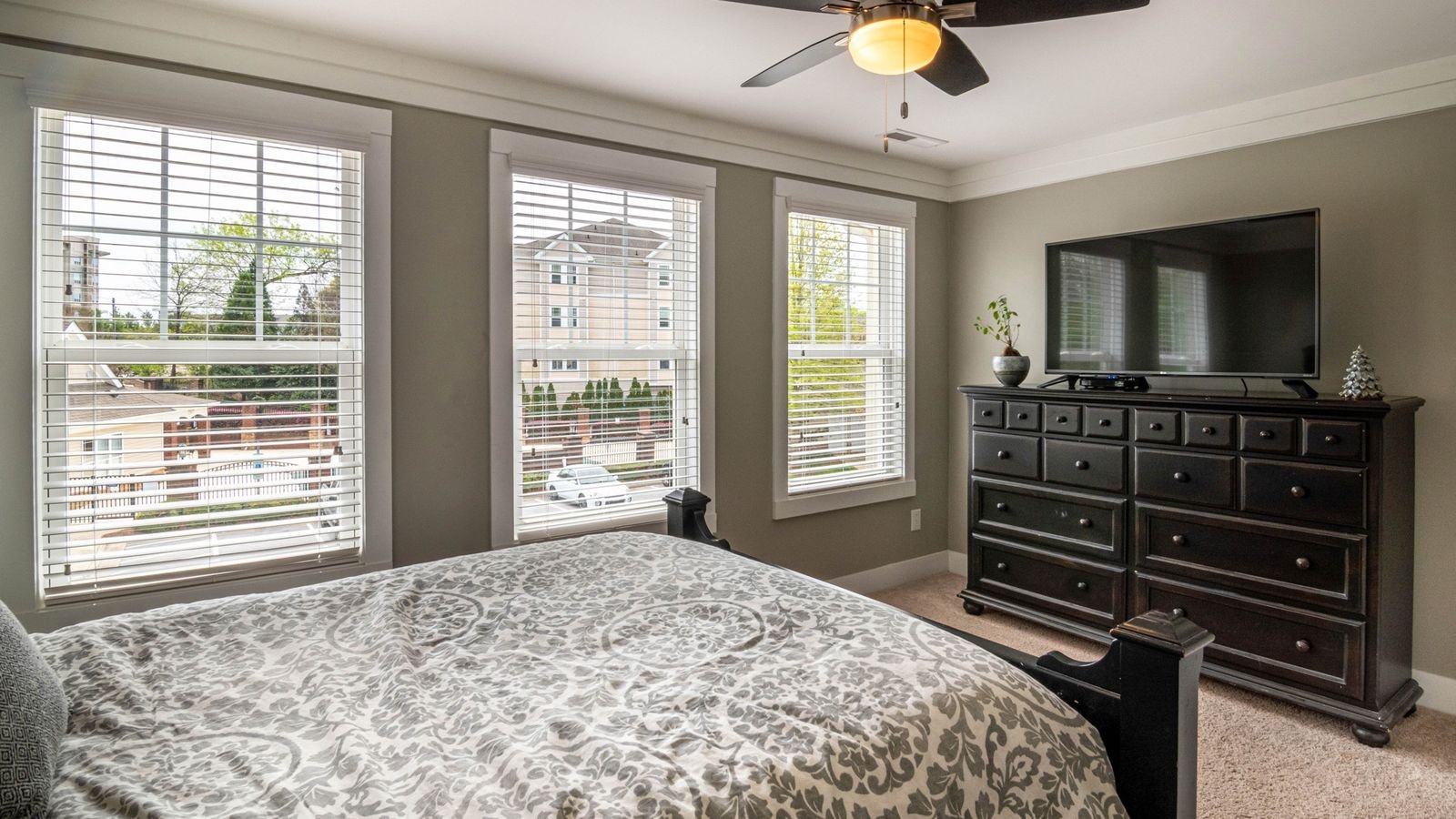
In a bedroom, noise is the specification that matters most, and it is the one manufacturers advertise least. A fan you cannot hear at low speed is worth more than one with an extra 500 CFM. Motor hum, blade wobble, pull-chain rattle and the faint buzz of a cheap dimmable light kit all become intolerable at two in the morning even though none of them registered in the showroom.
DC motors have a real advantage here. They run quieter at low speed, offer more usable speed steps, and avoid the low-frequency hum that some AC motors produce when dimmed. Look for models with sealed bearings and a remote or wall control rather than pull chains, which sway and click in their own airflow. Blade balance is the other half of the equation, and it is worth spending a few extra minutes at installation to check.
Sizing for a bedroom is usually straightforward. Most bedrooms fall between 144 and 225 square feet, which puts you in 44 to 52 inch territory. Position the fan over the centre of the room rather than centred over the bed, since the strongest downdraft directly over a sleeper’s face is more irritating than pleasant. If you want to compare well-reviewed options for this exact use case, the roundup of the best ceiling fans for bedroom spaces is a good starting point, and there is a more focused list of the best quiet ceiling fans for bedroom use if silence is your single priority.
Living Rooms and Great Rooms: Coverage and Ceiling Height
Living areas are usually the largest open spaces in a house, and they are where undersized fans fail most visibly. A 42 inch fan in a 400 square foot great room will spin cheerfully and cool a circle about the size of a rug. Rooms over 400 square feet generally need a 60 inch or larger fan, or two smaller fans spaced across the room, which often looks better and distributes air more evenly than one enormous unit.
Ceiling height changes the mounting hardware. Standard 8 to 9 foot ceilings work with the short downrod supplied in the box. Anything above 10 feet needs an extended downrod so the blades sit roughly 8 to 9 feet off the floor, which is the height where the airflow reaches people rather than dissipating overhead. Vaulted and sloped ceilings need an angled mount rated for the slope, and buying the correct canopy at the same time as the fan saves a second trip. For those situations the guide to the best ceiling fans for high ceilings covers downrod lengths and slope limits in detail.
Living rooms are also where the light kit earns its keep, since the fan often occupies the only ceiling box in the room. If it will be your primary light source, check the lumen output rather than the wattage, confirm it dims smoothly with your switch, and look at whether the LED module is replaceable. Integrated modules that cannot be swapped turn a fifteen-year fan into a five-year one. The selection of best ceiling fans with lights is worth reviewing before you commit.
Small Rooms, Nurseries and Home Offices
Small rooms have the opposite problem to great rooms: too much fan. A powerful 56 inch fan in a 100 square foot office produces a gale that scatters paper and makes the room feel uncomfortable on anything but the lowest speed. Under 100 square feet, look at 29 to 36 inch fans; from 100 to 175 square feet, 42 to 44 inches is usually right.
Clearance is the second constraint. Building practice calls for blades at least 7 feet above the floor and roughly 18 inches of clear space from the nearest wall or sloped surface. In a room with an 8 foot ceiling, that combination often rules out a downrod entirely and points you toward a flush or hugger mount. The comparison of the best ceiling fans for small room layouts and the list of best low profile ceiling fans both address this constraint directly.
In a nursery, add a further consideration: a fan that runs quietly and steadily provides useful white noise, but a light kit that cannot be dimmed low is a liability during night feeds. Remote controls with a memory function so the fan resumes its last speed after a power cut are worth seeking out here.
Bathrooms and Damp Spaces
Bathrooms are the one room where the wrong fan is a genuine safety issue rather than a comfort compromise. Standard fans are rated for dry locations only. A bathroom fan must carry at least a damp location rating, and a fan positioned where it can be hit by spray, or one used in an outdoor covered area, needs a wet rating. These ratings cover sealed motor housings, moisture-resistant blade material and corrosion protection on the hardware.
Blades matter as much as the motor. Standard MDF or plywood blades absorb humidity, swell and warp, which produces the wobble that eventually loosens the mounting. ABS plastic, sealed composite or all-metal blades are the correct choice for a humid room. Note also that a ceiling fan is not a substitute for an extractor: it circulates moist air rather than removing it, so you still need proper ventilation. The list of the best bathroom ceiling fans is built around damp and wet ratings specifically.
Kitchens, Laundries and Utility Rooms
Kitchens sit somewhere between living rooms and bathrooms. Grease aerosolises and settles on blades, so smooth, wipeable surfaces beat textured wood. Avoid mounting a fan directly over a cooktop, where the downdraft disrupts burner flames and pulls cooking smells through the whole room. Off to the side, over a table or island, works far better. Laundry rooms need the same moisture tolerance as bathrooms if the space is unventilated.
Room-by-Room Size Reference
- Up to 75 sq ft (small bath, walk-in closet): 29 to 36 inch blade span, flush mount.
- 76 to 144 sq ft (small bedroom, office, nursery): 36 to 44 inches.
- 145 to 225 sq ft (standard bedroom, dining room): 44 to 52 inches.
- 226 to 400 sq ft (living room, primary bedroom): 52 to 60 inches.
- Over 400 sq ft (great room, open plan): 60 inches or larger, or two fans.
Controls, Smart Features and Wiring
How you control the fan affects daily satisfaction more than most people expect. Pull chains are cheap and reliable but require standing under the fan. Handheld remotes are convenient until they vanish into the sofa. Wall-mounted controls are the best of both, and smart fans add scheduling, thermostat integration and voice control.
The wiring caveat is important: many older ceiling boxes carry a single switched cable, meaning fan and light cannot be controlled separately from the wall. A remote receiver solves this without rewiring. Also confirm the box itself is fan-rated and braced to the joist, since a standard lighting box is not designed to carry a spinning load and is the most common installation shortcut that ends badly.
Mistakes to Avoid
- Choosing blade span by appearance rather than by room square footage.
- Hanging a dry-rated fan in a bathroom because it looked right.
- Mounting flush against a high ceiling, where airflow never reaches occupants.
- Reusing a non-fan-rated electrical box to save time.
- Ignoring CFM per watt and paying for it every month afterwards.
- Leaving fans running in empty rooms, which cools nobody.
Frequently Asked Questions
Can one fan cool two connected rooms?
Not effectively. Airflow drops off sharply beyond the blade circumference, so an open-plan area with two distinct zones is better served by two properly sized fans than one oversized one.
Do more blades move more air?
No. Blade count affects sound and appearance more than output. Three-blade fans with efficient motors often out-move five-blade designs while drawing less power, because pitch, motor torque and blade shape do the real work.
How low can a fan safely hang?
Keep blades at least 7 feet above the floor. Aim for 8 to 9 feet for the best balance of airflow and clearance, and use a downrod on ceilings over 9 feet to reach that range.
Is it worth paying more for a DC motor?
In bedrooms and rooms where the fan runs many hours a day, yes. DC motors typically use around 60 to 70 percent less electricity for equivalent airflow, run quieter, and offer finer speed control. In a rarely used guest room the payback is much slower.
Should I match all the fans in my house?
Matching finishes across sightlines looks tidy, but do not force one size everywhere. Size each fan to its room and keep the finish family consistent instead.
Final Thoughts
Choosing a ceiling fan by room comes down to four questions asked in order: how big is the space, how high is the ceiling, how wet does the air get, and how quiet does it need to be. Answer those honestly and the field narrows to a handful of candidates before you have looked at a single price tag. Buy the right size with the right rating and a motor efficient enough to justify running it, and a ceiling fan will quietly repay its cost every summer for a decade or more.