Owen Bradley
 Fire safety at home is one of the few areas where a modest amount of equipment and half an hour of planning genuinely changes survival odds. The gap between a household with working alarms on every level and a rehearsed escape route, and one with a single chirping detector in a hallway, is measured in minutes that matter enormously. Modern furnishings burn faster and hotter than those of a generation ago, which has shortened the time available to escape a room fire dramatically. This guide covers the three pillars of home fire safety: detection, suppression and planning, plus how to protect the documents and valuables that fire destroys permanently.
Smoke Alarms: Detection Technology Matters
Two sensing technologies dominate, and they respond to different fires.
Ionization sensors use a tiny radioactive source to ionize air between two plates; smoke particles disrupt the current and trigger the alarm. They respond quickly to fast, flaming fires with small combustion particles, such as burning paper or a flare-up on the stove. They are also the type most prone to nuisance alarms from cooking and steam.
Photoelectric sensors shine a light beam across a chamber onto a sensor placed off-axis. Larger smoke particles scatter the beam onto the sensor and trigger the alarm. They excel at detecting slow, smoldering fires, which is the category that most commonly kills people because it produces large volumes of toxic smoke while occupants sleep.
The practical answer is not to choose. Fit dual-sensor alarms, or fit both types in the home. Most safety authorities now recommend photoelectric alarms in and near bedrooms specifically, because smoldering upholstery and bedding fires are the overnight threat.
Also decide on power source. Ten-year sealed lithium units cost more up front and eliminate the annual battery ritual and the midnight chirp. Replaceable-battery units are cheaper but depend on you. Hardwired interconnected alarms, where one triggering sounds all of them, offer the best protection in multi-story homes. Detection options across all these types are compared in our roundup of the best fire alarms for residential use.
Placement and Replacement
Detection only works where the smoke goes. Install an alarm inside every bedroom, outside each sleeping area, and on every level of the home including the basement. In a home with a staircase, place one at the top of each flight, since stairwells channel smoke upward.
- Ceiling mounting is best, at least 4 inches from any wall, because smoke pools at the ceiling first.
- Wall mounting is acceptable at 4 to 12 inches below the ceiling.
- Avoid corners where air is relatively still, and avoid within 3 feet of supply vents, ceiling fans and bathroom doors.
- Keep at least 10 feet from cooking appliances to reduce nuisance alarms, or use a photoelectric unit if the layout forces closer placement.
- Do not fit in unconditioned attics or garages where temperature extremes cause failures; use heat detectors there instead.
Every smoke alarm has a service life, typically 10 years from the manufacture date printed on the back. Sensors drift and degrade whether or not the unit has ever sounded. Test monthly with the button, vacuum the vents twice a year, and replace the whole unit at end of life rather than trusting a test button.
Carbon Monoxide Detection Is a Separate Job
Carbon monoxide is odorless, colorless and produced by any incomplete combustion: a cracked heat exchanger, a blocked flue, a gas water heater, a generator run too close to the house. Smoke alarms do not detect it. Combination smoke and CO units exist and are convenient, but note that their sensors have different lifespans, with CO sensors often rated shorter than the smoke sensor.
Place CO alarms on every level and near sleeping areas. Because carbon monoxide mixes fairly evenly with air rather than rising sharply, mounting height is less critical than for smoke, though manufacturers’ guidance should be followed. Keep them at least 15 feet from fuel-burning appliances to avoid nuisance alarms from brief start-up emissions.
Smart alarms add a genuinely useful capability here: a phone alert when the house is empty, which is exactly the scenario where a local sounder helps nobody. Connected units also self-test and report low battery to the app rather than by chirping at three in the morning. Our comparison of the best smart smoke alarms covers connected detection, and dual-threat units appear in the best smoke and CO detectors guide.
Fire Extinguishers: Classes and Sizing
Extinguishers are rated by the class of fire they handle, and using the wrong one can make matters dramatically worse.
- Class A covers ordinary combustibles: wood, paper, cloth, most plastics.
- Class B covers flammable liquids: gasoline, oil, solvents, paint.
- Class C covers energized electrical equipment, where a conductive agent such as water would be hazardous.
- Class K covers cooking oils and fats, using a wet chemical agent that saponifies the burning oil.
For general household use, a multipurpose ABC dry chemical extinguisher is the correct default. Keep one on every floor, one in the garage or workshop, and one near but not inside the kitchen. Never put an extinguisher directly beside the stove, because a fire at the stove will block access to it; mount it by the kitchen exit instead.
Size sensibly. A 2A:10B:C unit weighing around 5 pounds is manageable for most adults and holds enough agent to be useful. Tiny 2 pound units discharge in seconds and are best treated as a last resort. A 10 pound unit is appropriate for a garage or workshop but is genuinely heavy to hold steady. Serviceable options are compared in our roundup of the best home fire extinguishers, with larger and rechargeable models covered among the best household fire extinguishers.
Using an Extinguisher, and Knowing When Not To
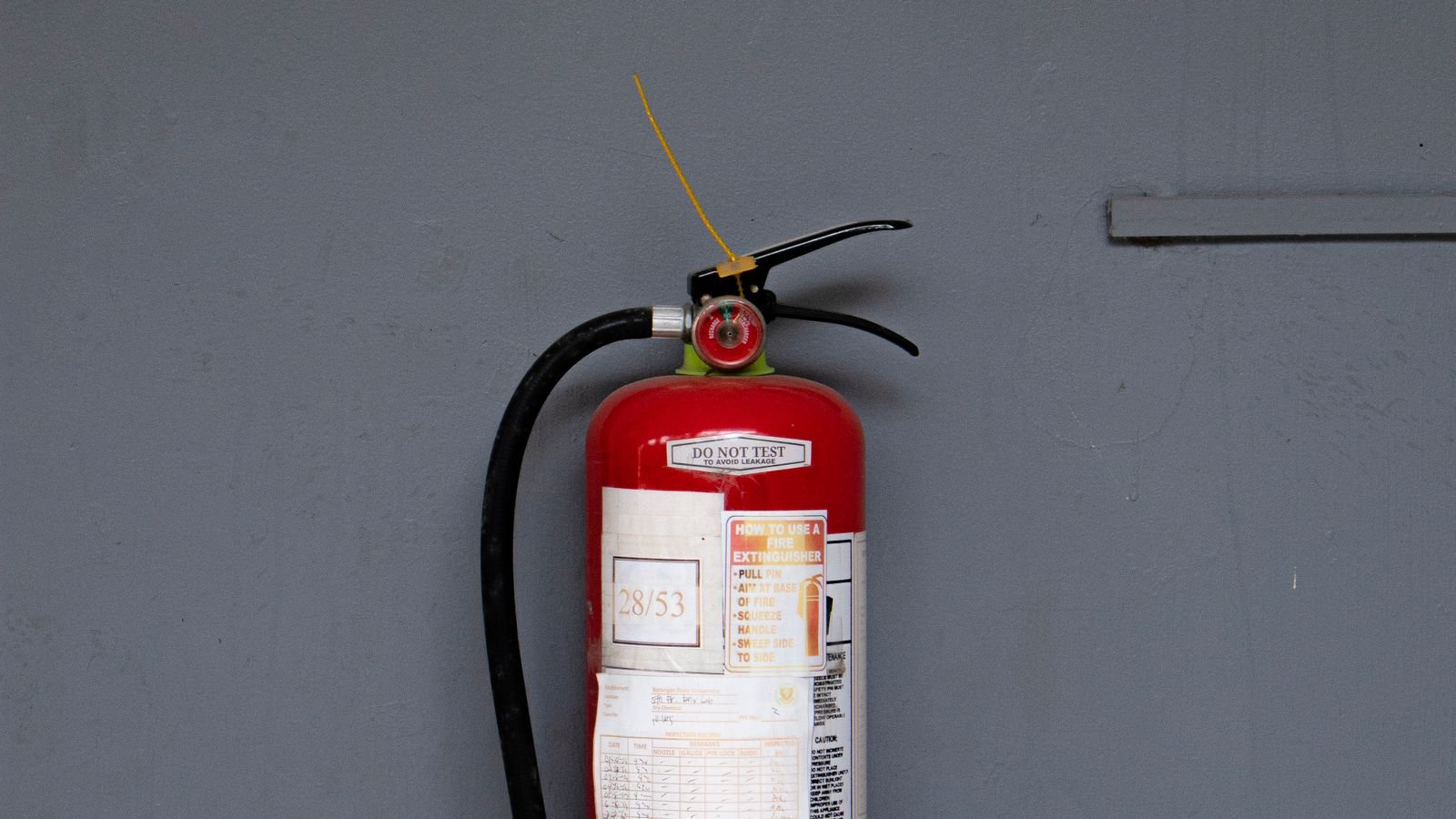
The standard technique is remembered as PASS: Pull the pin, Aim at the base of the flames rather than the visible fire, Squeeze the handle steadily, and Sweep side to side across the base until the fire is out.
Judgment matters more than technique. Fight a fire only if all of these are true: everyone else is already evacuating or out, the fire department has been called, the fire is small and contained to its point of origin, you have a clear escape route behind you, and you can stay upwind of smoke. If any one of those fails, leave. A 5 pound extinguisher provides roughly 10 to 15 seconds of discharge, which is not a long time.
Two specific scenarios deserve emphasis. Never use water on a cooking oil fire, as it vaporizes instantly and ejects burning oil across the room; smother a pan fire with a lid and turn off the heat. And do not attempt to fight a fire in a wall cavity or ceiling, because what you can see is a fraction of what is burning.
Escape Planning: The Part People Skip
Equipment buys you warning and a small chance of early suppression. The escape plan is what actually gets people out.
- Map the home and identify two ways out of every room, which usually means a door and a window.
- Check that windows open. Painted-shut sashes, security bars without quick releases and heavy furniture in front of egress windows are common and dangerous.
- Buy escape ladders for bedrooms above ground level, store them under the window they serve, and let everyone handle one once.
- Agree a meeting point outside and a safe distance away: a specific tree, a mailbox, a neighbor’s driveway.
- Assign responsibility for young children, elderly relatives and pets to specific adults so nobody assumes someone else has them.
- Practice twice a year, once at night. The difference between a discussed plan and a rehearsed one is substantial in the dark and in smoke.
Teach the fundamentals alongside the plan: stay low beneath the smoke layer, feel doors with the back of your hand before opening, close doors behind you as you go because a closed door dramatically slows fire spread, and never go back inside for possessions.
Protecting Documents and Valuables
Some losses cannot be replaced by insurance. Passports, deeds, birth certificates, backup drives and heirlooms are worth protecting physically.
Look for an independently tested fire rating expressed as a temperature and duration, commonly one hour at 1700 degrees Fahrenheit. That rating protects paper, which chars around 400 degrees. Digital media is far more fragile and needs a safe specifically rated for media, which maintains a much lower internal temperature. Check for a water rating too, since firefighting water damages what the fire did not.
Size and anchoring matter. A small safe that a person can carry away is a convenience for a burglar, so bolt it to the floor or choose one heavy enough to resist removal. Consider that a safe protects against fire only if it stays closed; leaving it open for convenience defeats the purpose entirely. Options are compared in our guide to the best fire resistant safes.
Frequently Asked Questions
How often should smoke alarms be replaced?
Every 10 years from the manufacture date, regardless of whether they still respond to the test button. The test button confirms the sounder and battery, not the sensor’s sensitivity, which degrades with dust and age.
Do extinguishers expire?
Disposable units are typically rated for around 12 years and should be replaced after that or after any discharge. Rechargeable units last longer but need professional inspection and recharging. Check the pressure gauge monthly and shake dry chemical units occasionally to prevent the powder compacting.
Are combination smoke and CO alarms a good idea?
They are convenient and reduce ceiling clutter, but the two sensors age differently. Note the replacement date for each, and be aware that replacing the combined unit at the earlier date is usually simpler than tracking them separately.
Why does my alarm chirp at night specifically?
Battery voltage drops slightly as temperature falls, and homes are coolest in the early hours, which pushes a marginal battery below the low-battery threshold. It is not coincidence, and sealed ten-year units eliminate it entirely.
Should I get interconnected alarms?
Yes if your home has more than one level or a long hallway. A fire starting in a basement may not wake someone in an upstairs bedroom until far too late, whereas interconnected alarms sound everywhere the instant one detects smoke.
Final Thoughts
Build fire safety in layers and in order. Detection first, because warning is what buys time: dual-sensor or paired alarms inside and outside every sleeping area, on every level, interconnected if possible, and replaced on schedule. Carbon monoxide detection next, since it addresses a threat you cannot perceive at all.
Then suppression, in the form of an ABC extinguisher on each floor placed near exits rather than near hazards, with everyone in the household knowing the PASS sequence and, more importantly, knowing when to walk away. Finally the escape plan, practiced in the dark, and a fire-rated safe for the documents that cannot be reprinted. None of this is expensive, and all of it takes one weekend to put in place properly.