
 Sofia Marchetti
 This page is for anyone choosing a desk chair for a home office, a shared workstation or a computer desk in a spare room. You do not need the most expensive chair. You need one that fits your body and your desk, and that you can adjust without a manual every morning.
Two things matter more than anything else. First, fit: seat height, seat depth and a backrest that meets your lower back. Second, adjustability: lumbar support, armrests and a recline you can lock or tune. Materials, color and style come after that.
The eight chairs below cover mesh task chairs, a chair with a footrest, a 500 lb rated leather chair and a mid-back leather chair for a home office that should not look like a cubicle.
How we chose
- Adjustment range: lumbar support you can move, armrests that adjust, and a recline with a lock or tension control.
- Listed fit numbers: seat height range, seat depth and seat width where the manufacturer publishes them.
- Weight rating: the maximum load stated in the spec sheet, with a margin above your own weight.
- Back material: breathable mesh versus padded leather, depending on room temperature and taste.
- Warranty and support terms stated on the listing.
Picks are based on manufacturer specs and owner reviews, not hands-on testing. You can read more about how we research products.
Quick picks
- Best for most people: Casasio 2307H — two-way adjustable lumbar, 3D headrest and a 350 lb listed capacity.
- Best for warm rooms: ELABEST 1096M — mesh on both the seat and the back, plus a three-position synchro-tilt.
- Best for dialing in fit: HUANUO FlowLift — seat-depth adjustment and 6D armrests.
- Best for taller users: CLOUVOU CleverSeat — listed for users up to 6.5 ft, with 4D armrests.
- Best for reclining breaks: ELABEST X100 — 18-inch pull-out footrest and 3D lumbar.
- Best simple mesh chair with headrest: Zeonsit 8188 — adjustable lumbar and headrest, flip-up arms.
- Best for heavier users: Cloomey Big and Tall — 500 lb listed capacity and an inflatable lumbar pad.
- Best leather look for a home office: YFO Leather Desk Chair — 22-inch wide seat and removable armrests.


Pros
- Certified to BIFMA 5.1, the commercial furniture test standard, with a stated capacity of 300 lb
- Synchro-tilt locks in 3 positions with a tension dial you set to your own body weight
- 3D armrests move for height, width and angle, so elbows sit level with a 29 in desk
- Lumbar pad slides vertically to meet the curve of your own lower back
- Mesh across the seat as well as the back, keeping airflow under the thighs in a warm room
Cons
- Offered in black only, with no other finish listed
- The mesh seat pan feels firmer at the front edge than a foam cushion over a long session
- 28.5 in across the arms, so it will not slide between closely spaced desk pedestals
The chair measures 26.4 in deep by 28.5 in wide with an overall height of 45.3 in, and it is certified to BIFMA 5.1, the commercial furniture test standard rather than a self-declared figure. Stated capacity is 300 lb.
- BIFMA 5.1 covers drop tests, backrest strength and stability, so the certification is meaningful for daily eight-hour use
- 28.5 in across the arms means it will not slide between two closely spaced desk pedestals
- 45.3 in of height gives a back tall enough to support the shoulder blades rather than stopping at the mid-spine
Check under-desk clearance before ordering. A 45 in back will not tuck under a low desk return, which matters in small rooms where the chair gets pushed away at night.

Pros
- Physical footprint measures 27.56"D x 27.56"W x 45.28"H for spatial placement
Cons
- Requires checking room space for HUANUO FlowLift Ergono prior to installation
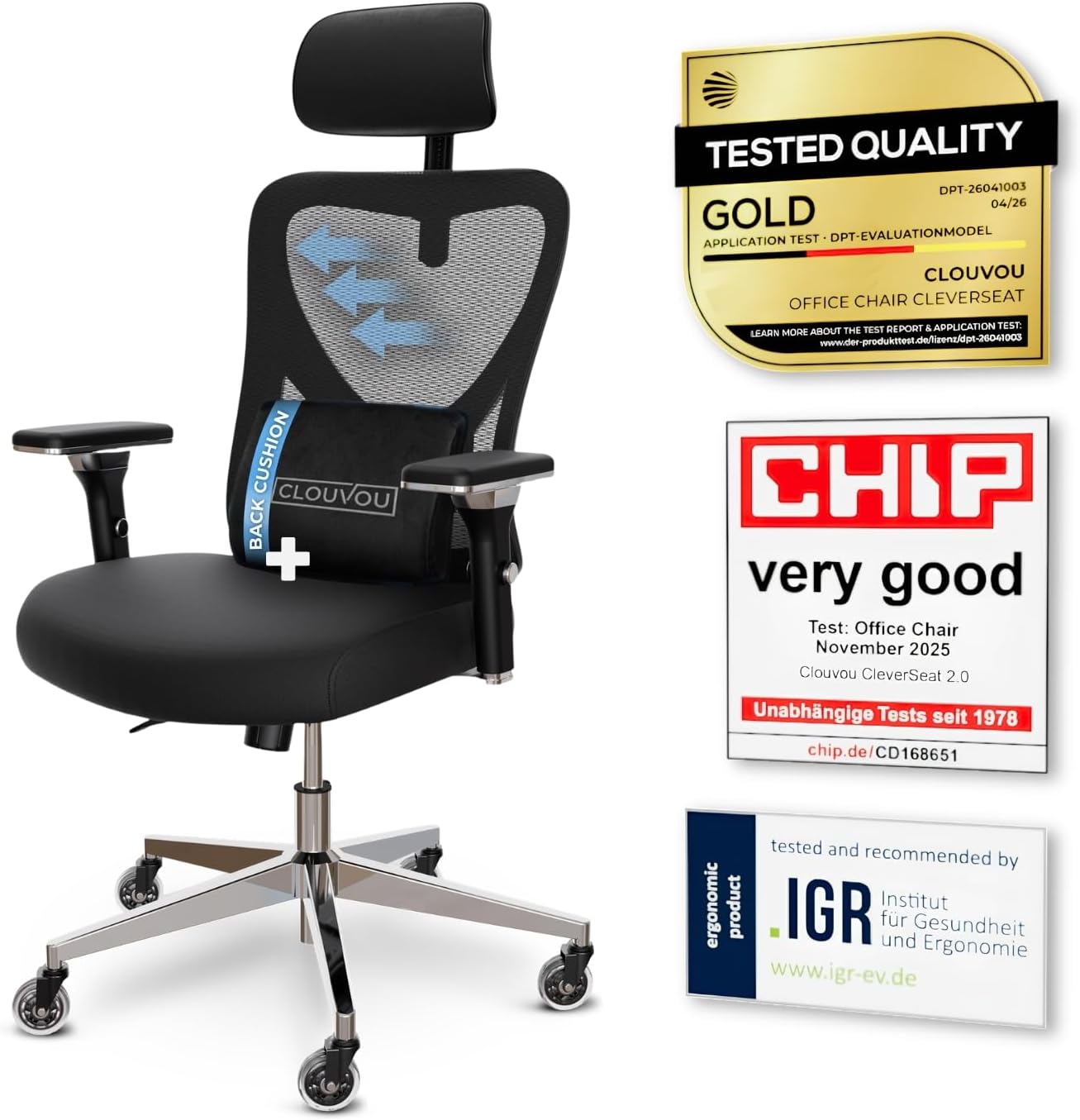
Pros
- 4D armrests adjust up, down, forward-back and pivot, so elbow height lines up with almost any desk
- 3-position backrest tilt locks the recline angle instead of leaving it free-floating
- Blade-shaped casters are engineered to roll quietly across hard flooring
Cons
- Frame combines chromium-plated and plastic components rather than a full steel shell, so it may flex more than an all-metal frame under aggressive rocking
- Backrest tilt is limited to 3 fixed positions rather than a continuous recline lock
- No separate seat-depth figure is listed beyond the 21-inch footprint, so users near the 6.5 ft sizing ceiling may find the seat pan short
The chair measures 21"D x 21"W x 39"H in its assembled footprint, a compact base built for desks in home offices and shared workspaces. Backrest support is rated for users up to 6.5 ft tall, wider than the sizing window most mesh task chairs advertise.
- Frame combines chromium-plated steel components with plastic housings for the armrests and base shroud
- 3-position backrest tilt locks the recline angle rather than floating freely
- 4D armrests adjust height, width, depth and pivot angle independently
Because the footprint stays close to 21 inches square, the chair fits under standard desks without needing extra clearance, while the taller backrest window suits users who outgrow shorter task chairs.

Pros
- 18-inch extendable footrest with 2-position angle adjustment supports a reclined break without leaving the chair
- 5D flip-up armrests adjust height, width, angle, and rotation, then fold flush to tuck under a desk
- 3D lumbar support adjusts up to 1.6 inches in depth and 2 inches in height to track different seated postures
Cons
- Footrest and 5D armrest mechanisms add moving parts that increase what there is to adjust and maintain over a simple fixed-arm chair
- Mist Black is the only finish offered, with no other color option
- Larger footprint at 26 x 24 inches needs more floor clearance than a compact task chair
The X100 measures 26"D x 24"W x 41"H and carries a 300 lb weight capacity, built for bigger frames than a standard mesh task chair. The 3D lumbar system adjusts depth by up to 1.6" and height by up to 2", with 15 degrees of rotation to track the spine's natural curve rather than pressing at one fixed point.
- Footprint: 26"D x 24"W x 41"H
- Weight capacity: 300 lb
- Lumbar adjustment: up to 1.6" depth, 2" height, 15-degree rotation
An 18" extendable footrest with 2-position angle adjustment pulls out from under the seat, adding leg support once the backrest is reclined for a break.

Pros
- Supports up to 350 lb, above the 300 lb capacity typical of mesh task chairs
- Adjustable lumbar pad and headrest let seat height and back curve be tuned independently
- Breathable mesh backrest promotes airflow across extended desk sessions
- Flip-up armrests free up desk space when raised out of the way
- Rocking recline function allows a lean-back break without leaving the seat
Cons
- Nylon frame construction rather than steel, so long-term load-bearing durability may lag heavier frames
- No tension lock mentioned for the rocking function, so recline resistance is not adjustable
- Seat height range is fixed to the gas cylinder travel, with no stated extended-height option
This task chair measures 20"D x 20"W x 45"H and is rated to hold up to 350 lb, higher than the roughly 250-300 lb ceiling common on entry-level mesh chairs. The frame uses nylon components paired with a virgin foam seat cushion for cushioning that resists flattening over time.
- Dimensions: 20" D x 20" W x 45" H
- Weight capacity: 350 lb
- Seat material: virgin foam cushion over a nylon frame
The higher weight capacity makes it a workable option for users who have outgrown standard-capacity task chairs.

Pros
- Rated to support up to 500 lbs on a heavy-duty metal base
- Inflatable lumbar airbag lets you adjust back support firmness to your own preference
- Multi-layer thick cushioning follows the body's outer contour across the seat and backrest
- Padded armrests add cushioning across the arm rest area for long sessions
- Seat height adjusts to help find a comfortable position relative to desk height
Cons
- No stated recline-lock degree figure, so check with the seller if a specific tilt angle range matters to you
- Sold in leather upholstery only, with no fabric or mesh alternative listed
- Manual lumbar inflation means comfort depends on manually pumping and adjusting the airbag rather than automatic support

Pros
- Rated to 300 lbs with a seat width of 22 inches and depth of 20 inches
- Armrests are removable, so the chair converts between a cross-legged-friendly seat and a standard armrest chair
- Seat cushion combines a wooden board base, sponge, and spring pack for support across long sitting sessions
- Casters are rated for wood floors, carpet, and marble alike
Cons
- Armrest height is fixed at 8.3 inches once installed, with no separate width or angle adjustment
- Leather-covered cushion runs less breathable than a mesh-backed alternative over long sessions
- Seat height range is listed only as adjustable, without specific minimum and maximum figures given
The chair has a seat width of 22 inches and a depth of 20 inches, with armrests set at 8.3 inches above the seat when installed. It carries a 300 lb weight capacity, and the seat cushion is built from a sturdy wooden board base topped with soft sponge and a highly elastic spring pack, aimed at keeping support consistent through long sitting sessions rather than compressing unevenly.
- Seat width: 22", depth: 20"
- Armrest height: 8.3" above seat
- Weight capacity: 300 lbs
- Leather-covered cushion over a wood, sponge, and spring build
Casters are designed to roll smoothly and quietly across wood floors, carpet, and marble alike, which covers most common home office flooring types.
Comparison
| Chair | Back | Lumbar | Headrest | Max weight |
|---|---|---|---|---|
| Casasio 2307H | Mesh | Adjustable, two-direction | 3D adjustable | 350 lb |
| ELABEST 1096M | Mesh (seat and back) | Adjustable height | Not listed | 300 lb |
| HUANUO FlowLift | Mesh (seat and back) | Adjustable height | 3D adjustable | Not listed |
| CLOUVOU CleverSeat | Mesh | Built-in lumbar cushion | Yes | Not listed |
| ELABEST X100 | Mesh | 3D (height, depth, rotation) | 3D adjustable | 300 lb |
| Zeonsit 8188 | Mesh | Adjustable | Adjustable | 330–350 lb (listing conflicts) |
| Cloomey Big and Tall | Leather | Inflatable | Not listed | 500 lb |
| YFO Leather Desk Chair | Leather, mid-back | Padded, not adjustable | No | 300 lb |
The picks in detail
Casasio 2307H
This chair covers the adjustments most people actually use. The lumbar cushion adjusts in two directions, the headrest moves in height, depth and angle, and the tilt has adjustable tension. The armrests flip up so the chair slides under a desk. The spec sheet lists a 350 lb capacity, a 20-inch seat depth and a mesh back over a foam seat. It holds a 4.7 rating across about 150 reviews, which is a modest sample.
Good fit if you want lumbar and headrest adjustment under $200 and share a small desk. Skip it if you want adjustable armrest height or width; the arms only flip.
ELABEST 1096M
The 1096M uses mesh on the seat as well as the back, so less of your body sits on foam. The listing describes a synchro-tilt with three lockable positions and a tension knob, 3D armrests (height, width, angle) and a lumbar pad that slides vertically. Listed seat height runs 19.6 to 23.6 inches, seat width is 20 inches and capacity is 300 lb. ELABEST says it meets BIFMA 5.1. There is no headrest.
Good fit if your room runs warm or you want a firm, upright task chair. Skip it if you are shorter; the lowest listed seat height is 19.6 inches.
HUANUO FlowLift
The FlowLift is the only chair here that lists seat-depth adjustment. That matters if your thighs are longer or shorter than average. It also has a lumbar system that moves up and down, a 3D headrest and 6D armrests that slide, pivot and tilt. The backrest locks at 95, 104, 114 or 123 degrees. Mesh covers the headrest, back and seat, and it rolls on rubber casters.
Good fit if standard chairs never fit your leg length. Skip it if you need a stated weight rating; the listing does not give one. Its review count is also small so far.
CLOUVOU CleverSeat
The CleverSeat listing says it is built for users up to 6.5 ft, which makes it a candidate for taller people. It has 4D armrests, a headrest, a built-in lumbar cushion and a backrest tilt with three positions. The listed footprint is 21 x 21 inches. It is the most reviewed chair on this page, with over 3,000 reviews.
Good fit if you are tall and want arms you can place exactly. Skip it if you need to know the weight limit or want a lumbar pad you can move; the spec sheet lists neither. Seat height and depth are not listed either.
ELABEST X100
The X100 is for people who like to lean back between tasks. An 18-inch footrest pulls out from under the seat, and the back reclines to three positions. The lumbar adjusts about 2 inches in height and 1.6 inches in depth, with some rotation. Seat height is listed at 18.3 to 23 inches, seat depth at 18 inches and capacity at 300 lb. The armrests adjust in five ways and flip up. Some listing claims, like specific percentages of airflow and strain reduction, are marketing and not independently verified.
Good fit if you want a recline-and-rest chair with real lumbar range. Skip it if floor space is tight; the base is listed at 26 x 24 inches.
Zeonsit 8188
A straightforward mesh chair with an adjustable lumbar pad, an adjustable headrest, flip-up armrests and a rocking tilt. The listing mentions a 5-year warranty and a memory foam seat. One caution: the spec table lists 350 lb capacity, but the product bullets say 330 lb. Plan around the lower number. Listed seat depth is 20 inches.
Good fit if you want a headrest and lumbar adjustment at a mid budget. Skip it if you are near 330 lb, or you want adjustable armrest height. The Casasio above offers a similar feature set with a consistent rating.
Cloomey Big and Tall
Cloomey lists a 500 lb capacity on a metal base with a grade 4 gas cylinder. The lumbar is an inflatable airbag, so you set the firmness yourself. The upholstery is leather with thick, multi-layer padding, and the casters are rubber-coated for hard floors. The listing gives a 1-year warranty.
Good fit if you need more than 350 lb of capacity. Skip it if you run hot, since leather breathes less than mesh, or you want a stated recline range. For more options, see our guide to chairs for bigger and taller frames.
YFO Leather Desk Chair
This is a mid-back leather chair with a diamond-pattern retro back. It suits a home office where looks matter. The seat is 22 inches wide and 20 inches deep, built from a wood board, sponge and a spring pack. The armrests are optional, so you can sit cross-legged without them. Capacity is 300 lb. Seat height and recline adjust, but the listing gives no ranges.
Good fit if you want a wide, cushioned seat and a furniture look. Skip it if you need adjustable lumbar or a high back; it has neither.
How to choose a desk chair that fits
Start with your desk, not the chair. Most desks are around 28 to 30 inches tall. Sit with your feet flat and your thighs roughly level. Your elbows should land at about desk height. If the chair’s lowest seat height is too tall for you, a footrest helps. If you are short, also look at our picks for shorter users.
Next, check seat depth. You want a gap of two to four fingers between the seat edge and the back of your knees. Few budget chairs list true seat depth, and some list the whole chair’s depth instead. When a listing says “20 inches” and the whole chair is also 20 inches deep, treat that number with care.
Then look at what adjusts:
- Lumbar: a pad you can move up and down is the minimum. Depth adjustment is a bonus.
- Armrests: flip-up arms save space. Height-adjustable arms help you keep shoulders relaxed.
- Recline: a lock or tension knob keeps the back from drifting while you type.
- Headrest: useful if you recline often; less important if you sit upright.
Mesh or leather for a computer chair?
Mesh breathes and suits warm rooms and long sessions. Leather and faux leather look more formal and wipe clean, but they hold heat. Many home office buyers pick a mesh back with a foam seat as a middle ground.
What makes a desk chair comfortable over a full day
Comfort is mostly fit plus the freedom to change position. A soft cushion feels good for an hour. Over a workday, a seat that keeps its shape and a back that supports you in more than one position matter more. If you want a deeper look at adjustable designs, see our guide to ergonomic chairs.
FAQ
How much should I spend on an office chair?
Most chairs here fall between $100 and $300. In that range you can get adjustable lumbar, a mesh back and flip-up arms. Spending more mostly buys more adjustment range, like footrests or multi-direction lumbar.
Is a gaming chair a good desk chair?
It can be, but many gaming chairs use fixed lumbar pillows and faux leather. If you work at a desk all day, a mesh task chair with adjustable lumbar is usually the more flexible choice.
What weight rating do I need?
Pick a chair rated well above your body weight. If you are close to the limit, go up a class. When a listing gives two different numbers, trust the lower one.
Do I need a headrest?
Only if you recline or lean back often. For upright typing, lumbar and armrest fit matter more.







Comments are closed.
No reviews yet. Be the first to share your experience!