Owen Bradley
 When a room gets uncomfortably warm, there are really only three practical answers: move air across your skin with a fan, or actually remove heat from the room with an air conditioner. That distinction sounds obvious but it is the single thing most people get wrong when shopping. A tower fan and a ceiling fan do not lower the temperature by a single degree; they make you feel cooler. An air conditioner genuinely cools the air but costs far more to buy and run. This guide compares all three honestly on cooling effect, running cost, noise, installation and the situations where each is clearly the right answer.

The Fundamental Difference: Air Movement Versus Heat Removal
Fans work through convection and evaporation. Moving air strips away the thin layer of warm, humid air that sits against your skin, letting sweat evaporate faster. The physiological effect is substantial — a decent breeze makes a room feel roughly 3 to 4 degrees Celsius cooler than it is. But the air temperature does not change. In fact, the motor adds a small amount of heat to the room. This is why running a fan in an empty room is pure waste: fans cool people, not spaces.
Air conditioners work through refrigeration. A compressed refrigerant absorbs heat indoors, is carried outside, and releases it there. The heat genuinely leaves the building, so the air temperature drops. As a side effect, condensation on the cold coil removes humidity, which is often as important to comfort as the temperature itself.
This difference explains almost every practical trade-off that follows. Fans are cheap because moving air takes very little energy. Air conditioners are expensive because moving heat against a temperature gradient takes a great deal.
Tower Fans
A tall, narrow column with a bladeless-looking grille hiding a cylindrical impeller. Tower fans push a broad vertical sheet of air and usually oscillate across a wide arc.
Strengths: a small floor footprint, so they fit beside a sofa or desk where a pedestal fan would not. The tall column moves air across a seated person’s whole body rather than just their head. They are portable, need no installation, are usually the quietest fan format at low speeds, and typically include timers, remote controls and sleep modes. Many add a basic dust filter or ionizer.
Weaknesses: lower total airflow than a comparable pedestal or box fan, because the impeller is small. The internal grille is genuinely awkward to clean, and dust accumulation reduces output noticeably over a season. They are also less effective at moving air across a large room.
Best for bedrooms, home offices, nurseries and any space where floor area is tight. Our comparison of the best tower fans weighs airflow against noise across the format, and for a broader look at pedestal, box and desk designs see the best cooling fans roundup.
Ceiling Fans
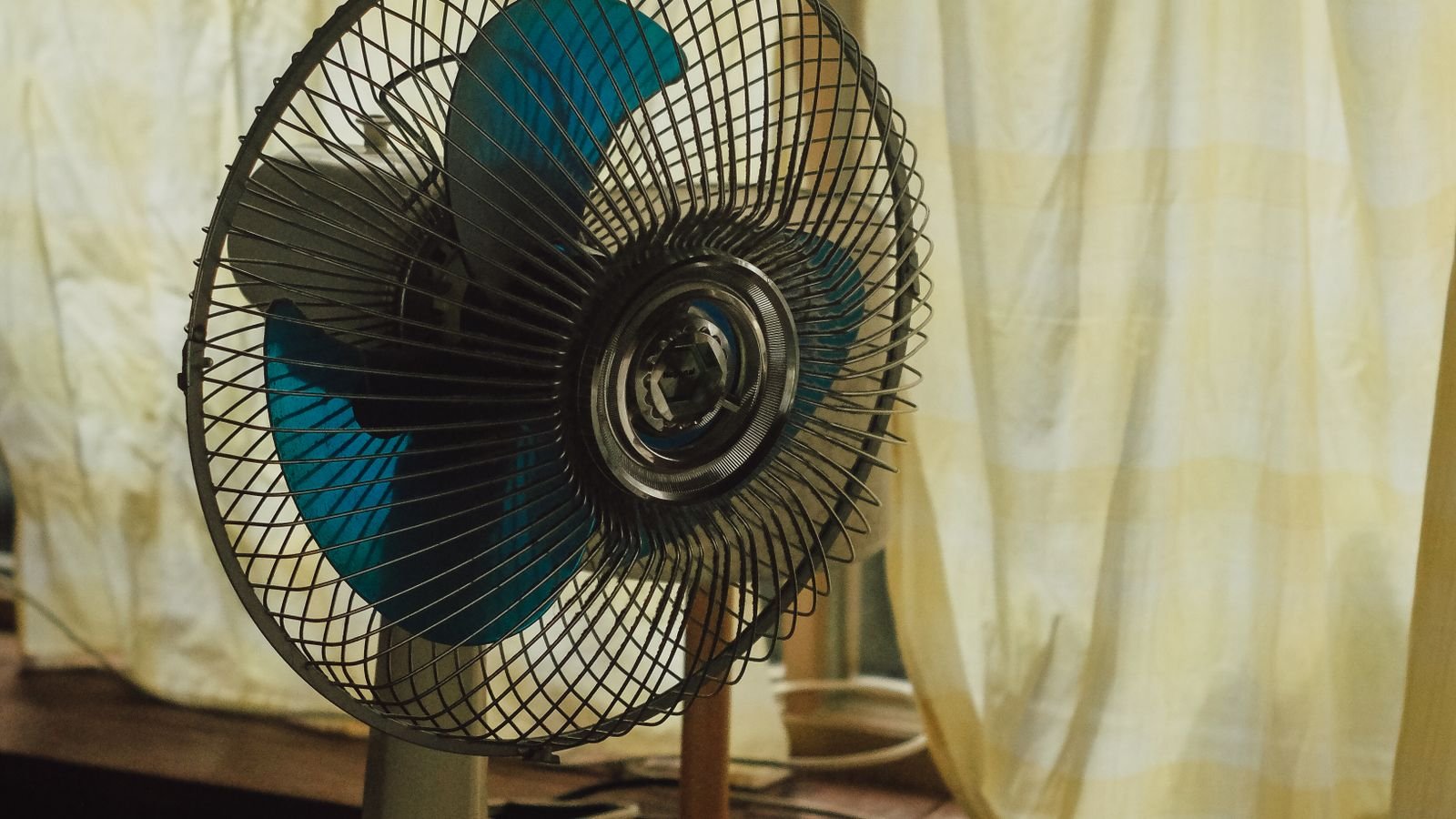
A fixed overhead fan moving a large volume of air slowly. Because the blade span is large, a ceiling fan can move far more air per watt than any portable fan.
Strengths: by far the most efficient way to move air, typically drawing 10 to 75 watts while producing a gentle draught across an entire room. It occupies no floor space, requires no storage, and adds nothing to visual clutter. Crucially, a ceiling fan is also useful in winter: reversed to run clockwise at low speed, it pulls cool air up and pushes warm air trapped at ceiling level back down the walls, which can meaningfully reduce heating costs in rooms with high ceilings.
Weaknesses: installation. It needs an electrical box rated for a moving load, adequate ceiling height for safety, and usually an electrician. It is not portable, it cannot be aimed at a specific person, and low ceilings rule it out entirely. Poorly balanced fans wobble and hum.
Sizing matters: roughly a 90cm span for rooms up to 10 square metres, 110 to 130cm for 10 to 20 square metres, and 130cm or larger beyond that. Blades should sit at least 2.1 metres above the floor and around 25 to 30cm below the ceiling for proper airflow.
Air Conditioners
The only option in this comparison that lowers the actual temperature. Several formats exist, each with a different trade-off.
- Window units. Efficient and relatively cheap because the hot side sits genuinely outside. They block a window, are heavy to install and are often noisy in the room.
- Portable units. The most flexible, requiring only a hose to a window. But single-hose designs pull already-cooled indoor air and exhaust it outside, creating negative pressure that draws warm air in from elsewhere, which is why they are markedly less efficient. Dual-hose models fix most of this.
- Mini-split systems. A quiet indoor head with the compressor outside. By far the most efficient and quietest option, and reversible for heating, but they are expensive and require professional installation.
- Central air. Whole-home cooling through ductwork. Excellent when it exists; a major project when it does not.
Sizing is measured in BTU per hour, and it is genuinely important to get right. As a rough starting point, allow around 20 BTU per square foot of floor area, then adjust upward for strong sun exposure, high ceilings, a busy kitchen or several occupants. Oversizing is a real mistake, not a safety margin: an oversized unit cools quickly, shuts off, and never runs long enough to remove humidity, leaving a room that is cold and clammy. If a portable is the practical choice for your space, our guide to the best portable air conditioner units covers single versus dual hose designs and venting, while the best small window air conditioners comparison suits rooms where a window install is possible.
Running Costs Compared
The energy gap between these options is enormous and worth internalising before you buy.
- Ceiling fan: roughly 10 to 75 watts. A DC-motor model at low speed uses less power than a light bulb.
- Tower fan: roughly 40 to 100 watts.
- Portable air conditioner: roughly 900 to 1500 watts.
- Window unit: roughly 500 to 1500 watts depending on capacity.
- Mini-split: roughly 500 to 1200 watts, but with a much better efficiency ratio per unit of cooling delivered.
The practical implication is that running a fan costs a small fraction of running air conditioning — often a twentieth or less. That is why the most cost-effective strategy in most homes is not choosing one or the other but combining them.
The Combination Strategy
Fans and air conditioning work extremely well together, and using them in combination is the single best value move available.
Because a moving breeze makes a room feel several degrees cooler, running a fan lets you set the air conditioner thermostat 2 to 3 degrees higher for the same perceived comfort. Every degree of setback saves a noticeable percentage of cooling energy, and the fan’s own consumption is trivial by comparison. A ceiling fan plus a modestly sized air conditioner will usually be cheaper to run, quieter and more comfortable than a larger air conditioner alone.
Air distribution matters too. Air conditioners cool a localised area near the unit; a fan spreads that cooled air through the room and eliminates the hot corners. In multi-storey homes, a fan at the top of the stairs helps enormously with the heat that collects upstairs.
Choosing by Situation
- Rented flat, no modifications allowed. Tower fan first. A portable air conditioner if the heat is genuinely unbearable and a window can take the hose.
- Bedroom, light sleeper. A ceiling fan on low, or a quiet tower fan with a sleep mode. Noise matters more than raw airflow here.
- Hot, humid climate. Air conditioning is not optional — fans do very little when humidity prevents evaporation. Add fans to reduce the load.
- Hot, dry climate. Fans go a long way, especially combined with night ventilation and daytime shading.
- Home office, all-day use. A ceiling fan for background comfort plus a small directional fan at the desk.
- Occasional heatwaves only. Fans plus good shading and night purging. Air conditioning is hard to justify for a few weeks a year.
- Home you own, long-term. Ceiling fans throughout plus a mini-split in the main living space is the most efficient permanent answer.
Reducing the Cooling Load First
- Close blinds and curtains on sun-facing windows during the day. Solar gain through glass is the largest single heat source in most homes.
- Ventilate at night when outdoor air drops below indoor temperature, then shut the house up in the morning.
- Create cross-ventilation by opening windows on opposite sides, and place a fan facing outward in a window on the leeward side to exhaust hot air.
- Switch off unnecessary electronics and incandescent lighting, which are genuine heat sources.
- Cook outdoors or use the extractor fan properly in hot weather.
- Insulate the loft. Heat entering through the roof drives upstairs temperatures more than anything else.
These cost little and reduce the size and running time of whatever cooling you install.
Frequently Asked Questions
Does a fan actually cool a room?
No. It cools people by accelerating evaporation from the skin. The air temperature stays the same or rises very slightly from motor heat, which is why leaving a fan running in an empty room achieves nothing.
Which direction should a ceiling fan turn?
Counter-clockwise in summer, pushing air downward for a direct breeze. Clockwise on low in winter to circulate warm air from the ceiling without creating a draught.
Are portable air conditioners worth it?
They are the least efficient air conditioning format but the only one many renters can use. If you buy one, choose a dual-hose model and seal the window kit carefully — a leaky seal undoes much of the cooling.
Can I use a ceiling fan and air conditioning together?
Yes, and you should. The fan lets you raise the thermostat by a few degrees for the same comfort, which usually saves more energy than the fan consumes several times over.
How do I stop a fan from being noisy at night?
Choose a model with a DC motor and a genuine sleep mode, run it one speed lower than feels necessary and position it further away, and clean the blades or grille regularly since dust buildup causes both imbalance and extra noise.
Final Thoughts
The right choice comes down to whether your problem is comfort or genuine heat. If a breeze is enough — dry climate, moderate temperatures, a room you occupy — a fan delivers most of the benefit for a tiny fraction of the cost, and a ceiling fan is the most efficient version of that answer. If the air itself is too hot or too humid for evaporation to help, only refrigeration will do, and the honest move is to size it properly rather than oversize it. For most homes the best answer is not one or the other: fit ceiling fans where you can, keep a tower fan for flexibility, add appropriately sized air conditioning for the worst of the season, and run them together so the thermostat can sit a few degrees higher than it otherwise would.