Owen Bradley
 Space heaters have a reputation for wrecking winter electricity bills, and also a reputation for saving money through zone heating. Both claims are true, depending entirely on how the heater is used. The arithmetic behind space heater running cost is genuinely simple, and once you can do it in your head you can settle the question for your own home rather than trusting a slogan. This guide lays out the formula, works through hourly, daily, and monthly figures at realistic electricity rates, explains why the number on the label overstates what you will actually pay, and shows the specific conditions under which heating one room beats heating the whole house. By the end you will know exactly what a portable heater will cost you through the cold months of 2026.
The Formula That Answers Everything
Electricity is billed in kilowatt-hours. One kilowatt-hour is one thousand watts drawn for one hour. To find what any appliance costs, you need three numbers: its wattage, the hours it runs, and your rate per kWh.
The calculation is: watts divided by 1,000, multiplied by hours of use, multiplied by your rate. That is the whole method, and it works identically for a heater, a kettle, or a clothes dryer.
Your rate is printed on your electricity bill. National averages hover around 16 cents per kWh, but the real spread is enormous, from around 11 cents in some regions to well over 30 cents in others. Because the rate is a straight multiplier, a household paying 30 cents pays nearly three times what a household paying 11 cents pays for the identical heater and identical hours. Always run the numbers with your own rate rather than an average.
Finding the Wattage
Almost every plug-in household heater maxes out at 1,500 watts, because that is the practical limit for a standard 15-amp circuit. Most units also offer a lower setting, commonly 750 or 900 watts. Some oil-filled radiators add a middle step around 1,200 watts. The rating is printed on a label on the base or back of the unit.
Hourly Cost at Common Rates
Take a 1,500-watt heater running at full power. That is 1.5 kWh per hour of continuous operation. Multiply by your rate to get the hourly cost.
- At 11 cents per kWh: about 17 cents per hour.
- At 16 cents per kWh: about 24 cents per hour.
- At 22 cents per kWh: about 33 cents per hour.
- At 30 cents per kWh: about 45 cents per hour.
On the lower 750-watt setting, halve every figure. At 16 cents, that is roughly 12 cents an hour. This is why multiple wattage settings are worth having: on a mildly cool day the low setting may hold the room perfectly well at half the cost.
Daily and Monthly Figures
Assume a common pattern: a heater running in a home office or living room for eight hours a day. At 16 cents per kWh on full 1,500-watt output, that is 12 kWh per day, or about $1.92.
Across a 30-day month that comes to roughly 360 kWh and about $58. If your rate is 30 cents, the same pattern costs closer to $108 a month. If you only run it four hours an evening, halve those figures.
These are ceiling numbers, however, because they assume the element runs continuously. In reality a heater with a functioning thermostat only runs part of the time, and that changes the answer substantially.
Why Duty Cycle Cuts the Real Bill
Once a room reaches the thermostat’s setpoint, the element switches off and stays off until the temperature drifts down again. The proportion of time it actually runs is the duty cycle, and it is the single biggest reason label-based estimates overstate real cost.
In a reasonably insulated bedroom or office of appropriate size, a duty cycle of 40 to 60 percent is common once the room is up to temperature. That turns a theoretical $58 month into something closer to $23 to $35.
Duty cycle depends on things you can influence. Better insulation, sealed draughts, closed doors, and drawn curtains all reduce heat loss and therefore reduce runtime. An oversized room, a single-glazed window, or an open door to a cold hallway pushes the duty cycle toward 100 percent, at which point you are paying the full ceiling figure and probably still feeling cold.
Thermostat Quality Is a Cost Feature
A vague mechanical dial with no numbers swings several degrees around the target, overshooting on the warm side and running more than necessary. A digital thermostat with a stated setpoint holds a tighter band and cycles less. Over a season, that difference is worth real money, which is why an accurate thermostat is the cheapest efficiency upgrade available on a heater.
The Zone Heating Case: When One Room Beats the House
Here is the crucial point that decides whether a space heater saves or costs money. Running a heater on top of your normal central heating always adds cost, with no offsetting benefit. The saving exists only when the heater lets you turn the whole-house thermostat down.
The mechanism is straightforward. Central heating warms every room, including the ones nobody is in. If you drop the house setpoint several degrees and warm only the room you occupy, you avoid heating a large volume of unoccupied space. Every degree of setback typically trims a few percent from whole-house heating energy, and several degrees compound.
Zone heating tends to pay off when your household spends most of its evening in one or two rooms, when the house is large relative to the space you actually use, and when the rooms you occupy are well enough insulated that the portable heater is not fighting a losing battle. It tends not to pay off in small apartments, in households spread across many rooms, or where the central system heats with a fuel much cheaper per unit of heat than electricity.
The Fuel Comparison That Matters
Electric resistance heating converts nearly all input energy into heat, which sounds ideal, but the comparison that matters is cost per unit of delivered heat, not efficiency. In many regions natural gas delivers heat at a considerably lower cost per unit than electricity, so a gas furnace can be cheaper per degree even at lower efficiency. A heat pump is different again, since it moves heat rather than generating it and can deliver several units of heat per unit of electricity, often making it cheaper to run than resistance heating.
The practical implication is that zone heating with electric heaters produces the clearest savings in homes with electric resistance central heating, or where you can leave large sections of the house genuinely cold. In a home with efficient gas heat or a modern heat pump, the case is weaker and depends heavily on local prices.
Making the Setback Actually Happen
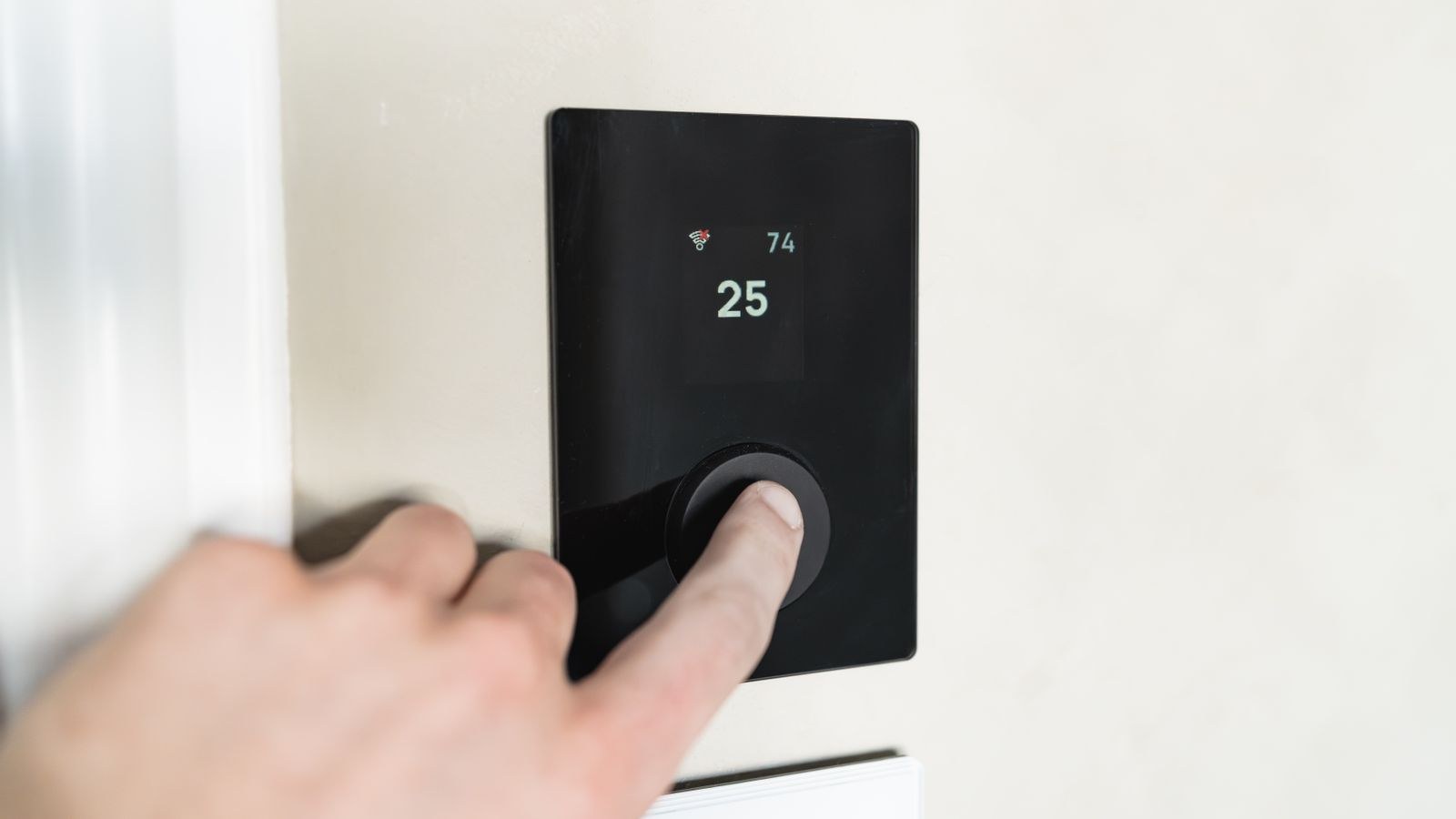
The theory of zone heating collapses if nobody remembers to turn the house thermostat down. This is a scheduling problem, and it is solved by the controller rather than the heater. A programmable thermostat that automatically drops the setpoint during the hours you are using a heated room, and again overnight, captures the saving without relying on discipline. Our comparison of the best programmable thermostats covers models suited to that pattern.
Building a sensible schedule matters as much as the hardware. Setbacks that are too aggressive leave the system working hard to recover, while setbacks that are too timid save little. Our walkthrough on how to choose a thermostat schedule covers how to set realistic periods around your actual routine.
If you are choosing a controller from scratch, our broader roundup of the best thermostats compares the full range. For households that want reliable scheduling without connected features, the best non smart thermostats list is the relevant one, and if you simply want an accurate readout and precise setpoints, our best digital home thermostats guide covers those.
Practical Ways to Cut the Running Cost
Several habits reduce the bill without reducing comfort, and most cost nothing.
- Use the low setting whenever it holds the room. Half the wattage is exactly half the cost.
- Close the door. Heating one room only works if the warm air stays in it.
- Draw curtains after dark. Windows are the largest heat loss path in most rooms.
- Block draughts at the door base and window frames. This directly lowers duty cycle.
- Use the timer. Warming a room for the hour before you use it, then shutting off, avoids hours of idle running.
- Set the thermostat a degree or two lower and wear a layer. Each degree removed cuts runtime measurably.
- Position the heater near the coldest wall or window, so convection circulates warmth across the room instead of pooling.
- Keep grilles and fins clean. Dust reduces heat transfer and makes the unit run longer for the same effect.
Estimating Your Own Number in Two Minutes
Take the wattage from the label and divide by 1,000. Multiply by the hours you realistically run it in a day. Multiply by your rate from your bill. That gives your worst-case daily cost. Multiply by 30 for a monthly ceiling, then multiply by roughly 0.5 for a realistic figure if the room is reasonably insulated and appropriately sized.
Compare that against what you expect to save from lowering the central setpoint. If your whole-house heating costs, say, $200 a month and a several-degree setback trims 10 to 15 percent, that is $20 to $30 saved against perhaps $25 to $35 spent on the heater. The margin is often thinner than people assume, which is exactly why running the numbers beats guessing.
Frequently Asked Questions
Do more expensive space heaters cost less to run?
Not because of the element. Two 1,500-watt heaters use the same energy per hour of operation. A pricier model may still cost less over a season if it has an accurate digital thermostat, multiple wattage settings, an eco mode, and a timer, since all of those reduce runtime.
Is it cheaper to run a heater on low for longer or high for less time?
Roughly the same energy is needed to hold a room at a given temperature either way. The low setting is usually preferable because it holds a steadier temperature with less overshoot, and overshoot is wasted energy.
How much does running a heater overnight cost?
Eight hours of a 1,500-watt unit at 16 cents per kWh has a ceiling of about $1.92, likely closer to a dollar with normal cycling. That said, leaving a space heater running unattended overnight is not recommended for safety reasons regardless of cost.
Why did my bill rise more than my estimate?
The two usual causes are a duty cycle far higher than expected, typically from a draughty or oversized room, and failing to lower the central thermostat, which means you paid for both systems at once.
Does a space heater use more electricity than an air conditioner?
Often yes, per hour. A 1,500-watt heater draws more than many window air conditioners, and unlike a heat pump it produces exactly one unit of heat per unit of electricity rather than multiplying it.
Final Thoughts
Space heater running cost is not mysterious: watts divided by 1,000, times hours, times your rate, then discounted for the time the thermostat keeps the element switched off. Run those numbers with your own electricity rate and your own realistic hours and you will get a figure far more useful than any general claim. The decisive variable is not the heater at all but whether you genuinely lower the whole-house setpoint while it runs. Pair a well-controlled portable heater with an automated central setback, close the door, block the draughts, and use the low setting whenever it suffices, and zone heating becomes a real saving through 2026 rather than a comfortable story that quietly adds to the bill.