Owen Bradley
 Few things are as unnerving as a standing desk that suddenly beeps, flashes a short code on its keypad and refuses to move. The natural assumption is a dead motor or a fried controller. In reality, the overwhelming majority of these faults are not failures at all: they are the frame’s safety logic telling you it has lost track of where the columns are, or that something interfered with a lift. Learning how to reset a standing desk takes about two minutes and resolves most stuck desks on the spot. This guide walks through the reset procedures, what the common error codes mean, and how to work out whether you have a calibration issue, an overload, or a genuine hardware fault.
Why Standing Desks Need Resetting at All
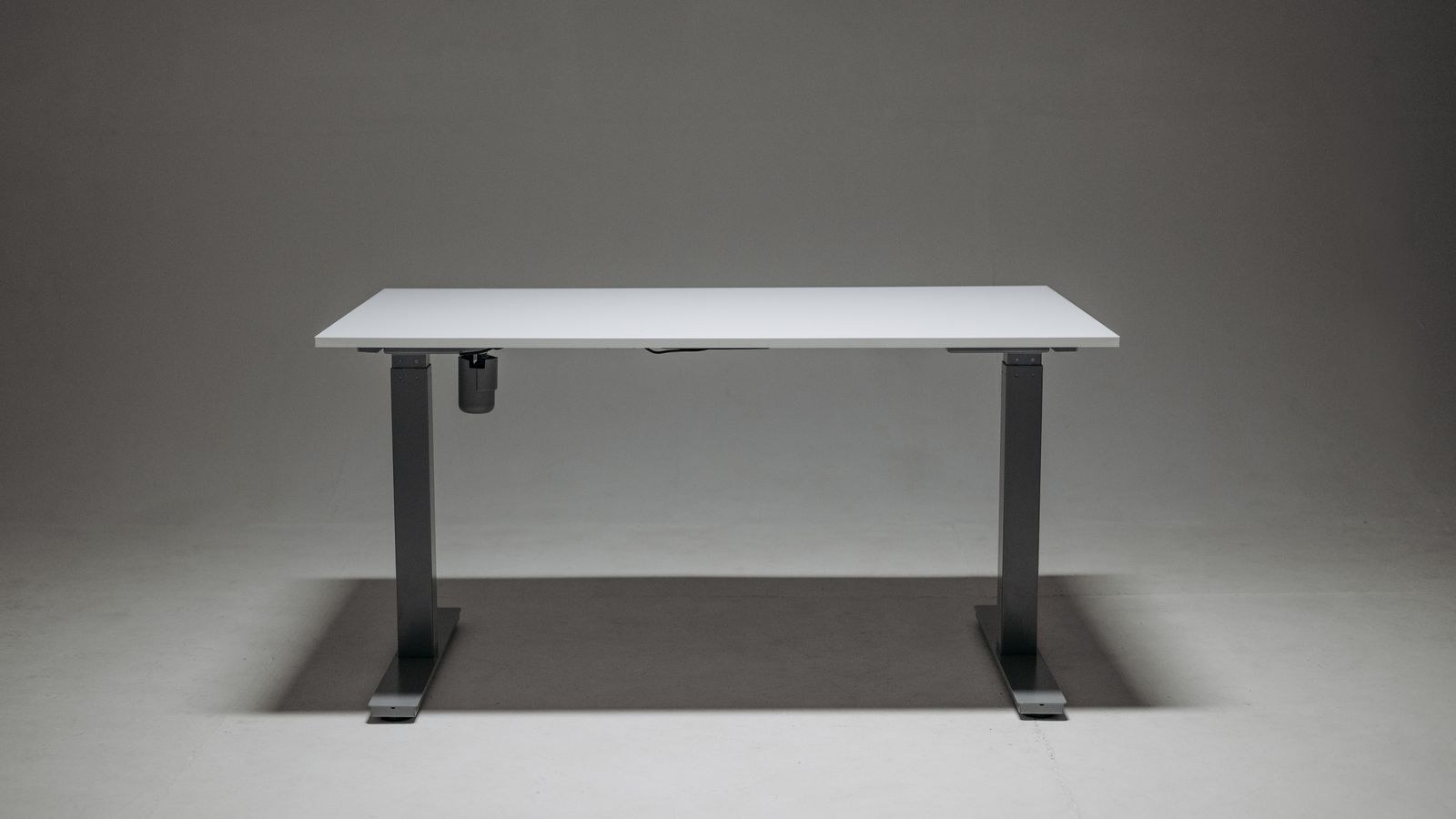
An electric desk does not have an absolute sense of height. The control box counts pulses from each motor to work out how far the columns have travelled, and it stores that count as the current position. Cut the power at the wrong moment, unplug a motor lead, bump a column while it is moving, or let one side meet resistance the other did not, and the stored count no longer matches physical reality.
When the controller detects that mismatch, it stops. It will typically refuse to raise, allow only limited downward movement, and beep or flash a code. This is deliberate: on a dual-motor frame, moving with bad position data could drive one column higher than the other and rack the desktop. The reset routine forces both columns down to a hard mechanical stop, where the controller knows with certainty that it is at zero, and rebuilds its reference from there.
Before You Start
- Clear the desktop of monitors, drawers and anything heavy. Reset routines drop the desk slightly below its normal minimum.
- Check nothing sits under the desk: a drawer unit, a bin, a chair arm or a PC tower will block the descent and cause a failed reset.
- Have the desk’s manual to hand, since button labels vary between controllers.
- Allow enough clear wall space; the desk needs its full travel to complete calibration.
Do not skip the clearance check. A reset that stalls halfway because a filing cabinet is in the way is the single most common reason people conclude their desk is broken.
How to Reset a Standing Desk
- Remove all load from the desktop. Take off monitors, laptops and anything clamped to the edge. Excess weight is the second most common cause of a failed reset, particularly if the load sits unevenly towards one column.
- Unplug the desk from the wall for at least 30 seconds. This clears the controller’s volatile memory and any latched fault. Sixty seconds is safer on older boxes. Plug it back in.
- Press and hold the down button until the desk reaches its lowest position. Keep holding. Do not tap it repeatedly; the routine needs one continuous press.
- Release, then press and hold the down button again for 10 to 20 seconds. After a few seconds you will usually hear a click or feel the desk drop slightly below its normal minimum. Keep holding until the desk rises a fraction on its own, or the display changes from an error code to a height number. That small rebound is the confirmation that calibration succeeded.
- If your keypad has a dedicated reset button, use that instead. Many programmable keypads use a recessed R or M button. The usual sequence is to hold it until the display shows RST, ASr or a flashing zero, then hold the down button until the desk completes its dip-and-rise cycle.
- Test a full travel cycle. Send the desk all the way up, then all the way back down, with nothing on it. Listen for even motor noise from both columns and watch that the desktop stays level. Any tilt means the reset did not complete on one side.
- Re-enter your height presets. A reset wipes saved positions. Raise the desk to your standing height, then press M followed by a number, or hold the number button, depending on your keypad.
- Reload the desktop gradually. Put the monitors back, then cycle the desk once more under load to confirm it lifts smoothly at working weight.
What the Error Codes Usually Mean
Codes vary by manufacturer, but the families are consistent across most controllers.
- Codes beginning E or ASR: generally a calibration or position-mismatch error. The reset routine above is the fix.
- HOT, H01 or a thermal symbol: the duty cycle limit has been reached. Motors in consumer desks are rated for intermittent use, typically around two minutes of movement in every eighteen. Leave the desk alone for 20 minutes and it will clear itself.
- Overload or LOC codes: either the desk is carrying more than its rated capacity, or the anti-collision sensor has triggered. Remove weight, check for obstructions, and try again.
- A single column not responding: points to a motor lead rather than the controller. Reseat both motor connectors with the desk unplugged.
- No display at all: check the keypad ribbon connector first, then the mains lead at both the wall and the control box.
The Overload Trap
Rated capacity is usually quoted as a static figure, and the desk’s ability to lift that weight is lower than its ability to hold it. A frame rated at 265 pounds may struggle to raise 200 pounds smoothly if the load is concentrated at one end. Three monitors, a heavy CRT-era speaker pair or a large PC tower sitting directly over one column will trip protection on a frame that has no problem with the same total weight spread evenly. Before assuming a fault, redistribute the load towards the centre and try again.
If the Reset Does Not Work
Work through these in order before concluding the desk has failed.
- Check the mains outlet with another appliance. Surprisingly often the problem is a switched socket or a tripped surge strip.
- Unplug the desk and reseat every connector. Motor leads, keypad, and the mains input at the control box. Push each one until it clicks. Partially seated plugs cause exactly the intermittent behaviour people describe as “sometimes it works”.
- Swap the motor leads between ports. If the dead column follows the port, the control box has a bad channel. If it follows the column, the motor or its cable is the problem. This single test tells you which part to replace.
- Inspect the cables along their run. Look for pinch marks where a cable passes over a frame edge or has been trapped by a cable tray. Crushed leads are common in desks that have been moved.
- Check for a physical bind. With power off, look at each column for scoring, dents or debris in the telescoping section. A column that will not slide freely will stall the motor regardless of electronics.
- Try the reset once more after a full hour unplugged. Some controllers need a long discharge before they will accept a recalibration.
If a swap test points at the control box or a motor, both are replaceable parts on most frames and are usually far cheaper than a new desk. Contact the manufacturer with your frame model and the code you are seeing. If the frame is out of warranty and parts are unavailable, a frame-only replacement that reuses your existing desktop is the economical route, and our roundup of the best standing desk frames covers models sold without a top.
How to Avoid Needing Resets
- Respect the duty cycle. Do not cycle the desk up and down repeatedly to show it off. Give the motors a rest between movements.
- Keep the path clear. Chairs, bins and drawer units under the desk are the leading cause of collision stops and failed descents.
- Manage cables properly. Leave enough slack that a cable at full height does not go taut, and route leads through a tray rather than over a sharp frame edge.
- Use a surge protector. Brownouts and spikes during movement are a common trigger for lost calibration.
- Balance the load. Centre heavy items rather than stacking them over one column.
- Do not sit or lean on the desktop. Downward force during a lift reads as an obstruction and trips protection.
Frames also differ in how tolerant they are. Better controllers handle uneven loads and power interruptions far more gracefully, which is worth knowing if you are replacing a desk that resets constantly. Our lists of the best electric standing desks and the broader best standing desks flag lift capacity and controller quality, while the best height adjustable desks comparison is useful if you want a frame with a simpler, less failure-prone mechanism. If constant electronics trouble has soured you on motors entirely, our guide to choosing between manual and electric standing desks lays out what you gain and lose by going crank-operated.
Common Mistakes
The most frequent error is tapping the down button instead of holding it. Reset routines require a single sustained press, often longer than feels natural, and releasing at the first click aborts the process.
The second is attempting a reset with a loaded desktop. Monitors and arms add enough weight to prevent the columns reaching the hard stop the controller needs to find zero, so the routine silently fails and people conclude the reset does not work on their model.
The third is repeatedly retrying after a thermal cutout. Each attempt adds heat, extending the cooldown. If you suspect a duty-cycle stop, walk away for twenty minutes.
Finally, many people replace a control box that was never faulty because they skipped the lead-swap test. That one diagnostic takes five minutes and prevents buying the wrong part.
Frequently Asked Questions
Will resetting erase my saved heights?
Yes, in nearly all cases. Note your preset heights before you start so you can re-enter them afterwards.
Why does my desk drop lower than usual during a reset?
That is intentional. The controller drives past the normal software limit to a mechanical stop so it can establish a true zero, then rises slightly to the working minimum.
My desk goes down but not up. Is it broken?
Usually not. Downward-only movement is the classic symptom of lost calibration, and it is the state the reset routine is designed to clear.
How often should I need to reset a standing desk?
Rarely, perhaps once a year or after a move or power cut. A desk needing weekly resets has an underlying issue, most often a damaged motor cable or a failing control box.
Can I reset a manual crank desk?
There is nothing to reset, since there is no electronic position memory. A crank desk that will not rise has a mechanical problem, usually a bound column or a stripped gear.
Final Thoughts
A standing desk that will not raise is far more often confused than broken. Clear the load, unplug for half a minute, hold the down button through the full dip-and-rise cycle, and most frames come straight back to life. If it does not, the lead-swap test will tell you within minutes whether the fault sits in the controller, a motor or a cable, and both of those parts are replaceable. Reserve the assumption that the desk is finished for the point where a real component has failed, not the first time you see an error code.