 Owen Bradley
 A fan you cannot hear is worth more than a fan that moves twice the air. Anyone who has bought a bedroom fan and found themselves lying awake listening to a rhythmic tick, a motor hum, or the sweep of oscillation reaching the end of its travel already knows this. The trouble is that decibel ratings on product pages are close to useless as printed. They are measured under conditions that bear little resemblance to a dark bedroom at two in the morning, and they describe volume without describing character. This guide explains what decibel figures actually mean, what 30, 40 and 50 dB feel like on a bedside table, which motor and design choices genuinely produce silence, and how to judge a fan before you buy it.

How Decibels Actually Work
The first thing to understand is that the decibel scale is logarithmic, not linear. An increase of 10 dB represents ten times more sound energy and is perceived by most people as roughly twice as loud. A 50 dB fan is therefore not slightly louder than a 40 dB fan; it is about twice as loud to your ears.
That compression means small numeric differences matter enormously at the quiet end. The gap between 32 dB and 38 dB looks trivial on a spec sheet but is very audible in a silent room. Conversely, the difference between 58 dB and 62 dB is barely worth arguing about, because both are far too loud for sleeping regardless.
Most published figures are A-weighted, written dBA, which adjusts the measurement to match human hearing sensitivity. This is the right weighting for judging perceived loudness, but it deliberately de-emphasises low frequencies, which means a fan with a deep motor hum can measure lower than it feels.
What Each Decibel Range Feels Like
Concrete reference points are more useful than abstract numbers.
- Under 25 dB: effectively inaudible in a bedroom. Comparable to rustling leaves at a distance. Very few fans achieve this at any usable speed.
- 25 to 35 dB: the genuine sweet spot for sleeping. Quieter than a whisper at one metre. You will notice it if you listen for it deliberately, and not otherwise.
- 35 to 45 dB: comparable to a quiet library or a modern refrigerator. Fine for most sleepers, and many people actively prefer this level as masking noise. Light sleepers will notice it.
- 45 to 55 dB: similar to a normal conversation in the next room. Too loud for a light sleeper, tolerable for someone who sleeps deeply or uses the sound deliberately.
- Above 55 dB: a fan you can hear over a television. Suitable for daytime cooling only.
Background matters too. A typical bedroom at night has an ambient level around 25 to 30 dB. A fan at 35 dB sits just above that floor and is noticeable. A fan at 30 dB effectively disappears into it. This is why the quietest models feel disproportionately better than their numbers suggest.
Why Published Ratings Mislead
Manufacturers almost always quote the lowest speed setting, measured in an anechoic chamber at a specified distance, often one metre or more. Your bedside table is closer than that, sound pressure falls off with distance, and your bedroom has hard walls that reflect rather than absorb.
Testing distance is the biggest variable. A reading taken at three metres can be 8 to 10 dB lower than the same fan measured at one metre. If a listing quotes a figure without stating the distance, treat it as optimistic. Some manufacturers also quote a figure that is simply the noise floor of their test chamber, which tells you nothing about the fan at all.
The other omission is speed. A fan advertised at 28 dB may reach 55 dB at maximum, and if you need speed three to feel cool, the quiet rating is irrelevant to you. Always look for a range across settings, not a single headline number.
Motor Type Is the Biggest Factor
If you learn one specification for choosing a quiet fan, make it this one. The motor type determines the noise floor more than blade design, housing or price.
DC motors use electronic commutation and permanent magnets. They run without the 50 or 60 Hz electrical hum that AC motors produce, draw far less power, and crucially allow genuinely fine speed control at the bottom of the range. A DC fan can typically offer eight to twelve speed steps, several of which are slow enough to be near-silent while still moving useful air.
AC motors are cheaper and produce a characteristic low hum that persists at every speed. They usually offer only three speeds, and even the lowest is often faster than you want at night. Because the hum sits in low frequencies that A-weighting discounts, an AC fan frequently sounds more intrusive than its dBA rating implies.
Expect to pay more for a DC motor, but the difference shows up on the electricity bill too, since a DC fan may draw 5 to 30 watts against 50 to 100 watts for an equivalent AC design. For a fan running eight hours nightly through summer, that is a meaningful recovery of the premium. Models built around this approach dominate our roundup of the best quiet tower fans.
Fan Shape and the Sound It Produces
Volume is only half of what keeps you awake. Character matters just as much, and different fan geometries produce fundamentally different sounds.
Tower fans use a cross-flow drum with many small vanes, producing a smooth broadband hiss close to white noise. The brain habituates to this quickly, which is why tower fans are the default recommendation for bedrooms even when their decibel figures are not the lowest available. Designs tuned specifically for overnight use appear in our list of the best tower fans for sleeping.
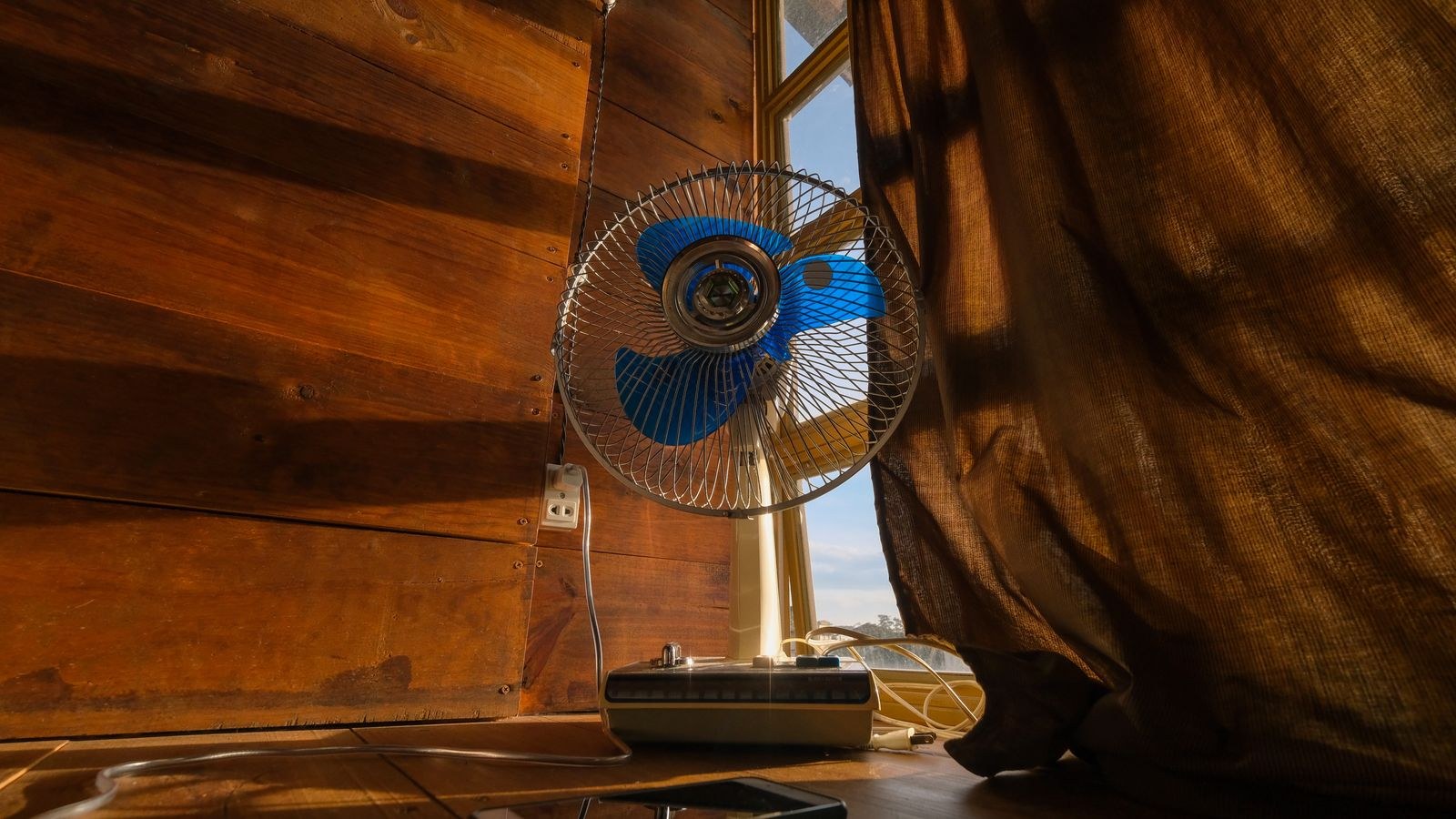
Pedestal fans use an axial blade that produces a periodic whoosh at blade-pass frequency plus motor hum. This structured, rhythmic sound is harder to ignore than a steady hiss at the same volume. Good DC pedestal fans have narrowed the gap substantially, and the quietest examples in our selection of the best quiet pedestal fans now compete directly with towers while moving considerably more air.
Ceiling fans can be the quietest option of all at the point where you sleep, because the motor is mounted several feet away and the blades turn slowly. A well-balanced ceiling fan on low is often inaudible. A poorly balanced one clicks and wobbles maddeningly, and that is an installation issue as much as a product one. Whichever shape you settle on, cross-checking against the best quiet cooling fans is a useful sanity check on how low the noise floor can realistically go.
Design Details That Separate Quiet From Silent
Beyond motor and shape, a handful of details make the difference between a fan you tolerate and one you forget about.
- Speed granularity. Three speeds is not enough. Eight or more lets you find the exact setting where airflow is sufficient and noise is not.
- Oscillation smoothness. Cheap oscillation mechanisms produce an audible click at each end of travel, which is exactly the kind of periodic sound that prevents sleep. Test it, or look for reviews mentioning it specifically.
- Sleep mode. A good implementation gradually steps the speed down over an hour or two and dims the display. Bright LED panels are a genuine sleep disruptor in their own right.
- Blade or drum balance. Any wobble becomes vibration, and vibration transmitted into a hard floor becomes a low-frequency hum through the whole room.
- Base stability. A fan that rocks slightly on a hard floor will resonate. A heavy, well-damped base kills that at source.

Placement Tricks That Buy You Free Quiet
You can reduce perceived noise substantially without spending anything. Distance is the strongest lever: doubling the distance from the fan to your head cuts sound pressure by about 6 dB, so moving a fan from two feet to four feet away is roughly equivalent to buying a considerably quieter model.
Surface matters next. A fan sitting directly on hardwood or tile couples its vibration into the floor, which acts as a soundboard. A rug, a foam pad, or even a folded towel under the base breaks that path and often removes a hum entirely.
Aim matters as well. Pointing a fan at a wall and letting the air circulate back is quieter at the ear than pointing it directly at your face, and often more comfortable because it avoids dry eyes and a dry throat. Finally, running a larger fan on a low setting is almost always quieter than running a small fan hard, because noise rises steeply with rotational speed. Buying more capacity than you need and using less of it is a legitimate quiet-fan strategy.
Common Mistakes
The first is buying on the headline decibel figure alone without checking the distance it was measured at or which speed it refers to. The second is choosing an AC fan to save money, then discovering its lowest speed is still too fast and its hum sits exactly in the range that keeps you alert.
The third is placing the fan on a hard floor beside the bed and blaming the fan for a resonance the floor created. The fourth is ignoring the display: a bright blue LED panel two feet from your face will disturb sleep regardless of how quiet the motor is, so check that the display can be dimmed or turned off entirely.
The fifth is assuming a quiet fan must be a small one. Undersized fans run at high speed to compensate and are among the noisiest options in practice. Correctly sized models drawn from the best fans for bedroom cooling can loaf along at a low setting and stay near their noise floor all night.
Frequently Asked Questions
What decibel level is quiet enough to sleep through?
Aim for 35 dB or lower at the speed you actually intend to run. Under 30 dB is genuinely excellent and effectively vanishes into typical bedroom ambient noise.
Are DC motor fans always quieter than AC fans?
Almost always at low speed, which is what matters for sleeping. They avoid electrical hum and offer far finer control at the bottom of the range. At maximum speed the difference narrows considerably.
Is white noise from a fan good or bad for sleep?
Many people sleep better with steady broadband sound because it masks sudden noises such as traffic or a door closing. What disrupts sleep is variability, so a consistent hiss helps while a clicking oscillation or a rising and falling hum does not.
Why does my fan get louder over time?
Dust accumulating on blades or the cross-flow drum unbalances it and disturbs airflow, and bearings dry out with age. Cleaning the intake and blades usually restores much of the original quiet, and it is worth doing at the start of each season.
Should I use oscillation at night?
Only if the mechanism is genuinely silent. Many sleepers find a fixed, indirect aim more restful than a sweep that changes the sound and airflow every few seconds.
Final Thoughts
Choosing a quiet fan for sleeping comes down to reading decibel figures sceptically and then looking past them. Check what speed and distance the rating refers to, favour a DC motor for its low hum and fine speed control, prefer a smooth broadband sound over a rhythmic one, and insist on enough speed steps that you can run the fan gently rather than flat out.
Then help it along once it arrives. Move it further from the bed, put something soft under the base, aim it indirectly, and dim the display. Those free adjustments routinely deliver a bigger improvement than upgrading to a more expensive model would, and combined with a well-chosen fan they are what turn a bedroom appliance into something you stop noticing entirely by the second night of 2026’s first heatwave.