Owen Bradley
 Walk into any TV aisle and three acronyms dominate the signage: OLED, QLED and Mini-LED. They sound like variations on a theme, and marketing departments work hard to keep it that way, but underneath they represent genuinely different ways of making light. One emits it per pixel, one filters it through quantum dots, and one packs thousands of tiny backlights behind the panel. Those differences decide how a set handles a dark film, a sunlit living room, a static news ticker and your budget. This comparison lays out what each technology does well, where each falls down, and how to match a panel type to your actual room rather than to a spec sheet.
The Fundamental Difference: Emissive Versus Backlit
Every current TV falls into one of two camps. Emissive panels generate light at each pixel, so a pixel showing black simply switches off and produces no light at all. Backlit panels have a separate light source behind a liquid crystal layer that acts as a shutter, and because no shutter is perfect, some light always leaks through in dark scenes.
OLED is emissive. QLED and Mini-LED are both backlit LCD variants. Grasping that single distinction explains almost every strength and weakness that follows, from OLED’s perfect blacks to Mini-LED’s brightness advantage. Everything else is refinement around those two approaches.
OLED: Per-Pixel Light and True Black
In an OLED panel, organic compounds emit light when current passes through them, and each subpixel is controlled individually. Switch one off and it produces absolutely nothing, giving an effectively infinite contrast ratio. A starfield looks like stars in space rather than grey dots on a grey field, and there is no halo around bright objects on dark backgrounds.
The advantages extend beyond contrast. Response times are near instantaneous, measured in microseconds rather than milliseconds, so motion stays clean without the smearing LCD panels show in fast action. Viewing angles are excellent, with colour and contrast holding up from far off-centre, which matters in wide rooms. Because pixels switch off independently, dark-room film watching is where OLED remains genuinely unmatched.
The trade-offs are brightness and burn-in. OLED peak brightness has climbed considerably with newer panel structures, but it still generally trails the best backlit sets in a bright room, especially on full-screen white content. Burn-in, where static elements leave a faint permanent trace, is a real if increasingly rare phenomenon. Modern panels mitigate it with pixel shifting, logo dimming and refresh cycles, and typical mixed viewing rarely triggers it, though a display left on a single channel logo for many hours a day remains a risk. If contrast is your priority, the best OLED gaming TVs show what the technology delivers when paired with modern gaming features.
QLED: Quantum Dots on a Conventional Backlight
QLED is not an emissive technology despite the name’s similarity to OLED. It is an LCD panel with a quantum dot layer added. Quantum dots are nanocrystals that convert blue backlight into extremely pure red and green, producing a wider colour gamut and higher colour brightness than a conventional LED LCD manages.
The practical result is a set that gets very bright, holds saturated colour even at high brightness levels, and costs considerably less than OLED at the same screen size. In a room with large windows or heavy daytime use, that brightness advantage is more visible than any contrast benefit, because ambient light washes out deep blacks regardless of the panel.
The weaknesses are the classic LCD ones. Black levels depend on how well the backlight can be dimmed locally, and standard edge-lit QLED sets show noticeable grey in dark scenes plus blooming around bright objects. Off-axis performance varies widely by panel type, and response times, while good, do not match OLED. For bright rooms where those compromises are acceptable, the best QLED gaming TVs cover the models that balance brightness against black level most successfully.
Mini-LED: Fixing the Backlight Problem
Mini-LED is not a new panel type at all, it is a dramatically improved backlight. Instead of a few dozen large LEDs, a Mini-LED set uses thousands of tiny ones arranged in hundreds or thousands of independently controlled dimming zones. Areas of the image that should be dark get their backlight turned down or off, while bright areas stay at full output.
Most Mini-LED televisions also carry quantum dots, so in practice Mini-LED and QLED overlap heavily; think of Mini-LED as the premium backlight and QLED as the colour layer. Together they deliver the highest peak brightness of any consumer TV technology, often well beyond what OLED reaches, along with contrast far closer to OLED than conventional LCD manages.
The remaining flaw is blooming. However many zones a set has, there are always far fewer zones than pixels, so a small bright object on a black background lights its whole zone and produces a faint halo. Better sets minimise this with more zones and smarter local dimming algorithms, but it never disappears entirely. Subtitles on a dark scene are the usual place you notice it. The best Mini-LED gaming TVs highlight models where zone counts and dimming control keep haloing genuinely hard to spot.
Head to Head on What Matters
- Black level and contrast: OLED first by a clear margin, Mini-LED a strong second, QLED third.
- Peak brightness: Mini-LED first, QLED second, OLED third, though modern OLED is closer than it once was.
- Viewing angles: OLED first, then panel-dependent for both LCD types.
- Motion clarity: OLED first thanks to near-instant pixel response.
- Burn-in risk: Only OLED carries any meaningful risk; LCD types have none.
- Price at a given size: QLED cheapest, Mini-LED mid to high, OLED typically highest.
- Longevity of brightness: LCD types hold output over many years more reliably.
Match the Panel to Your Room
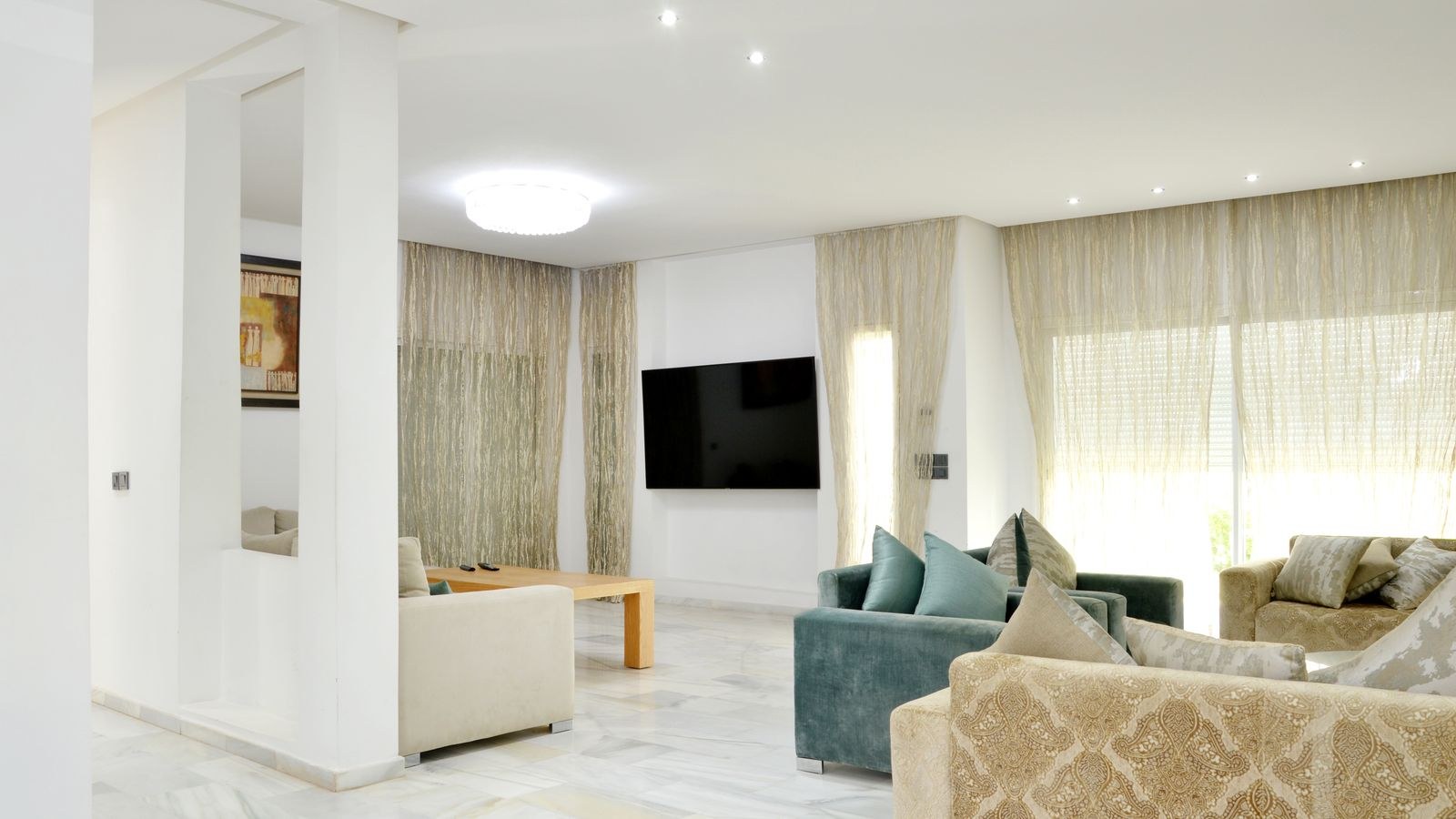
Room lighting is the single most useful deciding factor, and it is one you can assess without any technical knowledge. A living room with big windows, light walls and mostly daytime viewing favours brightness, which means Mini-LED or a good QLED. Ambient light raises the floor of perceived black anyway, so OLED’s advantage largely evaporates while its brightness deficit becomes obvious.
A dedicated media room, a basement, or any space where you watch mainly in the evening with lamps down favours OLED. In controlled light, the difference between true black and near black is immediately visible and genuinely changes how films look. Seating layout matters too: a wide sofa arrangement with viewers well off-centre suits OLED’s viewing angles, while a narrow room with everyone facing the screen removes that advantage. For rooms fighting daylight, the best bright gaming TVs gathers sets specifically chosen for high sustained output.
What About Gaming Specifically?
All three technologies now support the features that matter for consoles and PCs, including high refresh rates, variable refresh rate and automatic low latency mode. OLED holds an edge in motion clarity and input response, which competitive players notice. Mini-LED counters with brightness that makes HDR highlights genuinely punchy. Burn-in deserves a thought if you play one game with a fixed heads-up display for many hours daily, though modern mitigation makes it unlikely for mixed use. Whichever panel you choose, confirming full 4K support at high frame rates matters more than the panel type; the best 4K gaming TVs covers that across all three technologies.
Budget Tiers and Realistic Expectations
At the entry level you are choosing between basic LED LCD sets and lower-tier QLED models. Quantum dots meaningfully improve colour here, so a QLED is usually the better buy, but expect limited local dimming and modest contrast. Mid-range brings capable QLED sets with full-array dimming, or entry Mini-LED models with moderate zone counts, and this tier represents the value sweet spot for most bright-room households.
Upper mid-range is where OLED becomes accessible, typically at 55 and 65 inches, and where it competes directly with well-specified Mini-LED. At the top, both technologies deliver excellent results in their respective strengths, and the choice becomes purely about your room rather than about quality. A useful principle: at any given price, a well-implemented set from a strong model line beats a poorly implemented one using nominally superior technology.
Common Mistakes When Choosing
The most common error is assuming QLED and OLED are close relatives because the names rhyme. They are fundamentally different, and the similarity is deliberate marketing. Second is buying OLED for a bright conservatory-style room, then finding the picture washes out in daylight. Third is judging panels in a showroom, where torch-mode demo settings and overhead lighting flatter brightness and hide black-level differences entirely.
Buyers also over-weight burn-in fear. For typical varied viewing it is a remote risk, and worrying about it should not push you to a technology that suits your room less well. Finally, many shoppers compare local dimming zone counts across brands as if the number alone decides quality; the algorithm controlling those zones matters at least as much as how many there are.
Frequently Asked Questions
Is OLED still worth the premium?
In a light-controlled room, yes. Its contrast, motion and viewing angles remain unmatched. In a bright room, the premium buys advantages you will rarely see.
Is Mini-LED better than QLED?
Mini-LED is a backlight improvement and most Mini-LED sets are also QLED, so they are not really rivals. A Mini-LED set will out-contrast a conventional QLED set nearly every time.
How likely is OLED burn-in?
Unlikely with varied content thanks to pixel shifting and refresh routines. The risk rises with many hours daily of static logos, tickers or fixed game interfaces at high brightness.
Which technology lasts longest?
LCD-based sets generally hold brightness longer over a very long service life. OLED panels dim gradually, though modern designs have extended this substantially.
Do I need to worry about panel type for streaming?
Less than you might think. Streaming bitrates limit picture quality more than panel technology at normal viewing distances, so a good set of any type handles it well.
Final Thoughts
There is no overall winner, only a best fit. OLED owns dark-room contrast, motion and viewing angles. Mini-LED owns brightness and HDR impact while closing most of the contrast gap. QLED delivers strong colour and brightness at the friendliest price, provided you accept weaker black levels.
Decide by looking at your room before you look at any spec sheet. Assess how much light it gets, when you watch, and how your seating is arranged, then pick the technology that matches. Doing it in that order will get you a better picture in 2026 than chasing whichever acronym happens to be the most heavily advertised.