Owen Bradley
 The kitchen island is the hardest surface in the house to light well. It is a work zone that demands bright, shadow-free light for chopping and reading recipes, a social zone where people sit and talk over a glass of wine, and usually the visual centerpiece of an open-plan room. Ask a single fixture to handle all three jobs and it will fail at two of them. Most kitchens end up either with pendants that look beautiful and dazzle anyone seated at the counter, or with a grid of recessed cans that light the room evenly and leave your own shadow across the cutting board. This kitchen island lighting guide compares pendants, recessed cans and linear fixtures on the terms that matter, then gives the counts, mounting heights and lumen targets that produce glare-free prep light. If you are planning a renovation or just replacing tired fixtures in 2026, the numbers below are the ones worth writing down.
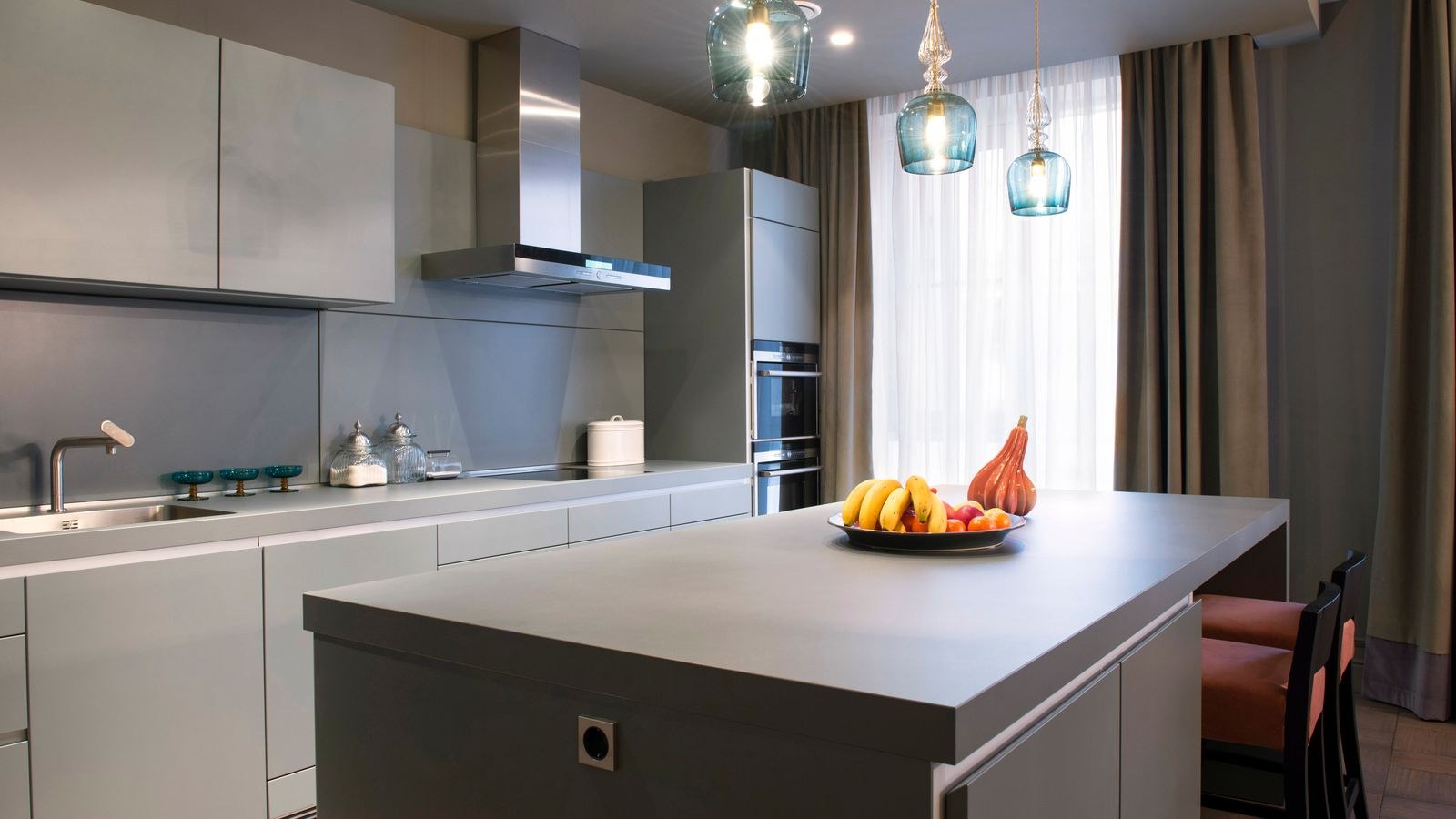
Think in Layers Before Choosing a Fixture
Professional kitchen lighting always uses at least three layers. Ambient light fills the room and keeps overall brightness comfortable. Task light lands directly on work surfaces so your hands and knives are clearly visible. Accent light highlights a backsplash, open shelving or the island itself and adds depth after dark.
The island usually needs task and accent light, while the room around it supplies ambient. That framing settles the pendants-versus-recessed argument before it starts: recessed cans are excellent ambient and decent task light, pendants are excellent task and accent light, and most good kitchens use both. The real question is not which one, but how many of each and at what height.
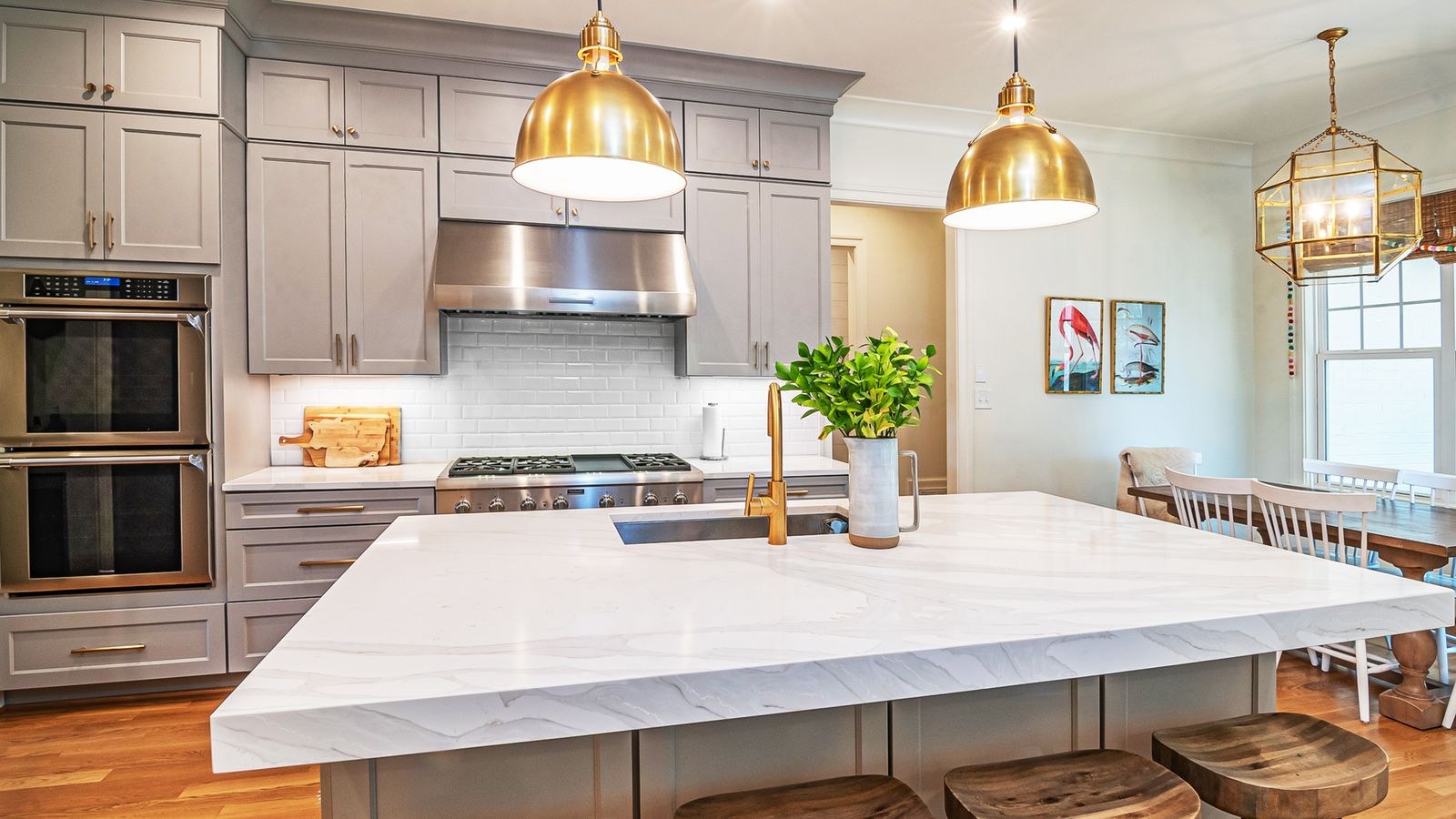
Pendant Lights Over the Island
Pendants are the default choice because they bring the light source close to the work surface, which massively improves how much usable illumination reaches the counter. A fixture hanging 32 inches above a countertop delivers far more light to that surface than the same output mounted at ceiling height, simply because illuminance falls off sharply with distance.
They also define the island visually. In an open-plan room where the kitchen flows into a living area, a row of pendants draws a line that says the island is a distinct zone. That is a design job no recessed can will ever do.
How Many Pendants and How to Space Them
Count is driven by island length. As a working rule, use two pendants for islands up to about 6 feet, three for islands between 7 and 9 feet, and four or a long linear fixture beyond 10 feet. Odd numbers tend to look better with small pendants; even pairs suit large statement fixtures.
For spacing, leave 6 inches minimum from the end of the island to the edge of the outer pendant, and ideally 12 to 15 inches. Space pendants 24 to 30 inches apart center to center for medium sizes, or 30 to 36 inches for large shades. A quick method that rarely fails: divide the island length by the number of pendants plus one, and place fixtures at those intervals so the gaps read evenly.
Hanging Height
Hang the bottom of each pendant 30 to 36 inches above the countertop. Thirty-two inches is the most common answer for an island with seating, since it clears sightlines across the counter while keeping the light close to the work surface. Go toward 36 inches if the pendants are large or if the ceiling is 9 feet or taller, and toward 30 inches if the pendants are small and the ceiling is standard height.
Two extra checks matter. First, look down the island from a seated position and confirm you cannot see the bare bulb; an open-bottom pendant at eye level is the most common glare complaint in a new kitchen. Second, verify that a tall person standing at the counter will not knock the shade with a raised hand.
Choosing Shade Style
The shade shape controls the beam. Opaque metal cones and domes throw a tight downward pool with crisp edges, ideal for task light but dramatic in a dark room. Glass globes and open cages scatter light in all directions and look attractive lit, but they expose the bulb and need a low-glare lamp inside. Frosted or opal glass splits the difference, delivering usable downlight with a soft glow. Because the bulb is often visible in these fixtures, bulb choice matters as much as fixture choice; our guide to the best light bulbs for pendant lights covers shapes, finishes and dimming behavior for exposed applications.
Recessed Lighting Over the Island
Recessed cans disappear into the ceiling and give a clean, uninterrupted look. In a kitchen with low ceilings, a strongly modern aesthetic, or an island that doubles as a serving buffet, they are often the better answer than pendants that would crowd the space.
The key detail is placement. Cans centered directly over the island edge cause your own body to cast a shadow onto the counter as you work. Instead, position them so the light falls slightly in front of where a person stands, generally 20 to 24 inches in from the island edge on the working side rather than straight down the centerline. Space cans roughly 3 to 4 feet apart along the island; a common formula is to divide the ceiling height by two to get the spacing in feet, so an 8-foot ceiling suggests 4-foot spacing.
Choose fixture size for the job. Four-inch and 5-inch cans give tighter, more controlled pools appropriate for a counter. Six-inch cans throw a wider beam better suited to general ambient coverage. Beam angle matters too: a 40-degree beam concentrates on the work surface, while a 60-degree beam blends into general room light. For a shortlist of trims and housings that suit kitchen work zones, see our roundup of the best recessed lighting for kitchen installations, and for the lamps that go inside them, the best recessed light bulbs for kitchen guide compares beam spread and color quality.
Linear and Track Fixtures
A single linear fixture, whether a long rectangular pendant, a bar-style LED or a track with adjustable heads, covers a long island with one clean gesture. Linear suspensions are especially good on islands over 8 feet, where three or four separate pendants can start to look busy.
Track lighting deserves more credit than it usually gets in kitchens. Adjustable heads let you re-aim light after the counters are in place, which is invaluable when the sink moves or the seating changes. Modern low-profile track looks far less like a retail store than the versions people remember, and monopoint or magnetic systems can be genuinely elegant.
The trade-off with linear fixtures is that a single long unit gives you one aesthetic statement rather than rhythm, and it must be centered precisely on the island because any misalignment is obvious across its whole length.
How Much Light: Lumen Targets
The general standard for kitchen task surfaces is 70 to 80 lumens per square foot, roughly double what a living room needs. Do the arithmetic on your island specifically rather than the whole room.
Take a common island of 3 feet by 7 feet, which is 21 square feet. At 75 lumens per square foot, you need about 1575 lumens landing on that counter. Split across three pendants, that is roughly 500 to 600 lumens each, well within the range of a standard LED bulb. A larger 4-by-10-foot island at 40 square feet needs about 3000 lumens, which typically means four pendants or a linear fixture with higher output.
Remember that pendant output is not the whole story. Some of the light from an open-bottom fixture escapes upward and sideways, so a globe pendant delivers less to the counter than a cone of the same rating. Add roughly 20 percent to your target when using diffuse open fixtures.
Color Temperature, CRI and Dimming
Kitchens look best in the 2700K to 3500K band. Use 2700K if the kitchen is visually connected to a living room and you want the warmth to carry across. Use 3000K as the safe all-purpose default, crisp enough for food prep without feeling cold. Push to 3500K only in a very modern kitchen with cool-toned stone and stainless surfaces. Anything at 4000K or above starts to make food look unappetizing and skin look grey.
Insist on CRI 90 or higher in a kitchen. Nowhere else in the house does color accuracy matter this much: you judge whether meat is cooked, whether produce is fresh and whether a sauce has browned by eye. Low-CRI light makes all of those judgments harder.
Dimming is essential and often overlooked. Full task brightness is right at 7 a.m. and wrong at 9 p.m. when the island becomes a place to sit and talk. Put pendants and recessed cans on separate dimmers so you can drop the overheads and keep a soft glow above the counter. Verify that every bulb, driver and dimmer combination is compatible, because mismatched LED and dimmer pairings cause flicker, buzzing and dead zones at the low end. Our comparison of the best LED light bulbs for kitchen use covers which lamps dim smoothly and which do not.
Common Kitchen Island Lighting Mistakes
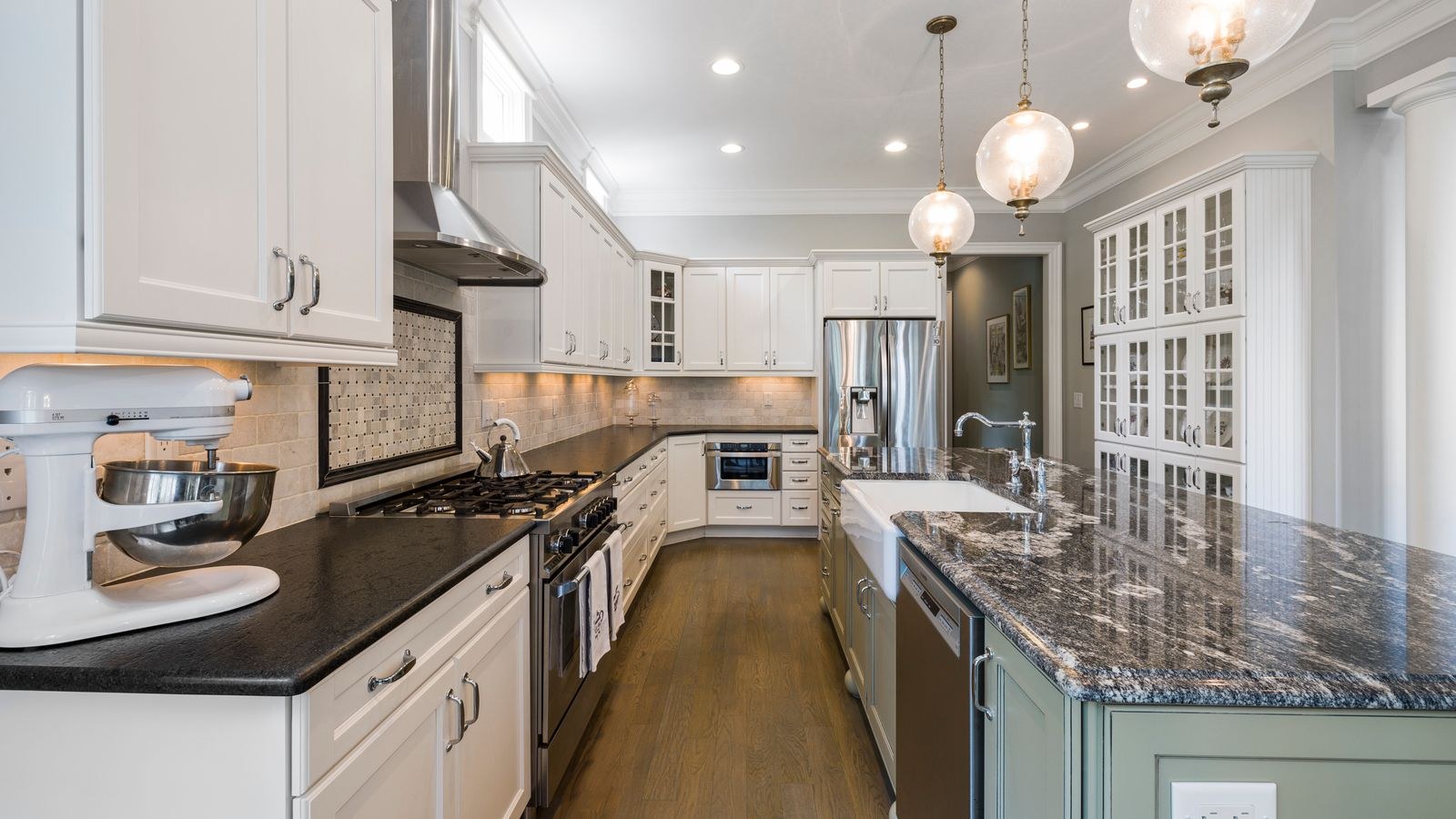
- Hanging pendants too low. Anything under 30 inches above the counter blocks sightlines and gets bumped. It also puts the emitter squarely in a seated person’s field of view.
- Centering pendants on the room instead of the island. The fixtures must align with the island, even if that puts them off-center in the room. Anything else reads as a mistake forever.
- Relying on recessed cans alone. Overhead-only light guarantees that you work in your own shadow.
- Choosing exposed-bulb pendants without checking glare. A vintage filament lamp at eye level across a counter is uncomfortable during a long dinner.
- Skipping dimmers. A kitchen that only has one brightness setting is a kitchen you will not want to linger in.
- Ignoring the electrical box location. Existing boxes rarely line up with a new island. Plan for moving them, or choose a linear fixture with a canopy that spans the offset.
- Mixing color temperatures. Warm pendants over cool recessed cans makes the whole kitchen look unresolved.
Frequently Asked Questions
How high should pendants hang over a kitchen island?
Thirty to 36 inches from the countertop to the bottom of the fixture, with 32 inches the most common choice. Hang higher for large pendants or tall ceilings, lower for small fixtures and standard ceilings.
How many pendants do I need over my island?
Two for islands up to about 6 feet, three for 7 to 9 feet, and four or a single linear fixture beyond 10 feet. Keep the outer fixtures at least 6 inches in from the island ends.
Can I use recessed lighting instead of pendants?
Yes, and in low-ceiling or minimalist kitchens it is often the better call. Offset the cans toward the working side of the island rather than the centerline so your body does not shadow the counter.
What color temperature is best for a kitchen?
3000K is the reliable default. Drop to 2700K if the kitchen opens onto a warm living space, and stay below 3500K so food and skin tones still look natural.
How many lumens does a kitchen island need?
Aim for 70 to 80 lumens per square foot of island surface. A typical 3-by-7-foot island wants roughly 1500 to 1700 lumens total, which splits neatly across two or three pendants.
Final Thoughts
Good island lighting comes from getting a handful of measurements right rather than from spending more. Center the fixtures on the island, hang them about 32 inches above the counter, size the count to the island length, target roughly 75 lumens per square foot, choose 2700K to 3000K bulbs at CRI 90 or better, and put everything on separate dimmers. Layer recessed cans around that core for ambient fill and offset them toward the work side so you never chop in your own shadow. Handle those decisions carefully and the island will work as well at 7 a.m. with a knife in your hand as it does at 9 p.m. with a glass in it.