Owen Bradley
 If your eyes ache by mid-afternoon, your head feels tight by evening, or you find yourself squinting at a screen you can see perfectly well, the problem is often not your monitor or your prescription. It is the lighting in the room around you. Home offices are frequently improvised into spare bedrooms and corners with lighting that was never designed for eight hours of close visual work — a single ceiling fixture, a window at the wrong angle, a screen glowing in an otherwise dark room. This guide explains what actually causes eye strain at a desk, and how to fix it with the right bulbs, positioning and control choices.
What Actually Causes Eye Strain
Digital eye strain has several contributing causes, and lighting is implicated in most of them.
- Contrast. A bright screen in a dark room forces your pupils to constantly adjust between the screen and everything around it. That repeated adjustment is genuinely tiring.
- Glare. Direct glare from a bare bulb or window in your field of view, and reflected glare bouncing off the screen, both reduce visible contrast and make you work harder to read.
- Flicker. Cheap LED drivers pulse rapidly. Most people cannot consciously see it, but the visual system responds to it, and it is associated with headaches and fatigue over long sessions.
- Insufficient light. Too little light on paper documents and the desk surface means your eyes strain to resolve detail.
- Uneven light. Bright pools next to shadowed areas force constant readjustment as you move between screen, keyboard and notes.
- Poor color rendering. Low CRI light makes everything look slightly wrong, and the eye works harder to interpret it.
Notice that only one of these is about brightness. The others are about distribution, quality and contrast — which is why simply installing a brighter bulb often makes things worse.
Brightness: How Much a Desk Actually Needs
A home office generally wants 30 to 50 lumens per square foot of ambient light, roughly twice a living room and comparable to a kitchen. On top of that, the desk surface itself wants dedicated task lighting delivering somewhere between 500 and 1000 lumens at the work area.
The key relationship is the ratio between the task area and its surroundings. Aim for the desk to be about three times brighter than the general room, not thirty times. A brilliantly lit desk in a dim room recreates the same contrast problem the screen already causes. Lift the ambient level of the whole room first, then add task light on top.
Color Temperature Through the Day
Cooler, bluer light improves alertness and perceived clarity; warmer light supports winding down. For a room used for focused work during the day, 4000K to 5000K is the productive range. It keeps you alert and renders documents crisply.
The complication is that many home offices double as bedrooms or living spaces, and 5000K light in the evening will interfere with sleep. The best solution is tunable lighting: cool and bright during working hours, dropping to 3000K or below after the workday ends. If you cannot tune, 4000K is the reasonable single compromise — alert enough for work without being harsh at night.
CRI matters here too. A CRI of 90 or above means printed material, screens and physical samples all render accurately. If your work involves any color judgment at all, this is not optional. Our comparison of the best light bulbs for home office use covers the flicker-free, high-CRI options that suit long working days.
Positioning: The Part Most People Get Wrong
- Never put a window directly behind or in front of your monitor. Behind means the screen is silhouetted against brightness; in front means it reflects. Position the desk so the window is to one side.
- Place the task lamp on the opposite side from your writing hand. Right-handed people put the lamp on the left so their hand does not cast a shadow across what they are writing.
- Keep the light source out of your direct sightline. If you can see the bulb from your seated position, it is producing glare. Use a shade, diffuser or a lamp with a deep hood.
- Aim task light at the desk surface, not at the screen. Light hitting the monitor washes out its contrast.
- Add bias lighting behind the monitor. A dim light on the wall behind the screen reduces the contrast between screen and background dramatically. This is one of the cheapest and most effective changes available.
- Light the walls, not just the desk. Illuminated vertical surfaces make the room feel evenly lit and reduce the tunnel effect of a single bright pool.
Managing Daylight
Natural light is the best light available and also the most variable. It changes intensity and angle through the day, and an office that is perfect at 10 a.m. can be unworkable at 4 p.m. when low sun comes through the window.
- Use adjustable window treatments. Blinds or sheer shades let you diffuse rather than block, keeping the daylight while removing the glare.
- Position the desk perpendicular to the window. The standard recommendation, and it works.
- Do not turn the electric lights off just because it is sunny. Daylight from one side plus no fill light on the other creates strong asymmetric shadows.
- Match your artificial light to daylight during the day. Around 5000K blends far better with daylight than 2700K does, which otherwise creates an obvious warm-cool split in the room.
Choosing Fixtures
Task Lamps
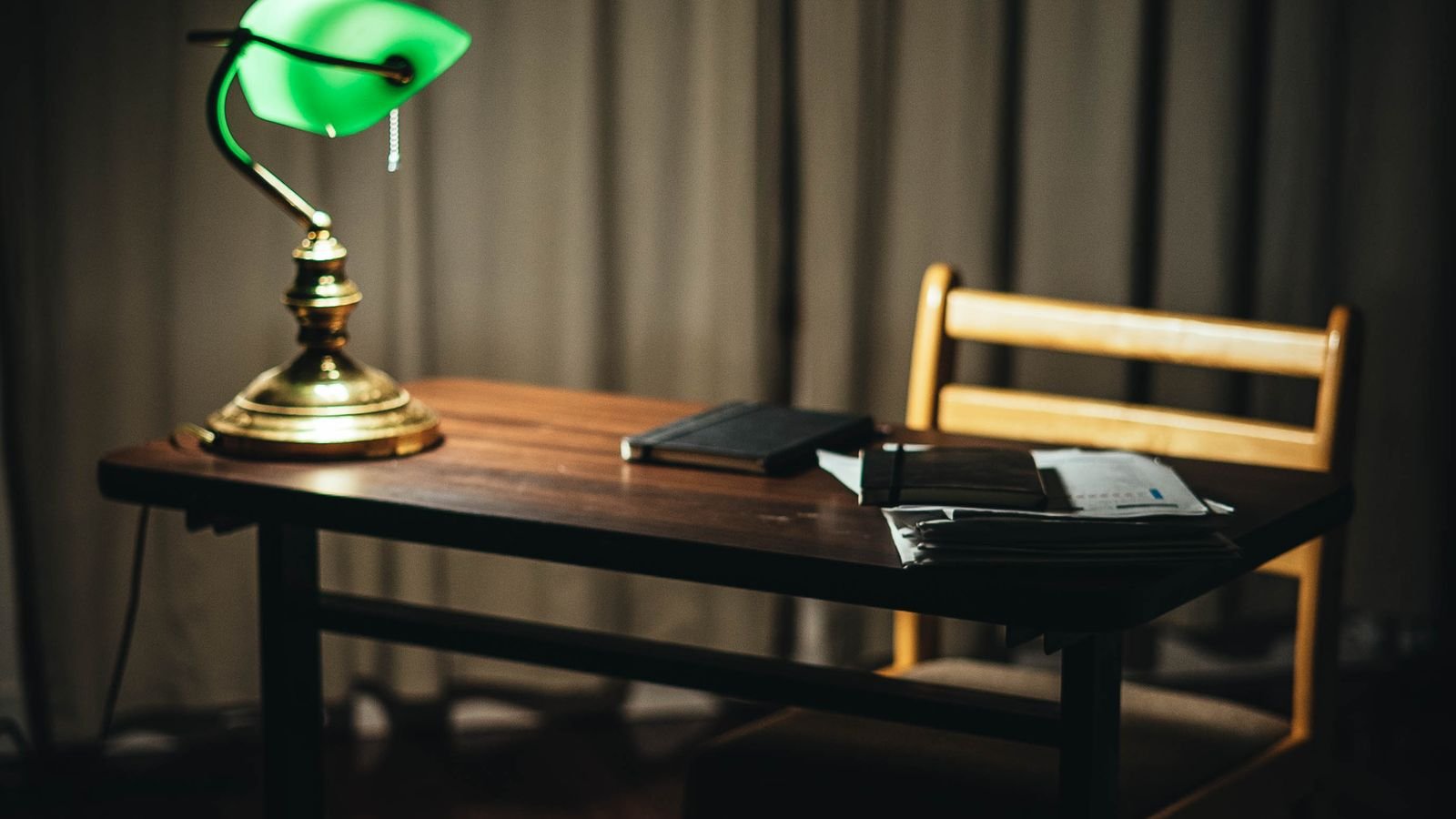
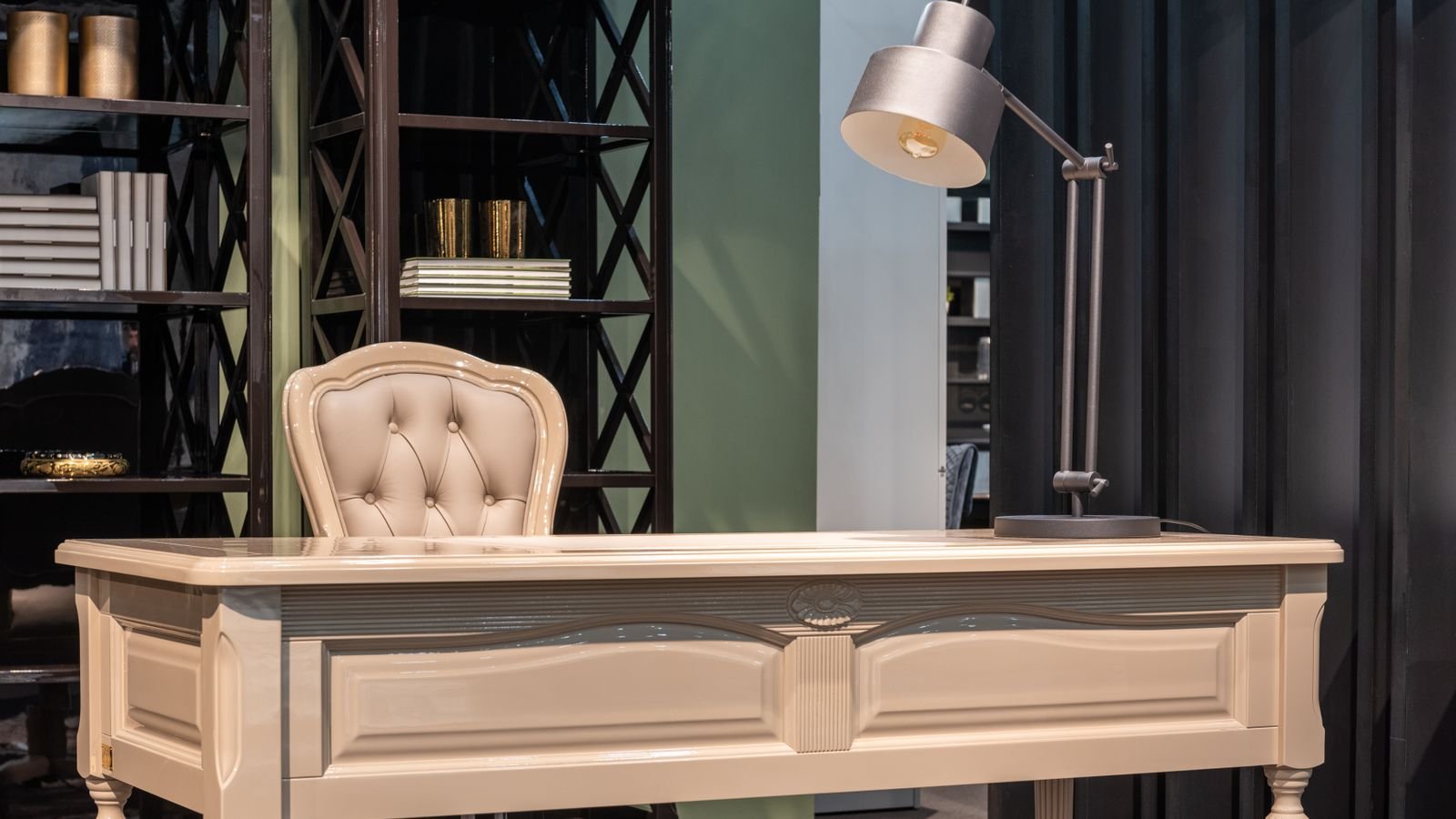
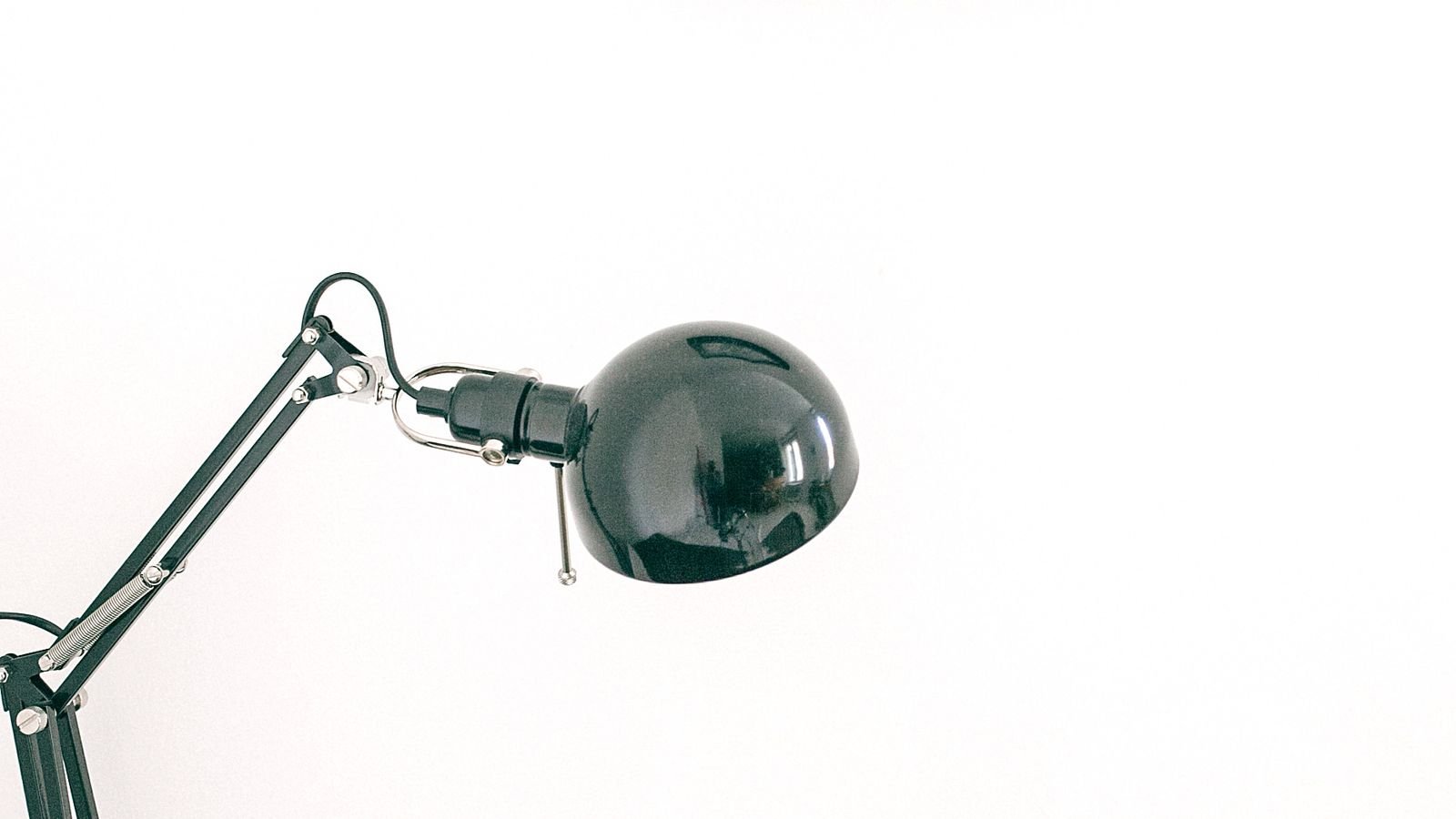
The most important purchase. Look for an adjustable arm or gooseneck, a head that can be aimed precisely, a diffused source rather than exposed LEDs, dimming, and ideally adjustable color temperature. A clamp mount saves desk space. Bar-style lamps that span the width of the desk give more even coverage than a single point source.
Ambient Lighting
Recessed downlights, a ceiling fixture on a dimmer, or a torchiere bouncing light off the ceiling. Bounced light is particularly good in an office because it is shadowless and glare-free. Whatever you use, put it on a dimmer.
Bias and Accent Lighting
An LED strip behind the monitor or a small lamp on a shelf behind the screen. Set it warm and dim. The effect on evening comfort is out of all proportion to the cost.
Monitor Light Bars
These clip to the top of a screen and throw light forward onto the desk without touching the display. They solve the shadow and reflection problem elegantly in small setups where a desk lamp will not fit.
For reading physical documents at length, the light bulbs for reading comparison covers options optimized for print contrast, while the light bulbs for eyes roundup focuses specifically on low-flicker, high-CRI choices. If your office is a converted room used for other things too, the office light bulbs guide covers the tunable options that let one fixture serve both roles.
Flicker: The Invisible Problem
Flicker deserves its own section because it is the least understood cause of office eye strain. All mains-powered LEDs modulate to some degree; the question is how deeply and at what frequency. Poor drivers produce deep modulation at low frequencies, which the visual system detects even when you consciously do not.
You can test crudely with a phone camera in slow-motion mode — visible banding suggests significant flicker. Reputable manufacturers publish flicker percentage or advertise flicker-free operation. Since this is a bulb you will sit under for thousands of hours, it is worth paying for a driver that does not pulse. Note also that dimming often makes flicker worse, so test at the level you will actually use.
A Practical Setup Checklist
- Ambient light across the room, dimmable, at 4000K to 5000K during working hours.
- An adjustable task lamp positioned opposite your writing hand, aimed at the desk, delivering 500 to 1000 lumens.
- Bias light behind the monitor, warm and dim.
- Desk perpendicular to the window, with adjustable shades.
- All bulbs at CRI 90 or above and verified low flicker.
- No bare bulb visible from your seated position.
- A way to shift everything warmer at the end of the working day.
- The 20-20-20 habit — every 20 minutes, look at something 20 feet away for 20 seconds. No lighting setup replaces this.
Common Mistakes to Avoid
- Working with only a screen for light. The highest-contrast, most fatiguing arrangement possible.
- One bright overhead and nothing else. Creates shadows on the desk and glare on the screen.
- Aiming the task lamp at the monitor. Washes out the display and creates reflections.
- Choosing 2700K bulbs for a workspace. Comfortable for a lounge, sleep-inducing at a desk during the day.
- Ignoring flicker to save a few dollars per bulb. A false economy over an eight-hour day.
- Positioning the desk facing a window. Guarantees squinting for part of every sunny day.
- Skipping dimmers. The light level you need at 9 a.m. is not the one you need at 8 p.m.
Frequently Asked Questions
What color temperature is best for a home office?
4000K to 5000K during working hours for alertness and clarity. If the room is used in the evening as well, choose tunable bulbs that drop to 3000K or below after work, or settle on 4000K as a single compromise.
How bright should a desk lamp be?
Roughly 500 to 1000 lumens at the work surface, with the surrounding room lit to about a third of that level. The ratio between task and ambient matters more than the absolute number.
Does bias lighting behind a monitor really help?
Yes, noticeably. It reduces the contrast between a bright screen and a dark wall, which is one of the main drivers of eye strain during long sessions. A dim warm strip is enough.
Are blue light filtering bulbs necessary for an office?
During working hours, no — some blue content supports alertness and is appropriate at a desk. Filtering is worthwhile in the evening, but it is better achieved by dimming and warming your lighting after work than by filtering all day.
How do I know if my bulbs flicker?
Point a phone camera at the bulb in slow-motion video mode and look for banding, or wave a pencil rapidly in front of it and look for a stroboscopic stutter. Products that publish a flicker percentage or claim flicker-free operation are the safer choice.
Final Thoughts
Comfortable office lighting comes from balance rather than power. Raise the ambient light in the whole room, add a properly aimed task lamp opposite your writing hand, put a dim glow behind the monitor, and keep every light source out of your direct line of sight. Choose bulbs with high CRI and verified low flicker, aim for cooler light during the working day, and give yourself a way to warm everything down in the evening. These changes cost very little and they compound — a desk set up this way in 2026 simply stops being the thing that makes your eyes tired by three o’clock.