Owen Bradley
 Hard water is the quiet saboteur of a good shower. It leaves chalky rings on glass, turns shampoo into a stubborn film, clogs nozzles until the spray fires sideways, and leaves skin feeling tight rather than clean. Most people blame the fixture, replace it, and watch the same problem return within a year. The real issue is dissolved mineral content in the supply, and the fixes fall into three quite different categories that are routinely confused with one another: filtration, softening, and scale-resistant hardware. This guide explains what each actually does, what a shower-level solution can and cannot achieve, and how to build a setup that keeps working rather than one that looks good for a month.
What Hard Water Actually Is
Hardness is a measure of dissolved calcium and magnesium picked up as groundwater passes through limestone, chalk and gypsum. It is not a contaminant in the health sense; hard water is perfectly safe to drink and even contributes trace minerals. It is a nuisance in the mechanical and cosmetic sense.
Hardness is usually expressed in grains per gallon or in parts per million. Below 3.5 grains per gallon is soft, 3.5 to 7 is moderately hard, 7 to 10.5 is hard, and above that is very hard. Your municipal supplier publishes an annual water quality report with the figure. If you are on a well, a mail-in test kit will give you hardness along with iron, pH and sulfur, all of which affect which treatment makes sense.
Why Hard Water Damages Showers
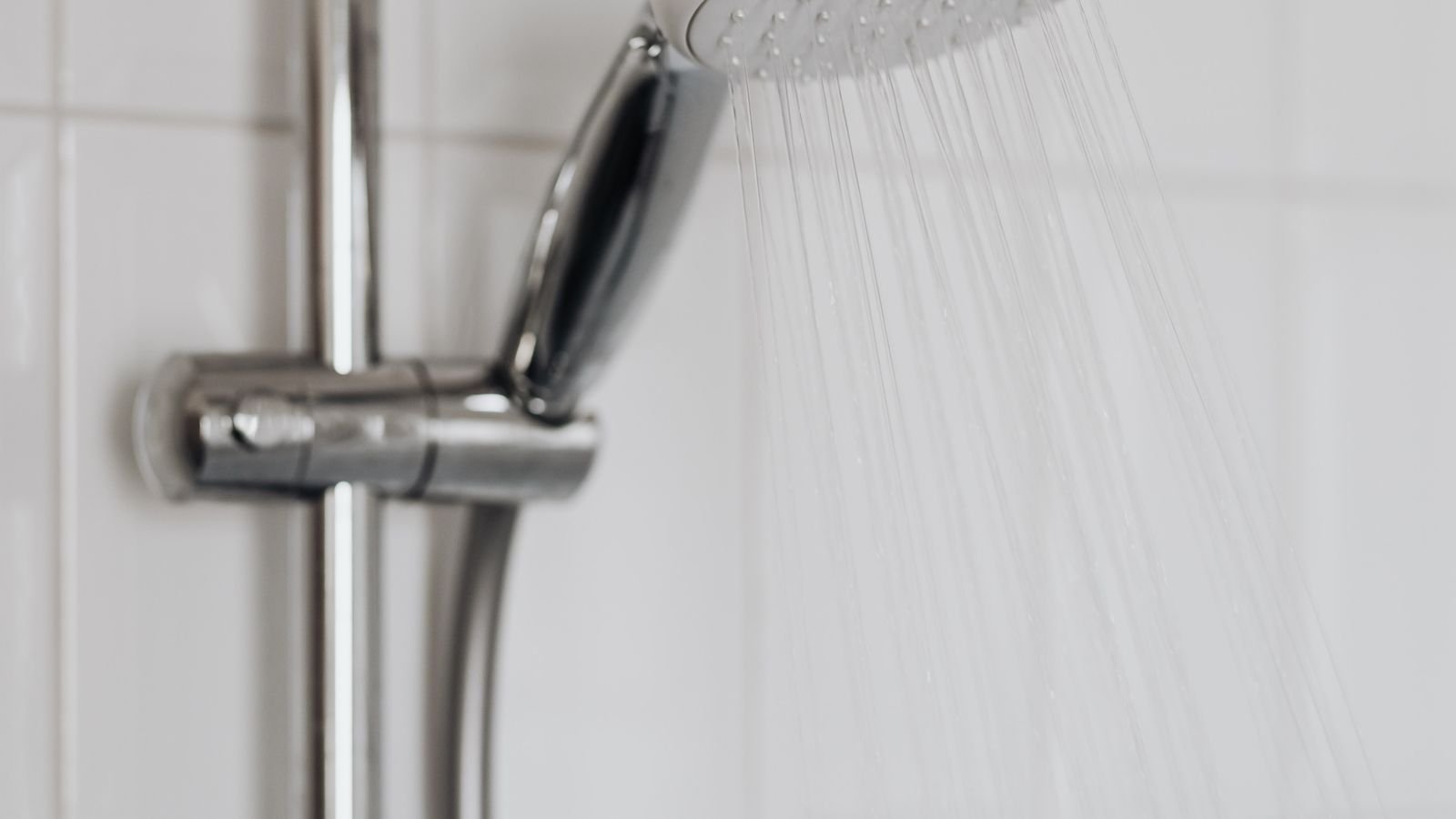
Every time water dries on a surface, the dissolved minerals stay behind. On glass and tile that produces the familiar spotting and film. Inside a shower head it is more consequential: scale narrows the tiny nozzle apertures, and because the narrowing is uneven, the spray pattern degrades before the total flow does. Individual jets shoot off at odd angles or shut down entirely.
Scale also builds inside the water heater, where it insulates the heating element and drives up energy use, and inside valve cartridges, where it causes stiff handles and eventual dripping. Hot water accelerates all of this, since heating drives carbonates out of solution. That is why the shower, not the cold tap, always shows the problem first.
There is a personal side too. Hard water reacts with soap to form an insoluble residue that clings to skin and hair. That film, more than the minerals themselves, is what makes hair feel straw-like and skin feel itchy after showering in a hard-water area.
Filtration, Softening and Conditioning Are Not the Same Thing
This is the single most important distinction in the entire subject, and manufacturers blur it constantly.
Filtration
A filter removes things suspended or dissolved in water by trapping or chemically converting them. Shower filters typically use KDF-55, a copper-zinc alloy that converts free chlorine into harmless chloride through a redox reaction, paired with activated carbon for chloramine, odors and organics, and sometimes calcium sulfite. Filtration reliably improves how the water feels on skin and hair. It does not remove calcium or magnesium in any meaningful quantity.
Softening
True softening is ion exchange. Water passes through a resin bed that swaps calcium and magnesium ions for sodium or potassium ions. The resin eventually saturates and must be regenerated with a brine solution, which is why real softeners have a salt tank and a control valve and occupy floor space near the main supply. This is the only method that genuinely removes hardness.
Conditioning
Salt-free conditioners, sometimes sold as template-assisted crystallization or magnetic devices, do not remove minerals. The better ones encourage calcium to form microscopic crystals that stay suspended rather than adhering to surfaces, which reduces scale build-up in pipes and heaters. Results vary considerably with water chemistry, and the magnetic variants in particular lack solid supporting evidence. Treat conditioning as scale mitigation, not softening.
What a Shower-Level Solution Can Realistically Deliver
Set expectations honestly. A shower filter or a filtered head will noticeably reduce chlorine smell, ease dry skin and itchy scalp, and cut down on sediment and some metals. Many people report softer-feeling hair within two weeks, and that effect is real, driven mainly by chlorine removal.
What it will not do is stop limescale on the glass or in the head. No cartridge small enough to hang off a shower arm contains enough ion-exchange resin to soften a 2 GPM flow for more than a few minutes, and none of them can regenerate. If a product claims to soften hard water from a shower-sized housing, that claim is marketing rather than chemistry.
If your priority is skin and hair comfort, a shower-level solution is the right, inexpensive answer. If your priority is eliminating scale throughout the house, you need a whole-home softener at the point of entry, and the shower filter becomes a complement rather than a substitute. Our comparison of the best shower water filters covers inline units, and the best water filters for shower heads guide covers cartridge-based options that fit behind an existing head.
Inline Filters vs Filtered Shower Heads
Two form factors dominate, and the choice is mostly about whether you like your current head.
An inline filter is a cylindrical housing that screws between the shower arm and whatever head you already own. It keeps your existing fixture, holds more media than a head-integrated cartridge and therefore usually lasts longer, and can be replaced independently. The downsides are added length that lowers the head by two or three inches, an extra threaded joint that can weep, and a visible canister.
A filtered shower head integrates the media into the head body. It looks tidier, adds no length, and is a single-part replacement. In exchange the media volume is smaller, cartridges are proprietary, and when the filter housing eventually fails you replace the whole fixture.
A third option worth knowing about is the handheld with a filter in the hose base, which combines filtration with the practical advantages of a detachable head. Whichever you choose, verify cartridge price and availability first; a cheap unit with expensive or discontinued cartridges is a poor bargain.
Reading Filter Specifications Honestly
- Media type. KDF-55 for chlorine and some heavy metals, activated carbon for chloramine, odor and organics, calcium sulfite for chlorine in hot water where carbon performs poorly. A combination is better than any single medium.
- Rated capacity. Usually quoted in gallons, commonly 10,000 to 15,000. Divide by your household’s shower usage to get a realistic service life rather than trusting the “six months” on the box.
- Flow restriction. Any filter adds resistance. If your supply pressure is already marginal, choose a low-restriction design or you will trade dry skin for a weak spray.
- Third-party certification. Independent testing against a recognized standard is meaningfully better evidence than a manufacturer’s own percentage claims.
- Housing material and thread. Standard 1/2 inch NPT keeps you compatible with any head. A metal housing survives being cranked on with a wrench; plastic collars crack.
Hardware That Resists Scale
Independent of any filtration, the fixture itself can be chosen to cope with hard water. The single most useful feature is soft silicone or rubber nozzle tips, which flex enough that scale cracks off when you rub them with a thumb. A head with rigid metal or hard plastic nozzles in a hard-water area will need chemical descaling every few weeks instead of a ten-second wipe.
Beyond nozzles, prefer a brushed nickel or brushed stainless finish over polished chrome or matte black, because brushed textures disguise the white residue that hard water inevitably leaves. Look for a removable face plate or a design that can be disassembled for soaking, and choose a metal swivel joint since the constant descaling routine is hard on plastic threads. Fixtures built with these details are collected in our guide to the best shower heads for hard water, while combined filtering fixtures appear among the best filtered shower heads.
A Practical Descaling Routine
- Fill a plastic bag with white vinegar, enough to submerge the face of the head.
- Secure the bag around the head with a rubber band or cable tie so the nozzle face is fully immersed. Leave it for one hour, or overnight if scaling is heavy.
- Remove the bag and rub every nozzle firmly with a thumb or a soft brush to dislodge softened deposits.
- Run the shower on the hottest setting for a full minute with the head pointed away from you to flush out loosened debris.
- Unscrew the head and check the small inlet screen for grit at least twice a year; this is the usual cause of an abrupt drop in flow.
- Wipe glass and tile with a squeegee after each shower. It sounds fussy, but it prevents the deposit forming in the first place and saves far more effort than it costs.
Do not use bleach or abrasive pads on any finish, and keep acidic descalers off matte black and oil-rubbed bronze coatings, which they will haze permanently. Descaling glass is a related battle, and our notes on the best ways to clean glass shower doors cover products that work on carbonate film specifically.
When to Step Up to Whole-Home Treatment
Consider a whole-home approach when hardness exceeds roughly 10 grains per gallon, when your water heater is losing efficiency or making rumbling noises from sediment, when appliances such as dishwashers and washing machines are scaling internally, or when you are simply tired of descaling every fixture in the house individually.
A point-of-entry softener treats every tap and appliance, protects the plumbing itself and removes the underlying cause rather than the symptoms. The costs are installation, floor space, ongoing salt, and a slight increase in sodium in the drinking water, which is why many households pair a softener with a dedicated drinking-water filter at the kitchen sink. Broader whole-house treatment options are compared in our roundup of the best home water purifiers.
Frequently Asked Questions
Will a shower filter fix my limescale problem?
No. It will improve how the water feels on skin and hair by removing chlorine, but calcium and magnesium pass straight through. Scale prevention requires either whole-home softening or a diligent descaling routine paired with scale-resistant hardware.
How long do shower filter cartridges really last?
Manufacturers quote around six months, which assumes moderate use. A busy family bathroom may exhaust a cartridge in three. Judge by gallons rated versus gallons used, and replace early if the chlorine smell returns.
Do magnetic or electronic descalers work?
Evidence is weak and inconsistent. Some users report reduced scale adhesion, but controlled testing has not reliably reproduced the effect. If scale is genuinely costing you money, ion exchange is the method with demonstrated results.
Does a filter reduce my water pressure?
Slightly, yes, since it adds flow resistance. On a healthy supply of 50 psi or more the difference is barely noticeable. On a marginal supply it can be significant, so choose a low-restriction unit and consider a head designed for low pressure.
Is hard water bad for my health?
Not in itself. The calcium and magnesium are harmless and mildly beneficial. The skin and hair complaints associated with hard water come from soap residue and from chlorine, both of which are addressable without removing the minerals.
Final Thoughts
Start by finding out how hard your water actually is, because the number determines the sensible level of investment. If hardness is moderate and your complaint is dry skin and dull hair, a good filtered head or inline filter plus a scale-resistant fixture will solve most of it for very little money. If hardness is high and it is damaging appliances and heaters, the shower is only the most visible symptom and a whole-home softener is the honest answer.
Whatever you fit, keep the maintenance simple and regular: a vinegar soak once a month, a thumb over the nozzles every week, a squeegee on the glass, and a calendar reminder for cartridge changes. Hard water never really goes away, but with the right combination of filtration, hardware and habit it stops being something you notice.