Owen Bradley
 Curved monitors moved from novelty to mainstream so quickly that many buyers now assume a curve is simply a newer, better version of a flat screen. It is not. Curvature is a design trade-off that solves a specific problem, and on the wrong panel at the wrong distance it delivers nothing but a higher price and an awkward reflection profile. This guide explains what curvature ratings such as 1800R and 1000R actually mean, where a curve genuinely improves comfort and immersion, why designers and photographers usually stay flat, and how to decide which shape belongs on your desk in 2026. By the end you should be able to look at any spec sheet and know instantly whether the curve is doing useful work.
What the Curvature Numbers Mean
Curvature is expressed as a radius in millimetres followed by the letter R. An 1800R panel is a section of a circle with a radius of 1800mm, or roughly 1.8 metres. A 1000R panel comes from a much tighter circle of one metre. The smaller the number, the more aggressive the curve.
The number has a practical meaning that most spec sheets never explain: the radius is the ideal viewing distance. If you sit one metre from a 1000R screen, every point on the panel is the same distance from your eyes, which is the entire purpose of the curve. Sit much further away and the curve becomes pointless; sit much closer and it can feel like the edges are wrapping past you. Common ratings run from gentle 1800R and 1500R through to aggressive 1000R and 800R, with tighter curves generally reserved for the widest panels.
Why Curvature Exists At All
On a wide flat panel viewed from close range, the corners are physically further from your eyes than the centre. That difference causes three subtle problems: your eyes must refocus slightly as you scan across, colours shift because most panel technologies change appearance with viewing angle, and brightness drops toward the edges. A curve equalises the distance and largely removes all three effects. On a narrow panel the distance difference is negligible, which is exactly why a curve on a 24 inch screen accomplishes almost nothing.
Where Curved Panels Genuinely Help
The benefit scales with width. On a 34 inch ultrawide, the edges of a flat panel sit noticeably further away and often look slightly washed out at desk distance. Add a curve and the whole image becomes visually consistent, which reduces the small ongoing effort of scanning across the screen. On 49 inch super-ultrawide panels a curve is effectively mandatory, since a flat version would be unusable at desk range.
Immersion is the second real benefit, and it matters most in gaming. Wrapping the image slightly around your field of view increases the sense of being inside a scene, particularly in racing, flight and open-world titles. Combined with a wide aspect ratio, the effect is genuinely more convincing than a flat screen of the same size. If that is what you are after, the best curved monitors guide covers which curvature ratings suit which sizes, and the best ultrawide monitors roundup shows how width and curve usually arrive together.
Comfort Over Long Sessions
Many people who move from a flat ultrawide to a curved one report less fatigue at the end of a long day, even though they struggle to name a single visible improvement. That is consistent with what curvature does: it removes small, constant corrections your eyes were making without your awareness. The effect is real but modest, and it only exists on wide panels where the geometry problem was significant to begin with.
Where Flat Panels Still Win
Anything involving straight lines and precise geometry favours a flat screen. Architectural drawings, page layouts, vector illustration and photo composition all rely on judging whether a line is truly straight, and a curved panel introduces a subtle bend that your brain must correct for. Professionals in these fields overwhelmingly stay flat, not out of habit but because the tool must not distort the work.
Flat panels also handle sharing better. Two people watching a curved screen from either side get noticeably different images, because the curve is optimised for a single central seat. In an office where colleagues lean in to review something, or where a screen is occasionally shown to a client, flat is more practical. For colour-critical and layout work, the best monitors for graphic design selection concentrates on flat panels with strong colour accuracy for exactly these reasons.
Mounting, Space and Reflections
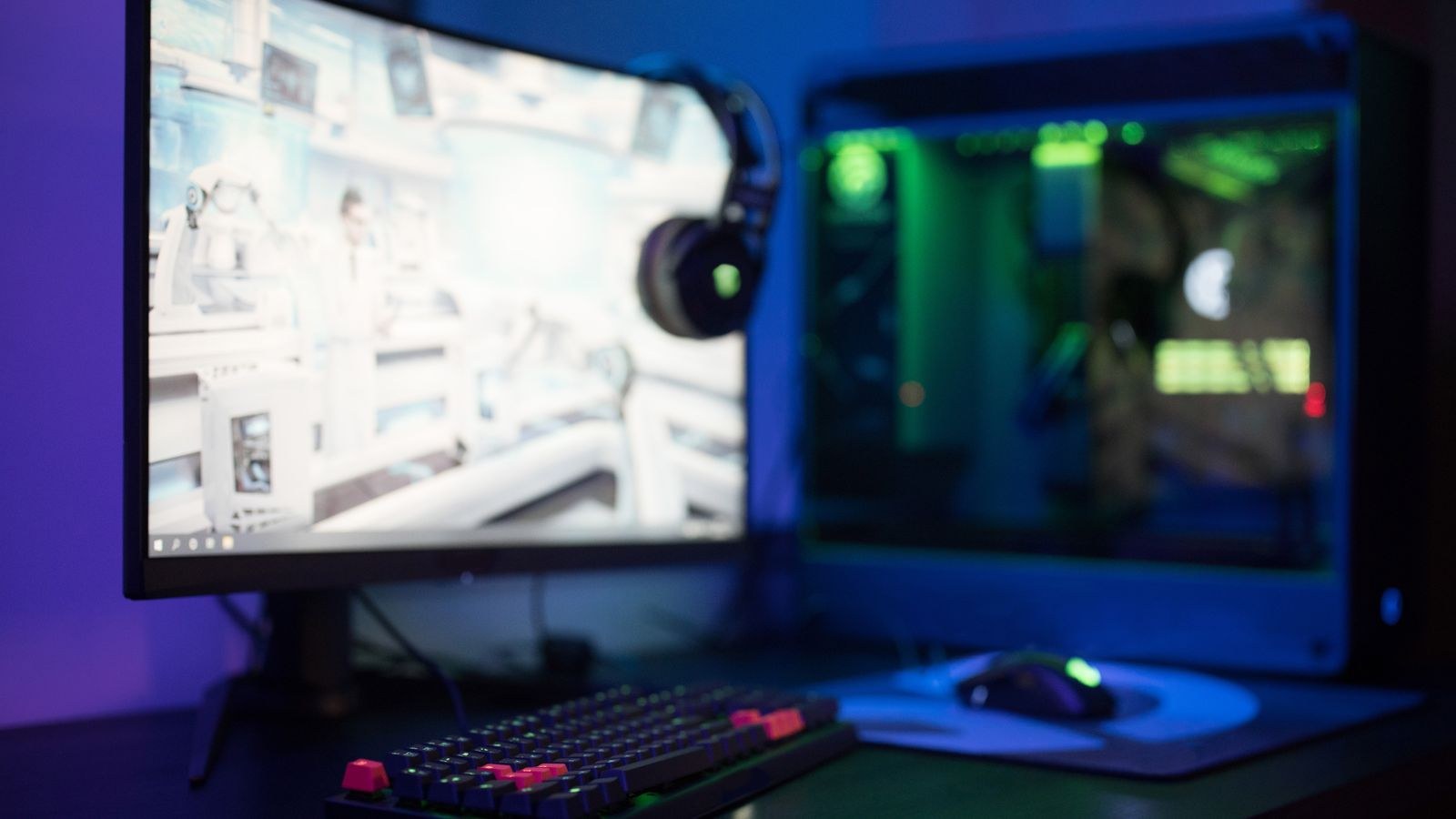
Practical considerations often decide the matter. Curved panels do not sit flush against a wall, so wall-mounting leaves a gap, and they are harder to position in a corner. They are usually heavier and physically deeper than flat equivalents, which matters if your monitor arm has a tight weight rating.
Reflections behave differently too. A flat screen bounces a window or lamp back at one predictable angle that you can tilt away. A curved panel spreads reflections across a wider arc, which can put a smear of glare in the centre of your view depending on where the light source sits. If your workspace has a bright window behind your seating position, test carefully before committing to a curve.
Size and Curve: The Pairings That Work
- 24 to 27 inches, 16:9: Stay flat. The distance difference across the panel is too small for a curve to accomplish anything meaningful.
- 32 inches, 16:9: Optional. A gentle 1800R curve is mildly beneficial, but a flat panel remains perfectly comfortable.
- 34 inch ultrawide: Curved is preferred. 1900R or 1800R suits typical desk distances well.
- 38 to 40 inch ultrawide: Curved strongly recommended, usually 2300R to 1800R depending on the model.
- 49 inch super-ultrawide: Curved essentially required, typically 1000R, and it needs a deep desk to work.
The pattern is simple: the wider the panel, the stronger the case for a curve, and the tighter that curve should be.

Curvature and Gaming Performance
A curve changes how a game feels, not how fast it runs. It has no effect on refresh rate, response time or frame rate, and it does not increase the load on your graphics card. What it can affect is competitive perception. In fast shooters, some players find that a curve helps them notice movement at the edges because those edges are angled toward them, while others prefer a flat panel because it presents an undistorted reference for tracking targets.
There is no consensus, and both shapes appear at the top level of competitive play. The safe advice is to prioritise refresh rate, response time and panel quality first, then treat curvature as a preference. Panels that get the fundamentals right in both shapes are collected in the best monitors for gaming guide, and if you are targeting the mid-range performance sweet spot, the best 1440p gaming monitors roundup narrows it further.
Does a Curve Cost More?
Slightly, but less than it used to. Manufacturing curved glass adds cost, though volume production has narrowed the gap considerably. At the same size and specification, expect a modest premium. The larger price differences you see between curved and flat models are usually driven by other specifications bundled in, such as higher refresh rates or better colour coverage, rather than by the curve itself. Compare complete specifications rather than assuming the curve explains the price.
How to Decide in Four Questions
- How wide is the panel? Below 32 inches at 16:9, flat is the sensible default.
- How far do you sit? Match the curvature radius roughly to your viewing distance for the best result.
- Does your work depend on straight lines? If yes, choose flat and do not compromise.
- Will anyone else view the screen with you? Shared viewing favours flat panels.
If your answers point in different directions, weight the work question most heavily. Immersion is pleasant, but distortion in professional output is a daily problem.
Common Mistakes Buyers Make
The most frequent error is buying a curved panel because it looks modern, without checking whether the size justifies it. A curved 24 inch monitor delivers essentially no benefit and can slightly complicate mounting. The second mistake is mismatching curvature to seating distance, most often buying an aggressive 1000R panel and then sitting nearly two metres away, where the curve simply looks odd.
A third pitfall is mixing shapes in a multi-screen setup. A curved primary next to a flat secondary creates an awkward junction where the two images meet at different angles, which is more distracting than either shape alone. Finally, some buyers get so focused on the curve that they overlook panel technology, contrast, brightness and refresh rate, which affect the daily experience far more than geometry ever will.
Frequently Asked Questions
Is a curved monitor better for your eyes?
On wide panels, mildly yes, because it keeps the whole image at a consistent distance and reduces small refocusing efforts. On standard 16:9 screens of 27 inches or less the difference is negligible, and factors like brightness and screen height matter far more.
Does 1000R mean better than 1800R?
No, only more aggressive. The best rating is the one that matches your viewing distance and panel width. A tight 1000R curve on a screen you sit far from will feel excessive, while a gentle curve on a 49 inch panel does too little.
Can I use a curved monitor for design work?
You can, but it is not ideal for layout, illustration or architectural work where judging straight lines matters. Photo colour grading is less affected than geometry-heavy tasks, though most professionals still prefer flat for reliability.
Do curved monitors work well on a wall mount?
They mount fine on standard VESA arms and brackets, but they will not sit flush against a wall and tend to be heavier. Check the weight rating of your arm and allow extra clearance behind the panel.
Final Thoughts
Curved and flat monitors are not competing generations of technology, they are two solutions aimed at different situations. A curve earns its place on wide panels viewed from a fixed central seat, where it makes the image consistent and deepens immersion. Flat panels stay the right choice for standard sizes, shared viewing, and any work where a straight line must look straight. Match the curvature radius to your seating distance, size the panel to your desk, and judge refresh rate and colour quality before shape. Do that and the monitor you buy in 2026 will suit the way you actually use it, curved or not.