
 Marcus Bell
 Choosing the Best Routers for Cable Internet in 2026
If you subscribe to a cable internet plan from providers like Xfinity, Cox, or Spectrum, the router you connect makes an enormous difference in how fast and reliable your connection actually feels. Even the quickest cable plan can be held back by an outdated or underpowered router that struggles to spread signal across your home. That is why finding the best routers for cable internet is one of the smartest upgrades you can make, and it usually costs far less than the monthly fees you would pay to rent equipment from your provider.
This guide is not a product-by-product review. Instead, it walks you through how to think about cable internet routers, what specifications truly matter, and how to match a device to your home, your plan, and your budget. By the end, you will know exactly what to look for and be able to shop with confidence.
To help you compare popular options at a glance, here is a curated list of top-rated routers and modem-router combos worth considering for cable internet setups.

Pros
- Dual-band Wi-Fi 5 Wave 2 rated at up to 600 Mbps on 2.4GHz and 1300 Mbps on 5GHz
- Four Gigabit LAN ports plus one Gigabit WAN for consoles, a smart TV and a desktop
- Three external antennas with beamforming cover up to roughly 1,200 sq ft
- MU-MIMO across three spatial streams serves several clients at once instead of one at a time
- OneMesh pairing with a compatible extender creates one roaming network name
Cons
- No USB port at all, so there is no shared network drive and no printer sharing
- No VPN server or client function, a capability the Archer A9 carries but this model does not
- Wi-Fi 5 only, with no 6GHz band and no OFDMA, and a separate modem is still required

Pros
- Covers up to 2,000 sq ft from a single unit, roughly a 25-foot radius
- Two auto-sensing 2.5 GbE ports support internet plans up to 2.5 Gbps
- Supports 120+ connected devices on one network
- Backward compatible with all previous generations of the same mesh system for gradual expansion
- Backed by a 3-year warranty on the router hardware
Cons
- This listing is a 1-pack, so covering more than 2,000 sq ft means buying additional eero units to extend the mesh
- Full Wi-Fi 7 speed benefits only apply to client devices that also support the 802.11be standard
- Advanced network features and remote management depend on the eero app rather than a local web-based admin panel

Pros
- Up to 1200 Mbps on 5 GHz plus 574 Mbps on 2.4 GHz for 1.8 Gbps of combined bandwidth
- Four high-gain external antennas with beamforming to focus signal toward distant devices
- OFDMA scheduling keeps dozens of smart-home devices from congesting the available airtime
- Joins an EasyMesh network, so a compatible extender shares one network name across a house
- Built-in OpenVPN and PPTP server plus a 2-year warranty on the hardware
Cons
- Dual-band only - there is no 6 GHz radio, so Wi-Fi 6E and 7 clients gain nothing extra
- WAN and LAN ports top out at gigabit, which bottlenecks any internet plan faster than 1 Gbps
- A separate modem is still required for most internet services, since none is built in
Bandwidth splits into up to 1200 Mbps on 5 GHz and up to 574 Mbps on 2.4 GHz, which is where the AX1800 label comes from. Those are link speeds shared across connected devices, not a guaranteed per-device figure.
- 5 GHz carries the fast traffic - 4K streaming, gaming, large downloads - over shorter distances.
- 2.4 GHz travels further through walls and is where most smart plugs, cameras and sensors live.
- Four high-gain antennas plus beamforming aim signal at devices rather than radiating evenly.
OFDMA lets the router talk to several devices within the same transmission slot, which is the practical Wi-Fi 6 gain in a busy household: fewer stalls when a dozen devices all want airtime at once.

Pros
- Combined throughput up to 2882 Mbps on 5GHz plus 688 Mbps on 2.4GHz across dual bands using Wi-Fi 7's Multi-Link Operation
- Two 2.5 Gbps ports (one WAN/LAN switchable) plus three 1 Gbps LAN ports break past the single-gigabit bottleneck of older routers
- 2.0GHz quad-core processor and 4 internal antennas with beamforming target coverage up to 2,000 sq. ft. for up to 60 connected devices
- EasyMesh compatibility lets it pair with additional routers or extenders to expand coverage without replacing the whole system
- USB 3.0 port adds local network storage or printer sharing that many entry routers skip entirely
Cons
- Dual-band only, so it does not include the 6GHz band found on tri-band Wi-Fi 7 routers, reducing available spectrum in congested networks
- 2,000 sq. ft. coverage figure is on the smaller end for whole-home Wi-Fi 7 systems, so larger homes may need an EasyMesh extender
- HomeShield's advanced security and parental control features typically require an ongoing subscription beyond the basic free tier
The Archer BE230 is a dual-band BE3600-class Wi-Fi 7 router with combined speeds up to 2882 Mbps on 5GHz and 688 Mbps on 2.4GHz, using 4-stream Multi-Link Operation to keep connections stable as devices roam between bands. Four internal antennas with beamforming push signal toward hard-to-reach corners, with coverage figures up to 2,000 sq. ft. and support for up to 60 connected devices at once.
- Combined throughput up to 2882 Mbps (5GHz) and 688 Mbps (2.4GHz)
- 4-stream Multi-Link Operation for Wi-Fi 7 devices
- Coverage figures up to 2,000 sq. ft. for up to 60 devices
- 4K-QAM modulation for added data capacity per stream
Because this is a dual-band model, it skips the 6GHz band found on tri-band Wi-Fi 7 routers, which matters most in dense apartment buildings with heavy 5GHz interference from neighboring networks.

Pros
- AX3000 dual-band Wi-Fi provides 160MHz bandwidth and 1024-QAM for
- 1.2GHz Dual Core CPU: high-performance wireless networking
- Designed for More Devices. Designed for connecting 100+ devices,
- Smart Beamforming Technology. Using beamforming technology, the

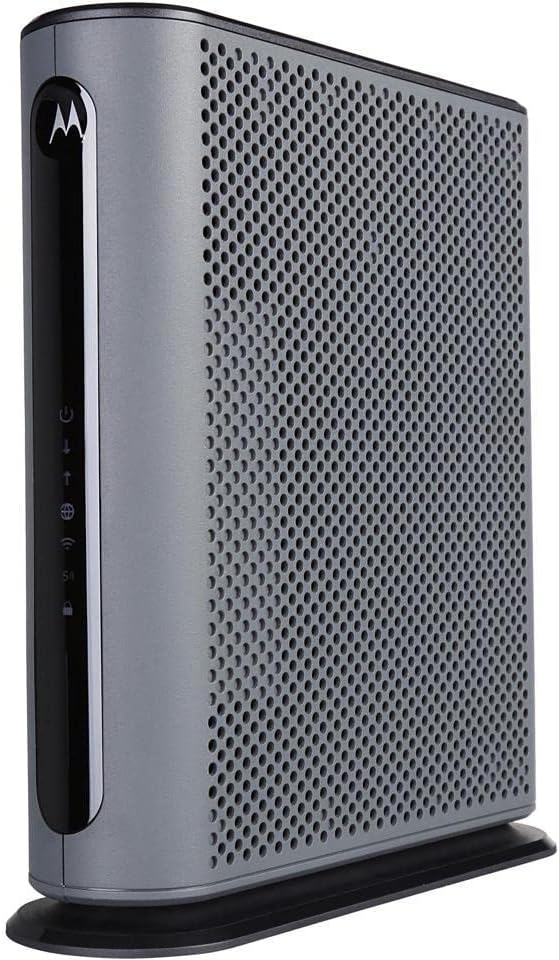
Pros
- 16x4 DOCSIS 3.0 channel bonding supports actual cable service speeds up to 375 Mbps
- AC1900 dual-band Wi-Fi runs 2.4GHz and 5GHz simultaneously alongside 4 Gigabit Ethernet ports
- Built-in DFS support opens extra 5GHz channels that most routers cannot access, cutting neighbor interference
- Broadcom modem chipset adds denial-of-service attack protection at the hardware level
- Combines modem and router into one unit, removing a second power cable and box from the desk
Cons
- No phone jack, so it cannot be used for any landline or VoIP calling service
- Only compatible with cable internet; fiber, DSL and satellite services such as Verizon, AT&T or CenturyLink will not work with it
- AC1900 Wi-Fi standard predates Wi-Fi 6, a ceiling for the newest high-throughput client devices
The modem side uses 16x4 DOCSIS 3.0 channel bonding, rated for actual cable internet service speeds up to 375 Mbps. The router side runs AC1900 dual-band Wi-Fi across 2.4GHz and 5GHz simultaneously, with Power Boost amplifying the wireless signal to the FCC-allowed limit for extended range.
- Four Gigabit Ethernet LAN ports handle wired connections to PCs, game consoles or streaming boxes
- DFS channel support opens additional 5GHz spectrum that standard routers cannot use, reducing crowding from neighboring Wi-Fi networks
- AnyBeam beamforming focuses the wireless signal toward connected devices instead of broadcasting evenly in all directions
Larger homes with multiple floors may still see weaker signal at the far edges, since this is a single-unit router rather than a mesh system.

Pros
- Tri-band radios at 2402 Mbps on 6GHz, 2402 Mbps on 5GHz and 574 Mbps on 2.4GHz
- 2.5 Gbps port usable as either WAN or LAN, for multi-gig service or a wired NAS
- 1.0 GHz dual-core CPU with 512 MB of memory and six high-gain antennas with beamforming
- 160MHz channels on the 6GHz band, clear of legacy device traffic and neighbouring overlap
- Runs OpenVPN, PPTP and L2TP as both server and client, with WPA3 and a 2-year warranty
Cons
- Only Wi-Fi 6E clients can use the 6GHz band, and 6GHz signal attenuates faster through walls than 5GHz
- A separate modem is still required for most cable and DSL services
- Just one 2.5 Gbps port, so a second multi-gig wired device drops back to Gigabit
Three radios rather than two: 2402 Mbps on 6GHz, 2402 Mbps on 5GHz and 574 Mbps on 2.4GHz, making up the 5400 Mbps combined headline. The 6GHz band is the reason to buy a 6E unit at all, because it carries no legacy traffic from older devices and has room for 160MHz channels without overlapping the neighbours.
Six high-gain antennas with beamforming shape signal toward connected devices, and OFDMA plus true tri-band working raises capacity roughly fourfold against a comparable dual-band unit when many devices are active at the same time.
Behind the radios sit a 1.0 GHz dual-core CPU and 512 MB of memory, which is what stops throughput collapsing when dozens of clients, QoS rules and a VPN tunnel are all live at once. The housing is shaped for heat dissipation rather than stacking.
It works with any provider that hands off an Ethernet connection, including AT&T, Verizon, Xfinity, Spectrum, RCN, Cox, CenturyLink and Frontier. As with any standalone router, a separate modem is still needed for most cable and DSL services, so this replaces the router half of an existing gateway rather than the whole box.
On the client side, only Wi-Fi 6E devices can use the 6GHz band. Recent flagship phones, current laptops and newer 6E adapters qualify; anything older sits on 5GHz or 2.4GHz and sees no benefit from the third radio at all. Worth knowing too: 6GHz attenuates faster through walls than 5GHz, so the fastest band is also the shortest ranged.
OneMesh support lets a compatible extender join as a single roaming network name rather than appearing as a second SSID.

Pros
- Combines a DOCSIS 3.0 modem and AC1900 WiFi 5 router in one device, cutting down on separate equipment
- 24x8 channel bonding supports up to 30 connected devices across 2.4GHz and 5GHz bands
- Four Gigabit Ethernet LAN ports handle wired connections for consoles, PCs, and storage drives
- Certified for use with Xfinity, Spectrum, and Cox cable internet plans
- WPA/WPA2 encryption plus a double firewall are built in for network security at no extra setup step
Cons
- Not compatible with fiber, DSL, satellite, or bundled voice services, and it will not work on Verizon, AT&T, CenturyLink, DirecTV, or DISH lines
- Only one USB 2.0 port for additional device connectivity, rather than USB 3.0 speeds
- ISP activation is required after setup, adding an extra call or online step before the connection goes live

Pros
- Covers up to 2,000 sq. ft. and supports 25 concurrent devices on dual-band WiFi 6 AX2700
- Combines a DOCSIS 3.1 cable modem with a WiFi 6 router, removing the need for two separate boxes
- 4 Gigabit Ethernet ports plus port aggregation for wired devices that need maximum throughput
- 1 USB 3.0 port available for connecting external storage or a printer
- 32x8 channel bonding on the modem side supports fast, stable cable internet plans
Cons
- Not compatible with Verizon, AT&T, CenturyLink, DSL providers, DirecTV, or DISH, so it only works with select cable ISPs
- Included security suite runs on only a 30-day trial before a subscription is needed to keep using it
- 2,000 sq. ft. coverage may need a satellite or extender in larger or multi-story homes
How Cable Internet Works With Your Router
Understanding a little about the hardware chain helps you buy smarter. Cable internet enters your home through a coaxial cable that plugs into a modem. The modem translates that signal into data your devices can use. A router then takes that data and shares it wirelessly, and through Ethernet ports, to every phone, laptop, TV, and smart device you own.
You have two paths to choose from. The first is a standalone router that connects to a separate modem. The second is a combo unit, sometimes called a gateway, that packs both the modem and the router into a single box. Options like the Motorola MG7550 and the NETGEAR Nighthawk C7000 are combo devices that replace the equipment your provider rents you, which can save real money over time.
Standalone Router vs Modem-Router Combo
A standalone router gives you flexibility. When Wi-Fi standards advance, you can upgrade just the router and keep your modem. It also tends to offer stronger wireless performance and more advanced features. A combo unit, on the other hand, is simpler, takes up less space, and means one less device to power and manage. If you value tidiness and want to stop renting hardware, a combo like the NETGEAR Nighthawk CAX30 is a compelling all-in-one answer.
Match the Router to Your Cable Plan Speed
The single most important step is matching your router to the internet speed you actually pay for. Buying a router rated far below your plan wastes the bandwidth you are paying for, while buying one rated far above it may be overkill for a modest plan.
Wi-Fi routers are labeled with combined speed ratings such as AC1900, AX1800, AX3000, or BE3600. These numbers add up the theoretical throughput across all bands, so real-world speeds are always lower. Still, they give a useful sense of tier. For a plan around 200 to 300 Mbps, an affordable dual-band model such as the TP-Link Archer A8 or the Cudy AX3000 has plenty of headroom.
Entry-Level Plans Under 300 Mbps
If your cable plan lands in the lower or middle tiers, you do not need to spend much. A solid Wi-Fi 6 router like the TP-Link Archer AX21 delivers dependable coverage and modern efficiency without a premium price. These routers handle everyday streaming, video calls, and browsing across a household with ease.
Fast Plans Above 500 Mbps or Gigabit
Premium cable plans that reach 500 Mbps, 800 Mbps, or gigabit speeds deserve a router that can keep up. Look for a device with a 2.5G WAN port so the wired link to your modem is not a bottleneck. The TP-Link Archer AXE75 and the Wi-Fi 7 TP-Link Archer BE230 both include faster ports designed for these higher tiers, so your top-speed plan can actually reach your devices.
Understand Wi-Fi Standards and Bands
Wi-Fi standards keep evolving, and each generation brings better speed, capacity, and efficiency. Knowing the differences helps you decide how future-proof you want your purchase to be.
- Wi-Fi 5 (AC): Still capable for basic homes and budget combos, and perfectly fine for lighter plans.
- Wi-Fi 6 (AX): The current sweet spot, offering better performance in busy households with many connected devices.
- Wi-Fi 6E: Adds a clean 6 GHz band for less interference, ideal for gaming and 4K streaming.
- Wi-Fi 7 (BE): The newest standard with the highest capacity and lowest latency, built for the years ahead.
If you want a device that stays relevant, a Wi-Fi 7 option like the Amazon eero 7 represents the leading edge. For most households today, however, a strong Wi-Fi 6 router remains the practical, cost-effective choice.
Dual-Band vs Tri-Band
Dual-band routers broadcast on 2.4 GHz and 5 GHz. The 2.4 GHz band reaches farther but is slower, while 5 GHz is faster over shorter distances. Tri-band routers add a third band, either another 5 GHz or a 6 GHz band, to reduce congestion when many devices are online at once. Larger, device-heavy homes benefit most from tri-band designs, while smaller homes are well served by a quality dual-band unit.
Coverage, Home Size, and Mesh Options
Speed means little if the signal cannot reach the far corners of your home. Router coverage is influenced by antennas, transmit power, walls, and floor layout. For apartments and smaller homes, a single powerful router usually blankets the space. For larger or multi-story homes, a mesh system spreads several nodes around to eliminate dead zones.
Many modern routers support mesh expansion, so you can start with one unit and add more later. The Amazon eero 7 is built around mesh from the ground up, letting you grow coverage node by node. If travel or temporary setups matter to you, a compact device like the GL.iNet GL-SFT1200 travel router is handy for hotels, RVs, and cruises, though it is a companion device rather than a primary home router.
Ports, Features, and Security to Look For
Beyond raw speed, the right set of features improves your daily experience and keeps your network safe. Here are the details worth checking before you buy.
- Ethernet ports: Gigabit ports are standard, but a 2.5G port matters for fast plans and wired gaming rigs.
- USB ports: Useful for sharing a drive or printer across the network, as seen on the TP-Link Archer BE230.
- VPN support: Routers such as the Cudy AX3000 allow secure remote connections and privacy features.
- WPA3 security: The latest encryption standard protects your network from intrusion.
- Parental controls and QoS: Manage screen time and prioritize important traffic for smoother streaming and calls.
Easy setup also counts. Many routers now offer simple app-guided installation, and models like the TP-Link Archer AX21 work with voice assistants for added convenience.
Should You Buy a Modem-Router Combo?
For cable internet users, combo units carry a special appeal because they can replace the exact box your provider rents you. Confirming compatibility with your provider is essential, and popular combos are typically approved for major networks. The Motorola MG7550 is approved by leading cable companies, while the NETGEAR Nighthawk CAX30 pairs a DOCSIS 3.1 modem with Wi-Fi 6 for faster plans.
The trade-off is upgrade flexibility. When you eventually want a newer Wi-Fi standard, you must replace the whole unit rather than just the router. If you prefer to mix and match, keeping the modem and router separate is the more adaptable route, and it lets you invest in a premium wireless device like the TP-Link Archer AXE75 independently.
How to Set Up Your New Cable Router
Getting started is straightforward. Connect your modem to the router’s WAN port with an Ethernet cable, power both devices, and follow the setup app or web dashboard. You will create a network name and password, update the firmware, and optionally enable features like guest Wi-Fi or parental controls. If you switch to a combo unit, you will register the device with your provider so it recognizes your new hardware.
Place the router in a central, open location, ideally elevated and away from thick walls or metal objects. A good position often improves coverage more than any spec on the box.
Final Thoughts on the Best Routers for Cable Internet
The best router for your cable internet is the one that matches your plan speed, covers your home fully, and fits your budget without paying for features you will never use. Start by confirming your plan tier, then decide between a standalone router and a modem-router combo. From there, choose a Wi-Fi standard that gives you room to grow, and prioritize the ports and security features that matter most to your household.
Whether you want an affordable everyday performer like the TP-Link Archer A8, a future-ready mesh system like the Amazon eero 7, or an all-in-one combo like the NETGEAR Nighthawk C7000, there is a perfect match for your setup. Upgrade your router, stop overpaying in rental fees, and enjoy the fast, reliable connection your cable plan was always meant to deliver.


