 Daniel Okafor
How to Choose the Best Modern Desk Chairs for Your Home Office
Finding the best modern desk chairs is about more than looks. The right chair supports your posture through long working hours, complements a contemporary workspace, and matches the way you actually sit. With so many styles competing for attention – ergonomic mesh, upholstered executive, armless mid-century, and sleek swivel task chairs – it helps to have a clear framework before you buy. This guide walks you through the features that matter, the trade-offs between styles, and how to match a chair to your room, your body, and your budget.
Below is a curated shortlist of modern desk chairs worth considering. Use it as a starting point, then read on to learn how to narrow the field to the one that fits you best.

Pros
- Dimensions of 23.59"D x 19.1"W x 40"H engineered for optimal spatial fitting
Cons
- Requires verifying placement clearance for 23.59"D x 19.1"W x 40"H prior to installation
- Requires gentle maintenance routines to preserve the Faux Leather finish

Pros
- Designed with Effortless Mobility with Tailored Adjustability Designed for fluid movement and for reliable daily operation
- Designed with Certified Stability with Refined Engineering At the core of the for reliable daily operation
- Designed with Breathable Comfort for Extended Use Upholstered in high-quality breathable fabric for reliable daily operation
- Dimensions measure 27.4"D x 24.4"W x 43.3"H for spatial allocation
- Constructed using quality Textile materials
Cons
- Requires measuring doorways and room clearance for COLAMY Cocoon Mode prior to placement

Pros
- Physical footprint measures 22.44"D x 24.8"W x 37.01"H for spatial placement
Cons
- Requires checking room space for Mid Century Modern Off prior to installation
- Routine cleaning needed to maintain Walnut appearance


Pros
- Reinforced steel chassis supports up to 300 pounds, backed by a certified class 3 gas cylinder
- Seat height adjusts smoothly across a 5-inch range using the height lever
- Armless design slides fully under a desk, freeing space for storage or plants when not in use
- Stain-resistant faux leather resists spills, reducing worry about coffee or drink stains during desk work
- 90-120 degree rocking mode allows leaning back during breaks without a full recline lock
Cons
- No armrests at all, so users who prefer arm support during long typing sessions will not get it from this chair
- Curved mid-back design covers the lower and mid spine but does not extend into a full high-back headrest zone
- Faux leather surface is stain-resistant but not breathable, which can feel warmer than mesh over multi-hour sessions
This chair measures 23.2"D x 23.2"W x 37"H, built on a reinforced steel chassis rated for up to 300 pounds and a certified class 3 gas cylinder.
- Seat height adjusts across a 5-inch range using the side lever
- The curved mid-back design is shaped to follow the spine through the lower and middle back
- Walnut accents and diamond stitching are worked into the frame and upholstery for a furniture-style look rather than a typical task-chair appearance
The armless footprint keeps the chair's overall width close to the seat itself, letting it slide fully under a desk when not adjusted upright.

Pros
- Designed with Mid-back armless office chair with rolling function When working for for reliable daily operation
- Designed with Curved seat and backrest design This design better conforms to for reliable daily operation
- Dimensions measure 20.28"D x 20.28"W x 37.01"H for spatial allocation
Cons
- Requires measuring doorways and room clearance for Armless Office Cha prior to placement

Pros
- 3D lumbar support adjusts 1.6" in depth, 2" in height, and 15° of rotation to track the natural curve of the spine
- 18" extendable footrest with 2-position angle adjustment tucks away under the seat when not needed
- 5D flip-up armrests adjust for height, width, angle, and rotation, then flip up to slide fully under standard desks
Cons
- At 26"D x 24"W x 41"H with a footrest, it needs more floor clearance than a footrest-free task chair of similar size
- Sold in this listing in one grey mesh/grey frame colorway, so buyers wanting a different finish need a separate listing
- The AEP fatigue-reduction and neck-strain figures come from the manufacturer's own testing rather than an independent third-party lab
The X100 measures 26 inches deep, 24 inches wide, and 41 inches tall, with a 300-pound weight capacity that sits above the roughly 250-pound ceiling typical of standard mesh task chairs. That extra capacity, combined with the extra-wide 3D headrest, positions it for taller or larger users who find standard task chairs cramped.
- 300 lb weight capacity
- 26"D x 24"W x 41"H overall footprint
- Extra-wide 3D breathable headrest sized for broader shoulders and necks
- 18-inch extendable footrest adds forward reach when reclined
Because the footrest extends outward when deployed, the chair needs more floor clearance in front than a footrest-free task chair of similar seat size, worth factoring into a tight home office layout.
The seat's 3D lumbar mechanism is spring-loaded and auto-tracking, adjustable across 1.6 inches of depth, 2 inches of height, and 15 degrees of rotation, so it can be locked into the curve that fits a specific back rather than a single fixed position. The armrests add a fifth adjustment axis on top of the usual height and width.
- 3D Synchro-Tilt lumbar: 1.6" depth, 2" height, 15° rotation, lockable
- 5D flip-up armrests: height, width, forward/back, rotation, and flip-up
- 3-stage reclining mechanism pairs with the footrest for a lie-back position
- 28cm 3D AirFloat headrest adjusts independently of the backrest angle
With this many adjustment points, first-time setup takes longer than a fixed-arm task chair, and getting the lumbar and headrest dialed in usually takes a few sessions of fine-tuning rather than a single pass.

Pros
- Inflatable lumbar support lets the amount of lower-back pressure be adjusted rather than relying on a fixed foam bulge
- Flip-up armrests fold out of the way for cross-legged sitting on the extra-wide seat cushion
- Pneumatic lever adjusts seat height, with a separate control for tilt tension resistance
- Reinforced steel frame is rated to hold up to 275 pounds
- Bonded leather upholstery is built scratch-resistant to hold up better than a plain vinyl cover over daily use
Cons
- 275-pound weight capacity is on the lower end versus heavy-duty office chairs rated closer to 300-400 pounds
- Bonded leather is a layered material, which over years of flexing at the seams tends to peel or crack sooner than genuine top-grain leather
- No headrest is included on this model, so neck support during long sessions relies on the high-back shape alone rather than a dedicated headrest
This high-back executive chair measures 22.8"D x 26.8"W x 47.2"H overall and is rated to hold up to 275 pounds on a reinforced steel frame. An inflatable lumbar system allows the level of lower-back support to be fine-tuned rather than fixed at one shape.
- Overall size: 22.8"D x 26.8"W x 47.2"H
- 275-pound weight capacity
- Reinforced steel frame
- Faux (bonded) leather upholstery in black
The extra-wide seat cushion, combined with flip-up armrests, gives room to sit cross-legged rather than only in a standard forward-facing seated position, a detail worth noting for anyone who shifts position often during the day.

Pros
- Seat height adjusts across 19.3 to 23.3 inches, a 3.9 inch span that clears most desk aprons
- Armless profile just 21.9 inches wide, so it rolls entirely under a desk when not in use
- Supports 300 lb on a metal five-star base fitted with five silent casters
- Tilt tension knob and lock lever give a 90 to 135 degree rocking range you can set to your own weight
- Wipe-clean PU surface resists water and everyday wear, so a spilt drink is a cloth job rather than a stain
Cons
- No armrests at all, so forearms rest on the desk edge through long typing sessions
- Mid-back shell stops below the neck, meaning there is no head support when you tilt back
- Assembly typically takes 30 to 40 minutes rather than the ten-minute build of simpler task chairs
Overall the chair takes up 21.9 inches across by 20.5 inches deep, standing 35.8 inches tall, and the seat travels between 19.3 and 23.3 inches from the floor. Those numbers explain the whole design: without armrests it slides fully under a desk and disappears when not in use.
- 3.9 inches of height travel covers desk heights from low writing tables up to taller work surfaces
- Metal five-star base with five silent casters, holding a 300 lb user
- Curved backrest in a mid-back shape, supporting the lumbar area and mid spine rather than the neck
For a small room or a shared desk this footprint is the selling point. Measure the gap under your desktop, since armless chairs only pay off when they actually tuck away.
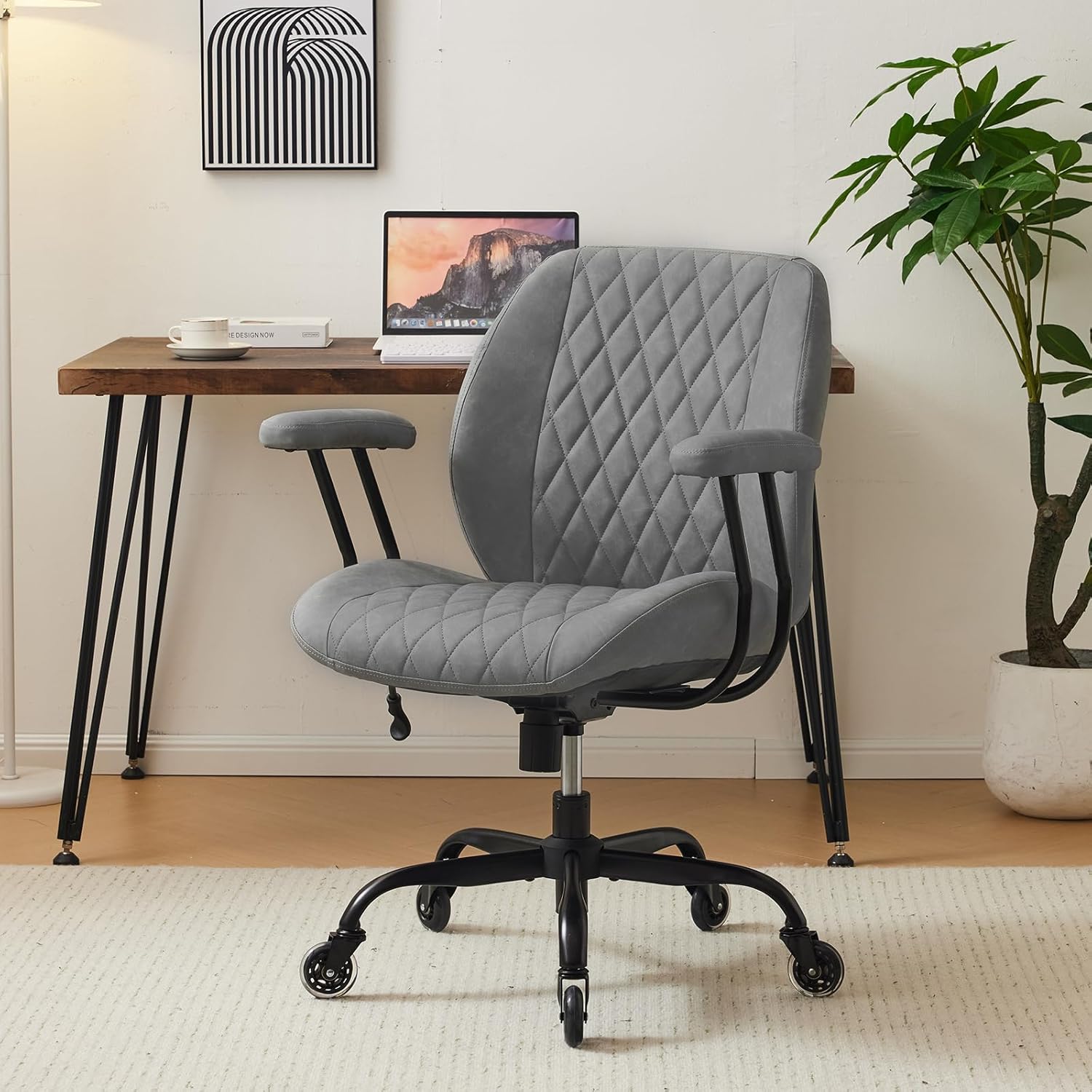
Pros
- Seat measures 22 in wide by 20 in deep, wider than the 19 to 20 in typical of task chairs
- Armrests stand 8.3 in above the cushion, keeping elbows near a right angle at a 29 in desk
- Armrests are optional at build time, so it can be set up open-sided for cross-legged sitting
- Seat combines a wooden board, soft foam and a high-elasticity spring pack rather than foam alone
- Casters are specified for wood floors, carpet and marble, so no aftermarket wheel swap is needed
Cons
- Offered in a single grey leather finish, with no darker option for a room where marks show
- No headrest is listed, so the back stops around shoulder height
- Lumbar shape is built into the padding rather than adjustable for depth or height
The seat measures 22 in wide by 20 in deep, with armrests standing 8.3 in above the cushion, and the listed capacity is 300 lb. The seat assembly itself is given as 20.47 in deep, 22.44 in wide and 18.5 in tall.
- A 22 in seat width is generous, since many task chairs sit nearer 19 to 20 in across
- The 8.3 in armrest height suits desks around 29 in tall, keeping elbows near a right angle
- Seat height and recline both adjust, so the fit can be tuned to the desk rather than the other way round
Measure your desk underside before ordering. With armrests fitted, the total height to the armpad decides whether the chair tucks fully away at the end of the day.
Why a Modern Desk Chair Matters
A desk chair is the single piece of furniture you touch most during a working day. Sitting for six, eight, or more hours in a chair that does not support your spine leads to fatigue, stiffness, and lower back or neck pain. A well-designed modern chair, by contrast, keeps your hips, spine, and shoulders in healthy alignment so you can focus on your work instead of your discomfort.
“Modern” also speaks to aesthetics. Today’s best chairs blend clean lines, neutral or bold color options, and materials like breathable mesh, faux leather, and walnut accents. A chair such as the Mid-Century Modern Armless Chair shows how a diamond-stitch faux leather seat and a walnut accent can look at home in a contemporary space while still doing its job. The goal is a chair that performs well and looks intentional in your room.
Key Features to Look For
Before comparing individual chairs, understand the core features that separate a comfortable, durable chair from one you will regret. Each of these deserves a moment of thought based on how you work.
Ergonomic Support
Ergonomics is the foundation of any good desk chair. Look for lumbar support that fills the natural curve of your lower back, a seat that lets your feet rest flat on the floor, and a backrest tall enough to support your upper spine. Adjustable lumbar systems are ideal because everyone’s back is shaped differently. Chairs like the Ergonomic Back and Neck Relief Chair pair a 2D adjustable lumbar with a 3D headrest, which is exactly the kind of layered support that helps during long sitting sessions.
Adjustability
Adjustable height is non-negotiable so your elbows sit near desk level and your thighs stay parallel to the floor. Beyond height, watch for tilt and rocking mechanisms, adjustable armrests, and recline tension controls. A chair with a tilt-and-rock function, such as the BESTFAIR Executive Chair, lets you shift positions through the day, which reduces pressure on any single part of your body. Flip-up arms are a bonus if you need to tuck the chair under a desk to save space.
Materials and Build
Mesh backs breathe well and suit warm rooms or people who run hot. Upholstered and leather-look chairs feel plush and polished but trap more heat. Consider a padded seat with quality foam for pressure relief – virgin foam holds its shape far longer than cheap padding. The ELABEST X100 Mesh Chair is a strong example of a breathable, big-and-tall friendly build with a footrest, while an upholstered option like the COLAMY Cocoon Executive Chair leans into a soft, cocooning feel.
Size and Footprint
Measure your space before you buy. High-back executive chairs command presence but need room. If your desk sits in a bedroom nook or a tight corner, a compact or armless design saves space and slides fully under the desk. Armless models like the Armless Mid-Century Desk Chair and the Home Office Armless Swivel Chair are made for smaller footprints and multi-use rooms.
Matching a Chair Style to Your Space
Modern desk chairs fall into a few broad camps. Knowing which camp suits your work and your room makes the decision far easier.
Executive and High-Back Chairs
These deliver full-spine support and a professional look ideal for video calls and dedicated home offices. They tend to be larger and often include headrests and generous padding. If you want an authoritative centerpiece, consider a high-back model such as the Modern Office High-Back Chair or the leather-look BESTFAIR High-Back Chair. They reward you with support that carries you through long days.
Mid-Century Modern Chairs
Mid-century designs mix retro warmth with clean modern lines, often using wood accents and slim profiles. They suit creative spaces and rooms where the chair should feel like decor as much as furniture. The Mid-Century Wooden Desk Chair with its adjustable backrest and wooden armrests is a good illustration of the style done comfortably.
Armless and Compact Chairs
Armless chairs are versatile, budget-friendly, and easy to move around. They work as a desk chair, a vanity seat, or an extra chair for a reading nook. Because they slide fully under a desk, they are ideal for small apartments. The Armless Walnut Swivel Chair pairs silent-rolling wheels with a compact PU leather build that fits almost anywhere.
Ergonomic Mesh Task Chairs
If breathability and long-session comfort top your list, a mesh task chair is hard to beat. The open back keeps air moving, and modern versions still offer strong lumbar and headrest support. The ELABEST X100 is a standout here for anyone who wants a cooler, more supportive seat with a footrest for breaks.
Comfort for Long Work Sessions
If you sit for extended stretches, prioritize three things: pressure relief, temperature control, and movement. A well-padded or contoured seat prevents the numbness that comes from firm, flat cushions. Breathable materials keep you from overheating. And a chair that lets you recline or rock encourages the small posture changes that keep your muscles from locking up.
Options like the Ergonomic Relief Chair and the leather YFO Ergonomic Office Chair are built around this idea, combining lumbar support with tilt or swivel motion. When you test a chair, sit in it the way you actually work – lean back, type, and reach – to feel how it moves with you rather than against you.
Setting a Realistic Budget
Modern desk chairs span a wide price range, and more expensive does not always mean better for your needs. Entry-level models around the hundred-dollar mark, like the Armless Walnut Chair or the Armless Mid-Century Chair, deliver clean style and solid basics for casual or occasional use. Mid-range chairs between roughly $150 and $200 usually add better foam, more adjustability, and stronger frames – think of the Mid-Century Wooden Chair or the YFO Ergonomic Chair.
At the higher end, feature-rich chairs like the ELABEST X100 justify their price with premium mesh, advanced lumbar systems, and big-and-tall capacity. Decide how many hours a day you will use the chair, then invest proportionally. A daily-driver work chair deserves more of your budget than a seat you use for an hour of email.
Common Mistakes to Avoid
Even a great chair disappoints if you choose it for the wrong reasons. Keep these pitfalls in mind:
- Buying on looks alone. A striking chair that lacks lumbar support will frustrate you within a week. Balance style with function.
- Ignoring your desk height. Your chair and desk work as a system. Confirm the seat can rise or lower to keep your elbows near desk level.
- Overlooking the wheels. Hard casters can scratch wood floors, while silent rubber wheels roll smoothly and quietly. The Armless Chair with Silent Wheels shows why this small detail matters.
- Forgetting the room. A high-back executive chair can overwhelm a small bedroom desk. Match the chair’s scale to your space.
- Skipping adjustability. The more your chair adjusts, the longer it stays comfortable as your setup changes.
How to Make Your Final Decision
Bring it all together with a simple checklist. First, define your primary use – full-time work, part-time tasks, or a multi-purpose seat. Second, measure your space and confirm the chair fits under your desk. Third, pick the support level your back needs, giving extra weight to lumbar and seat quality if you sit for hours. Fourth, choose a material that suits your climate and cleaning habits. Finally, set a budget that reflects how much you will actually use the chair.
Run your favorites through that filter and one option usually rises to the top. Whether you gravitate toward a plush upholstered seat like the COLAMY Cocoon Chair, a professional high-back like the Modern High-Back Chair, or a cool mesh task chair, the best modern desk chair is the one that fits your body, your room, and your routine.
Final Thoughts
The best modern desk chairs strike a balance between style, support, and value. Rather than chasing the flashiest design or the highest price tag, focus on ergonomics, adjustability, and a footprint that suits your space. Use the shortlist above to compare real options side by side, weigh the features that matter most to how you work, and choose with confidence. A thoughtfully chosen chair pays you back every single day you sit down to work – in better posture, less fatigue, and a workspace you genuinely enjoy using.