
 Sofia Marchetti
An ergonomic chair is not a style. It is a chair that adjusts to your body, so you can sit with your feet flat, your lower back supported and your shoulders relaxed. This page is for people setting up a home office or replacing a basic task chair with something they can actually tune.
Two things matter most. The first is lumbar support you can move to where your lower back curves. The second is enough adjustment elsewhere, such as seat height, seat depth, armrests and recline, to match your desk. A chair with ten adjustments you never use is no better than one with four that fit you.
How we chose
- Adjustable lumbar: height at minimum; depth or rotation counted as a plus.
- Seat fit: listed seat height range, seat depth and whether seat depth adjusts.
- Armrest adjustment: flip-up only, or true 3D to 6D movement.
- Recline control: lockable angles or adjustable tension.
- Listed weight rating and warranty terms.
Picks are based on manufacturer specs and owner reviews, not hands-on testing. See how we research chairs for details.
Quick picks
- Best for fine-tuning fit: HUANUO FlowLift — seat-depth adjustment, 6D armrests and four lockable recline angles.
- Best all-round value: Casasio 2307H — two-direction lumbar, 3D headrest and a 350 lb rating.
- Best lumbar range: ELABEST X100 — lumbar adjusts in height, depth and rotation, plus a footrest.
- Best without a headrest: Casasio 869 — four-way lumbar with listed travel and a 3.54-inch seat cushion.
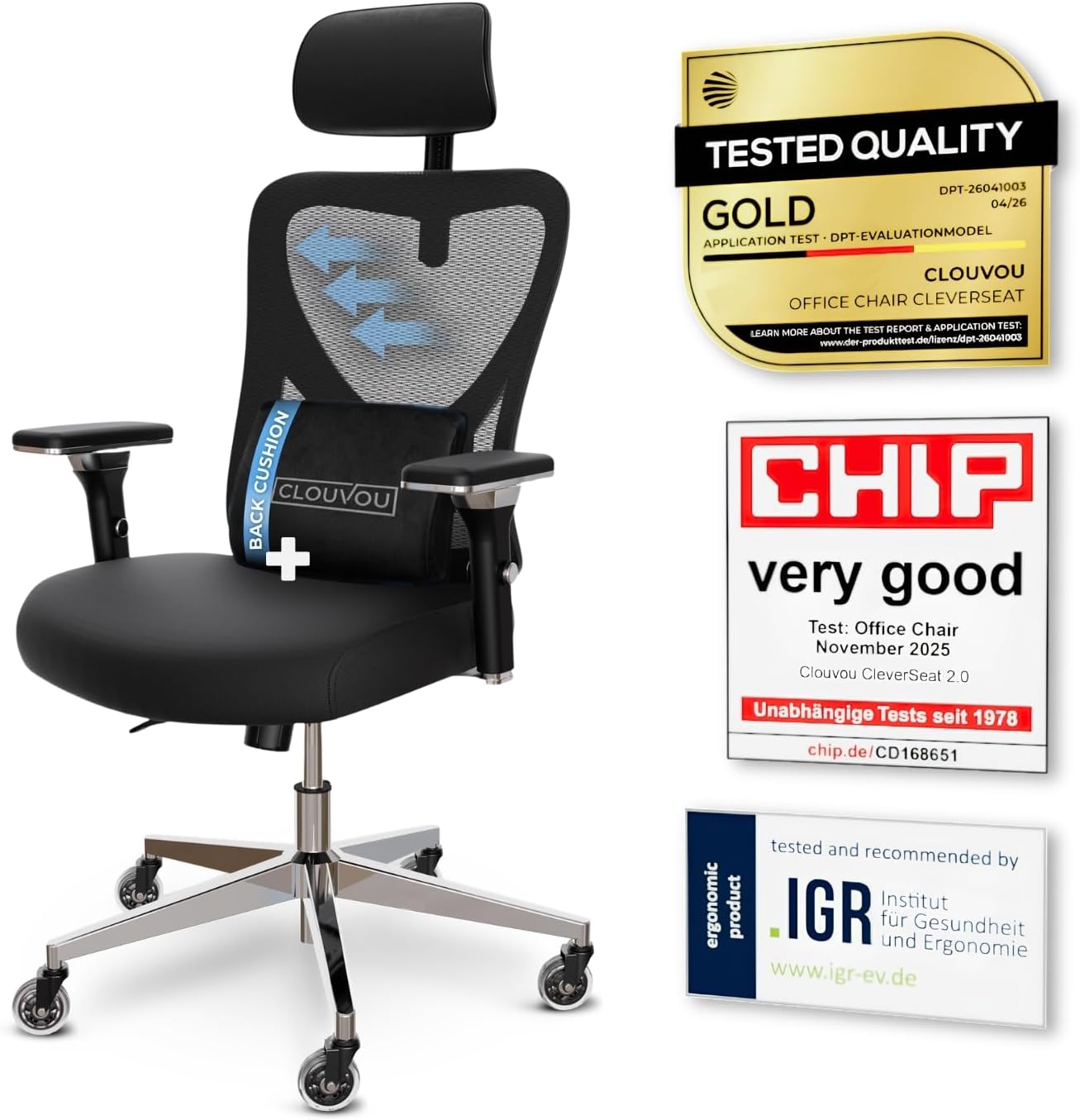
- Best for tall users: CLOUVOU CleverSeat — listed for users up to 6.5 ft, with 4D armrests.
- Best warranty in the price range: QLTPLUS OC-5189 — adjustable lumbar, 350 lb rating and a 5-year warranty.
- Best budget pick: XXISHE LDL-929 — up-and-down lumbar and a listed 17.72 to 22.44-inch seat height range.

Pros
- Physical footprint measures 27.56"D x 27.56"W x 45.28"H for spatial placement
Cons
- Requires checking room space for HUANUO FlowLift Ergono prior to installation


Pros
- 18-inch extendable footrest with 2-position angle adjustment supports a reclined break without leaving the chair
- 5D flip-up armrests adjust height, width, angle, and rotation, then fold flush to tuck under a desk
- 3D lumbar support adjusts up to 1.6 inches in depth and 2 inches in height to track different seated postures
Cons
- Footrest and 5D armrest mechanisms add moving parts that increase what there is to adjust and maintain over a simple fixed-arm chair
- Mist Black is the only finish offered, with no other color option
- Larger footprint at 26 x 24 inches needs more floor clearance than a compact task chair
The X100 measures 26"D x 24"W x 41"H and carries a 300 lb weight capacity, built for bigger frames than a standard mesh task chair. The 3D lumbar system adjusts depth by up to 1.6" and height by up to 2", with 15 degrees of rotation to track the spine's natural curve rather than pressing at one fixed point.
- Footprint: 26"D x 24"W x 41"H
- Weight capacity: 300 lb
- Lumbar adjustment: up to 1.6" depth, 2" height, 15-degree rotation
An 18" extendable footrest with 2-position angle adjustment pulls out from under the seat, adding leg support once the backrest is reclined for a break.

Pros
- Feature-rich design maximizes utility across intended use scenarios
- Premium materials resist wear and environmental degradation
- Full backward compatibility with existing peripheral ecosystems
Cons
- Some premium features may not work on legacy systems
- Advanced functions require compatible peripherals
Pros
- 4D armrests adjust up, down, forward-back and pivot, so elbow height lines up with almost any desk
- 3-position backrest tilt locks the recline angle instead of leaving it free-floating
- Blade-shaped casters are engineered to roll quietly across hard flooring
Cons
- Frame combines chromium-plated and plastic components rather than a full steel shell, so it may flex more than an all-metal frame under aggressive rocking
- Backrest tilt is limited to 3 fixed positions rather than a continuous recline lock
- No separate seat-depth figure is listed beyond the 21-inch footprint, so users near the 6.5 ft sizing ceiling may find the seat pan short
The chair measures 21"D x 21"W x 39"H in its assembled footprint, a compact base built for desks in home offices and shared workspaces. Backrest support is rated for users up to 6.5 ft tall, wider than the sizing window most mesh task chairs advertise.
- Frame combines chromium-plated steel components with plastic housings for the armrests and base shroud
- 3-position backrest tilt locks the recline angle rather than floating freely
- 4D armrests adjust height, width, depth and pivot angle independently
Because the footprint stays close to 21 inches square, the chair fits under standard desks without needing extra clearance, while the taller backrest window suits users who outgrow shorter task chairs.

Pros
- Rated to support 350 Pounds
- Dimensions measure 20inchD x 20inchW x 40inchH
- Construction uses Foam for durability
- Adjustable components allow customized positioning
- Includes extended manufacturer warranty coverage
Cons
- Requires professional assembly or installation service
- Limited in monochrome color options available
- Some optional accessories sold separately

Pros
- SGS certified and BIFMA tested with a 300 lb weight capacity
- Seat height adjusts 17.72 in. to 22.44 in. measured cushion to floor
- 90 deg flip-up armrests let the seat tuck fully under a desk apron
- PU leather cushion wipes clean while the mesh back vents heat during long sessions
- 3-stage gas cylinder with a tilt tension knob for rocking or upright lock
Cons
- Lumbar support slides up and down only, with no depth adjustment toward the spine
- No headrest, so the back stops at shoulder level and necks tire on long shifts
- Listed in black only, with no alternative finish offered
The seat pad is 18 in. deep with a PU leather face over thickened high-resilience foam, while the mesh back handles ventilation. Height adjusts from 17.72 in. to 22.44 in. measured cushion to floor, which suits desks in the common 28 to 30 in. band.
- Capacity 300 lb, SGS certified and BIFMA tested
- 3-stage gas cylinder under the seat
- Nylon base running on quiet casters
- Lumbar pad slides up and down the backrest
Check the 17.72 in. minimum seat height against your desk apron before ordering, since a low drawer box can stop the chair sliding under. Taller sitters should note that the backrest ends around shoulder level with no head support above it.
Comparison
| Chair | Lumbar adjustment | Seat depth adjust | Armrests | Headrest | Max weight |
|---|---|---|---|---|---|
| HUANUO FlowLift | Height | Yes | 6D | 3D | Not listed |
| Casasio 2307H | Two-direction | Not listed | Flip-up | 3D | 350 lb |
| ELABEST X100 | Height, depth, rotation | Not listed | 5D, flip-up | 3D | 300 lb |
| Casasio 869 | Height 1.8″, depth 1.06″ | Not listed | Flip-up | No | 330 lb |
| CLOUVOU CleverSeat | Built-in, adjustment not listed | Not listed | 4D | Yes | Not listed |
| QLTPLUS OC-5189 | Adjustable cushion | Not listed | Flip-up | No | 350 lb |
| XXISHE LDL-929 | Height | Not listed | Flip-up | No | 300 lb |
The picks in detail
HUANUO FlowLift
Seat-depth adjustment is rare at this price, and the FlowLift lists it. That lets you keep a small gap behind your knees whether your legs are long or short. The lumbar moves up and down, the headrest adjusts in three ways and the armrests move in six. The back locks at 95, 104, 114 or 123 degrees. Mesh covers the seat, back and headrest, and the chair rolls on rubber casters.
Good fit if other chairs feel too deep or too shallow. Skip it if you need a published weight limit; the listing does not state one, and the review base is still small.
Casasio 2307H
The 2307H covers the core ergonomic adjustments without much complexity. The lumbar cushion adjusts in two directions, the headrest in height, depth and angle, and the tilt tension is adjustable. Flip-up arms let it tuck under a desk. The listing gives a 350 lb capacity on a metal base. It has a 4.7 rating from about 150 reviews.
Good fit if you want lumbar and headrest adjustment for a home office under $200. Skip it if you want armrests that move in height or width; these only flip.
ELABEST X100
The X100 has the widest listed lumbar adjustment on this page: about 2 inches of height, 1.6 inches of depth and 15 degrees of rotation. Seat height is listed at 18.3 to 23 inches and seat depth at 18 inches. It adds a pull-out footrest, three recline positions and 5D armrests that flip up. Capacity is 300 lb. Claims in the listing about specific percentage reductions in strain are marketing, not something we can confirm.
Good fit if lumbar placement is your top priority and you like to recline. Skip it if you have a small room; the base is listed at 26 x 24 inches.
Casasio 869
This chair skips the headrest and puts the effort into the lumbar. The listing gives real numbers: 1.8 inches of up-and-down travel and 1.06 inches in and out. The seat cushion is listed at 3.54 inches thick. The hourglass mesh back and flip-up arms keep it compact, and capacity is 330 lb. The base is a five-point nylon design, and the listing says the lumbar range is meant to suit users from about 5’1″ to 6′.
Good fit if you sit upright and care about lower-back fit more than neck support. Skip it if you recline often and want a headrest.
CLOUVOU CleverSeat
The CleverSeat stands out for taller users: the listing says it is built for people up to 6.5 ft. It has 4D armrests, a headrest, a three-position backrest tilt and quiet blade-style casters. It has the largest review base here, at over 3,000 reviews.
Good fit if you are tall and want precise armrest placement. Skip it if you want an adjustable lumbar pad; the listing mentions targeted lumbar support but not how it adjusts. Weight capacity, seat height and seat depth are not listed. For more tall-friendly options, see our guide for taller users.
QLTPLUS OC-5189
A mesh-back chair with a molded foam seat, an adjustable lumbar cushion, flip-up arms and a tilt with adjustable rocking tension. The listing gives a 350 lb capacity on a metal base and a 5-year warranty, which is long for this tier. The flip-up arms let it tuck under a desk in a small room.
Good fit if you want a simple chair with adjustable lumbar and long warranty coverage. Skip it if you want a headrest or armrest height adjustment. Seat height range is not listed.
XXISHE LDL-929
The most affordable chair here pairs a PU leather seat with a mesh back. The lumbar moves up and down, and the listing gives a seat height range of 17.72 to 22.44 inches, which suits a wider range of heights than many chairs. The tilt has a tension knob, the arms flip up 90 degrees and capacity is 300 lb.
Good fit if you want an adjustable lumbar on a tight budget. Skip it if you want a high back or headrest; it is a mid-back chair. Budget shoppers can also compare our affordable ergonomic picks.
How to set up an ergonomic chair for your home office
A good chair still has to be set up. Work through these in order:
- Seat height: feet flat, thighs about level, knees near hip height. If your desk forces the seat too high, add a footrest.
- Seat depth: leave two to four fingers between the seat edge and the back of your knees. Use a seat slider if the chair has one.
- Lumbar: move the pad to the inward curve of your lower back, usually just above the belt line. It should feel present, not pushy.
- Armrests: set them so your shoulders relax and elbows sit near desk height. Flip them up if they block the desk.
- Recline: set tension so the back moves with you without pushing you forward. Lock it upright for focused typing if you prefer.
What to check on the spec sheet
Look for a seat height range with two numbers, not just “adjustable.” Check whether the listed seat depth is really the seat or the whole chair. Confirm the weight rating, and note how the lumbar moves. “Lumbar support” alone often means a fixed curve.
Ergonomic chair for an office versus a home office
Offices often share chairs, so quick adjustment levers matter more. At home, the chair usually fits one person, so you can set it once. Flip-up arms and a compact base help more at home, where desks are often smaller.
FAQ
What makes an office chair ergonomic?
Adjustability that matches your body: seat height, lumbar position and armrests at minimum. Seat depth and recline control add more fit.
Is mesh better for an ergonomic chair?
Mesh breathes well and suits long days in warm rooms. Foam or leather seats feel softer at first. Many chairs here use a mesh back with a foam seat.
Do I need 4D or 6D armrests?
Not always. Flip-up arms work if you mostly type close to the desk. Multi-way arms help if you switch between typing, mouse work and reading.
Can an ergonomic chair help with back pain?
Some people find that a well-adjusted chair helps them keep a neutral posture. It is one part of the setup. Our back pain chair guide covers what else to check.






Comments are closed.
No reviews yet. Be the first to share your experience!