
 Marcus Bell
Picking the best CPU coolers with RGB means balancing two goals that don’t always line up: strong thermal performance and lighting that actually looks good once it’s installed. Some coolers chase flashy RGB while skimping on heat pipes and fan pressure, so the rig looks great but throttles under load. Others cool a CPU just fine but ship with dim, single-zone lighting that barely shows through a tempered-glass panel. This guide breaks down what actually matters when shopping for an RGB cooler, then matches specific options to real builds — gaming rigs, quiet home offices, tight cases, and everything between.
Quick answer: If you only read one paragraph, our top pick among the best CPU coolers with RGB pick for most builds in 2026 is the Thermalright Peerless Assassin 120 Vision MAX — our #1 rated choice for pairing serious air cooling with a genuinely eye-catching display. See the full ranked comparison, alternatives, and buying advice below.

Pros
- Good Heat Dissipation The CPU cooling is mainly composed of a digital
- CPU Cooler Specifications Model Peerless Assassin 120 Digital ARGB
- Magnetic Digital Display Board The ARGB digital display board on the
- 162mm Height The overall height of the heatsink cooler is 162mm, which
- Wide Compatibility The cpu cooling is compatible with platforms AMD AM4
Cons
- Requires verifying computer chassis clearance for 5.43"L x 4.92"W x 6.38"H

Pros
- Four direct-contact heat pipes plus a copper base target higher-end AMD and Intel chips without needing a larger tower cooler
- 120mm PWM fan spans a 650-2,500 RPM range, so it can idle quiet and ramp up only under load
- Supports both current sockets - AMD AM5/AM4 and Intel LGA1851/1700 - without a separate bracket purchase
- Compact 152mm height (4.9"L x 2.9"W x 5.9"H) fits mid-tower cases with tighter side-panel clearance
Cons
- Single 120mm tower design tops out at four heat pipes, short of the five-to-six-pipe coolers built for higher-wattage flagship chips
- Only one fan is included; adding a second for push-pull airflow means buying an extra 120mm PWM fan separately
- ARGB lighting needs a motherboard header or separate controller to sync, since no standalone remote is included
The Hyper 212 PRO ARGB is a single-tower air cooler measuring 4.9"L x 2.9"W x 5.9"H, built around an aluminum fin stack with four direct-contact heat pipes running through a copper base.
- 4 heat pipes with a copper contact base
- Aluminum fin tower construction
- 120mm SickleFlow Edge PWM fan, 650-2,500 RPM range
- Compact 152mm total height for mid-tower cases
The asymmetrical heat pipe layout is arranged to clear tall RAM heat spreaders on the first DIMM slot, which is a common conflict point for tower coolers mounted close to the memory bank.
The bundled 120mm SickleFlow Edge fan runs on a 4-pin PWM header, letting the motherboard automatically ramp speed between 650 and 2,500 RPM based on CPU load rather than running at a fixed speed.
- PWM 4-pin fan control for automatic speed ramping
- Frosted blade design diffuses the ARGB lighting for a softer glow
- ARGB header (3-pin 5V) needed on the motherboard to control lighting; no external controller included
Since only a single fan ships in the box, builders wanting push-pull airflow through the fin stack for slightly lower load temperatures will need to source a matching 120mm PWM fan separately.
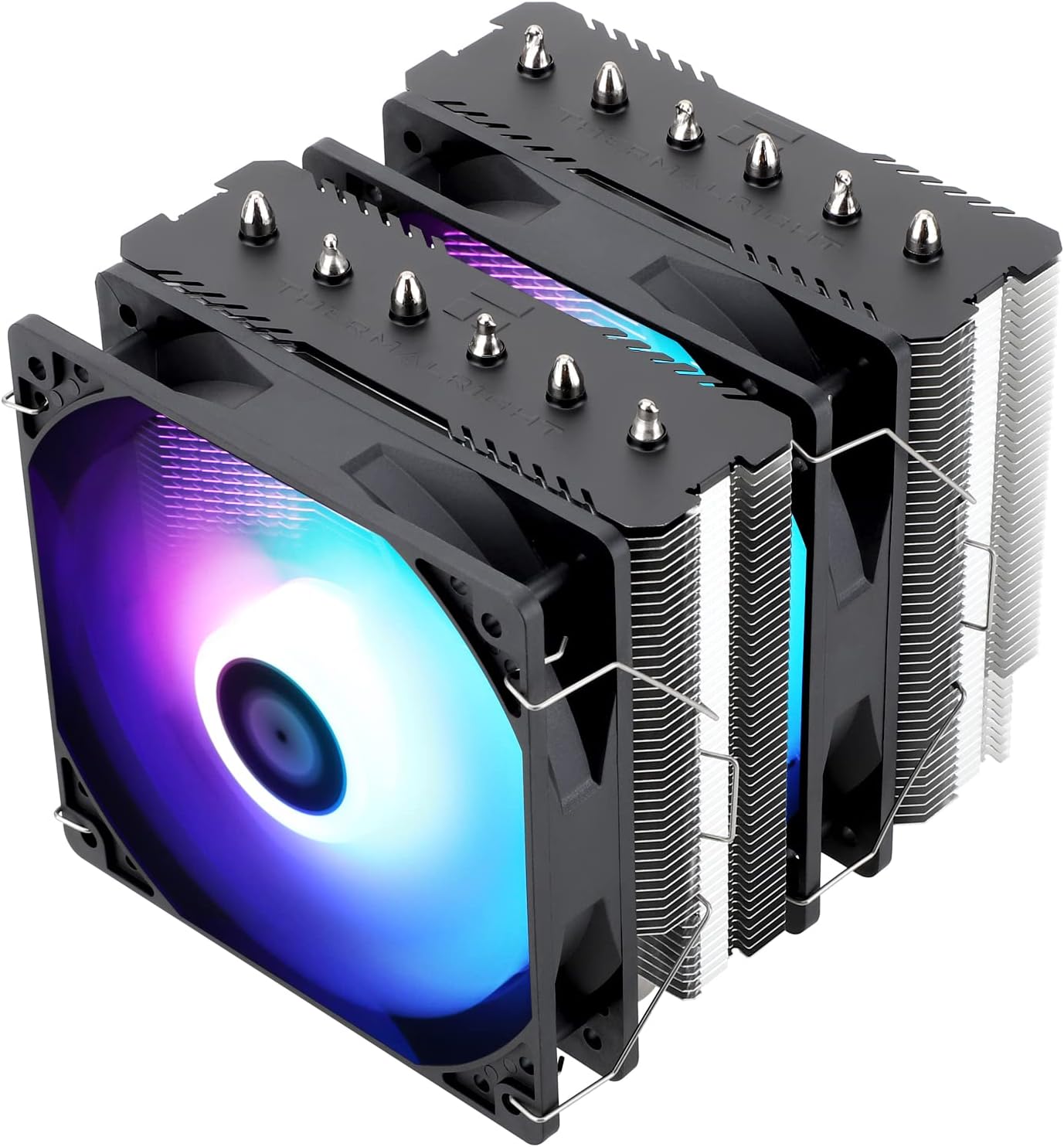
Pros
- Brand Overview is a Taiwan brand with more than 20 years
- Product specification PA120 SE ARGB
- CPU Cooler dimensions 125(L)x135(W)x155(H)mm (4.92x5.31x6.1 inch)
- heat sink material aluminum, CPU cooler is equipped with metal
- 2 PWM Fans Model TL-C12C-S
Cons
- Requires verifying computer chassis clearance for 4.92"L x 5.31"W x 6.1"H

Pros
- Three-phase FlowDrive pump is backed by a 6-year warranty on the pump itself
- Zero RPM PWM mode lets both radiator fans stop completely below set temperature thresholds
- Fan speed control runs up to 2,100 RPM under PWM for scalable cooling under load
- Comes pre-applied with XTM70 thermal paste, so no separate paste purchase is needed for first install
- Single iCUE Link System Hub cable run consolidates pump and fan connections instead of separate headers each
Cons
- 240mm radiator size caps cooling headroom versus 280mm or 360mm AIOs for higher-TDP chips
- Requires the iCUE software suite for full RGB and fan-curve control, an extra install step
- Socket support covers Intel LGA 1851/1700 and AMD AM5/AM4 only, so older AM4-predecessor or LGA1200-only boards aren't listed as compatible
This 240mm AIO measures 10.87"L x 4.72"W x 1.06"H and uses CORSAIR's FlowDrive engine, a three-phase-motor pump paired with a precision-engineered cold plate for CPU contact. The pump itself carries a 6-year warranty.
- 240mm radiator with 2x RX120 RGB fans
- Pump backed by a 6-year warranty
- Pre-applied XTM70 thermal paste for the first install
PWM fan control scales speed up to 2,100 RPM under load, and Zero RPM mode lets the fans stop completely once temperatures drop low enough, cutting noise during light workloads.

Pros
- Seven 6 mm heatpipes using AGHP 4.0 construction, which resists the gravity effect that troubles horizontally mounted towers
- Twin 120x120x25 mm PWM fans spinning to 1500 rpm for 66.17 CFM at no more than 25.6 dB(A)
- S-FDB bearings quoted at 20000 hours of service life
- Overall height of 154 mm clears the interior of most mid-tower chassis
- Mounting hardware for Intel LGA1700, 1851, 1200 and 115x plus AMD AM4 and AM5 is in the box
Cons
- At 154 mm tall it will not fit compact cases with cooler clearance below that figure
- Lighting runs on a 5 V 3-pin ARGB header, so boards offering only 12 V 4-pin RGB cannot drive it
- A dual-tower stack with two fans is heavy enough that mounting is far easier with the motherboard out of the case
The heatsink uses seven 6 mm heatpipes built with AGHP fourth-generation technology, set into a finely machined pure copper base under an anodised black fin stack. The point of AGHP is consistent behaviour whether the tower sits vertically or lies horizontally.
- Two TL-C12B-S V2 fans, 120 by 120 by 25 mm, 4-pin PWM at 12 V
- Fan speed of 1500 rpm plus or minus 10 percent, moving up to 66.17 CFM
- Noise quoted at 25.6 dB(A) or below at full speed
S-FDB bearings carry a 20000-hour service life figure, and the body uses industrial-grade PBT and PC plastics with UL class A insulation. Fin material is aluminium over the copper contact base.
Mounting kits cover a wide spread of current and recent sockets, which is what makes this cooler survivable across a platform change.
- Intel: LGA1700, LGA1851, LGA1200, LGA1156, LGA1155, LGA1151 and LGA1150
- AMD: AM4 and AM5
- Separate backplates and fasteners are supplied per platform, with instructions covering each
The physical envelope is 125 mm long by 135 mm wide by 154 mm tall. Width is the number to check against your memory: the design is described as memory-avoiding, but very tall heat-spreader kits in the first DIMM slot remain the classic clash with a front fan. If your kit has tall fins, plan to shift that fan upward slightly on its clips.
Fit the backplate and standoffs before anything else, ideally with the motherboard outside the case or with the tray cutout accessible. A dual-tower cooler blocks access to the socket area completely once mounted.
- Check the 154 mm height against your case cooler clearance figure first, as this is the single most common failure point
- Remove the front fan to reach the mounting screws, then clip it back once the tower is bolted down
- Connect the 4-pin PWM leads to CPU and CPU_OPT headers so both fans follow the same curve
Lighting needs a 5 V 3-pin ARGB header. Plugging a 5 V device into a 12 V RGB header damages the LEDs, so verify the header type before connecting anything.

Pros
- Brand Overview is a Taiwan brand with more than 20 years
- Product specification AX120R SE
- CPU Cooler dimensions 125(L)x71(W)x148(H)mm (4.92x2.8x 5.83 inch)
- Product weight 0.645kg(1.42lb)
- heat sink material aluminum, CPU cooler is equipped with metal
Cons
- Requires verifying computer chassis clearance for 4.72"L x 2.8"W x 5.83"H

Pros
- 2000RPM PWM Fan The heatsink cooler is equipped with a
- 151mm Heat Dissipation Height The overall height of the heatsink cooler
- AGHP Heat Pipe Technology 4x6mm heat pipe adopts AGHP upgraded 4th
- ARGB Divine Light Synchronization The ARGB of the pwm fan is
- Digital Screen Software Description The power supply and data
Cons
- Requires verifying computer chassis clearance for 4.72"L x 2.8"W x 5.94"H

Pros
- 360mm radiator ships with three RX120 RGB fans already mounted, so nothing has to be screwed together before installation
- The 2.1 inch IPS screen runs at 480x480 with a 600 cd/m2 backlight and 30 FPS, bright enough to read live CPU temperature through tinted glass
- iCUE LINK daisy-chaining puts the whole loop on a single port at the included System Hub instead of six separate fan and RGB cables
- Three-phase FlowDrive pump carries a 6-year warranty and arrives with XTM70 thermal paste already applied
- Zero RPM mode stops the fans entirely at idle, and PWM control sets the balance between noise and cooling
Cons
- iCUE LINK uses proprietary connectors, so the fans and hub only interoperate with CORSAIR's own ecosystem and cannot be mixed with standard RGB fans on the same chain
- The assembly measures 15.59 inches long by 4.92 inches tall, which rules out compact cases and many top-mount positions
- Socket support stops at Intel LGA 1851 and 1700 and AMD AM5 and AM4, so LGA 1200 and older builds are not covered
Check both of these before ordering, because neither is adjustable after the fact.
- Sockets: Intel LGA 1851 and LGA 1700, AMD AM5 and AM4. Nothing older is listed
- Radiator envelope: 15.59 inches long by 4.92 inches tall including fans
That 15.59 inch length is standard for a 360mm unit, but the 4.92 inch height is the figure that catches people out. Top-mounting needs that clearance between the case roof and the motherboard, and many mid-towers with tall VRM heatsinks or high memory cannot take it. Front-mounting is often the safer route, at the cost of drawing warm air over the graphics card. If you are on LGA 1200, AM3+ or an older Intel HEDT platform, this cooler simply does not have a bracket for you.

Pros
- Four 6mm pure copper vacuum heat pipes in direct contact with the processor, feeding 41 stacked fins
- Tower measures just 3.66 x 3.07 x 4.96 inches, around 126mm tall, so it clears most mid-tower side panels
- Narrow footprint leaves the memory slots and the area above the top PCIe slot open
- The 92mm PWM fan lifts off on metal clips, so the fin stack can be dusted without removing the tower
- Metal fasteners rather than plastic push-pins, covering Intel LGA 1851, 1700, 1200 and 115x plus AMD AM5 and AM4
Cons
- A single 92mm fan on a compact tower has far less heat capacity than a 120mm dual-tower for high-wattage processors
- Lighting runs a preset rainbow cycle rather than connecting to a motherboard ARGB header, so it will not sync with a themed build
- Finished in black only, with no other colourway listed for this model
The tower measures 3.66 x 3.07 x 4.96 inches, roughly 93 x 78 x 126mm, which is small for a tower cooler and exactly the point of the 92mm format.
- About 126mm tall, so it clears side panels in cases quoting 130mm or more of cooler height
- The narrow footprint leaves the memory slots and the area above the top PCIe slot open
- 41 stacked fins, bent at the edges to keep the channels between them open to airflow
- Fits micro-ATX and many ITX builds where a dual-tower cooler physically cannot go
Compared with a 120mm dual-tower the trade is straightforward: far less bulk and less mass hanging off the motherboard, and correspondingly less thermal headroom at sustained full load.
Four 6mm pure copper heat pipes run in direct contact with the processor and carry heat straight into the fin stack, with no intermediate baseplate to cross.
- Vacuum-sealed pipes pressed tightly into 41 inserted fins for consistent conduction
- A single 92mm PWM fan lets the motherboard scale speed with temperature, so idle noise stays low
- The fan lifts off on metal clips for dusting, which matters because a 92mm fin stack clogs faster than a 120mm one
- Rainbow RGB lighting on the fan plus a lit top nameplate
The lighting runs a preset colour cycle rather than connecting to a motherboard ARGB header, so it will not synchronise with the rest of a themed build. Treat it as ambient decoration rather than part of a coordinated scheme.

Pros
- Clean Classic Design A clean and minimalist design offers a modern
- Gen S Dual Chamber Pump An improved copper base design to target heat
- CryoFuze Thermal Paste Now included premium CryoFuze thermal paste,
- Optimized Fan Blades Our optimized PWM curve blade design improves
- Frosted Blade Design Our frosted blade design has been refreshed to
Cons
- Requires verifying desktop clearance for 15.5"L x 4.7"W x 1.1"H dimensions
- Periodic cleaning recommended to maintain the Aluminum, Copper, Plastic finish
What Makes an RGB CPU Cooler Worth Buying
Lighting is the fun part, but it should never be the deciding factor on its own. Before you fall for a flashy product photo, check that the cooler can actually handle your CPU’s heat output at the noise level you’re willing to live with.
Cooling Performance Still Comes First
Heat pipe count, fan static pressure, and radiator or heatsink surface area determine how well a cooler holds temperatures under sustained load. A six-pipe dual-tower air cooler or a 240mm AIO will comfortably handle most mainstream gaming CPUs. If you’re running a power-hungry chip or pushing an overclock, you’ll want more headroom than a compact single-tower design can offer.
RGB Software and Syncing Your Build
Most RGB coolers use their own control app, but many also sync through your motherboard’s ecosystem — Corsair iCUE, ASUS Aura Sync, or MSI Mystic Light. Check compatibility before buying if you want every light in your case moving in unison. A cooler that only syncs through its own hub, disconnected from everything else, gets old fast once you notice the mismatch.
Socket Compatibility and Case Clearance
Confirm your motherboard socket before ordering; every cooler in this roundup supports current Intel LGA 1851/1700 and AMD AM5/AM4 platforms, but mounting hardware still varies by brand. Also measure your case’s RAM clearance for air towers and radiator space for AIOs, since a cooler that doesn’t physically fit is no bargain at any price.
Matching Cooler Size to Your CPU’s Power Draw
A cooler that’s rated for a mid-range chip won’t necessarily keep a high-core-count processor comfortable under sustained load. Check your CPU’s rated power draw, then pick a cooler with some thermal headroom above that number rather than the bare minimum. Undersizing a cooler is the fastest way to hit thermal throttling, and no amount of RGB fixes a CPU that’s clocking down to stay cool. If you’re unsure how much headroom you actually need, a slightly larger air tower or a 240mm AIO is usually the safer call over a compact single-fan unit.
Air Tower or AIO for RGB Lighting?
Air coolers put their RGB on the fan hub and sometimes a top display, which reads well through a side panel without extra tubing to route. Liquid coolers spread lighting across the pump cap and radiator fans, plus an LCD screen on premium models, giving you more surface area to show off. Neither is objectively better for looks — it depends on your case’s window placement and how much you want to spend. If you’re leaning toward a quieter, simpler build, our best air CPU coolers guide covers non-RGB and RGB towers side by side. For bigger radiators and pump-driven cooling, check our best liquid CPU coolers roundup.
Best RGB CPU Coolers by Use Case
Rather than ranking these 10 purely by price, here’s how to match one to the build you’re actually planning.
Best Budget RGB Air Cooler
If you want lighting without stretching your budget, the Cooler Master Hyper 212 PRO ARGB is the safest bet on this list. It carries over 10,000 reviews at a 4.7 rating, which tells you it holds up across years of daily use, not just an unboxing video. At under $20, it’s an easy add to almost any budget gaming build.
Best RGB AIO for a Showcase Build
For a rig built to be looked at, the CORSAIR Titan 360 RX LCD pairs a 360mm radiator with a customizable LCD screen and three RGB fans. It’s priced like a flagship part because it performs like one, with enough thermal headroom for a high-wattage CPU under a sustained overclock. Our best CPU coolers for overclocking guide compares more options built for that kind of sustained load.
Best for Small or Compact Cases
Not every build has room for a tall dual-tower or a 240mm radiator. The JONSBO CR1400 RGB uses a compact 92mm fan design that fits cramped mini-ITX cases and low-profile builds where RAM height is tight. You’ll give up some thermal ceiling compared to bigger coolers, so it’s best paired with a mid-range CPU rather than a power-hungry flagship chip.
Best Quiet RGB Option
RGB and silence aren’t mutually exclusive. The Thermalright Assassin X120 Refined SE ARGB runs a single PWM fan tuned for low noise at idle and moderate load, which suits a home office or streaming setup where fan whine would be distracting. For more picks built around low decibel ratings, see our best quiet CPU coolers comparison.
Best Value RGB AIO
If you want liquid cooling’s cleaner look around your RAM slots without paying flagship prices, the CORSAIR iCUE Link Titan 240 RX delivers a 240mm radiator, two RGB fans, and the iCUE Link hub for well under $100. It’s the kind of pick that handles a mid-range gaming CPU comfortably while still looking the part behind glass.
Common Mistakes to Avoid When Buying an RGB CPU Cooler
A few avoidable missteps account for most of the buyer’s-remorse posts you’ll see about RGB coolers.
- Choosing looks over heat pipes. A cooler with flashy lighting but only two thin heat pipes will struggle on anything above an entry-level CPU.
- Ignoring RAM height with air towers. Tall dual-tower coolers can physically block tall RGB memory modules; check clearance specs before ordering either part.
- Assuming every RGB cooler syncs with your motherboard. Some only work through their own bundled app, so confirm ecosystem compatibility if matching lighting across components matters to you.
- Skipping the fan curve setup. Factory defaults are often tuned for quiet idle, not sustained gaming load, so revisit the curve in BIOS or the maker’s software after installing.
- Forgetting about RGB header limits. Daisy-chaining too many fans and strips off one motherboard header can undervolt the lighting or cause flicker; check your header count and use a hub if you’re running several zones.
Keeping an RGB Cooler Looking and Running Its Best
Dust dulls both cooling performance and lighting brightness over time, so a can of compressed air every couple of months keeps fins and fan blades clear. Loose RGB headers are a common culprit behind flickering lights, so double-check every connector is fully seated after any case cleaning session. Keep your cooler’s companion app or motherboard firmware updated, since lighting sync bugs are usually fixed faster than most people expect. If you ever reseat the cooler for a CPU swap, apply a fresh pea-sized dot of thermal paste rather than reusing what’s left on the old cold plate.
It’s also worth listening for changes in fan or pump sound every few months. A steady hum that turns into a rattle or whine usually means dust buildup or a bearing wearing down, not a lighting problem, so troubleshoot the mechanical side before assuming it’s a software glitch. Cleaning the radiator fins on an AIO with compressed air, rather than a vacuum, avoids static discharge near sensitive electronics.
Frequently Asked Questions
Does RGB lighting affect CPU cooling performance?
Not directly. The LEDs themselves draw negligible power, but a cooler designed around flashy lighting sometimes sacrifices heat pipe count or fan pressure. Always check the underlying cooling spec, not just the lighting.
Can I sync RGB coolers with my motherboard’s ecosystem?
Many can, through Corsair iCUE, ASUS Aura Sync, or MSI Mystic Light, but not every model supports every ecosystem. Check the manufacturer’s compatibility list before assuming your whole build will light up in unison.
Are RGB CPU coolers louder than non-RGB versions?
Generally no. The fans themselves determine noise, and RGB versions typically use the same blade design as their non-RGB counterparts. The lighting controller adds negligible extra sound.
Do I need a separate hub to control RGB fans?
Some coolers include a built-in controller or connect straight to a motherboard header, while others need a bundled hub for full effects. Check the box contents before buying if you’re short on case headers.
How much should I budget for a good RGB CPU cooler?
A solid RGB air cooler starts around $20, while a well-reviewed 240mm RGB AIO typically runs $70–$100. Premium 360mm units with LCD screens can climb toward $190, mostly for the display and radiator size rather than a dramatically cooler CPU.


