Owen Bradley
 An accent chair is the piece of furniture people buy on instinct and regret on delivery day. It looked perfect in the photo, then it arrived and swallowed the corner, blocked a walkway, or sat so low next to the sofa that the whole room looked unbalanced. Almost none of that is about taste. It is about scale, seat height, base type, and fabric, four measurable things that decide whether a chair complements your living room or fights it. This accent chair buying guide walks through each of them in order, so the chair you choose in 2026 earns its place instead of just filling a gap.

Decide What Job the Chair Has to Do
Accent chairs are asked to do wildly different jobs, and the right shape depends entirely on which one you have in mind. A reading chair needs a supportive back, arms at a comfortable height, and enough depth to settle into for an hour. An extra seat for guests needs to be easy to get out of and light enough to move. A purely decorative piece in a bedroom corner can prioritize silhouette over comfort because nobody will sit in it for long.
Be honest about which of those you are buying. The sculptural low-slung chair that anchors a magazine spread is often uncomfortable for anyone over fifty, and the deep, enveloping armchair that reads as cozy can dominate a small apartment. Naming the job first narrows the field faster than any style filter, and it stops you from comparing across categories that were never competing. Browsing the best accent chairs becomes much more productive once you know whether you need a lounger or a light occasional seat.
Scale: The Measurement Most People Skip
Scale is the relationship between the chair and everything around it, and getting it wrong is the number one cause of buyer’s remorse. A chair that is proportionally too large makes a room feel crowded even when there is technically floor space left; one that is too small looks like an afterthought next to a substantial sofa.
Width and Depth
Most accent chairs measure between 28 and 36 inches wide. Under 28 inches you are in slipper and side chair territory, which works beautifully in tight corners and narrow rooms. Above 36 inches the chair reads as a lounge piece and needs real breathing room. Depth matters just as much: 30 to 34 inches overall depth is typical, but the seat depth, meaning the usable cushion from front edge to backrest, is what determines comfort. Anything over 22 inches of seat depth suits taller people and lounging; 18 to 20 inches suits shorter frames and upright sitting.
Clearance and Traffic Flow
Leave at least 30 inches of walkway around a chair in a main traffic path, and 18 inches between the chair and a coffee table so legs fit comfortably. Before ordering, mark the footprint on the floor with painter’s tape and live with it for two days. It is a five-minute exercise that catches problems no product photo will reveal.
Seat Height and How It Relates to Your Sofa
Seat height is where accent chairs quietly go wrong. Most sofas place the seat 17 to 19 inches off the floor. If your accent chair sits at 15 inches, anyone in it is looking up at the people on the sofa, conversation feels awkward, and the room’s horizontal lines break. Keep the accent chair within about two inches of the sofa seat height and the whole arrangement reads as intentional.
Comfort has its own rules. A seat height near 18 inches lets most adults plant their feet flat with knees at roughly a right angle, which is easy to get out of. Lower seats in the 14 to 16 inch range feel relaxed and modern but demand more effort to stand up from, which matters in a household with older family members. Arm height should land close to the sofa’s arm height too, for the same visual reason.
Base Types: Fixed, Swivel, Glider and Legs
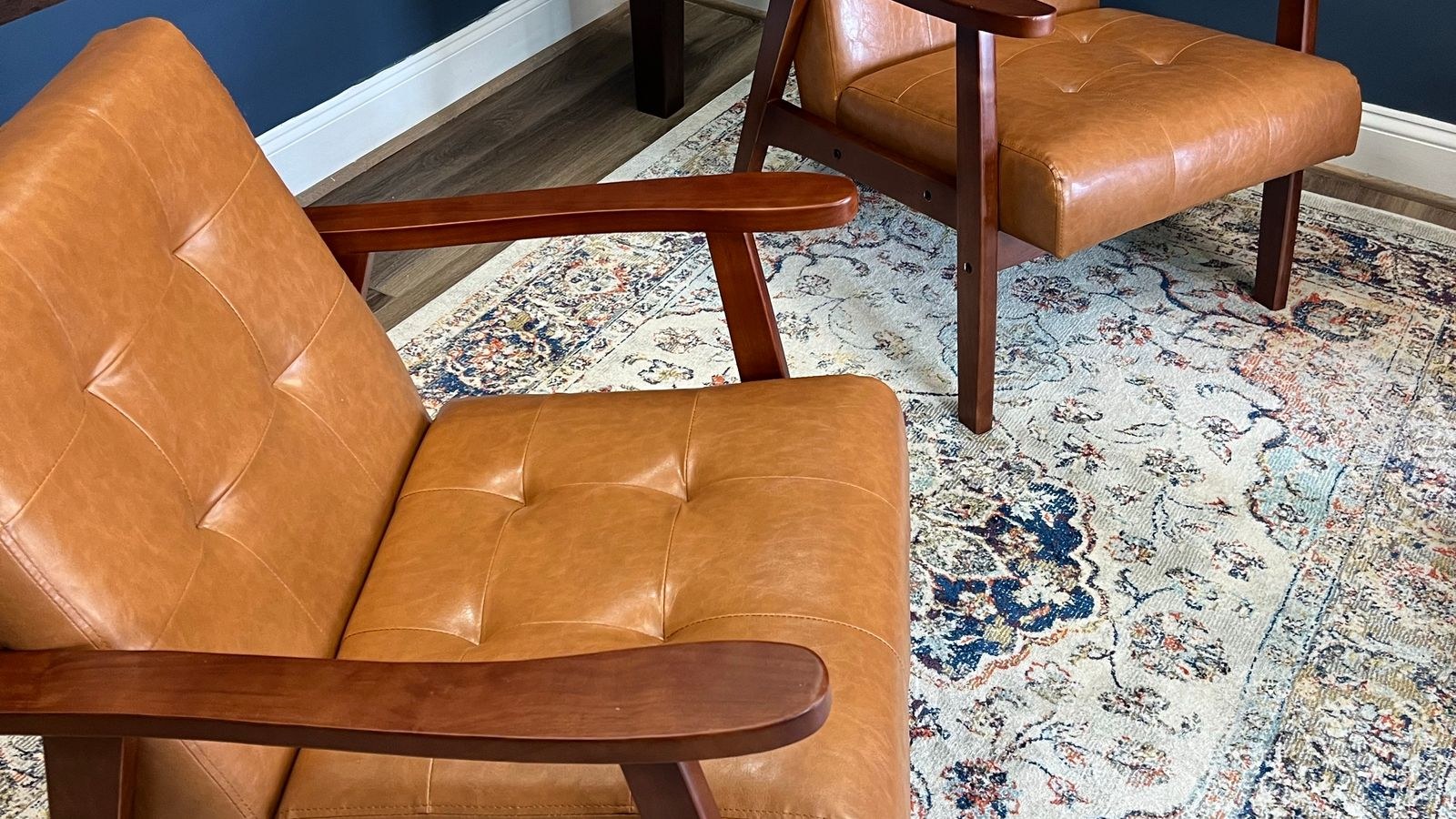
The base changes both function and how heavy the chair looks. A fixed four-leg base is the most common and the most versatile, and exposed tapered legs make a chair appear lighter because you can see floor underneath it. A skirted or fully upholstered base does the opposite, grounding the chair and making it feel substantial, which suits larger rooms.
Swivel bases solve a specific problem: rooms with two focal points, such as a television on one wall and a window or fireplace on another. Being able to turn without moving the chair makes an open-plan space far more usable, and swivel chairs have become a default choice in great rooms for exactly that reason. The trade-off is a heavier, wider base that is harder to tuck into a corner, and slightly more mechanical complexity over time. Gliders and rockers add motion for nurseries and reading corners, but they need clearance behind them.
Choosing a Silhouette That Fits Your Room
Barrel and Tub Chairs
A barrel chair wraps a continuous curved back around the sitter, which softens hard-edged rooms and works well in pairs facing a sofa. The rounded form takes up less visual space than its footprint suggests, making barrel chairs a reliable pick for open floor plans where the back of the chair is visible from the rest of the room.
Slipper Chairs
Armless and compact, a slipper chair is the specialist for tight spaces, narrow entryways, and bedroom corners. Without arms it slides closer to other furniture and disappears visually, so two of them can add seating to a small living room without crowding it. Look at slipper chairs whenever your tape measure says a standard armchair simply will not fit.
Wingbacks, Club Chairs and Loungers
Wingbacks bring height and formality and suit traditional rooms with tall ceilings. Club chairs are low, deep, and leather-friendly, ideal for a den. Modern loungers with reclined backs and low seats prioritize relaxation over conversation. Each of these is a bigger commitment of space than a slipper or barrel chair, so confirm your clearances first.
Fabric, Leather and Everyday Practicality
Upholstery decides how the chair ages. Performance fabrics with a tight weave resist stains and pilling and are the sensible default in homes with children or pets. Linen and cotton blends look relaxed and breathe well but wrinkle and mark easily. Leather is durable and wipes clean but shows scratches and can feel cold in winter.
Velvet deserves its own note because it is having a long moment. It is softer and more durable than its reputation suggests, particularly in polyester performance versions, and its pile catches light in a way that makes a plain shape look expensive. It does show crushing and pet hair, so it rewards occasional brushing. If the look appeals, the best velvet chairs cover the range from jewel-tone statement pieces to muted neutrals.
Reading a Durability Rating
Commercial upholstery is rated in double rubs, a measure of abrasion resistance. Anything above 15,000 double rubs is fine for residential use, and 30,000 or more suits a chair that will be sat in daily. Also check whether cushion covers are removable, whether the fabric is cleanable with water-based or solvent cleaners, and whether the seat cushion is foam, foam wrapped in fiber, or down blend. Foam holds its shape; down feels luxurious but needs regular fluffing.
Frame and Cushion Quality
The frame determines lifespan. Kiln-dried hardwood joined with corner blocks, dowels, and screws is the benchmark; particleboard and plastic joints are the warning sign. Suspension underneath matters just as much: eight-way hand-tied springs are the traditional premium method, sinuous serpentine springs are the practical mainstream choice, and elastic webbing is acceptable in lighter chairs but sags soonest.
Sit-test whenever possible. Press down on the front edge of the seat; it should feel firm rather than hollow. Rock the chair gently by an arm to check for wobble, which suggests weak joinery. Lift one side to gauge weight, since a suspiciously light chair usually means a lightweight frame. These three checks take under a minute and tell you more than the product description will.
Making It Work With What You Already Own
An accent chair does not need to match your sofa, and matching often flattens a room. It should relate instead: pick up a color from a rug or cushion, or contrast a soft sofa with a crisper, more structured chair. Two smaller chairs facing a sofa create a balanced conversation group; one larger chair angled toward the sofa works better in a room that already feels full.
Think about the whole seating plan rather than the single purchase. If you are still assembling the room, comparing options across the wider category of living room chairs helps you see how a pair of occasional chairs, a recliner, and a sofa can share a space without competing. Keep at least one seat in the room easy to get in and out of, and avoid placing a chair where its back faces the main entrance.
Common Mistakes to Avoid
- Buying from photos without dimensions. Styling shots use oversized rooms and undersized props.
- Ignoring seat height relative to the sofa. A two-inch mismatch is visible from across the room.
- Choosing depth for looks, not for your height. Deep seats leave shorter sitters unsupported.
- Overlooking the back of the chair. In open plans, the back is what most people see.
- Picking delicate fabric for a high-traffic room. Performance weaves cost little more and last far longer.
- Forgetting the doorway. Measure the narrowest point on the delivery path.
Frequently Asked Questions
Should my accent chair match my sofa?
No. Coordinating is better than matching. Share an undertone or repeat an accent color from your rug or cushions, but let the chair differ in texture or shape so it reads as a deliberate choice.
Do I need one chair or two?
Two smaller chairs create symmetry and better conversation flow when you have the space. One larger chair works better in rooms under about 150 square feet or where a walkway crosses the seating area.
Is a swivel base worth the extra cost?
It is if your room has more than one focal point or an open-plan layout. In a straightforward rectangular living room with a single television wall, a fixed base is simpler and usually more comfortable.
How do I know if the seat depth suits me?
Sit back fully. Your lower back should meet the backrest while a few fingers fit between the seat edge and the back of your knees. If your legs dangle or your back cannot reach, the depth is wrong for you.
Final Thoughts
Choosing an accent chair well comes down to sequencing. Name the job first, measure the space and mark it out, match the seat height to your sofa, then pick a base and silhouette suited to how the room is used. Only at that point should style, fabric, and color enter the decision, and by then the shortlist will be small enough that you can choose confidently rather than hopefully. Do it in that order in 2026 and the chair will look like it was always meant to be there, which is exactly what a good accent chair is supposed to achieve.