Owen Bradley
 A pendant light that is two inches too low turns a beautiful kitchen island into an obstacle course. One that is six inches too small over a dining table looks like an afterthought no matter how much it cost. Sizing is the part of pendant shopping that decides whether the finished room looks designed or improvised, and it is almost entirely a matter of arithmetic rather than taste. The good news is that the formulas are simple, well established, and easy to check with a tape measure before you buy anything. This guide covers hanging heights, fixture diameter, spacing between multiple pendants, and the adjustments you need for tall ceilings, low ceilings, and awkward room shapes, so your pendants land at exactly the right place the first time.
The Three Measurements You Need First
Before any formula is useful, write down three numbers. First, the ceiling height in the exact spot where the pendant will hang, measured from the finished floor. Second, the surface dimensions, meaning the length and width of the island, table, or counter the pendant will light. Third, the surface height, which is 36 inches for a standard counter, 30 inches for most dining tables, and 42 inches for a bar-height island.
Everything else follows from those three figures. Skip them and you will end up guessing, which is how pendants end up blocking sightlines across a kitchen or hanging so high they light the ceiling instead of the food.
Hanging Height Rules by Location
Over a Kitchen Island
The standard is 30 to 36 inches from the countertop to the bottom of the pendant. Thirty inches suits smaller fixtures and shorter households; 36 inches keeps larger shades out of the way and preserves sightlines across an open plan. If people will sit at the island and face each other, err toward 32 to 34 inches so the fixtures do not block eye contact.
In terms of floor height, that puts the bottom of the pendant roughly 66 to 72 inches above the floor over a 36-inch counter. Anyone in the household taller than about six feet should stand where the pendant will hang and check clearance before you drill.
Over a Dining Table
Aim for 30 to 34 inches from the tabletop to the bottom of the fixture. Because nobody walks under a dining table, you can hang lower here than over an island, and lower generally looks better: it defines the table as its own zone and creates the intimate pool of light that makes a dining room feel finished. If the fixture has an open bottom and a visible bare bulb, hang a little higher to keep the filament out of seated sightlines.
Over a Bar or Peninsula
Bar-height surfaces at 42 inches need the same 30 to 36 inch gap, which puts the pendant bottom around 72 to 78 inches from the floor. Because bar seating is high, favor the upper end of that range so the fixtures clear the heads of seated guests.
In an Entryway or Foyer
Here the rule is about clearance rather than task light. Keep the bottom of the fixture at least 7 feet above the floor in any walkway. For a two-story foyer, the traditional guidance is to center the fixture in the window from the outside view and keep the bottom roughly level with the second-floor landing.
Over a Stairwell
Measure from the highest step the fixture will hang over, and maintain a minimum of 7 feet of clearance from that tread to the bottom of the pendant. Also confirm you can actually reach the fixture to change a bulb, either from a landing or with a ladder that can be safely positioned.
The Ceiling Height Adjustment
All the numbers above assume a standard 8-foot ceiling. For every additional foot of ceiling height, add 3 inches to the hanging drop. A 10-foot ceiling therefore takes about 6 inches more drop than an 8-foot ceiling, which keeps the fixture visually connected to the surface below rather than floating in space.
Low ceilings work in reverse. Under 8 feet, reduce the drop and choose a fixture with a compact profile or switch to a semi-flush mount. Trying to force a dramatic pendant into a 7.5-foot ceiling is the fastest way to make a room feel cramped.
How Big Should the Pendant Be?
The Room Diagonal Method
For a single pendant lighting a room rather than a specific surface, add the room’s length and width in feet, then convert that sum to inches. A 12 by 14 foot room gives 26, so a fixture around 26 inches in diameter suits the space. This rule scales well and prevents both the tiny-fixture and overwhelming-fixture failures.
The Surface Width Method
For a pendant over a table or island, the combined width of all fixtures should be roughly one half to two thirds of the surface width. A 60-inch table is best served by a fixture or fixture group spanning 30 to 40 inches. Going wider crowds the table edges; going narrower leaves the fixture looking undersized.
Height of the Fixture Itself
A useful check for fixture height is 2 to 3 inches of fixture per foot of ceiling height. A 9-foot ceiling comfortably carries a fixture 18 to 27 inches tall. Anything taller starts to dominate, and anything much shorter disappears.
Spacing Multiple Pendants
Multiple pendants over an island or table follow their own rules, and getting the spacing wrong is more noticeable than getting the height slightly off.
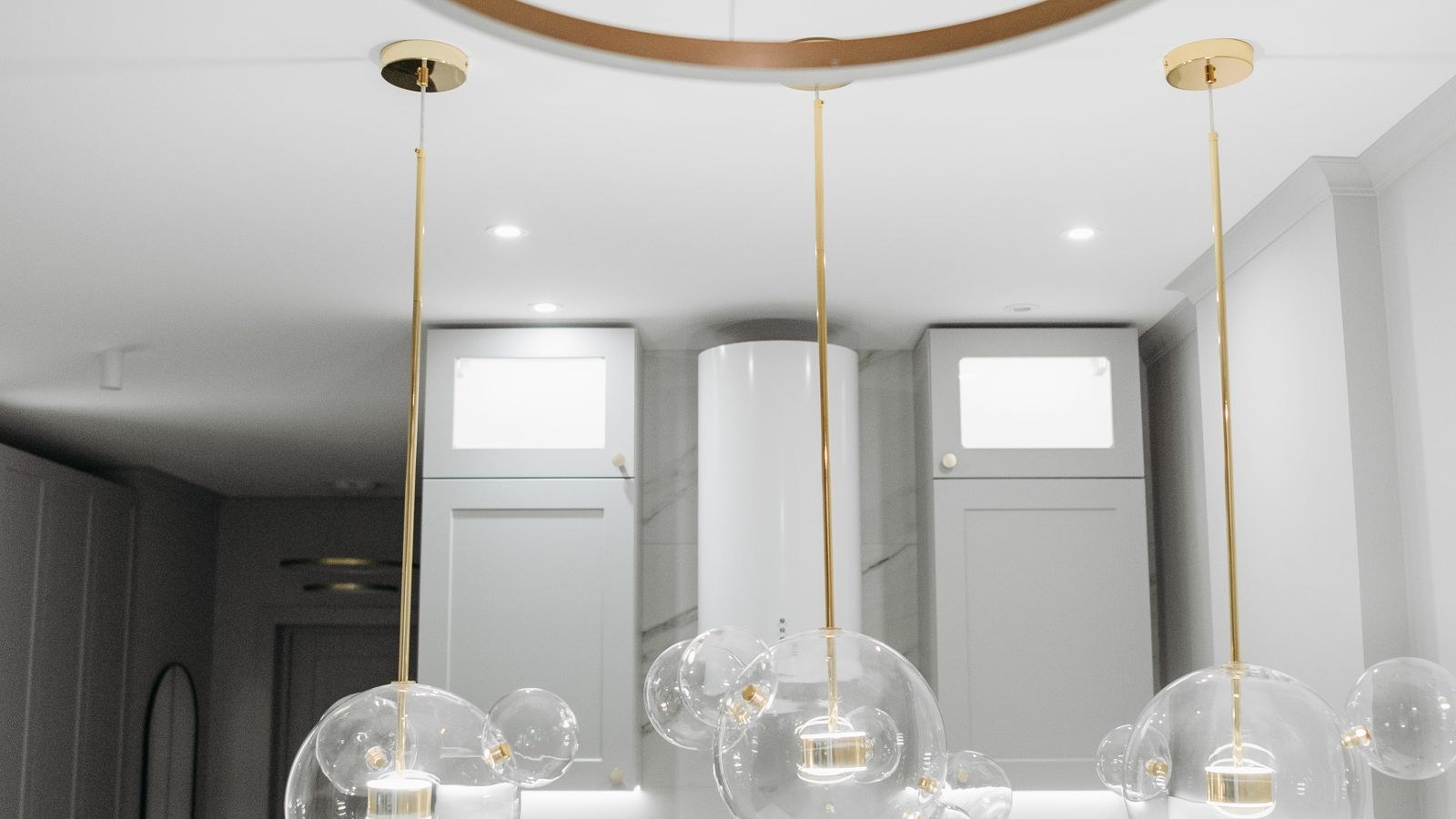
- Choose the count by island length. Islands under 6 feet usually take two pendants, 6 to 8 feet take two large or three medium, and anything over 8 feet takes three or more. Odd numbers tend to look better with small fixtures, even numbers with large ones.
- Space centers 24 to 30 inches apart for medium pendants. Larger fixtures need more, and the gap between adjacent shades should never be less than about half a shade width.
- Keep 6 to 12 inches from the island end to the outer edge of the end fixtures, so the group reads as centered rather than crowded.
- Center the group on the island, not on the room. Islands are often off-center in an open plan, and aligning to the island is what your eye reads as correct.
- Hang all pendants at exactly the same height unless you are deliberately staggering them over a stairwell or in a double-height space.
Choosing the Bulb and Light Output
Sizing the fixture is only half the job; the light coming out of it has to suit the room. For a kitchen island, target roughly 300 to 400 lumens per square foot of work surface across all pendants combined. Over a dining table, far less is needed because the goal is atmosphere rather than task light, and dimming down to a low warm glow is often the whole point.
Color temperature belongs in the 2700K to 3000K range for dining and living areas, where warm light flatters food and skin. Kitchens can go slightly cooler at 3000K to 3500K if the pendants are the primary task source. Whatever you choose, keep it consistent with nearby fixtures, and pick a bulb with CRI 90 or higher wherever food is served. Our roundup of the best light bulbs for pendant lights covers the shapes, bases, and dimming behavior that suit exposed and enclosed shades.
When the Bulb Is Visible
Open-bottom and clear-glass pendants put the bulb on display, which makes filament appearance part of the design. Vintage-style shapes with visible filaments look intentional in an industrial or farmhouse kitchen, and they also demand a bit more hanging height so nobody stares straight into the glass. Browse the best Edison bulbs for classic filament shapes, or the best LED Edison bulbs if you want the same look with a fraction of the heat and power draw.

Cord, Chain, and Adjustability
Check the maximum and minimum drop before you buy. Many pendants ship with a fixed cord that can be shortened but not lengthened, and a fixture whose maximum drop is 40 inches will not work in a room with a 12-foot ceiling without an extension kit. Rod-mounted pendants use fixed stem segments, so confirm the kit includes enough rods for your ceiling height.
Sloped ceilings need a compatible canopy. A standard flat canopy on an angled ceiling leaves a visible gap and hangs the fixture off vertical. Look for a sloped-ceiling adapter or a swivel canopy rated for your ceiling pitch.
Mistakes That Ruin Otherwise Good Pendants
The most common is hanging too high. People fear the fixture will be in the way, so they raise it, and the result is a light that seems disconnected from the surface it is supposed to define. Trust the 30 to 36 inch rule and check clearance with a broom handle before drilling.
The second is buying undersized fixtures. Pendants look considerably larger in a showroom or product photo than they do installed in a real room. When you are between two sizes, choose the larger one.
Third, people forget that the electrical box location dictates where the pendant hangs. If the existing box is not centered on the island, you either move the box, use a swag hook and cord, or install a canopy that spans multiple pendants from a single point. Discovering this after the fixture arrives is a bad afternoon.
Finally, many installs skip a dimmer. A pendant at full brightness during dinner is harsh, and the same fixture at 30 percent transforms the room. Add a dimmer and verify the bulbs are dimmable and compatible with the switch type. For a broader look at layering pendants with ambient and accent sources, see our overview of the best lighting options for whole-home planning.
A Quick Pre-Purchase Checklist
- Ceiling height measured at the exact mounting point.
- Surface dimensions and height recorded.
- Target drop calculated, plus 3 inches per foot above 8-foot ceilings.
- Fixture diameter checked against the room diagonal or surface width rule.
- Number of pendants and center-to-center spacing planned.
- Maximum and minimum cord or rod length confirmed against your ceiling.
- Electrical box location verified as centered on the surface.
- Dimmer compatibility and bulb type confirmed.
Frequently Asked Questions
How low should a pendant hang over an island?
Between 30 and 36 inches from the countertop to the bottom of the fixture. Choose the lower end for small fixtures and the upper end for large shades or open sightlines across a room.
How many pendants do I need over my island?
Two for islands under about 6 feet, two or three for 6 to 8 feet, and three or more beyond that. Balance the count against fixture diameter so the group spans roughly half to two thirds of the island length.
Can pendant lights be too big?
Yes, though undersizing is far more common. A fixture wider than about two thirds of the surface below it starts to overwhelm the space and can interfere with reaching across the table or counter.
Do pendants work with 8-foot ceilings?
They do, as long as you choose a compact fixture and keep the drop tight. Over a table where nobody walks, an 8-foot ceiling handles pendants comfortably. In a walkway, a semi-flush fixture is usually the safer choice.
Should all pendants hang at the same height?
Over a table or island, yes. Uneven heights read as a mistake rather than a design choice. Staggered heights only work in double-height spaces like stairwells and foyers where the arrangement is clearly intentional.
Final Thoughts
Pendant sizing rewards fifteen minutes with a tape measure more than it rewards a bigger budget. Record your ceiling height, surface dimensions, and surface height, then apply the rules: 30 to 36 inches of clearance above the work surface, 3 extra inches of drop per foot of ceiling above 8 feet, a fixture group spanning half to two thirds of the surface width, and 24 to 30 inches between pendant centers. Confirm the cord length and electrical box position before ordering, add a dimmer, and choose warm, high-CRI bulbs. Follow that sequence and your pendants will look like they were specified by a designer rather than picked from a page, and they will still look right long after 2026.