Owen Bradley
 Putting a workstation in the room you sleep in feels like a compromise, and done badly it is one. Work creeps into the evening, the laptop glows at bedtime, and the room stops feeling restful. But a home office in a bedroom does not fail because the room is small; it fails because nothing separates the two functions. Zoning is the fix. With deliberate desk placement, storage that closes, lighting that changes character after dark, and a few habits that mark the end of the working day, a bedroom can host a genuinely productive office without wrecking your sleep. This guide walks through the whole process, from measuring the room to the final tidy-up routine that makes the arrangement sustainable.
What You Need Before You Start
- A tape measure and paper. You will sketch the room to scale before moving anything heavy.
- A desk sized to the wall you choose, not to the desk you wish you had room for.
- A task lamp with a directional head, separate from the room’s ceiling light.
- Closed storage: a drawer unit, a cabinet, or lidded boxes. Open shelves keep work visible.
- A power strip with surge protection and a few cable ties or adhesive clips.
- A rug or runner if you want a visual boundary without building anything.
Set aside an afternoon. Most of the work is decision-making rather than assembly, and decisions go faster when you can see the whole room mapped out rather than shuffling furniture and hoping.
Step-by-Step: Setting Up the Space
- Measure the room and mark the fixed points. Note the door swing, the window, every power outlet, the radiator, and the wardrobe doors. These are non-negotiable and they eliminate most desk positions immediately.
- Sketch the room to scale on graph paper. Cut out paper rectangles for the bed, desk, and chair and move those around instead of the real furniture. Five minutes here saves an hour of lifting.
- Identify candidate desk walls. A desk needs roughly 30 inches of clear depth in front of it for the chair to pull out, plus the desk’s own depth. Any wall that leaves under 60 inches total is out.
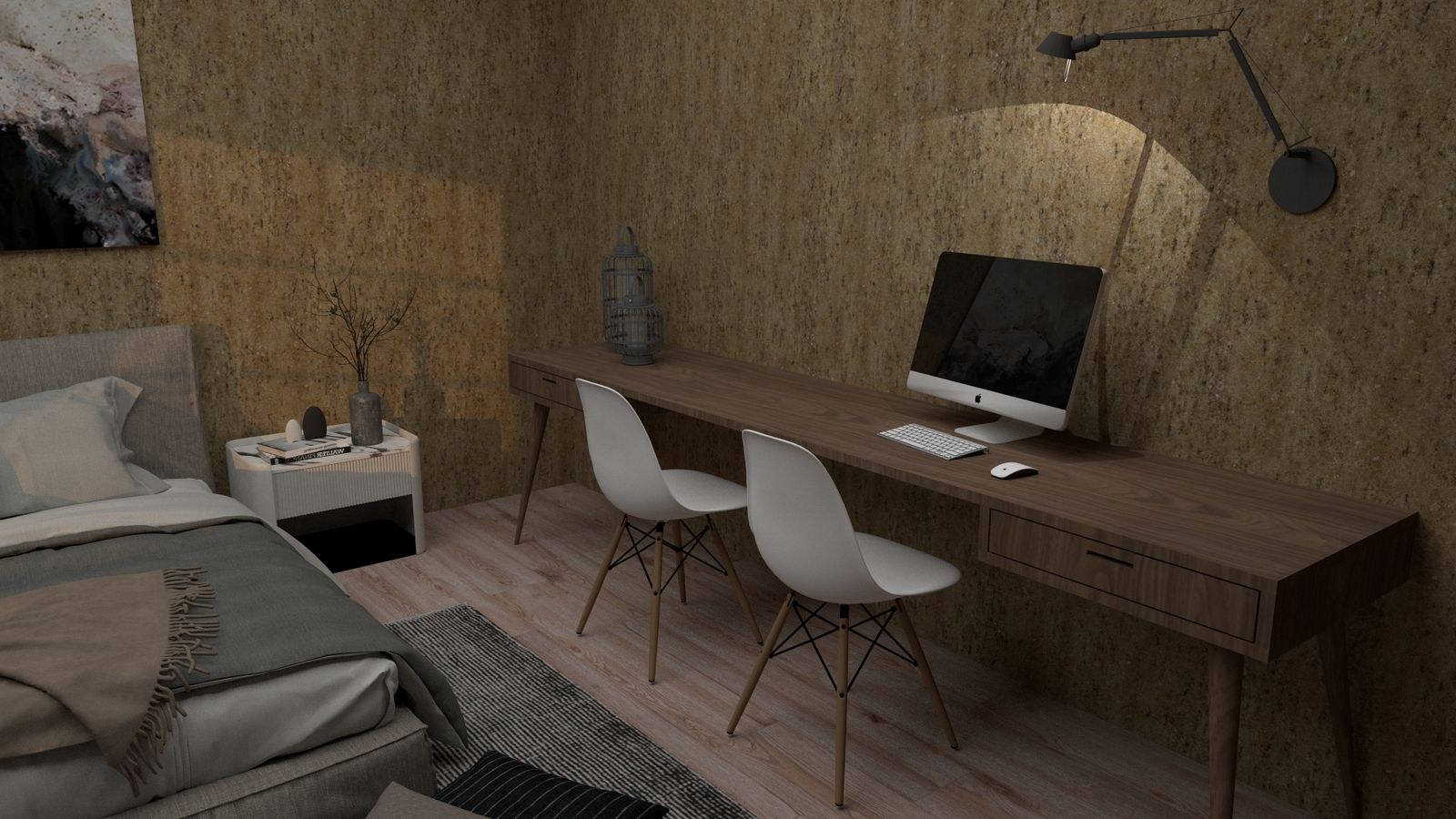
- Choose the position that puts your back to the bed. If you sit facing a wall or a window with the bed behind you, the bed leaves your field of view while you work. This single choice does more for concentration than anything else in the room.
- Set the desk at the right height. Elbows at roughly 90 degrees, forearms level with the surface. If the desk is too tall, raise the chair and add a footrest rather than slouching down to meet it.
- Position the screen relative to the window. Side-on to the glass is ideal. Facing the window puts glare on your eyes; backing onto it puts reflections on the screen.
- Run power before you push furniture back. Mount a power strip under the desk, route cables along a leg, and secure them so nothing dangles into the walkway between desk and bed.
- Install the storage next. Everything work-related should have a home behind a door or lid. Anything that cannot be hidden gets a tray, so it is at least contained.
- Add the task lamp and test it after dark. Light the desk surface, not the room. Check that the beam does not spill across the bed.
- Lay the rug to define the zone. A small rug under the desk and chair reads as a separate area even in a room of 100 square feet.
- Sit and work for a full day before committing. Live with the layout before you drill anything into a wall. Small irritations become obvious quickly.
Choosing a Desk That Fits the Room
The temptation is to buy the biggest desk that technically fits. Resist it. In a bedroom, circulation space matters more than surface area, and a desk that forces you to squeeze past the bed will quietly make you stop using it. Measure the wall, subtract at least 24 inches of walkway, and let that number set your maximum width.
Depth is where most people go wrong. A 30-inch deep desk is standard in an office but eats a bedroom. A 20 to 24-inch depth is enough for a laptop or a single monitor on an arm, and it gives back six inches of floor. Our roundup of the best desks for small spaces is built around exactly this trade-off, while the best compact desks list focuses on the narrowest models that still hold a full working setup.
Two other formats suit bedrooms. A wall-mounted floating desk removes the legs entirely, so the floor stays visible. A secretary desk with a fold-down front hides the workspace behind a panel in one movement. For models built around tight footprints, see the best desks for a small home office.
The Chair Question
A bedroom cannot usually accommodate a large executive chair without it dominating the room. Look instead for a compact, armless or low-arm task chair that tucks fully under the desk when not in use. Height adjustment and a supportive backrest are the two features worth paying for; headrests and wide fixed arms mostly add bulk. Several models in our best home office chairs selection are deliberately scaled for rooms where the chair has to disappear when the workday ends.
Zoning: Making One Room Read as Two
Zoning is the art of signalling to your brain that two different activities happen in one space. You do not need a wall. You need consistent, repeated cues.
- Flooring. A rug under the work area creates an obvious boundary at almost no cost and adds sound absorption.
- Orientation. Face away from the bed. Even a 90-degree turn changes what your peripheral vision is processing all day.
- Colour. Keep the work zone slightly cooler and more neutral than the sleeping zone. Warm textiles read as rest; clean surfaces read as focus.
- A physical divider. An open shelving unit, a tall plant, or a folding screen breaks the sightline without blocking light. Place it perpendicular to the wall between the two zones.
- Headboard placement. If the room allows, put the bed and the desk on different walls entirely rather than in a line.
- Height. Keep everything in the sleeping zone low and everything storage-related in the work zone vertical. The eye reads the change as a boundary.
Lighting the Two Zones Differently
Lighting is the most powerful zoning tool and the one people most often skip. A single overhead fixture forces both activities to share the same light, which flattens the room and keeps it feeling like an office at 10pm.
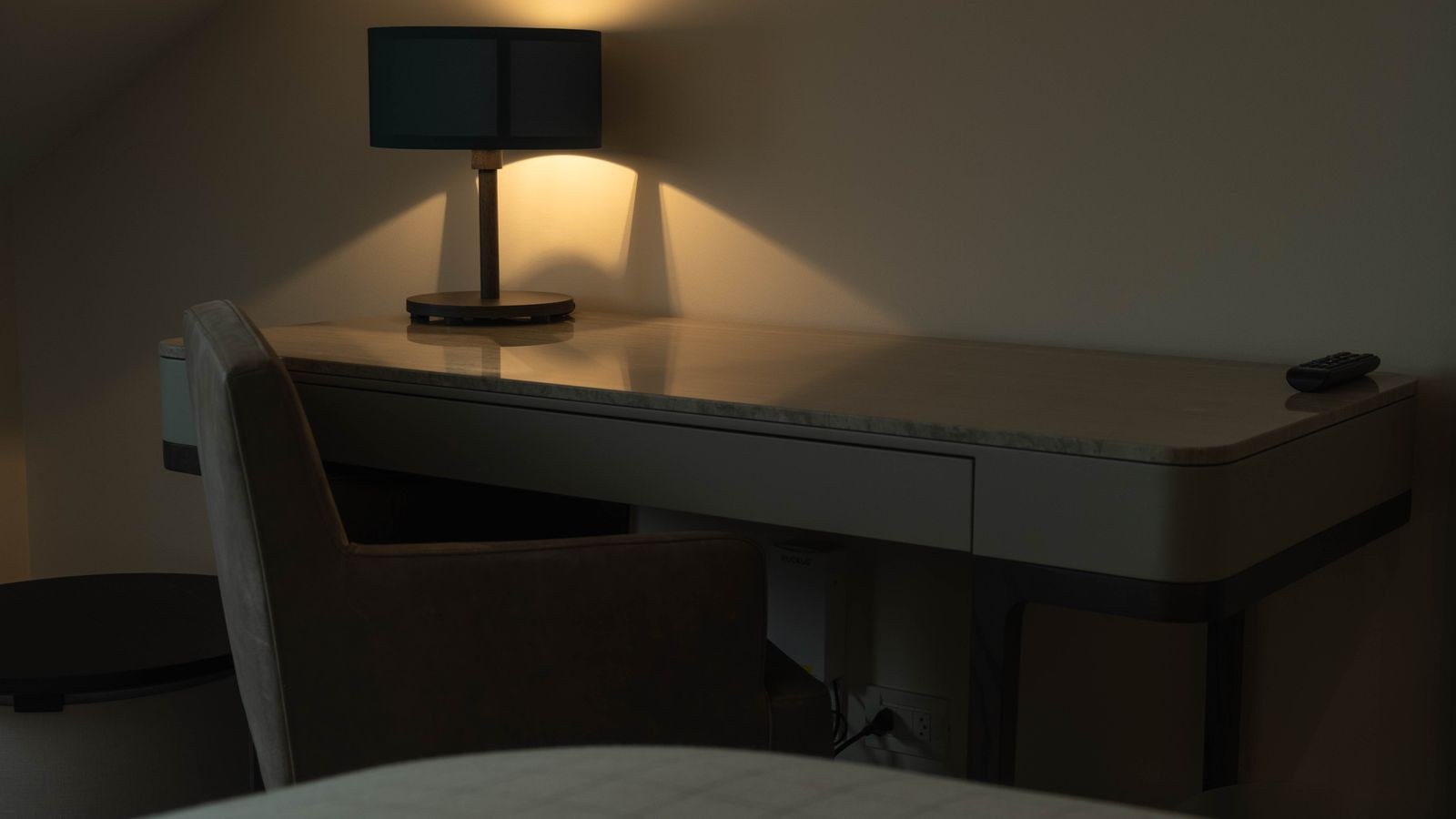
Give the desk its own task lamp with a directional head, ideally around 4000K in colour temperature for alertness, and enough output to light the work surface without lighting the whole room. Give the bedside a separate warm lamp, 2700K or lower, on its own switch. When you finish work, turning off the task lamp and switching to the warm one is a physical action that ends the day. Add dimming to the ceiling light if you can, so the room can drop from working brightness to evening brightness in one movement.
Place the lamp on the opposite side from your writing hand so it casts no shadow, and angle the head so no bulb is directly visible from the desk or the bed.
Storage That Keeps Work Out of Sight
Visible work is unfinished work as far as your brain is concerned. The single most effective habit in a bedroom office is a two-minute end-of-day reset where everything goes away.
Build the storage that makes that possible. A shallow drawer unit under the desk holds documents, chargers, and stationery. A single lidded box handles the overflow that never fits a category. Vertical file holders on a shelf keep paper upright rather than spread across the desk. If your desk has no drawers, an under-desk hanging tray adds one without floor space. Where the room genuinely has none to spare, look upward: a shelf mounted 16 inches above the desk gains storage without touching the walkway.
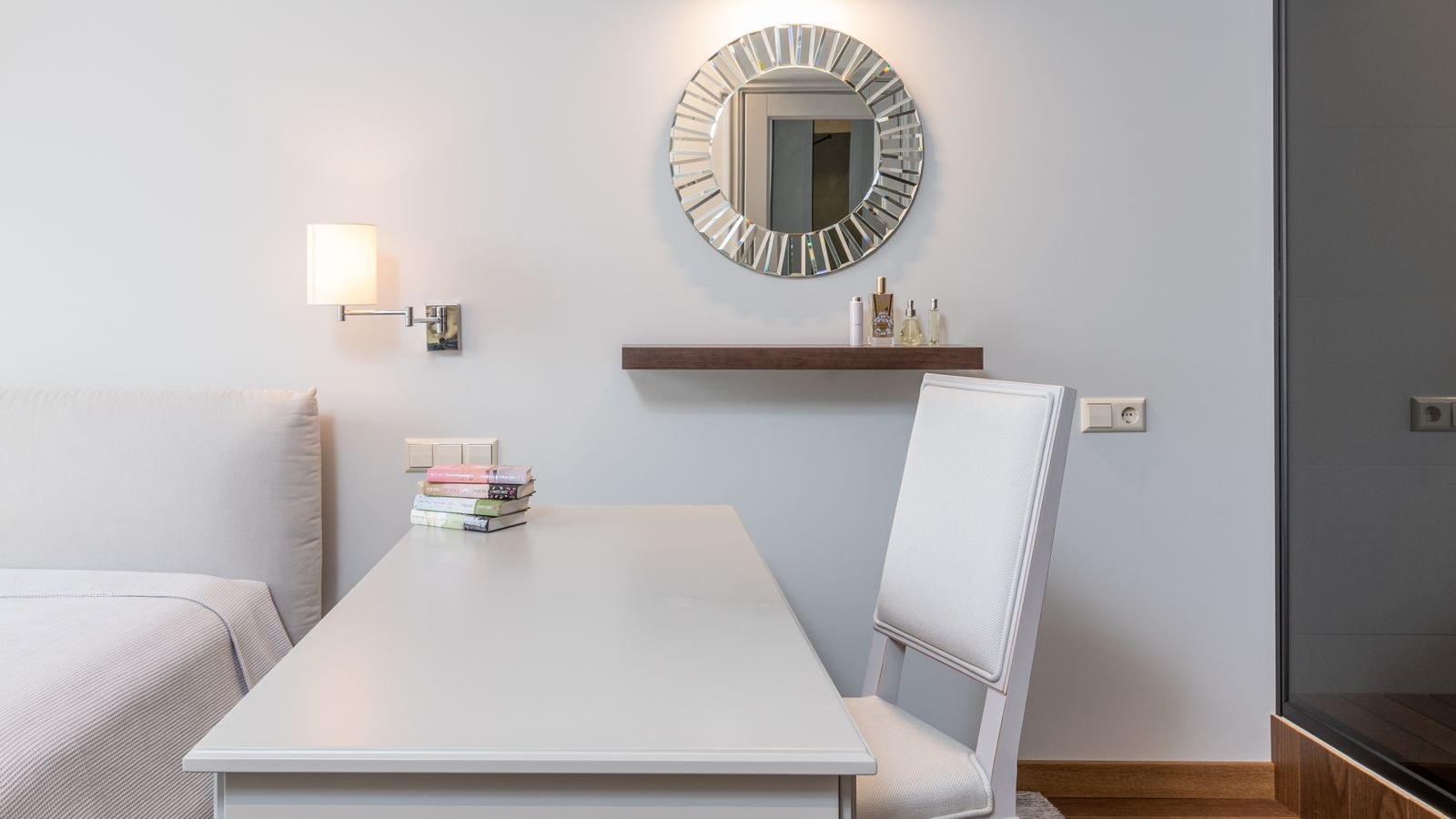
Cables, Noise, and the Small Details
Cables ruin the visual calm of a bedroom faster than anything else. Mount a power strip to the underside of the desk with adhesive brackets so no block sits on the floor. Run everything to that one point, sleeve the bundle, and clip the sleeve along a desk leg. Leave enough slack for a laptop to be lifted off the desk without unplugging three things.
Noise is the other detail worth planning for. If you take calls, soft surfaces help enormously; a rug, curtains, and a fabric headboard cut echo far more than any hard-surfaced room. Position the desk away from the shared wall if there is one, and keep the door path clear so you can close it during meetings. For a wider view of how desk, chair, network, and lighting decisions interact across a whole workspace, our home office setup guide covering desk, chair, router and lighting works through each layer in turn.
Mistakes to Avoid
- Facing the bed while you work. The most common layout error and the hardest to override with willpower.
- Buying the desk before measuring the walkway. A desk that fits the wall but blocks the room is worse than a smaller one.
- Relying on the ceiling light alone. Without a separate task lamp, the room never changes mode.
- Using the bed as a chair. It trains your body to associate the bed with alertness, which is exactly backwards.
- Open storage everywhere. Visible files and cables keep the room in work mode around the clock.
- Leaving the laptop open overnight. Close it, or better, put it in a drawer. The visual cue matters more than you expect.
Frequently Asked Questions
Is it unhealthy to work in your bedroom?
It is not inherently harmful, but poor separation can weaken the mental association between the bedroom and sleep. Zoning, separate lighting, and a clear end-of-day routine address most of that risk.
How small can a bedroom desk be?
A 36-inch wide by 20-inch deep surface comfortably holds a laptop, a notebook, and a drink. Below about 30 inches wide you start losing usable space for anything beyond a single device.
Should the desk face the window?
Side-on is generally best. Facing the window causes glare and eye strain; backing onto it puts reflections on your screen. Placing the window to your left or right gives daylight without either problem.
What if the room only has one usable wall?
Use a fold-down or wall-mounted desk that clears away entirely, or place the desk at the foot of the bed facing outward so the bed sits behind your line of sight.
Final Thoughts
A bedroom office works when the two functions are genuinely separated in orientation, light, and storage, even if they are only separated by four feet of floor. Measure before you buy, choose a shallower desk than you think you need, sit with your back to the bed, and give the work zone its own lamp on its own switch. Then build the two-minute habit of clearing the surface and switching lamps at the end of the day. Do those things and the room will read as an office while you are working and as a bedroom the moment you stop, which is the whole point.