Owen Bradley
 If you have ever spent an evening riding the volume control, turning it up to catch a whispered line and then diving for the remote when an explosion arrives, your center channel is the reason. Roughly two-thirds of everything you hear in a film comes out of that one speaker, yet it is routinely the cheapest and worst-placed component in the system. This center channel speaker guide explains why dialogue turns muddy, how to match a center to the main speakers you already own, where to physically put it around a television, and which settings in your receiver are quietly working against you.
What the Center Channel Actually Does
In a stereo system, dialogue appears to come from between the two speakers because both play it at equal level, creating what engineers call a phantom center. That illusion works beautifully for one listener sitting exactly on the axis between the speakers, and it collapses for everyone else. Move a few feet off centre and the voice slides toward the nearer speaker.
A surround mix solves this by giving dialogue its own discrete channel anchored to a physical speaker below or above the screen. Every seat on the sofa hears voices coming from the picture. That anchoring, not extra volume, is the point. It is also why the center channel carries the heaviest workload in the system and why a weak one drags down the entire experience.
Why Dialogue Sounds Muffled: The Usual Suspects
Poor dialogue is almost never one problem. It is usually three small ones stacking up.
The Speaker Is Trapped in a Cabinet
Most people slide the center into the shelf beneath the television because that is where the space is. That shelf becomes a small resonant chamber. Mid frequencies bounce inside it, arrive at your ears slightly delayed, and smear consonants. Any rear port is choked by the back panel, and the cabinet’s own panels vibrate in sympathy. This single placement issue accounts for more bad dialogue than any specification on the box.
It Is Firing at Your Knees
Tweeters are directional. A center sitting low in a media unit aims its high frequencies at the floor in front of the sofa. Consonants like s, t, and f live in that treble range, and losing them is exactly what “I can hear them talking but I cannot understand them” means.
The Design Compromises Fight Each Other
Most centers use a horizontal layout with two woofers flanking a tweeter, known as MTM. This shape fits under a screen, but it creates lobing: at off-axis angles the two woofers arrive out of step with each other and cancel in the crossover region, which is precisely where vocal energy sits. Listeners at the ends of the sofa get a thinner, hollower voice than the person in the middle. Designs that mount a dedicated midrange driver vertically in line with the tweeter avoid this problem and are worth seeking out. Models built around vocal clarity appear throughout our roundup of the best center channel speakers.
Matching the Center to Your Main Speakers
Sound pans constantly across the front three channels. A car drives from left to right, a character walks across a room, and the mix moves that sound between speakers. If the center has a different tonal character to the left and right, that pan audibly changes colour as it crosses, which is distracting even when you cannot name what is wrong.
The reliable way to avoid this is to buy the center from the same manufacturer and, crucially, the same product family as your mains. Within a family the drivers, crossover slopes, and cabinet voicing are designed to match. Mixing brands across the front stage is the most common cause of a front soundstage that never quite gels.
Also match capability, not just brand. A tiny center paired with large towers will run out of headroom during loud scenes while the mains are still relaxed, and the receiver’s calibration will be forced to turn the mains down to match. As a rule, the center should have woofers at least as large as those in your mains, and preferably the same tweeter. If you are building the front stage from scratch, our guide to the best home theater speakers shows which families offer properly scaled centers alongside their towers.
Placement: Getting the Physical Setup Right
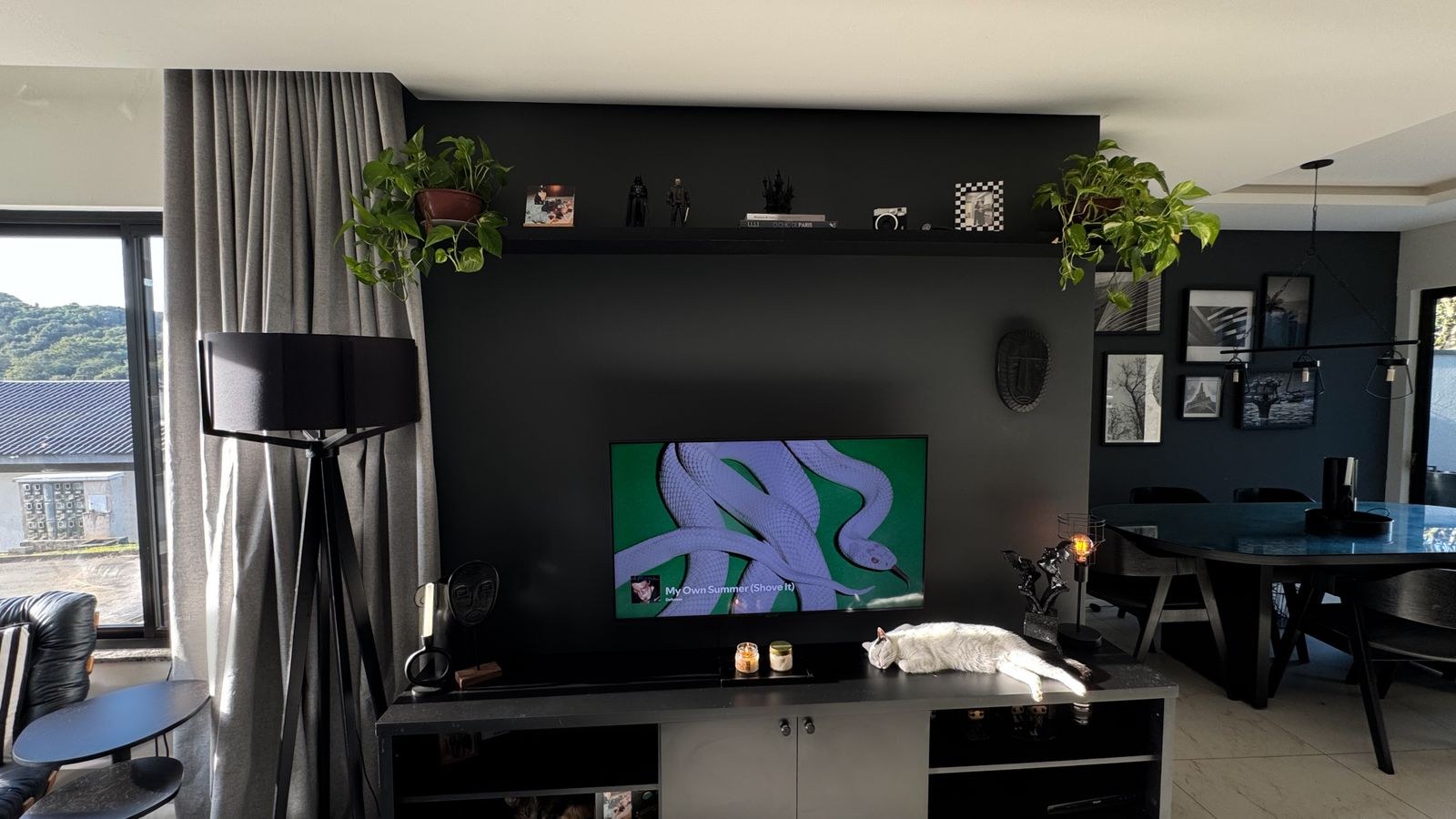
The goal is simple to state and awkward to achieve: the center’s tweeter should be as close to ear height as possible, and as close to the vertical centre of the screen as possible, firing directly at the listening position.
- Choose above or below the screen. Either works. Directly beneath a wall-mounted television is most common; directly above is fine and sometimes gets closer to ear height.
- Get it out of the cabinet. If the speaker must sit in a media unit, pull it forward until the baffle is flush with the front edge, or slightly proud of it. This alone often produces a clearly audible improvement.
- Angle it toward your ears. If the speaker sits well below or above ear level, tilt it so the tweeter aims at the seated listening position. Small isolation wedges or a dedicated mount handle this neatly.
- Decouple it from the surface. Isolation pads under the cabinet stop it transmitting vibration into a hollow shelf, which reduces boominess in the lower midrange.
- Keep it equidistant. Position it on the same horizontal axis as your left and right speakers where possible, so the front three form a coherent stage rather than a triangle pointing forward.
Avoid placing the center inside a fully enclosed cabinet with a glass door, behind a soundbar, or on a shelf where the tweeter is blocked by the television’s own bezel or a soundbar sitting in front of it.
Receiver Settings That Change Everything
A correctly chosen and placed center can still sound wrong if the receiver is configured badly. Four settings do most of the damage.
Speaker size and crossover. Set the center to “small” and use an 80Hz crossover in most systems, so the subwoofer handles the lowest frequencies. Leaving a modest center set to “large” asks it to reproduce bass it cannot manage, which muddies the midrange where dialogue lives.
Distance. Enter the measured distance from each speaker to the main listening seat. The receiver uses this to time-align the channels. An error of even a couple of feet blurs the front image.
Level. Run the automatic calibration, then trim the center by ear. Adding 1 to 2dB above the calibrated level is a very common and entirely legitimate adjustment for dialogue clarity, because film mixes are made for rooms far larger than a living room.
Dynamic range. Look for a night mode, dynamic range compression, or dialogue enhancement setting. These compress the gap between quiet speech and loud effects, which is exactly the problem most people describe. They are less pure but genuinely useful for evening viewing.
Beyond the Speaker: Other Causes of Poor Dialogue
Sometimes the center is innocent. Check the source format first: many streaming apps default to a two-channel or compressed surround stream, and some send stereo unless you change an audio setting in the app or the television. A compressed mix will never sound as clear as a full bitstream.
Check the connection path as well. Passing audio through a television’s optical output usually strips the signal down to two channels or basic surround. Feeding sources directly into the receiver, or using an eARC-capable HDMI connection, preserves the full multi-channel mix.
Room acoustics matter too. A hard floor, a glass coffee table, and bare walls all produce early reflections that arrive shortly after the direct sound and blur speech. A rug between the sofa and the speakers, curtains on a large window, and soft furnishings do more for intelligibility than most equipment upgrades. If clarity is your priority above all else, the designs collected in our list of the best speakers with clear vocals are voiced with midrange presence specifically in mind.
Do You Need a Center Channel at All?
In a room where you always sit dead centre, a well-matched stereo pair can produce a convincing phantom image and some listeners prefer it, because it sidesteps every horizontal-center compromise described above. Most receivers let you set the center to “none” and fold that channel into the mains.
For everyone else, and particularly for households where several people watch together from across a wide sofa, the discrete center is the better answer. It keeps voices locked to the screen for every seat. Standard packages built around this principle are compared in our guide to the best 5.1 speakers, and if you plan to extend to a wider array later, the options in our best surround sound speakers roundup cover how the center scales alongside additional channels.
Common Mistakes Buyers Make
Buying the smallest center in the family to fit an existing shelf is the classic error. The shelf is easier to change than the laws of acoustics. Measure the space you can actually make available, not the space that currently exists.
Mixing brands across the front three is the second. Even excellent speakers from different makers rarely blend as well as an average matched set.
Leaving the calibration untouched is the third. Automatic room correction is a starting point, not a final answer, and center level in particular usually benefits from a small manual trim.
Finally, many people upgrade the subwoofer or add height channels while the center stays untouched from a decade-old budget package. Given how much of the soundtrack passes through it, the center deserves a proportionate share of the budget, arguably the largest share of the front three.
Frequently Asked Questions
Can I use a bookshelf speaker as a center channel?
Yes, and it often performs better than a horizontal center because a vertical driver arrangement avoids lobing. The only obstacles are physical: finding space above or below the screen and keeping it from blocking the picture.
Should the center go above or below the television?
Whichever puts the tweeter closer to ear height, angled toward the seats. Below is more common and usually easier, but above is entirely valid and can work better with a low-mounted screen.
Why does the center sound different from the ends of the sofa?
That is horizontal lobing from a two-woofer layout. Toeing the speaker slightly, moving to a design with a vertical midrange and tweeter array, or using a bookshelf speaker as the center all reduce it.
Does raising the center level hurt the mix?
A small increase of 1 to 2dB is a normal, widely used adjustment and will not damage the balance. Larger increases start to detach voices from effects and make the front stage sound artificial.
Final Thoughts
Dialogue problems are fixable, and the fixes are cheaper than most people assume. Start with placement, because pulling the speaker forward and angling it at the seats costs nothing. Then check the receiver’s crossover, distance, and level settings. Only after those are correct should you consider replacing the speaker, and when you do, match it to your existing mains and give it woofers and a tweeter equal to theirs. A properly chosen, properly placed center is the single component that makes a surround system feel finished.