Owen Bradley
 Dry indoor air causes a specific and recognisable set of miseries: a sore throat on waking, cracked lips, itchy skin, static shocks off every door handle, nosebleeds in children, and a cough that lingers for weeks after a cold has gone. A humidifier fixes all of it, provided you buy the right type and run it properly. The central choice is between cool mist and warm mist, and the two work in genuinely different ways with different safety profiles, running costs and maintenance demands. This guide explains how each one works, which suits which household, and how to size, place and clean a humidifier so it helps rather than causing new problems.

How the Two Types Actually Work
Cool mist humidifiers add moisture without heating the water, using one of two mechanisms. Evaporative models draw air through a wet wick filter with a fan, so water evaporates naturally into the airstream. Ultrasonic models use a high-frequency vibrating plate to fling water into an ultra-fine visible fog. Both leave the room’s temperature essentially unchanged, or fractionally cooler.
Warm mist humidifiers boil water in an internal chamber and release the resulting steam, which cools slightly on the way out. The boiling process kills bacteria and mould in the tank water, and the emitted vapour is warm rather than cool.
The distinction between evaporative and ultrasonic cool mist matters as much as the cool-versus-warm question. Evaporative units are self-regulating — as the air approaches saturation, evaporation naturally slows, making over-humidification almost impossible — but they need replacement wick filters and produce audible fan noise. Ultrasonic units are near-silent and filter-free, but they can easily over-humidify and they disperse whatever minerals are in the water as fine white dust across the room.
Cool Mist: Strengths and Weaknesses
Advantages. No heating element means no burn risk, which makes cool mist the standard recommendation for nurseries and children’s rooms. Running costs are low, since the only power draw is a fan or a transducer rather than a heater. Cool mist units are usually available in larger capacities and can serve bigger rooms. Ultrasonic models are quiet enough to run beside a bed.
Drawbacks. Because the water is never heated, the tank is a hospitable environment for bacteria and mould if neglected, so cleaning discipline matters more. Ultrasonic units create white mineral dust from hard water, which settles on furniture and can be inhaled — using distilled or demineralised water, or a demineralisation cartridge, solves it. Evaporative models need a new wick every one to three months and the fan is audible. Cool mist can also make an already cold room feel slightly chillier.
Comparisons of the best cool mist humidifiers set evaporative and ultrasonic models against each other on noise, tank size and filter cost, which are the three things that determine how a unit feels to live with.
Warm Mist: Strengths and Weaknesses
Advantages. Boiling sterilises the water, so bacterial and mould output is minimal and there is no white dust regardless of water hardness. Warm mist units are the quietest of all, since there is no fan and no transducer — only the faint sound of boiling. Many accept medicated inhalants in a small cup. The warm vapour is more comfortable in a cold bedroom and feels soothing during a chest cold.
Drawbacks. The heating element consumes considerably more electricity, often ten to twenty times as much as a comparable cool mist unit. There is a genuine burn hazard from hot water and steam, which rules them out where small children or pets can reach. Mineral scale builds on the heating element and needs regular descaling with vinegar or citric acid. Output is usually lower, and coverage is limited to smaller rooms. They also add a small amount of heat to the room, which is unwelcome in summer.
Which Should You Choose?
- Nursery or child’s bedroom: cool mist, without exception. The burn risk outweighs every other consideration.
- Adult bedroom in a cold climate: either works; warm mist is quieter and adds welcome warmth, cool mist is cheaper to run.
- Large open-plan living space: cool mist evaporative, which offers the coverage and self-regulation a big space needs.
- Cold and flu relief: either helps. Warm mist feels more soothing to many people, and supports inhalants; medical evidence does not clearly favour one over the other.
- Hard water area with no distilled water supply: warm mist or evaporative cool mist, both of which avoid the white dust problem inherent to ultrasonic units.
- Allergy or asthma household: evaporative cool mist, since the wick traps some minerals and the design does not aerosolise tank contents the way ultrasonic units can.
- Lowest running cost: cool mist, comfortably.
Sizing and Coverage
Manufacturers quote coverage in square feet and output in gallons per day. Both are measured under favourable laboratory conditions, so treat them as optimistic. A rough guide: small personal units suit rooms up to about 300 sq ft, mid-size units 300 to 500 sq ft, large units 500 to 1000 sq ft, and whole-house or console units beyond that.
Ceiling height matters and is usually ignored — a room with a vaulted ceiling contains far more air than its floor area suggests. Draughty rooms, frequent door opening and high air exchange rates all increase the required output substantially.
Tank size determines how often you refill, not how much moisture is produced. A unit with a small tank and high output may need filling twice a day, which is the most common reason humidifiers end up unused. For overnight running, look for a tank that comfortably lasts 12 hours at your usual setting, and check that the opening is wide enough to clean by hand and that the tank fits under a tap.
Getting the Humidity Level Right
The target is 40 to 50 percent relative humidity. Below 30 percent, the dryness symptoms appear. Above 60 percent, you create a different set of problems: dust mites thrive, mould grows in wall cavities and around windows, condensation forms on cold glass, and wooden furniture and floors can swell.
A built-in humidistat that measures the room and cycles the unit on and off is the most valuable feature in the category, and it is what keeps ultrasonic units from flooding a room with moisture. If your unit lacks one, buy a separate hygrometer for a few pounds and check it — running blind is how people end up with damp patches behind furniture.
Watch the windows in winter as your practical indicator. Persistent condensation on the inside of glass means humidity is too high for the outdoor temperature, and you should reduce output regardless of what the display claims. If moisture problems persist in a specific area rather than being a whole-house issue, the answer may be the opposite appliance entirely — the best dehumidifiers for bedrooms comparison covers rooms where excess rather than insufficient moisture is the problem.
Placement That Makes a Real Difference
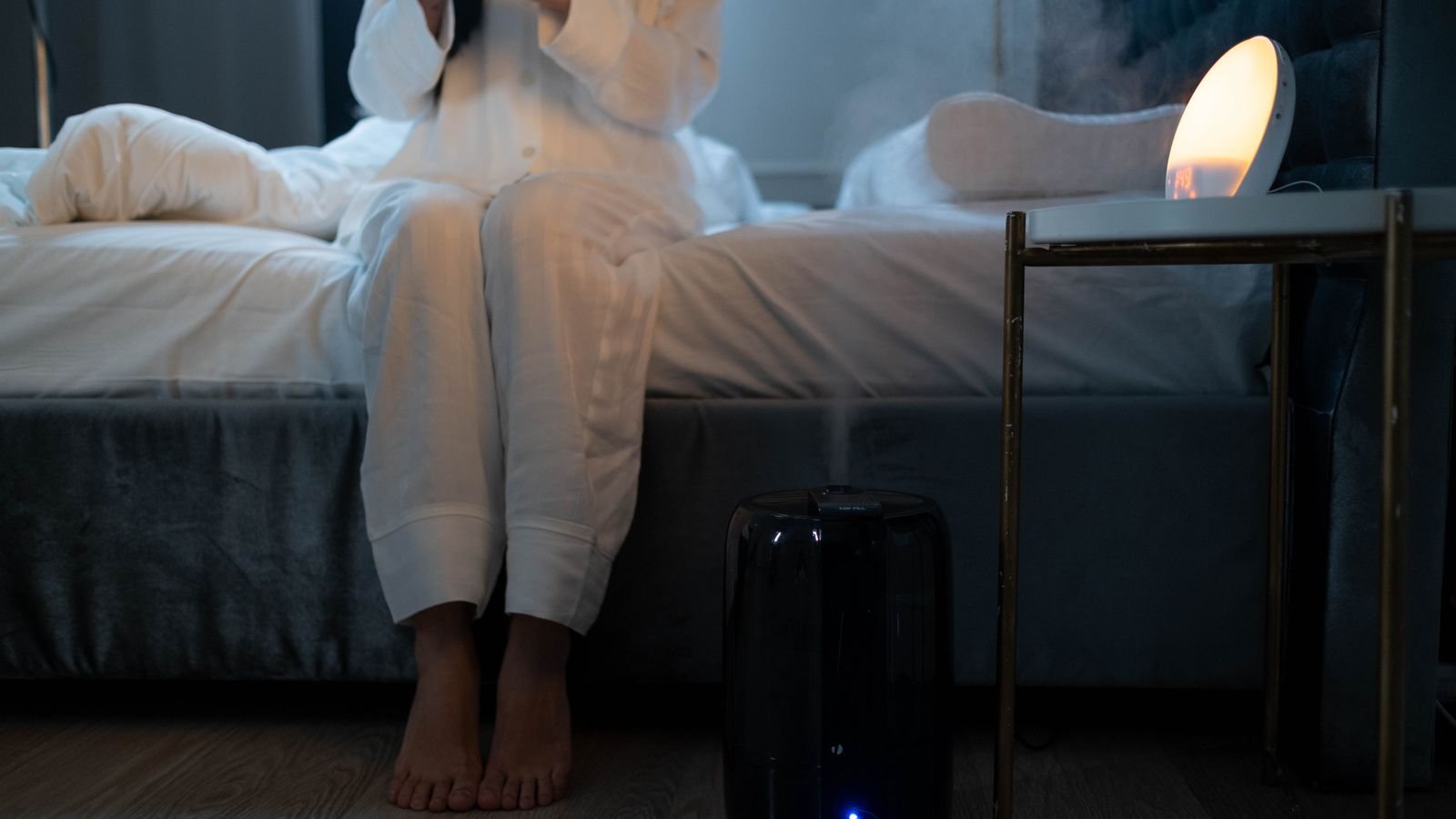
Position changes performance more than most people expect. Place the unit on a raised surface — a table or dresser — rather than the floor, so mist disperses into the room’s air rather than settling and wetting the carpet. Keep it at least a couple of feet from walls and furniture to avoid damp patches on plaster and wood.
Do not aim mist directly at a bed, a wooden floor, electronics, artwork or books. Keep the unit away from heat sources and direct sunlight, both of which confuse the humidistat. In a bedroom, a position across the room from the bed usually gives better distribution and less noise than a nightstand.
Air quality and humidity are related but separate issues, and a humidifier does not filter anything. Households running one through a long winter often pair it with an air cleaner, and our comparison of the best air purifiers for bedrooms covers models sized for the same rooms. Temperature also interacts with perceived humidity, so a well-managed heating schedule through a best programmable thermostats setup keeps the two working together rather than against each other.
Cleaning and Maintenance
This is the part that decides whether a humidifier improves your air or degrades it. A neglected tank grows biofilm and aerosolises it into the room, which is genuinely worse than dry air.
- Daily. Empty any remaining water, rinse the tank and refill with fresh water. Never top up standing water.
- Weekly. Descale with white vinegar or a citric acid solution, then disinfect with a dilute bleach solution or the manufacturer’s recommended cleaner, and rinse thoroughly.
- Every one to three months. Replace evaporative wick filters. A stiff, discoloured or crusty wick has stopped working long before it looks worn out.
- Warm mist units. Descale the heating element regularly; scale reduces output and eventually kills the element.
- End of season. Clean thoroughly, dry completely, and store with the tank open. Storing damp guarantees mould by autumn.
Using distilled or demineralised water reduces both scale and white dust dramatically, and it is the single easiest upgrade to ultrasonic performance in a hard water area.
Common Mistakes to Avoid
- Running a humidifier without measuring humidity, and pushing the room well past 60 percent.
- Topping up standing water instead of emptying and refilling.
- Placing an ultrasonic unit near electronics or polished wood, where white dust and mist do real damage.
- Buying a warm mist unit for a child’s room.
- Ignoring wick replacement, then concluding the unit “stopped working”.
- Choosing a large-output unit with a small tank and giving up on the refilling routine.
- Using tap water in an ultrasonic model in a hard water area and blaming the machine for the dust.
Frequently Asked Questions
Is warm mist better for colds and congestion?
Many people find warm vapour more soothing, and it allows the use of inhalants. In terms of actual moisture delivered to the airways, the difference is small — both types relieve dry throat and congestion effectively, so choose based on safety and running cost.
What is the white dust from my humidifier?
Dissolved minerals from tap water, aerosolised by an ultrasonic transducer and settling on surfaces. Switch to distilled water, fit a demineralisation cartridge, or move to an evaporative or warm mist model, which do not produce it.
Can I run a humidifier all night?
Yes, provided the room is monitored and stays in the 40 to 50 percent range. A model with a humidistat and an auto shut-off when the tank empties is what makes overnight running safe and unattended.
Do I need to use distilled water?
Only really necessary for ultrasonic models, where it eliminates white dust and reduces cleaning. Evaporative and warm mist units cope with tap water, though descaling is more frequent in hard water areas.
Which type is cheaper to run?
Cool mist, by a wide margin. An ultrasonic unit typically draws in the region of 20 to 40 watts, while a warm mist unit boiling water can draw several hundred. Over a winter of nightly use the difference is noticeable on a bill.
Final Thoughts
If children or pets share the room, the decision is already made: cool mist. Otherwise, choose warm mist for quiet, sterile output in a small cold bedroom, evaporative cool mist for large spaces and allergy households, and ultrasonic cool mist for near-silent running where you can supply soft or distilled water. Whichever you choose, buy one with a humidistat, size it to the room rather than the label, put it on a table away from walls, and commit to the cleaning routine. A humidifier that is emptied daily and descaled weekly is a genuine health upgrade; one left to sit half full for a month is the opposite.