Owen Bradley
 Watching a bright screen in a dark room is genuinely tiring. Your pupils keep adjusting between the picture and the black wall behind it, and after two hours your eyes let you know. TV backlighting fixes that, and along the way it makes the picture look better by giving your visual system a neutral reference point for white. The question is which approach to take: a simple LED strip stuck to the back of the panel, or a full ambient lighting kit that reads the screen and matches its colours in real time. This guide compares both honestly, including the parts the marketing leaves out.
Why Bias Lighting Works
The effect has a name and a standard behind it. Bias lighting is a modest, neutral light source placed behind a display, and the recommended reference is a colour temperature around 6500K, matching the D65 white point that video content is mastered to. When the surround is that colour, your eye treats it as white and everything on screen is judged against it correctly.
Two things follow. First, apparent contrast improves. Dark areas of the image look deeper because your eye is no longer adapting to an absolute black surround, and shadow detail becomes easier to see. Second, eye strain drops sharply because the brightness difference between the screen and its surroundings shrinks. Neither effect requires much light. Bias lighting is meant to be subtle, and running a strip at full brightness undoes both benefits.
Simple LED Strips: What You Get
A basic backlight strip is adhesive tape carrying LEDs, powered from a USB port on the television so it turns on and off with the set. It costs very little, installs in ten minutes, and delivers most of the eye-comfort benefit. The variations that matter are colour and control.
- Fixed white strips: the purist option. Choose 6500K, not warm white, if picture accuracy is the goal.
- RGB strips: single-colour-at-a-time across the whole strip. Fun for mood lighting, less useful as true bias lighting unless set to white.
- RGBIC or addressable strips: individual segments can show different colours, enabling gradients and chase effects without any screen syncing.
- Smart strips: app or voice control, scheduling, and integration with the rest of a smart home.
Build quality varies more than the price suggests. LED density, quoted per metre, determines whether you see a smooth glow or a row of dots on the wall. Adhesive quality determines whether the strip is still attached next summer. Our roundup of the best TV light strips covers both, along with the connector types that make corners easier.
Ambient Lighting Kits: What the Extra Money Buys
An ambient kit adds screen-matching. It samples what is displayed and drives an addressable strip so the light behind the panel extends the image outward: green when the scene is a forest, blue during a night sky, red during an explosion. The perceived screen size grows and immersion increases noticeably, particularly with films and games.
There are three ways kits capture the picture, and the difference matters enormously.
- Camera-based: a small camera mounted above the screen watches the picture. Works with every source, including consoles and streaming sticks, but must be calibrated and can be confused by room lighting.
- HDMI pass-through: a box sits between your sources and the television and analyses the signal directly. The most accurate and lowest-latency approach, but it must support your resolution and refresh rate or it will bottleneck the picture.
- Software-based: the source device itself computes the colours. Excellent for a computer connected to the display, useless for a set-top box.
If you compare the best LED strips for TV against full sync kits, the honest summary is that strips deliver the health and contrast benefits for a fraction of the price, while sync kits deliver an experience that strips cannot approximate.
Measuring, Placement, and Coverage
Getting the physical install right matters more than the product tier. Measure the back of the panel and buy a strip length that covers three or four sides with a little slack. Many people deliberately leave the bottom edge unlit because the stand or media unit blocks it anyway, and a three-sided run avoids an awkward cable crossing.
Position the strip roughly two inches in from the outer edge and facing the wall, not outward. Light aimed at the viewer creates glare and hot spots; light aimed at the wall reflects back as a soft, even glow. Distance from the wall matters too: a television mounted flush leaves nowhere for the light to spread and produces a hard, patchy line, while three to six inches of clearance gives a smooth halo.
Wall Colour, Room Light, and Realistic Expectations
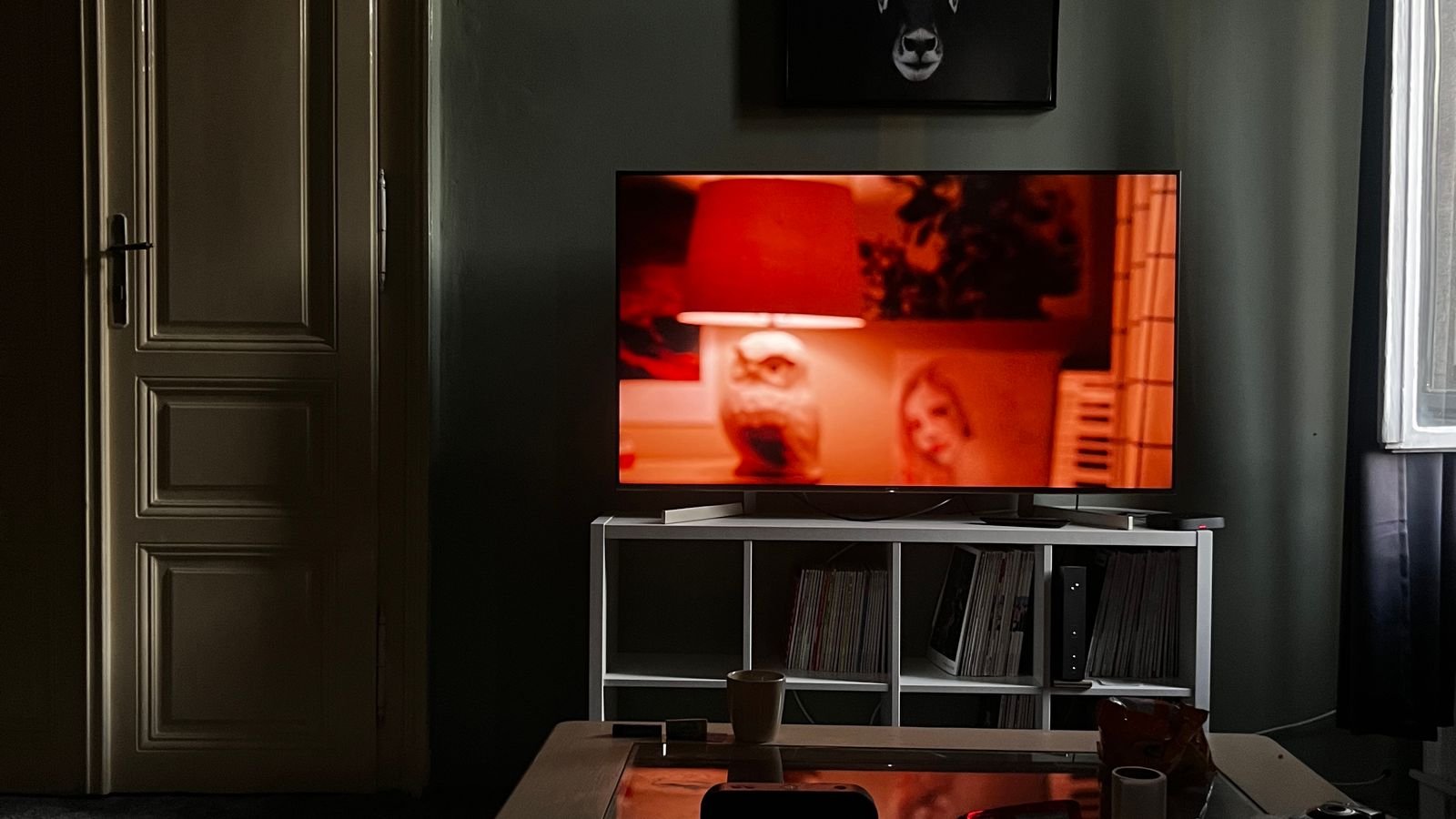
The wall behind the screen is effectively part of the product. A neutral grey or white wall reflects colours faithfully and makes a sync kit look spectacular. A strongly coloured wall tints everything, so a deep blue wall will never show warm oranges properly no matter what the strip is doing. Textured surfaces scatter light and soften the effect, sometimes pleasantly.
Ambient room lighting competes directly with the effect. Backlighting is at its best in a dim room and nearly invisible in daylight. If your viewing happens mostly during the day, a simple strip is the rational purchase, and the money saved is better spent on curtains.
Power, Wiring, and Keeping It Tidy
USB-powered strips are the easiest option because they switch with the television and add no cable to the wall. The limitation is current: a USB port typically supplies enough for a moderate run at moderate brightness, and a long, dense, full-brightness strip will exceed it, producing dimming toward the far end. Longer runs need a mains adapter, which means one more cable to route. Putting that adapter on one of the best smart plugs restores the switch-with-the-television behaviour you lose by leaving USB power.
- Clean the panel back with isopropyl alcohol before applying adhesive. Dust is why strips fall off.
- Use the supplied corner clips rather than bending the strip sharply, which cracks the copper traces inside.
- Do not cut anywhere except the marked cut lines, and expect the cut section to be unusable without a connector.
- Leave a service loop near the controller so the strip is not under tension.
- Test everything before sticking anything down. Adhesive is one-shot on most products.
Choosing Between Them: A Short Decision Path
Answer these and the choice is usually obvious.
- Is the main goal reducing eye strain? A fixed 6500K white strip does this as well as anything and costs the least.
- Do you watch mostly in a dark room? If yes, a sync kit is worth considering. If no, it will rarely be visible.
- Do you game or watch films more than news and daytime television? Sync kits shine with cinematic content and are wasted on talk shows.
- Is your wall neutral coloured? If not, a sync kit’s accuracy advantage largely disappears.
- Do you already run a smart home? A smart strip that joins existing scenes may be more useful than a standalone sync box.
For households wanting general room lighting around the media wall rather than strictly behind the panel, comparing the best lights for TV setups covers lamps and light bars as alternatives worth considering.
Common Mistakes That Ruin the Effect
- Running the strip too bright. Bias lighting should be around 10 percent of the screen’s peak brightness. Too much light creates its own glare.
- Choosing warm white. A 2700K strip tints the surround orange and actively harms colour perception.
- Aiming the LEDs at the room. This is the single most common installation error and produces visible dots instead of a glow.
- Buying a strip that is too short. Three-sided coverage looks intentional; two-sided looks unfinished.
- Ignoring HDMI specifications on sync boxes. A pass-through that cannot carry your console’s full output will silently reduce your picture quality.
- Blocking ventilation. Do not tape over the television’s cooling slots.
Frequently Asked Questions
Does TV backlighting actually reduce eye strain?
Yes. Reducing the contrast between a bright screen and a dark surround means your pupils stop constantly readjusting, which is the main cause of fatigue during long dark-room viewing.
Will a light strip damage my television?
No, provided you do not cover ventilation openings and do not exceed the USB port’s rated current. Adhesive removes cleanly from most panel backs with gentle heat.
What colour temperature should I use?
6500K, matching the D65 reference white used in video mastering. Any other setting shifts your perception of on-screen colour.
Do sync kits add input lag?
A good HDMI pass-through adds no meaningful lag to the video path. Camera-based kits add none at all, since they never touch the signal.
Can I use one strip for both bias lighting and mood lighting?
Yes. An addressable smart strip can sit at neutral white during films and switch to colour scenes at other times, which is why they are the most popular middle option.
Final Thoughts
Both approaches are legitimate, and the gap between them is about ambition rather than quality. A modest 6500K strip, mounted facing the wall, at low brightness, with a few inches of clearance, gives you the entire eye-comfort and contrast benefit for very little money. A sync kit adds spectacle that a strip cannot match, provided you have a neutral wall, a dim room, and content worth extending. Decide which of those two outcomes you are actually buying, install it properly, and resist the urge to turn the brightness up.