Owen Bradley
 Most people set a fan down where there happens to be a free outlet, point it at themselves and accept whatever comfort they get. That works, but it wastes most of what the fan can do. A fan does not cool air, it moves it, and where you place it decides whether that movement actually removes heat from the room or simply stirs the same warm air in a circle. Get the placement right and a single inexpensive fan can drop the perceived temperature of a room by several degrees and flush out accumulated heat in under an hour. Get it wrong and three fans running at full speed will leave you no more comfortable than one. The difference is entirely in the geometry.
The Two Jobs a Fan Can Do
Every fan placement strategy serves one of two purposes, and confusing them is the root of most disappointment. The first job is personal cooling: blowing air across your skin so sweat evaporates faster. This makes you feel cooler immediately but does nothing at all to the room, which is why running a fan in an empty room is pure waste.
The second job is heat removal: physically exchanging hot indoor air for cooler outdoor air, or breaking up the layers of hot air that collect near the ceiling. This genuinely lowers room temperature but only works when the air you are pulling in is cooler than the air you are pushing out. Decide which job you need before you decide where the fan goes, because the optimal placement for each is almost the opposite of the other.
Read the Room Before You Move Anything
- Check indoor versus outdoor temperature. Exhaust and cross-flow strategies only pay off once outside air is genuinely cooler, which in summer usually means after sunset. Before that, keep windows shut.
- Find your openings. Note which windows and doors are on opposite or adjacent walls, and which side of the house is shaded.
- Identify the hot side. A west-facing wall that has baked all afternoon is where heat is entering, so that is where you want to be pushing air out, not drawing it in.
- Look for the ceiling heat layer. Stand on a chair. If the air near the ceiling is noticeably warmer, you have stratification that a tall or upward-angled fan can break up.
- Count your fans honestly. Two fans used as a pair almost always beat three fans pointed randomly.
Step-by-Step: Positioning Fans for Fast Cooling
- Set up a cross-flow path first. Open a window on the cool, shaded side of the room and another on the opposite or an adjacent wall. Air needs both an entry and an exit, and a single open window with a fan in front of it achieves very little. The straighter and less obstructed the path between the two openings, the faster the exchange.
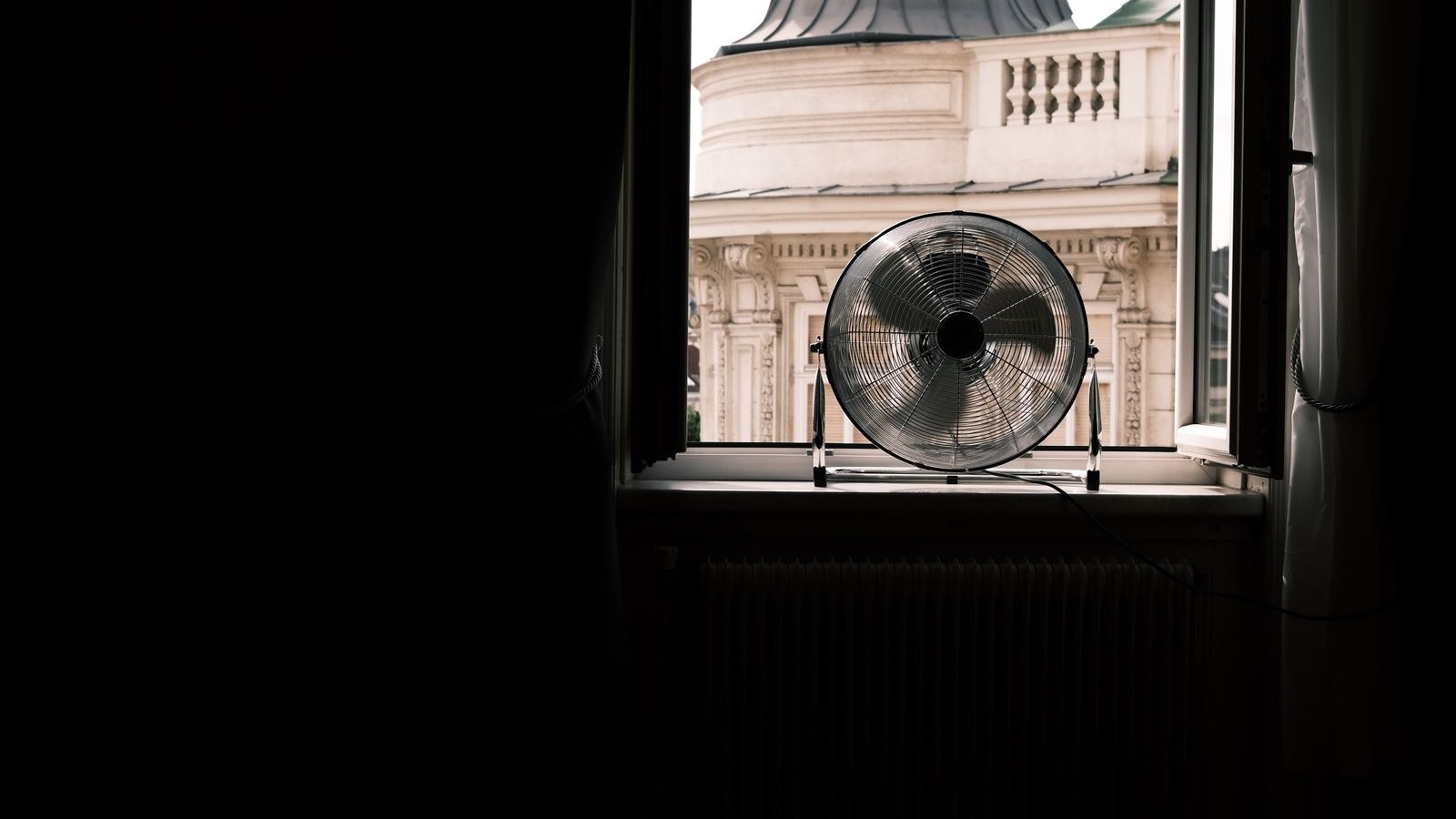
- Put the fan in the window on the hot side, facing outward. This is the key move and the one most people get backwards. A box fan mounted in the window and blowing outward creates negative pressure in the room, which drags cooler air in through the other opening far more effectively than a fan blowing inward pushes it. Exhausting beats supplying because the fan’s outflow is a focused jet while its intake pulls from a wide area.
- Seal around the fan in the window. Stuff a towel or a piece of cardboard into the gaps beside and above the fan. Without a seal, the fan simply recirculates the air it just expelled straight back through the gap, and you lose most of the pressure difference you were trying to create.
- Add a second fan at the inlet, aimed into the room. If you have two, place the second fan at the cool-side window facing inward and slightly upward. Now you have a push-pull pair that establishes a strong, directional current through the entire space rather than a swirl near one wall.
- Angle intake air upward, not straight ahead. Air entering the room should be directed toward the ceiling so it mixes with the hot layer collected there and sweeps it toward the exhaust. Blowing incoming air straight across the floor leaves the hottest air in the room untouched.
- Use a doorway fan for interior rooms. If the room has only one window, put the exhaust fan in that window and place a second fan in the doorway blowing into the room from the cooler hallway. The hall then becomes your inlet.
- Create a whole-house draft on cool evenings. Open windows on the lowest and coolest side of the house, put an exhaust fan in an upstairs window on the warm side, and let the natural stack effect work with the fan rather than against it. Hot air already wants to leave through the highest opening, so help it.
- Set ceiling fans to turn counterclockwise in summer. Viewed from below, the blades should push air straight down to create a cooling breeze on occupants. The reverse, clockwise setting is for winter, where it gently pulls air up and redistributes warm ceiling air without a draft.
- Position a personal fan across your body, not at your face. For sleeping or desk work, place the fan to one side at roughly torso height and let it sweep across you, ideally on oscillation. Direct blasting at the face all night dries out eyes and sinuses and is the usual reason people wake with a sore throat.
- Pair a fan with an air conditioner rather than choosing between them. A fan placed to move the AC’s cold output away from the unit and into the far corners of the room lets you raise the thermostat several degrees for the same comfort, which is where the real energy saving comes from.
- Give every fan room to breathe. Keep the intake at least a foot clear of walls, curtains and furniture. A restricted intake cuts airflow sharply and creates turbulence noise that makes the fan sound like it is working harder than it is.
Placement Patterns for Common Rooms
In a bedroom with two windows, run the push-pull pair overnight with the exhaust on the warmer side, then close everything at dawn to trap the cool air you gained. In a bedroom with one window, exhaust through the window and pull from the hallway through a doorway fan. In a living room or open-plan space, an oscillating fan placed in a corner sweeping diagonally across the room covers more area than a fan set against the middle of a wall.
For a kitchen, run the range hood alongside your window fan. In a home office, a small fan aimed across the desk at torso height beats a large fan trying to cool the whole room. In an attic-adjacent upstairs room, prioritise exhaust over circulation, because the ceiling is a continuous heat source.
Safety Considerations
Window fans need to be secure. A fan resting loosely on a sill can be knocked out of an upper-floor window, so use the expandable side panels or brackets and close the window down onto the frame. Do not run a fan in a window during rain, and unplug it if a storm is expected, since water reaching the motor is both a shock and a fire risk.
Keep cords out of walkways rather than under rugs, where wear goes unnoticed until insulation fails. Plug fans directly into wall outlets where possible. Remember too that in extreme heat above roughly 95F a fan blowing hot air on skin can increase heat stress instead of relieving it, and at those temperatures air conditioning or leaving the space is the correct response.
Troubleshooting a Setup That Is Not Working
If airflow feels weak despite a good layout, the usual culprit is a missing second opening. If the room feels breezy but stays hot, you are recirculating rather than exchanging, which normally means outdoor air is not actually cooler yet or the fan is blowing inward on the hot side. If one part of the room stays warm, check for a furniture blockage or a closed interior door. If the fan is loud but ineffective, move it away from the wall, because most fan noise comes from a restricted intake.
Common Mistakes
- Blowing air into the room from the hot side. This imports heat. Exhaust on the hot side, intake on the cool side.
- Opening only one window. Without an exit path, a fan just churns the same air.
- Leaving fans running in empty rooms. They cool people, not spaces, and the motor adds a little heat.
- Ventilating during the day. Before evening, outdoor air is usually hotter than indoor air.
- Leaving the ceiling fan on the winter direction. The clockwise setting produces almost no cooling breeze.
- Pushing the fan against a wall to save floor space. A choked intake costs both airflow and quiet.
Choosing the Right Fan for the Job
Placement gets you most of the way, but format matters too. Box and window fans are the best exhaust tools because they sit flat in a frame and move high volume at low pressure. Pedestal and tower fans are better at personal cooling and room circulation because they deliver air at body height. If you are building a setup from scratch, the roundup of the best house fans for cooling covers whole-home options, while the best air cooling fans and the best cooling fans for rooms compare models by airflow and noise for single spaces. Where floor space is tight, the slim profile of the best tower fans suits bedrooms and offices well. And if the room has no ducted supply at all, the guide to cooling a room without central air explains when fans stop being enough.
Frequently Asked Questions
Should a window fan face in or out?
Out, on the warmer side of the room, with another window open elsewhere for intake. Exhausting creates a stronger pressure difference than blowing inward and pulls cool air through the whole space.
Does a fan actually lower room temperature?
Only when it exchanges indoor air for cooler outdoor air. Otherwise it creates a wind-chill effect on skin that feels several degrees cooler without changing the thermometer reading.
Which way should a ceiling fan turn in summer?
Counterclockwise when viewed from below, so the blades push air downward and create a breeze you can feel. Reverse it to clockwise in winter to redistribute warm ceiling air gently.
Is it better to use one big fan or two smaller ones?
Two smaller fans set up as a push-pull pair usually beat one large fan, because the pair establishes a directional current through the room instead of a local swirl.
Final Thoughts
Fan placement is about creating a path, not creating wind. Decide whether you want personal cooling or genuine heat removal, then build the layout around that choice. For heat removal, wait until outdoor air is cooler, open two windows on opposite sides, exhaust from the hot side with the gaps sealed, and angle intake air upward toward the ceiling layer. For personal cooling, put the fan across your body at torso height and use oscillation. Do that and you will get far more comfort out of the fans you already own.