Owen Bradley
 Plenty of homes have at least one room with no ceiling fixture at all. Older houses and most apartments simply never got one, leaving you with a bare wall switch that controls half an outlet and a room that goes gloomy the moment the sun drops. The instinct is to buy one very bright lamp and call it done, which is exactly why so many of these rooms end up with a glaring hot spot in one corner and darkness everywhere else. The real fix is a layered plan: several modest light sources at different heights, most of them bouncing light off the ceiling, all controlled conveniently enough that you actually use them. Here is how to do it.

What You Will Need
- A torchiere or uplight floor lamp to replace the missing ceiling fixture.
- Two or three secondary lamps: table lamps, a reading floor lamp, or a wall-mounted plug-in sconce.
- LED bulbs in a consistent color temperature across every fixture.
- Extension cords or flat cord covers rated for the load, plus cord clips to keep runs tidy.
- Smart plugs or a remote outlet switch if the wall switch does not control an outlet.
- Tape measure for testing positions before committing.
First, Check for a Switched Outlet
Before buying anything, find out whether the room already has a half-hot outlet. In many rooms without a ceiling fixture, one receptacle, usually the top half of one outlet, is wired to the wall switch specifically so a lamp can act as the room light.
To check, flip the wall switch on, then plug a lamp into each half of every outlet in the room and see which one responds to the switch. If you find one, that outlet becomes the anchor for your main lamp, and you get proper switch-at-the-door control for free.
If nothing is switched, do not run new wiring. A smart plug paired with a wireless wall button mounted next to the existing switch achieves the same thing in five minutes and comes with you when you move.
Understand the Three Layers
A ceiling fixture provides ambient light, and its absence is why the room feels wrong. Replacing that one function is only a third of the job.
Ambient is the general fill that raises the whole room to a comfortable level. Without a ceiling fixture, you create it by bouncing light off the ceiling with a torchiere or uplight. Task is focused light for reading, working, or cooking, placed close to the activity. Accent is the low-level light that adds depth: a table lamp on a console, a small lamp behind a plant, a picture light on the wall.
A room that feels genuinely well lit almost always has at least three separate sources. One giant lamp cannot produce ambient, task, and accent light at the same time, which is precisely the trap most people fall into.
Step-by-Step: Lighting the Room
- Map the room and its uses. Sketch the furniture and mark what actually happens where: a reading chair, a desk, a sofa for watching TV, a dining table. Each activity is a light you will need.
- Identify every available outlet. Note the location of each receptacle and which, if any, is switched. Outlet positions will constrain your lamp placement more than aesthetics will.
- Place the ambient source first. Put a torchiere in the corner diagonally opposite the doorway, where it lights the largest share of the room. Uplight bouncing off a white ceiling reads remarkably like a real ceiling fixture and produces almost no glare.
- Work out total brightness. Aim for roughly 20 lumens per square foot in a living room and 30 to 40 in a room used for reading or work. A 12 by 14 foot living room needs about 3,400 lumens, split across sources rather than crammed into one.
- Distribute that total across fixtures. Give the torchiere the largest share, around half, then split the rest between two or three smaller lamps. Several 800-lumen sources beat one 3,000-lumen source every time.
- Add task lighting where people actually sit. Put a lamp beside the reading chair with the shade bottom at roughly eye level when seated, so light falls on the page and not into your eyes.
- Fill the corners. A dark corner makes an entire room read as dim regardless of how bright the center is. A small table lamp, an uplight behind a plant, or a floor lamp on a low setting fixes it cheaply.
- Standardize your bulbs. Use the same color temperature throughout: 2700K for a warm, relaxed living room or bedroom, 3000K to 4000K for a home office or craft space. Mixed temperatures are what make a room look accidental.
- Solve the switching. Put the ambient lamp on the switched outlet if one exists. If not, add smart plugs and either a wireless wall button by the door or a simple voice or app routine so the whole set turns on together.
- Manage the cords. Run cords along the baseboard with clips, or use a flat cord cover under a rug for anything crossing a walkway. Never run a cord under a rug without a proper cover, and match extension cord ratings to the load.
- Live with it for a week, then adjust. Sit in each spot in the evening and note where you still squint or where a lamp glares. Moving a lamp two feet is often the difference between adequate and excellent.
Why Torchieres Do the Heavy Lifting
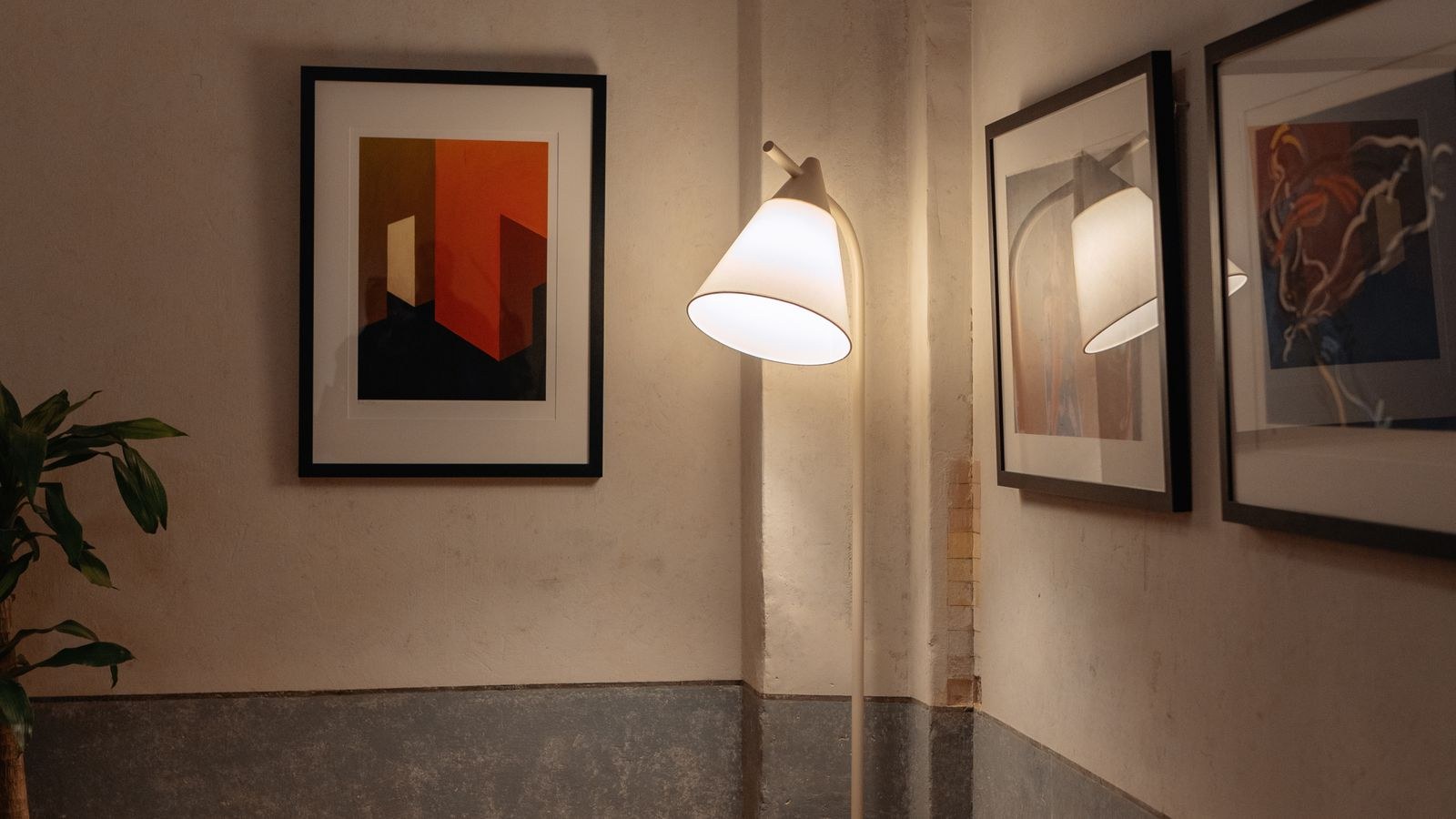
A torchiere aims its output at the ceiling, turning the entire ceiling into a large, soft, diffuse light source. That is fundamentally what a ceiling fixture does, which is why a torchiere replaces one so convincingly. Because you never see the bulb directly, glare stays low even at high output.
Two conditions make or break it. The ceiling should be white or near-white, since a dark ceiling absorbs the light instead of returning it. And the ceiling should be reasonably low, ideally under 10 feet, so the bounced light comes back down at usable intensity.
Look for a model with a dimmer, since ambient light is the layer you most want to vary between a bright afternoon and a quiet evening. Our roundup of the best torchiere floor lamps compares output and dimming across the common styles, and the broader floor lamps to light up a room guide covers arc, tree, and multi-head designs that spread light in more than one direction.
Placement Rules That Make the Difference
Corners beat centers. A lamp in a corner lights two walls and reaches most of the room. The same lamp against the middle of a wall lights one wall and wastes half its output.
Spread the sources. Distribute lamps around the perimeter rather than clustering them. Three lamps in a triangle light a room evenly; three lamps on one side create a bright half and a dark half.
Vary the heights. A floor lamp, a table lamp, and something at wall height together give a room depth. Everything at one height looks flat and institutional.
Aim at surfaces, not at space. Light bouncing off a wall, ceiling, or bookcase fills a room. Light shot into open air just travels until it hits something and mostly disappears.
Keep bulbs out of sight lines. From your usual seat, you should see lit surfaces, not exposed bulbs. If a filament is visible from the sofa, either add a shade or move the lamp.
Wall and Ceiling Color Matter More Than You Think
A room with white walls and a white ceiling can feel twice as bright as an identical room in a deep color with exactly the same lamps. Bounced light is free light, and dark surfaces throw it away.
You do not have to repaint. A large mirror opposite your main lamp effectively doubles that source, and light curtains, a pale rug, and a light bookcase all reflect rather than absorb.
Troubleshooting
- The room is bright but still feels dim: the corners are dark. Add a low-cost lamp to each unlit corner before adding brightness anywhere else.
- Glare from a lamp: the bulb is visible from your seat. Add a shade, raise the fixture, or aim it at a wall.
- Harsh shadows on faces: a single strong source is doing all the work. Add a second, softer source from another direction.
- The lighting looks mismatched: bulbs of different color temperatures. Replace them all with a single Kelvin rating.
- Nothing turns on at the door: no switched outlet. Add smart plugs and a wireless wall button beside the existing switch.
- Cords everywhere: reposition lamps toward outlets, use cord covers along baseboards, and consider a battery or rechargeable lamp for a spot with no nearby receptacle.
Mistakes to Avoid
The single biggest is buying one very bright lamp instead of several moderate ones. It creates a hot spot and leaves the room feeling worse, not better. The second is putting every lamp against walls at the same height, which flattens the space. The third is mixing warm and cool bulbs across a room, which reads as sloppy even to people who cannot say why. Finally, ignoring the switching problem means a beautifully lit room that nobody bothers to turn on, because reaching four separate lamp switches in the dark is genuinely annoying. If you want a shortcut to fixture selection, our guides to the best lamps to light up a room and to lighting for dark rooms group models by the coverage they realistically deliver.
Frequently Asked Questions
How many lamps does a room with no overhead light need?
Three at minimum: one ambient uplight, one task lamp where you read or work, and one accent lamp to fill a dark corner. Larger rooms usually want four or five.
How many lumens should I aim for?
Roughly 20 lumens per square foot for a living room and 30 to 40 for a workspace or reading room, split across multiple fixtures rather than concentrated in one.
Can I add a ceiling light without wiring?
Not a true hardwired one, but you can get very close. A torchiere bouncing light off a white ceiling produces a comparable ambient effect, and a plug-in pendant hung from a ceiling hook with the cord run to a wall outlet is another renter-friendly option.
What color temperature should I use?
2700K for living rooms and bedrooms, 3000K to 4000K for offices and craft spaces. The important part is using the same rating in every fixture in the room.
How do I control all the lamps at once?
Put each lamp on a smart plug and group them, then add a wireless wall button next to your existing switch. It gives you a single control at the door with no wiring and no landlord conversation.
Final Thoughts
A room with no overhead light is not a problem to solve with brightness, it is a problem to solve with distribution. Check for a switched outlet first, then place a dimmable torchiere in a corner to bounce ambient light off the ceiling, add task lighting where people actually sit, and fill every dark corner with something small. Keep the bulb color consistent, aim light at surfaces rather than into open space, and set up one control that turns the whole scheme on from the doorway. Done that way, the room reads as deliberately lit rather than as one that is missing something.