Owen Bradley
 The bathroom vanity is the one place in a home where lighting has a job beyond looking nice. You shave there, apply makeup there, check whether a mole has changed shape there. Get the bulb wrong and the mirror lies to you — foundation that looked seamless at the sink turns orange in daylight, or a cool blue-white bulb makes everyone in the household look faintly unwell. Vanity lighting is also uniquely unforgiving because the fixtures are often small, enclosed, and exposed to steam. This guide covers picking the right bulb for a vanity fixture on the numbers that matter, and installing or replacing it safely without cracking a shade or stripping a socket.
The Four Numbers That Decide a Vanity Bulb
Ignore packaging adjectives and read the Lighting Facts panel for these four figures.
- Colour rendering index (CRI). The most important spec for a vanity and the one most people never check. CRI measures how faithfully a light source reveals colour compared to natural daylight, on a scale to 100. Cheap bulbs sit around 80, which flattens skin tones and makes reds look muddy. For a mirror you want CRI 90 or higher, and 95+ if you do detailed makeup work.
- Colour temperature. Between 3000K and 4000K is the sweet spot. Below 2700K everything skews yellow and makeup gets over-applied to compensate. Above 5000K the light turns clinical and blue, exaggerating shadows and blemishes. Around 3500K is the most broadly flattering and still accurate.
- Lumens. Aim for a total of roughly 1600 to 2400 lumens across the whole vanity area. For a fixture holding three bulbs, that is around 500 to 800 lumens each — the equivalent of an old 40 to 60 watt incandescent.
- Damp rating. Bathrooms are humid. A bulb rated for damp locations resists the moisture that shortens the life of standard bulbs in a steamy room.
Why Placement Matters as Much as the Bulb
Even a perfect bulb produces bad results in the wrong position. A single fixture mounted above the mirror throws light downward, casting shadows into the eye sockets, under the nose and beneath the chin — the classic unflattering bathroom look that no bulb can fix.
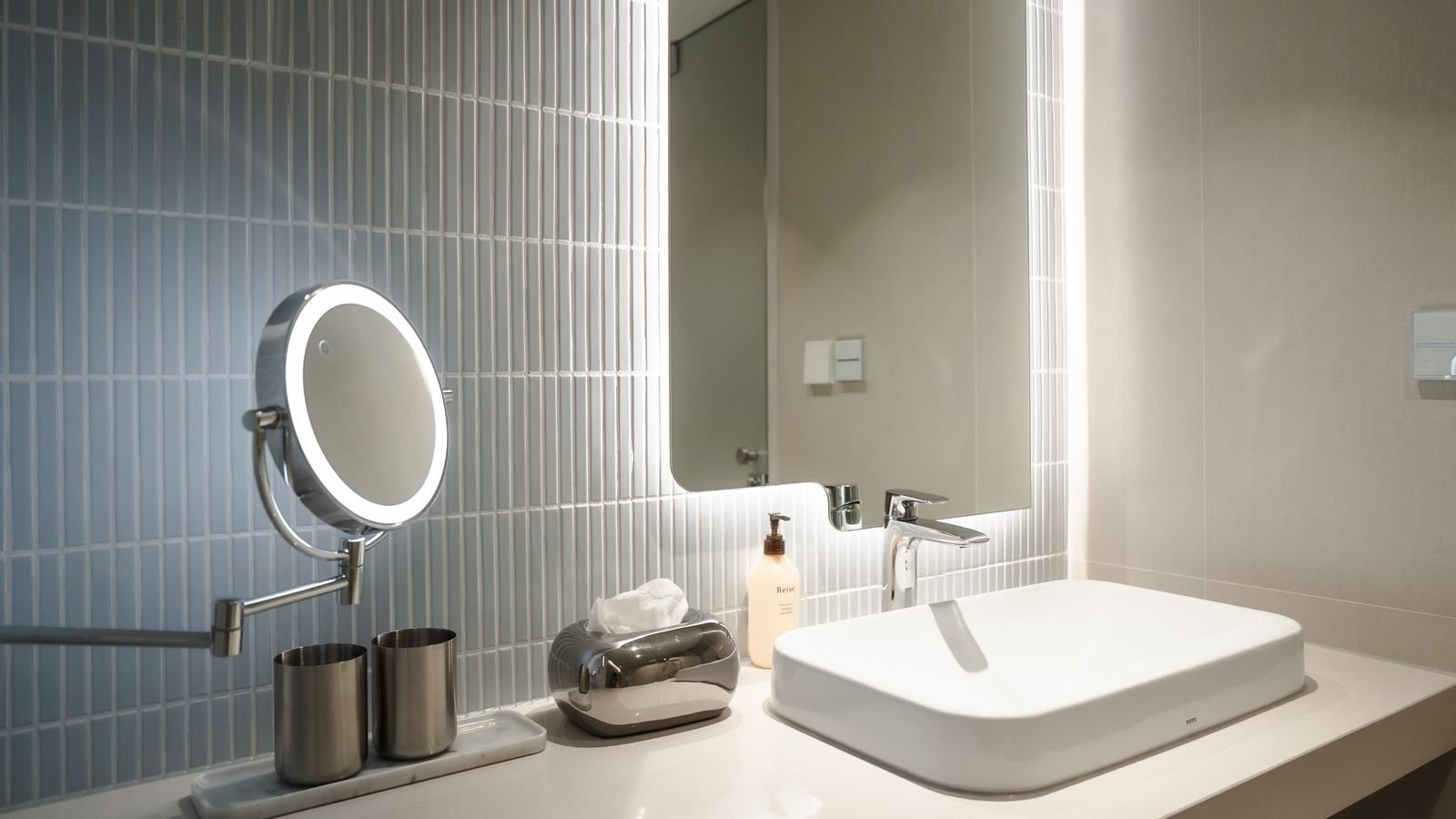
The professionally recommended arrangement is cross-illumination: light sources on either side of the mirror at roughly eye level, around 60 to 66 inches from the floor and about 36 to 40 inches apart. Light arriving from both sides fills in facial shadows evenly. If side sconces are not possible, a wide horizontal fixture above the mirror with a diffusing shade is the next best option, because the diffuser softens the downward shadows considerably.
Whatever the fixture, choose frosted or opal bulbs rather than clear ones. A clear bulb puts a bright filament or diode array directly in your field of view, producing glare and harsh shadow edges. Frosted glass spreads the source and softens everything.
Choosing the Right Bulb Type
Vanity fixtures use a few common shapes, and the shape affects both fit and appearance.
- G25 globe bulbs — the round bulbs used in Hollywood-style bar fixtures and exposed strip lights. Choose frosted, and match the finish across all sockets.
- A19 standard bulbs — the everyday pear shape, used in enclosed vanity fixtures with a shade covering the bulb.
- B11 or candelabra bulbs — small decorative bulbs with an E12 base, common in period-style fixtures and sconces.
- T-shaped or tubular bulbs — used in narrow linear fixtures where an A19 will not physically fit.
Check whether your fixture is fully enclosed. LEDs generate heat at the base, and a sealed glass shade traps it, which is the leading cause of premature LED failure in bathrooms. If the shade encloses the bulb completely, buy one explicitly marked “enclosed fixture rated.” Where you want a matched set across a multi-socket vanity bar, a comparison of the best light bulbs for bathroom vanity makes it easier to find bulbs sold in packs with consistent CRI and colour temperature.
What You Will Need
- Replacement bulbs — buy the full set at once, from the same batch, so colour temperature matches exactly.
- A non-contact voltage tester.
- A screwdriver for shade retaining screws.
- A clean dry cloth or cotton gloves — skin oils on a bulb envelope create hot spots.
- A step stool if the fixture is above a wide vanity you cannot comfortably reach across.
- A towel laid over the sink to catch a dropped bulb or screw.
Step-by-Step Installation
- Switch off the light and let the bulbs cool. Old incandescent or halogen bulbs stay hot enough to burn for several minutes. For anything beyond a straight bulb swap, cut the circuit at the breaker.
- Verify the power is off. Hold a non-contact voltage tester near the fixture. If you are only replacing a bulb with the switch off, that is generally sufficient, but confirm at the breaker before touching wiring.
- Lay a towel across the sink and vanity top. A dropped bulb on a porcelain basin shatters instantly and chips the basin. Two seconds of preparation avoids a genuinely annoying cleanup.
- Remove the shade or globe. Most unscrew from a threaded collar or are held by two or three small thumbscrews. Support the shade with one hand while loosening — the last screw releases it entirely.
- Remove the old bulb. Grip the base rather than the glass envelope and turn counter-clockwise. If it resists, do not force it — see the troubleshooting section below.
- Check the socket. Look inside for corrosion, a blackened contact, or a brass tab pressed flat against the base. A flattened tab is a common cause of a bulb that will not light. With power off, gently lift the tab a few millimetres with a wooden or plastic tool.
- Install the new bulb. Handle it by the base or with a cloth. Thread it in by hand until it seats, then give it a gentle snug turn. Over-tightening can crack the base and damage the socket threads.
- Replace all bulbs in the fixture at once. Mixed bulbs of different ages, brands, or colour temperatures give a vanity an uneven, patchy look that is immediately visible in the mirror.
- Refit the shade. Tighten retaining screws only until they hold — over-tightening cracks glass shades, and a hairline crack in a humid bathroom will spread.
- Restore power and check the result in the mirror. Stand where you actually use the mirror and look for shadows under the eyes and chin, glare from any exposed diode, and whether skin tone looks natural.
Troubleshooting Common Problems
- The bulb will not unscrew. Humidity plus heat can corrode a base into the socket. With power off, wear a glove and try steady pressure rather than force. A wide rubber band between palm and bulb adds grip. If the glass separates from the base, cut power at the breaker and use pliers on the remaining metal shell.
- New bulb does not light. Check that it is fully seated, then inspect the socket’s centre contact tab. Test the bulb in a known-good lamp to isolate whether the bulb or the fixture is at fault.
- LEDs failing quickly. Almost always heat from an enclosed shade, or moisture. Switch to enclosed-rated, damp-rated bulbs.
- Flickering. Usually a dimmer incompatible with LEDs, or a loose bulb. Confirm the bulbs are dimmable if the fixture is on a dimmer.
- Buzzing. Common with LEDs on an old leading-edge dimmer designed for incandescent loads. An LED-compatible dimmer resolves it.
- Uneven colour across the bar. Mixed batches or brands. Replace all bulbs with a single matched set.
Frequently Asked Questions
What colour temperature is most flattering at a vanity?
Around 3000K to 3500K. It is warm enough to be pleasant, neutral enough that makeup applied under it still reads correctly in daylight.
Does CRI really matter for a bathroom?
More than anywhere else in the house. A low-CRI bulb misrepresents skin tone, which is the exact thing you are trying to judge at a mirror. CRI 90 or above is worth paying for.
How many lumens do I need above a vanity?
Roughly 1600 to 2400 lumens total across the vanity area. Divide by the number of sockets to get the per-bulb figure.
Can I use standard LED bulbs in a bathroom?
Yes, provided the fixture is not in the direct shower spray zone. Look for a damp-location rating, and an enclosed-fixture rating if the shade seals around the bulb.
Why do my vanity bulbs keep burning out?
The usual causes are heat trapped in an enclosed shade, moisture in a poorly ventilated bathroom, or vibration from a door slamming against the wall. Improve extraction, fit enclosed-rated bulbs, and check that the fixture is firmly mounted.
Final Thoughts
A bathroom vanity bulb is judged by a single test: does the mirror tell you the truth? Choose CRI 90 or higher at 3000K to 3500K, aim for 1600 to 2400 lumens across the vanity, pick a frosted envelope to kill glare, and make sure the bulb is damp-rated and, if the shade encloses it, enclosed-rated too. Install with the power off and a towel over the sink, replace every bulb in the fixture at the same time from the same batch, and hand-tighten rather than forcing. Ten minutes and one matched set of bulbs will do more for how the room works every morning than any amount of new tile.