Owen Bradley
 Eye strain rarely announces itself. It shows up as a dull ache behind the brows around hour four, a habit of rubbing your eyes at the end of a workday, or the vague sense that your desk is fine but you would rather work somewhere else. More often than not the culprit is the light. A ceiling fixture eight feet overhead cannot deliver enough usable illumination to a page or a keyboard, and a laptop screen surrounded by darkness forces your pupils into constant adjustment. A good desk lamp fixes all of that for less than the cost of a mechanical keyboard. This desk lamp buying guide explains the specs that actually determine comfort, from lumens and CRI to arm reach and glare control, and shows how to position a lamp so long sessions stop hurting. If you are upgrading a workspace in 2026, this is the cheapest meaningful improvement on the list.
Lumens: How Much Light a Desk Actually Needs
Brightness is measured in lumens, not watts. Watts tell you how much energy a bulb consumes; lumens tell you how much light it emits. An LED can produce 800 lumens on 9 watts, so any spec sheet that leads with wattage is either dated or hiding something.
For a desk lamp, the useful range is 400 to 1000 lumens. Around 400 to 600 lumens suits a workspace that already has decent ambient room light and only needs a supplementary pool. Between 600 and 800 lumens is the general sweet spot for reading, writing and screen work in a normally lit room. Push toward 800 to 1000 lumens when the surrounding room is dim, when you do detailed work such as drafting or soldering, or when older eyes need more light to resolve fine print.
Beyond about 1200 lumens on a desk you start creating a contrast problem rather than solving one. A blazing pool of light next to a dim room forces your eyes to keep re-adapting, which is precisely the fatigue you are trying to avoid. The goal is a desk that is comfortably brighter than the room, not one that looks like an interrogation.
Color Temperature: Warm, Neutral or Cool
Color temperature, measured in kelvin, controls whether the light feels cozy or clinical. Lower numbers are warmer and more orange; higher numbers are cooler and bluer.
- 2700K to 3000K (warm). Relaxing and easy on the eyes. Best for evening reading, journaling and any desk that lives in a bedroom.
- 3500K to 4000K (neutral). The most versatile band for general office work. Crisp enough to feel alert without the harshness of daylight white.
- 5000K to 6500K (cool daylight). Maximum perceived sharpness, useful for color-critical work, technical drawing and daytime focus. Fatiguing over long periods and disruptive close to bedtime.
Many quality lamps offer tunable white, letting you shift across that range with a button. That flexibility is genuinely useful if the same desk hosts morning spreadsheets and late-evening reading, because dropping to a warm setting after dark reduces the blue-light exposure that pushes back sleep onset. If you are matching bulbs across a whole room rather than a single fixture, our guide to the best light bulbs for home office spaces covers how to keep color temperature consistent across ceiling, floor and desk sources.
CRI: The Spec Most Shoppers Skip
The Color Rendering Index scores how faithfully a light source reveals colors compared with natural daylight, on a scale to 100. A cheap LED at CRI 70 makes reds look muddy, skin look grey and printed material look flat. At CRI 90 and above, colors and contrast look correct and text edges appear crisper.
For general typing and reading, CRI 80 is acceptable. For anything involving color judgment, including design work, photo editing, painting, makeup, sewing or model building, insist on CRI 90 or higher. Some manufacturers publish an R9 value alongside CRI, which specifically measures deep red rendering; a positive R9 above 50 is a strong sign of a genuinely good LED. Reputable brands publish these numbers, and the ones that do not usually have a reason.
Flicker and Glare: The Invisible Comfort Specs
Cheap LED drivers pulse at line frequency, producing flicker that most people cannot consciously see but that measurably contributes to headaches and eye fatigue over hours. Look for language such as flicker-free, DC-driven or low-ripple output. A rough field test: point a phone camera at the lit lamp and look for rolling bands on the screen. Heavy banding means heavy flicker.
Glare comes in two forms. Direct glare happens when you can see the emitter itself from your seated position, which a good lamp prevents with a recessed diffuser, a shade lip or an angled head. Reflected glare bounces off a glossy monitor, a laminated desk or a laptop lid and lands in your eyes. The fix is placement rather than product: aim the light across the work surface from the side rather than down onto a screen, and tilt the head so no reflection path leads back to your seat.
Arms, Reach and Adjustability
The mechanical design of a lamp determines whether you will actually position it well or just leave it wherever it landed on day one.
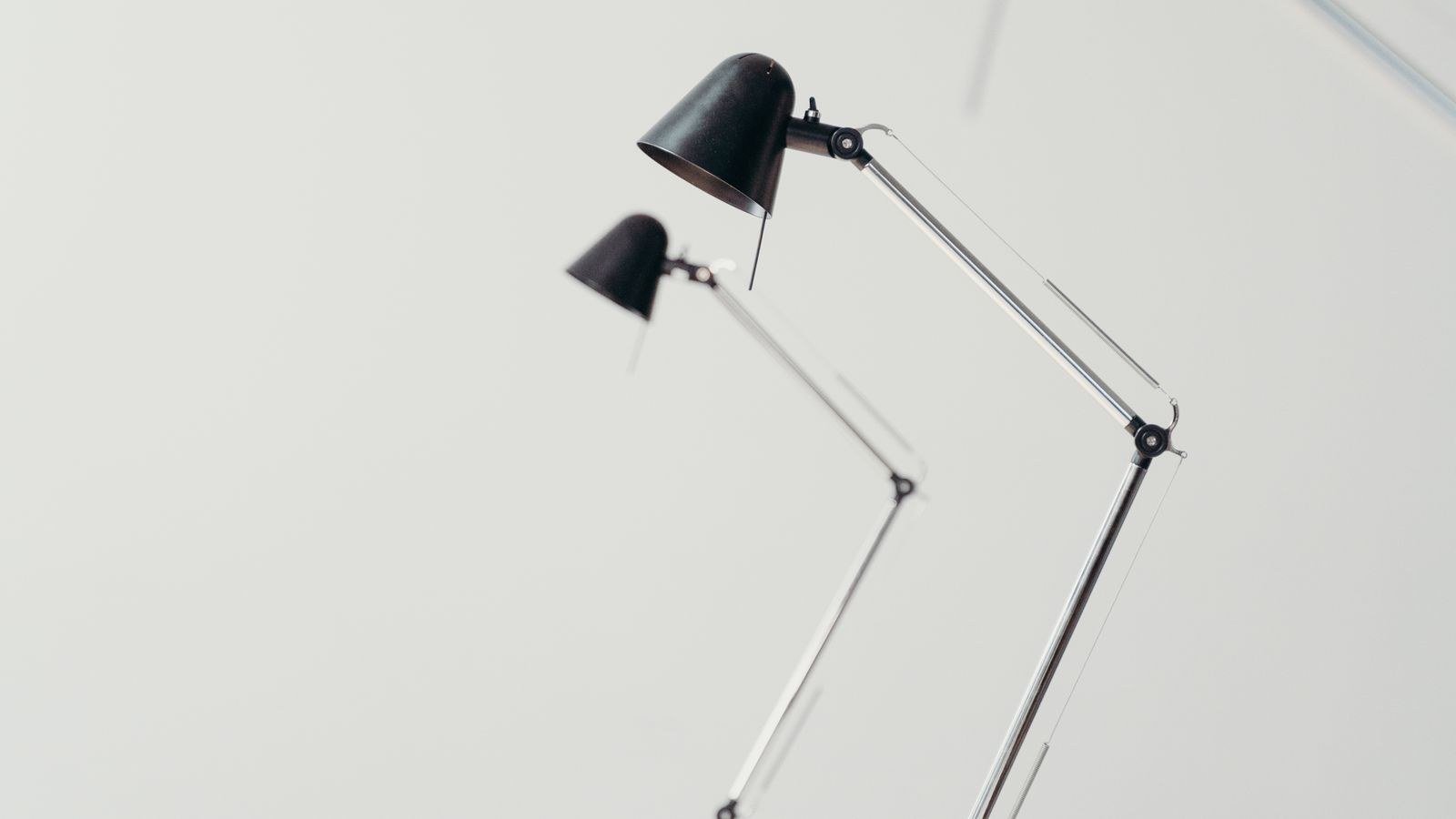
- Spring-balanced articulating arms are the classic architect style. They hold position anywhere in a wide envelope and move with one hand. The best choice for anyone who reconfigures a desk often.
- Gooseneck arms bend freely and cost less, but they sag over time and cannot support a heavy head.
- Fixed-angle bar lamps mount a long LED strip on a rigid post. They deliver superb even coverage across a wide desk with almost no glare, but you cannot bring the head down close to a book.
- Clamp-mount lamps free the entire desktop and give the highest reach for the footprint. Check the clamp opening against your desk thickness before buying.
Reach is the number that matters most on a deep desk. Measure from where the base or clamp will sit to the far edge of your work area. A lamp with 18 inches of reach cannot light the far side of a 30-inch-deep surface. Vertical range matters too: the head should be able to sit 15 to 20 inches above the desktop, which is where lux and glare control balance best.
Controls, Power and Extras
Stepless dimming is worth paying for. Three-step dimming always seems to offer one setting slightly too bright and one slightly too dim. Touch sliders and physical dials both work; what matters is that the lamp remembers your last setting when you switch it on rather than defaulting to maximum.
Useful extras, roughly in order of real value:
- Memory function that restores your preferred brightness and color temperature.
- USB-A or USB-C charging port in the base, which removes one wall wart from the desk.
- Ambient light sensor that nudges output as daylight changes through the day.
- Timer or pomodoro modes, genuinely handy for some people and ignored by most.
- Rechargeable battery, which matters only if the lamp needs to travel between rooms.
Check the base footprint against your available space. A weighted round base 7 to 9 inches across is stable but eats real estate; a clamp or grommet mount costs nothing in desktop area. And confirm the cord is long enough to reach your outlet without a stretched extension running across a walkway.
Specialty Desk Lamps
Some work needs more than general illumination. Magnifying lamps combine a lens of 3 to 5 diopters with a ring of LEDs, which is the standard solution for electronics repair, jewelry work, fine needlework and reading very small print. Lens quality varies enormously, and a cheap acrylic lens distorts at the edges in a way a glass lens does not. Our roundup of the best magnifying lamps compares lens material, diopter strength and arm stability.
Hobby and craft lamps sit between task and specialty, prioritizing very high CRI and broad even coverage over a work mat rather than a tight pool. If your desk doubles as a craft surface, see the options in our best craft lamps guide, which weighs color accuracy against coverage area.

Positioning Your Lamp Correctly
Even the best lamp fails in the wrong spot. A few placement rules solve most problems:
- Place the lamp on the side opposite your writing hand so your hand does not cast a shadow across the page.
- Keep the head 15 to 20 inches above the work surface, angled across the desk rather than straight down.
- Never let the lamp shine directly onto a monitor; light the paper and the desk, and let the screen supply its own brightness.
- Match the lamp’s brightness roughly to your screen’s, so your eyes are not jumping between a bright display and a dark surround.
- Add a second, softer light source elsewhere in the room to lift the overall level and reduce contrast.
- Position the lamp so you can never see the emitter itself from your normal seated posture.
Budget Tiers and What They Buy
Under $30 you get basic LED lamps with acceptable brightness, three-step dimming and unpublished CRI. Fine for a guest desk or a child’s homework spot, but flicker and color quality are lotteries.
The $30 to $90 band is where most people should shop. Expect stepless dimming, tunable white, published CRI in the high 80s or low 90s, and an arm that holds its position. Build quality at this level is usually good enough for daily use over many years.
Above $90 you pay for genuinely flicker-free drivers, CRI 95 and above, wide bar-style emitters that cover a full desk without glare, precision spring arms, and durable metal construction. If you spend eight hours a day at the desk, the upgrade is defensible purely on comfort. For a shortlist of well-rounded models suited to full-time work, see our picks for the best desk lamps for home office setups.
Common Mistakes to Avoid
- Buying on wattage. Wattage says nothing about output on an LED. Read lumens.
- Choosing cool daylight for a bedroom desk. 6500K light near bedtime delays sleep. Use tunable white or stay warm.
- Working with a bright lamp in a dark room. High contrast tires eyes faster than low light. Lift the ambient level too.
- Ignoring reach. A short arm on a deep desk lights one corner and leaves the rest in shadow.
- Skipping the dimmer. A lamp with one brightness setting is wrong most of the day.
- Trusting a lamp with no published CRI. Silence on that spec is usually an answer.
Frequently Asked Questions
How many lumens should a desk lamp have?
Between 400 and 1000 lumens, with 600 to 800 covering most reading and computer work. Go higher only if the surrounding room is dim or the task is unusually detailed.
What color temperature is best for studying?
Neutral to cool white in the 4000K to 5000K range keeps you alert during daytime study. Switch to 2700K or 3000K in the evening so the light does not interfere with sleep.
Does CRI really matter for a desk lamp?
For plain text work, CRI 80 is adequate. For any task where color accuracy or fine contrast matters, CRI 90 or above makes a visible difference in both accuracy and perceived sharpness.
Are LED desk lamps bad for your eyes?
Quality LEDs are not. Problems come from flicker in cheap drivers, direct glare from unshielded emitters, and excessive brightness contrast against a dark room. Choose a flicker-free, well-diffused, dimmable lamp and those issues disappear.
Final Thoughts
A desk lamp is a small purchase with an outsized effect on how a workday feels. Ignore the marketing language and check five numbers: lumens in the 600 to 800 range for typical work, a color temperature that matches when you use the desk, CRI of 90 or better if color matters, an explicit flicker-free claim, and enough arm reach to cover your surface. Then position it to the side, angled across the desk, with a second light lifting the room behind you. Do that and the dull ache behind the brows at 4 p.m. tends to disappear on its own.