 Ryan Delgado
Choosing the best studio speakers shapes every mix, master, and late-night listening session you record. The right pair reveals detail your earbuds hide, so you make decisions that translate to other systems. The wrong pair flatters everything, then your tracks fall apart in the car. This guide ranks 10 powered monitors across budgets, room sizes, and workflows. You will see who each model suits, where it struggles, and which specs actually matter. Whether you produce beats, edit podcasts, or just want honest sound at your desk, there is a match here. Let us break down the picks and the buying logic behind them.
Quick answer: For most home producers and desk setups in 2026, our top pick among the best studio speakers is the Yamaha HS4 — our #1 rated choice. It pairs a trusted studio pedigree with a compact footprint and honest tuning. See the full ranked comparison, alternatives and buying advice below.
Pros
- Dual RCA jacks plus Bluetooth give both wired and wireless connection options
- Multipoint Bluetooth pairing keeps two source devices connected at once
- 3" woofers and 1.1" tweeters are tuned by a built-in DSP for balanced sound
- Included 6.6' (2.0m) speaker cable and AC adapter with 3 international plug adapters
- No separate receiver or amplifier needed, since power and amplification are built in
Cons
- Bluetooth-only wireless connection, with no Wi-Fi or multi-room streaming support
- Compact bookshelf-sized woofers won't fill a large living room the way floor-standing speakers do
- Wired setup between the two speakers still relies on the included 6.6' cable, limiting placement distance

Pros
- Delivers a wide 60 Hz to 22 kHz frequency response for detailed low-end and treble reproduction
- Pairs a 4.5-inch cone woofer with a 1-inch dome tweeter in a 2-way bass-reflex cabinet
- Accepts XLR, TRS phone combo, RCA and stereo mini inputs, covering most audio interfaces without an adapter
- Room control and high trim response switches tune output to a room's acoustics
- Ships as a matched pair with cables and anti-slip pads included
Cons
- Sold as passive-style near-field monitors meant for close desk placement, not general room-filling listening
- No wireless or Bluetooth connectivity, so a wired connection to an interface or mixer is required
- No onboard EQ presets beyond the room control and trim switches, so fine-tuning is manual
Each HS4 monitor is a 2-way bass-reflex powered speaker built around a 4.5-inch cone woofer and a 1-inch dome tweeter, delivering a frequency response of 60 Hz to 22 kHz. Output power sits at 26 W and above per unit, aimed at accurate near-field monitoring rather than filling a large room with volume.
Room control and high trim response switches on the back panel let the response curve be adjusted to compensate for a desk near a wall or a room with heavy bass buildup, without needing external EQ hardware. This keeps the mix translation consistent across different studio setups.
- 60 Hz-22 kHz frequency response
- 4.5-inch woofer paired with 1-inch dome tweeter
- Room control and trim switches for acoustic tuning

Pros
- 42 W RMS across the pair, driven by an amplifier built into the powered cabinet
- Two RCA inputs stay connected at once, so a computer and a turntable preamp need no replugging
- 13 mm silk dome tweeter paired with a 4 inch full range driver in each cabinet
- MDF cabinets finished in wood-effect vinyl rather than moulded plastic
- Bass and treble knobs on the side panel plus an infrared remote for volume
Cons
- No Bluetooth on this model, so every source has to be cabled in
- The passive cabinet is driven from the powered one over a supplied cable of fixed length, which caps how far apart the pair can sit
- No subwoofer output, so adding a sub means splitting the signal upstream
Each cabinet pairs a 13 mm silk dome tweeter with a 4 inch full range driver, and the amplifier inside the powered speaker delivers 42 W RMS across the pair. Silk domes tend toward a softer top end than metal, which is easier to sit beside for a full working day.
- Cabinets are MDF rather than moulded plastic, which damps resonance at volume.
- The near-field tuning suits a desk or a bookshelf a couple of metres from the listener.
- Bass and treble are shaped by physical knobs, not a software equaliser.
There is no powered subwoofer in the system and no output to add one, so the low end is whatever the 4 inch drivers and the cabinet volume produce. For most desk listening that is ample; for film effects or bass-forward electronic music it is the ceiling.

Pros
- 66W-42W RMS power output with dual drivers
- Bluetooth 5.0 wireless connectivity
- Adjustable EQ controls (bass/treble)
Cons
- No built-in subwoofer means limited bass response for music lovers

Pros
- An outstanding way to upgrade your monitoring so that your mixes
- Now comes included with Studio One Prime and Studio Magic plug-in
- 5.25-inch woven composite woofer delivers solid low-end sound with
- 1-inch ultra-low-mass silk-dome tweeter eliminates harshness and
- 80 watt, Class AB bi-amplification provides plenty of volume and
Cons
- Requires verifying desktop clearance for 7.7"D x 7"W x 10.2"H dimensions

Pros
- Flat frequency response from 52Hz to 40kHz carries Hi-Res Audio certification for accurate studio-style monitoring
- 18W x 2 RMS output with a 92.5dB peak SPL fills a medium room without needing a separate amplifier
- Bluetooth 5.4 with multi-point connection lets two source devices stay paired and switch without re-pairing
- Balanced TRS input reduces noise on longer cable runs, useful for connecting production gear or instruments
- EDIFIER ConneX app adds EQ and acoustic room compensation controls beyond the physical front-panel knobs
Cons
- No internal battery, so the pair must stay plugged into wall power rather than running portably
- 16.2-inch height and MDF cabinet construction make these bulkier to relocate than plastic desktop speakers
- Acoustic tuning controls require reading the room compensation settings correctly, an extra setup step

Pros
- Silk dome tweeter paired with a 3.5-inch woven woofer targets clean, articulate sound with low end that a typical laptop speaker can't reach
- TRS, RCA, and 3.5mm inputs cover audio interfaces, playback devices, and consoles or PCs without extra adapters
- Built-in headphone output lets you switch to private listening directly from the monitor without unplugging the speaker cable
- Tone knob shifts response from a flat reference sound to boosted bass and treble for gaming or casual listening
- Location switch optimizes output for close-up desktop placement or farther bookshelf listening in the same pair of speakers
Cons
- No Bluetooth on this base model, so wireless streaming needs the separately sold CR3.5BT variant instead
- Compact 3.5-inch woofers reach a practical low-end limit, so a dedicated subwoofer like the CR8SBT is worth adding for deeper bass
- Being active monitors, they need power at the desk, unlike a single passive speaker running off another amplifier's power
A location switch on the back flips between desktop mode, tuned for close-up listening a couple feet away, and bookshelf mode, tuned for listening from farther across a room, so the same pair adapts to a studio desk or a shelf near a couch. Each monitor measures 7.1 x 5.5 x 8.1 inches, compact enough to sit on either side of a monitor without dominating the desk. As active speakers, both units need their own power connection at the desk rather than pulling power from a separate amplifier.
- Size: 7.1"D x 5.5"W x 8.1"H per speaker
- Location switch: desktop or bookshelf tuning
- Power: active design, needs its own power connection


Pros
- 4.5-inch Kevlar woofers deliver smooth punchy bass response tailored for music production
- 120W bi-amplified power fills rooms with crystal-clear sound
- Silk dome tweeters provide precise stereo imaging and clean highs
- Acoustically-inert MDF cabinet with bass-reflex design stops unwanted vibration
Cons
- Wired-only connection lacks Bluetooth or wireless convenience
- MDF cabinet not suitable for extreme temperature or humidity swings

Pros
- 50W of Class AB amplification split across a stereo pair for room-filling volume without distortion
- 3.5-inch woven-composite woofers paired with 1-inch silk-dome tweeters cover an 80Hz-20kHz range
- Balanced TRS, RCA and front-panel aux inputs cover computers, interfaces, mixers and turntables in one unit
- Built-in high- and low-frequency tuning controls adjust the sound to a room without extra acoustic treatment
- Front-panel headphone jack allows private listening without unplugging the speaker cables
Cons
- 50W output is sized for near-field desktop listening, not for filling a large room
- No wireless connectivity, so every source needs a cable connection
- No companion subwoofer is included, though one can be added separately for deeper bass
The Eris 3.5 pair runs on 50W of onboard Class AB amplification, driving 3.5-inch woven-composite woofers alongside 1-inch silk-dome tweeters across an 80Hz to 20kHz frequency range. Built-in high- and low-frequency acoustic tuning controls let listeners adjust the response to compensate for a small room or a desk pushed against a wall, without buying separate acoustic treatment.
- Class AB amplification aims for clean output at typical desktop listening volumes
- Tuning controls handle both bass buildup and treble harshness independently
- Woven-composite woofer material is chosen for tighter, more accurate bass response
At 5.5 x 6 x 8.3 inches per speaker, they are sized for desk placement rather than shelf or floor use.
What studio speakers actually are
Studio speakers, also called studio monitors, aim for flat, uncolored sound. Consumer speakers boost bass and treble to sound exciting on a showroom floor. Monitors do the opposite, showing your audio warts and all. That honesty is the whole point of the category.
You want to hear a harsh cymbal or a muddy bass note clearly. Only then can you fix it before others hear the problem. Most models here are “powered” or “active,” meaning amplification is built in. You skip a separate amp and plug straight from your interface.
Monitors versus regular speakers
A regular bookshelf speaker hides flaws behind a pleasant curve. A monitor exposes them so your work travels well between devices. If you only stream music, you may prefer a warmer voice. If you create audio, accuracy wins every time.
How to choose the best studio speakers
Start with your room and your ears, not the spec sheet. A large monitor in a tiny room creates bass buildup and fatigue. Match the driver size to the space you actually have.
Woofer size and room fit
3.5-inch and 4-inch woofers suit desks and bedrooms under 100 sq ft. 5-inch woofers, like the Yamaha HS5, handle bigger rooms and lower bass. Going larger without treatment often makes things worse, not better. Be honest about your square footage.
Inputs and connectivity
Look for balanced XLR or TRS inputs to reject noise on long cable runs. Unbalanced RCA works fine for short desktop distances. Bluetooth adds casual streaming, which matters if the same speakers double for relaxing. The Edifier MR3 covers all three, which is rare at its price.
Tuning controls
Room-correction switches tame bass near walls and adjust treble brightness. Yamaha’s Room Control and High Trim let you compensate for a boxy space. These small dials save you from expensive acoustic panels early on. Prioritize them if your desk sits against a wall.
Best studio speakers by use case
No single pair wins for everyone, so match the model to your goal. Below are the standouts, each chosen for a specific listener and budget.
Best overall
The Yamaha HS4 earns the top spot with a 4.7 rating across 2,331 reviews. For the pair, it delivers Yamaha’s famed accurate midrange in a compact body. It is not the loudest option, so large rooms may want more. For desks and small studios, though, it is hard to beat.
Best budget
The Edifier MR3 costs and holds a 4.6 rating. You get Hi-Res certification, Bluetooth 5.4, and both TRS and RCA inputs. That feature stack shames pricier rivals for anyone starting out. Bass is modest, so add a subwoofer if you mix hip-hop.
Best for tight desks
The PreSonus Eris 3.5 squeezes 50W and a silk-dome tweeter into a small frame. With 1,587 reviews, it is a proven desktop workhorse. The 3.5-inch woofer keeps bass tidy in cramped spaces. Gamers and editors love its clean, fatigue-free voice.
Best with Bluetooth
The Edifier R1700BT blends near-field monitoring with wireless convenience. Its 66W RMS output and wooden enclosure suit both work and evening playlists. It bridges the studio and living-room worlds neatly. Purists may want more neutral tuning for critical mixing.
Best for serious mixing
The Yamaha HS5 steps up to 5-inch woofers and full XLR and TRS inputs. It reveals low-end detail smaller pairs miss. Choose it if you mix in a treated room above 100 sq ft. It is overkill for a cramped bedroom desk.
Best for multimedia and PC
The M-Audio BX4 pairs 4.5-inch woofers with bundled production software. With 3,912 reviews, it is a friendly first monitor. It handles music, video editing, and gaming without complaint. The tuning leans slightly fun rather than laboratory-flat.
Your practical buying guide
Beyond the picks, a few specs decide long-term happiness. Read this before you check out.
Sizes and power
RMS wattage tells you real, sustained loudness, not marketing peak numbers. The Edifier R1280T offers 42 watts RMS, which suits quiet rooms. Bigger power helps only if your space and ears need it. Match volume to distance, since near-field means sitting close.
Compatibility with your gear
Check what outputs your audio interface or computer provides first. Balanced TRS or XLR pairs with most interfaces cleanly. If you only have a headphone jack, RCA or AUX models fit better. The Mackie CR3.5 includes a location switch for left-right placement flexibility.
Single versus pairs
Confirm whether a listing is one speaker or two. Some prices reflect a single unit, which surprises buyers at checkout. Stereo monitoring needs a matched pair for accurate panning. Read the title carefully, as several listings here specify “Pair.”
If you want a deeper technical comparison of neutral monitors, our guide to the best studio monitor speakers for accurate mixing drills into driver design and frequency response. It pairs well with this roundup when you are torn between two finalists.
Common mistakes to avoid
Most disappointment comes from setup, not the speakers themselves. Sidestep these errors and your monitors will sing.
Ignoring speaker placement
Shoving monitors against a wall doubles the bass unnaturally. Pull them out a few inches and angle them toward your ears. Aim for an equilateral triangle between both speakers and your head. This costs nothing and fixes more than new gear would.
Buying too big for the room
A 5-inch monitor in a closet-sized room overwhelms it. You end up fighting boomy low end all day. Smaller woofers often sound tighter and more honest in tiny spaces. Choose driver size for your room, not your ego.
Skipping stands or isolation
Placing speakers flat on a desk smears the low frequencies. Foam isolation pads or small stands decouple them from the surface. This simple upgrade sharpens clarity instantly. Budget a little extra for it from day one.
For a desk-first setup where the same pair handles work and play, our picks for the best desktop speakers for a clean workstation cover footprint and cable management in detail. Gamers and streamers may also like the versatile options in our best computer speakers for everyday listening guide.
Frequently asked questions
Are studio monitors good for everyday listening?
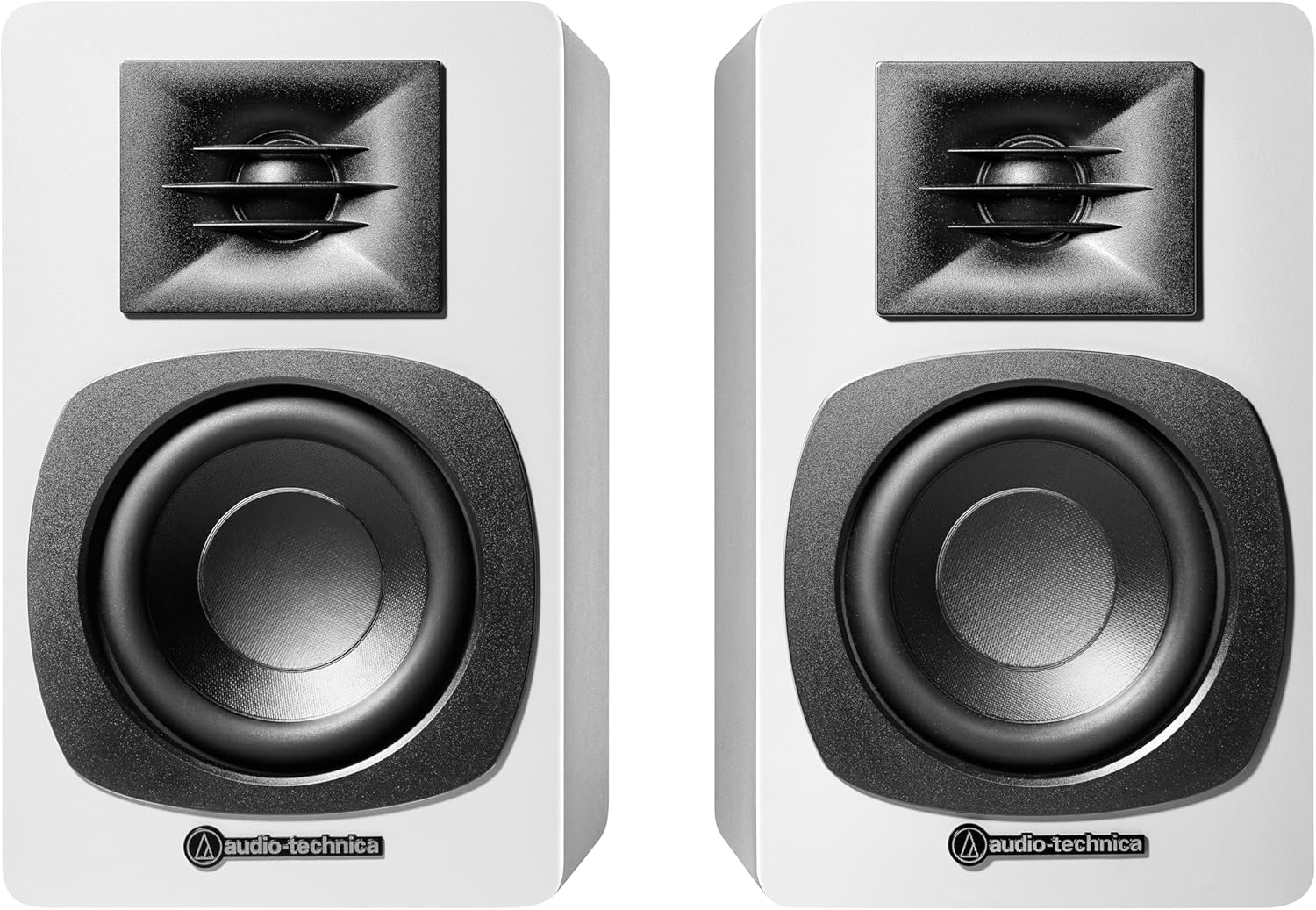
Yes, though they sound flatter than consumer speakers by design. Some listeners find that honesty refreshing after boosted earbuds. If you crave heavy bass for parties, add a subwoofer. The Audio-Technica AT-SP3XWH leans warmer if pure fun matters more.
Do I need an audio interface to use them?
Powered monitors need only a signal source, not a separate amp. A computer headphone jack works via RCA or AUX in a pinch. An interface improves sound quality and adds balanced XLR or TRS inputs. Bluetooth models like the Edifier R1700BT skip cables entirely for casual use.
What size woofer should I buy?
Choose 3.5-inch or 4-inch woofers for desks and rooms under 100 sq ft. Step up to 5-inch woofers, like the PreSonus Eris E5, for larger treated rooms. Bigger drivers reach lower but demand more space and volume. Matching size to room prevents muddy, fatiguing bass.
Are cheap studio speakers worth it?
Absolutely, especially for learning and casual production. Models now offer clean tweeters and useful inputs. You lose some low-end extension and headroom versus pricier pairs. Upgrade later once your ears and room mature.
Can I use studio speakers for gaming?
Yes, and many gamers prefer their crisp, detailed sound. Directional cues and footsteps come through clearly. A pair with a location switch or Bluetooth adds flexibility. Just place them properly for the widest stereo image.
The bottom line
Your ideal pair depends on room size, budget, and how you work. For most desks, the Yamaha HS4 balances accuracy, size, and price beautifully. Tight budgets get real value from the Edifier MR3, while larger rooms reward the Yamaha HS5. Nail your placement, match woofer size to your space, and any pick here will serve you for years. Compare current prices, then trust your ears to make the final call.