 Ryan Delgado
 Switching your home over to LED bulbs is one of the smartest energy upgrades you can make, but there is a catch that catches a lot of people off guard: not every dimmer plays nicely with LEDs. If you have ever installed a shiny new dimmer only to be greeted by flickering, buzzing, or a bulb that refuses to go below half brightness, you already know the frustration. Finding the best dimmer switches for LED lights is less about grabbing the cheapest option on the shelf and more about matching the right technology to your bulbs, your wiring, and how you actually want to control the room.
This guide walks you through everything you need to know before you buy. Instead of ranking products one by one, we focus on the decisions that matter: the difference between smart and manual dimmers, why LED compatibility is trickier than it looks, what your electrical box needs to support, and how to shortlist the right switch for each room in your home.

Pros
- Handles up to 150 watts of dimmable LED or CFL load, or 600 watts of incandescent/halogen
- Works without a neutral wire, so it fits older home wiring that lacks one
- Single-pole or 3-way wiring configurations are both supported by the same switch
- Pairs with Alexa, Apple HomeKit, Google Assistant and Sonos once a hub is connected
- Optional Pico wireless remote, sold separately, adds control points without new wiring
Cons
- Full app, voice and scheduling features require the separate Caseta Smart Hub, not included with this switch
- 150-watt LED/CFL ceiling means several high-wattage smart bulbs on one circuit can exceed the limit
- White finish and wallplate only ship in this listing, with no alternate color bundled
This dimmer switch handles up to 600 watts of incandescent or halogen load, or 150 watts of dimmable LED or CFL load, and installs on single-pole or 3-way circuits. It works in homes of any age since it does not require a neutral wire at the switch box.
- 150W dimmable LED/CFL, 600W incandescent/halogen
- Single-pole and 3-way wiring supported
- No neutral wire required
- Included wallplate, white finish
Because the LED/CFL ceiling is lower than the incandescent wattage ceiling, adding up the wattage of all connected LED bulbs against the 150W limit avoids overloading the circuit.

Pros
- Handles up to 150W of dimmable LED load or 600W of incandescent/halogen load from a single switch
- No neutral wire required, making it easier to retrofit into older homes than switches that demand one
- Works with Alexa, Apple Home, Google Assistant, Ring, Serena shades and Sonos once paired to a hub
- Smart Away randomizes on/off timing to simulate occupancy while the household is away
- Single-pole/3-way compatible, so it can replace either a standalone switch or one half of a 3-way circuit
Cons
- Requires a separate smart hub for smart features, the switch alone only provides local wall dimming without hub connectivity
- Not rated for low-voltage applications such as track or landscape lighting, limiting it to standard line-voltage fixtures
- Maximum 150W LED load caps how many bulbs or fixtures a single switch can control on higher-wattage LED setups
This dimmer handles up to 150W of dimmable LED load or 600W of incandescent and halogen load, but is explicitly not rated for low-voltage applications like track or landscape lighting. It works in single-pole or 3-way configurations, and does not require a neutral wire at the switch box.
- LED load: up to 150W
- Incandescent/halogen load: up to 600W
- Wiring: single-pole/3-way, no neutral wire required
Because it is rated for line-voltage fixtures only, anyone running low-voltage landscape or track lighting off the same circuit will need a different dimmer model rated for that specific load type.

Pros
- Smart in-wall dimmer switch controls lighting via app or voice commands
- Connects directly to 2.4GHz Wi-Fi networks without requiring a hub
- Dimmable LED and incandescent bulb support provides smooth dimming
- Customizable preset schedules automate indoor lighting daily
Cons
- Requires neutral wire inside electrical wall box for installation
- Wiring installation requires shutting off main electrical circuit breakers

Pros
- Works with existing bulbs already installed, so there is no need to buy new smart bulbs to add dimming control
- No neutral wire required for installation, which suits many older homes with two-wire switch boxes
- Supports up to 600 watts of incandescent or halogen load, or 150 watts of dimmable LED or CFL bulbs
- The paired smart hub runs without relying on home Wi-Fi, so switch response stays fast even during router outages
Cons
- A separate smart hub is required for app control, scheduling, and voice assistant integration, it is not included with this switch
- A remote for wireless 3-way setups is sold separately, not bundled with the dimmer
- Wall plate is sold separately as well, so the switch ships without a finishing cover plate
This dimmer supports up to 600 watts of incandescent or halogen bulbs, or 150 watts of dimmable LED or CFL bulbs, and installs without requiring a neutral wire, which matters in older homes wired with only two conductors at the switch box. It measures 1.13 x 2.93 x 4.69 inches and is built with a metal and plastic housing.
- Load capacity: 600W incandescent/halogen or 150W dimmable LED/CFL
- No neutral wire required
- Configuration: single-pole or 3-way
- Dimensions: 1.13 x 2.93 x 4.69 inches
Because it works with the bulbs already in the fixture, switching to smart dimming does not require replacing existing incandescent, halogen, LED, or CFL bulbs with proprietary smart bulbs.

Pros
- App-guided setup walks through wiring steps for a single-pole install with neutral wire
- Works with Amazon Alexa and Google Assistant for hands-free on/off and dimming control
- Gentle Off feature fades lights down gradually instead of cutting them off abruptly
- Away Mode randomly toggles lights to simulate occupancy while a home is empty
- UL Certified construction with a polycarbonate housing for standard wall installation
Cons
- Requires a neutral wire in the wall box, installation cannot be completed without one
- Single-pole wiring only, it does not support 3-way or multi-switch circuits
- 2.4GHz Wi-Fi only, so it will not connect to a 5GHz-only network without a dual-band router
Once installed, the switch adds remote and voice control on top of standard dimming.
- Controls lights from anywhere via the Kasa app over a 2.4GHz Wi-Fi connection
- Works with Amazon Alexa and Google Assistant for voice-activated dimming
- Gentle Off fades lights out gradually, useful for a child's bedtime routine
- No hub is required, the switch connects directly to the home Wi-Fi network
Because the switch relies on 2.4GHz Wi-Fi specifically, homes running a 5GHz-only network segment will need to enable a 2.4GHz band for setup.
Pros
- Handles up to 150W of dimmable LED/CFL bulbs or 600W of incandescent/halogen on one circuit
- Works in single-pole or 3-way wiring, so it controls lights from one or two switch locations
- No neutral wire required, which keeps installation compatible with older home wiring
- Offers over 250 distinct lighting levels through the slide control next to the toggle
- Metal construction with a compact 1.18 x 2.86 x 4.6-inch footprint fits standard wall boxes
Cons
- Coordinating wall plate is sold separately, so the switch alone ships without a faceplate
- 150W LED/CFL ceiling limits it to smaller fixture groups, since larger multi-bulb chandeliers may exceed that load
- White finish only in this listing, with no other color option included
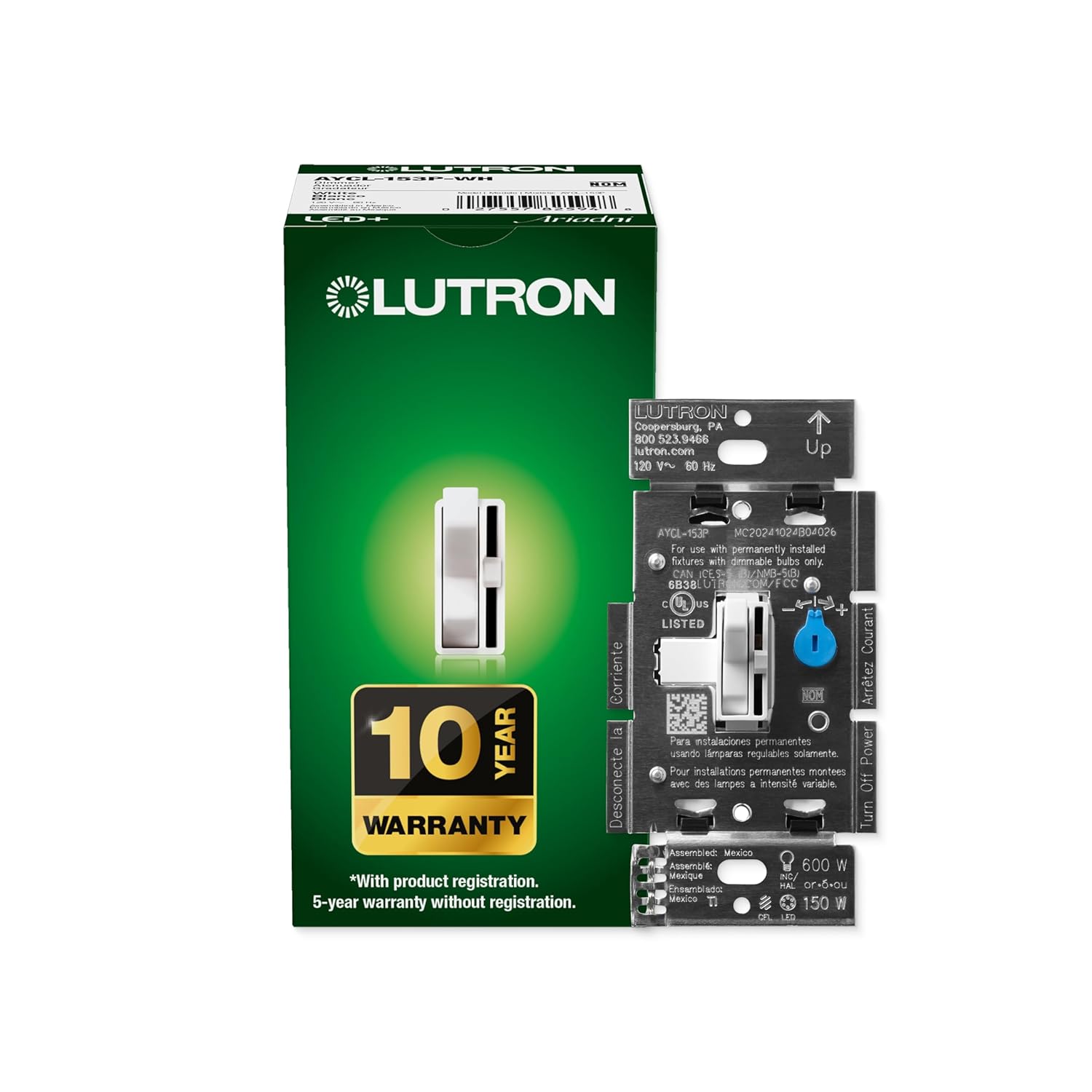
This Lutron Ariadni dimmer is rated for up to 150W of dimmable LED or CFL bulbs, or 600W of incandescent or halogen bulbs, on a single circuit. It supports both single-pole wiring, controlling lights from one switch location, and 3-way wiring, controlling the same fixture from two separate switches using a standard companion toggle.
No neutral wire is required for installation, which matters in older homes where the electrical box may only carry a hot and a switched-leg wire. The dimmer measures a compact 1.18 x 2.86 x 4.6 inches and is built with metal internal components rather than an all-plastic housing.
- 150W LED/CFL or 600W incandescent/halogen capacity
- Single-pole or 3-way wiring support
- No neutral wire required
Given its 150W LED/CFL and 600W incandescent/halogen limits, this dimmer fits typical living rooms, dining rooms, kitchens and bedrooms where a handful of bulbs share one circuit, rather than rooms with a large multi-bulb chandelier that could exceed the wattage ceiling. The 3-way wiring option makes it useful in rooms with two entry points, such as a hallway-connected living room or a basement with stairs at both ends.
- Suited to standard-size rooms with moderate bulb counts
- 3-way compatibility fits rooms with two switch locations
- Not ideal alone for large chandeliers near the 150W LED ceiling
Because it works with a broad range of dimmable LED and CFL brands, it is a practical fit for anyone gradually converting a home to LED lighting room by room.

Pros
- Handles up to 150 watts of dimmable LED/CFL bulbs or 600 watts of incandescent/halogen on the same circuit
- Works in single-pole setups or 3-way configurations controlling one light from two switches
- Paddle switch plus a separate slide control lets you turn lights on/off and adjust brightness independently
- Compact 1.31 x 2.94 x 4.69-inch size fits a standard wall box without special wiring
Cons
- Coordinating Claro wall plate is sold separately, not included with the switch
- Almond finish only in this listing, so matching other paddle colors elsewhere in a home may take extra shopping
- Compatible bulb list is broad but not universal, so checking specific LED bulb compatibility beforehand avoids flicker issues
This dimmer is rated for up to 150 watts of dimmable LED or CFL bulbs, or up to 600 watts of incandescent or halogen bulbs, and can handle a mixed load of LED and halogen bulbs on the same circuit. LED+ technology is built specifically to reduce flicker and buzz on compatible LED bulbs.
- 150W maximum for dimmable LED/CFL bulbs
- 600W maximum for incandescent/halogen bulbs
- Supports mixed bulb-type loads on one circuit
Since not every LED bulb dims identically, checking a bulb's dimmer compatibility before installation helps avoid flicker or a limited dimming range, particularly with lower-wattage LED bulbs near the bottom of the dimming curve.

Pros
- Works with up to 150W of dimmable LED/CFL bulbs or 600W of incandescent/halogen on one switch
- Tap on/off plus a separate rocker for dimming keeps quick toggling and fine adjustment on the same control
- No neutral wire is required, simplifying installation in older homes without one
- Expands to 3-way or multi-location setups for up to 10 locations with a companion switch
- Installs in as little as 15 minutes using standard tools
Cons
- Multi-location setups beyond a single switch require a separate MA-RR-XX companion switch, sold apart
- LED and CFL bulbs are capped at 150W, well below the 600W ceiling for incandescent or halogen bulbs
- Tested compatibility applies to specific bulb brands, so pairing with untested LED bulbs may need trial and error

Pros
- Handles up to 150 watts of dimmable LED or CFL bulbs, or up to 600 watts of incandescent/halogen bulbs on one switch
- Works as either a single-pole switch or in a 3-way setup controlling the same lights from two locations
- No neutral wire required, so it fits older home wiring that lacks a neutral conductor at the switch box
- Rocker turns lights on/off at a memorized level while a separate slider fine-tunes brightness across more than 150 lighting levels
- Installs in about 15 minutes per the manufacturer, though a matching wallplate is not included
Cons
- Coordinating wallplate is sold separately, so the switch alone ships without a decorative cover plate
- Maximum 150W LED/CFL load caps how many bulbs can run on a single switch in a high-fixture-count room
- White finish only in this listing, with no alternate color options bundled
This dimmer handles up to 150 watts of dimmable LED or CFL bulbs, or up to 600 watts of incandescent or halogen bulbs, covering most single-room lighting loads on one switch. It works in either single-pole or 3-way wiring configurations, so the same switch can control a light from one location or coordinate with a second switch controlling it from two locations.
- Up to 150W dimmable LED/CFL load
- Up to 600W incandescent/halogen load
- Single-pole or 3-way wiring compatible
Lutron states the switch has been tested across thousands of bulbs and dozens of brands for flicker-free dimming, though performance still depends on the specific LED driver inside each bulb; pairing with an untested bulb brand can occasionally show flicker at very low dim levels.
Pros
- - an easy way to create a big impact for a minimal cost and
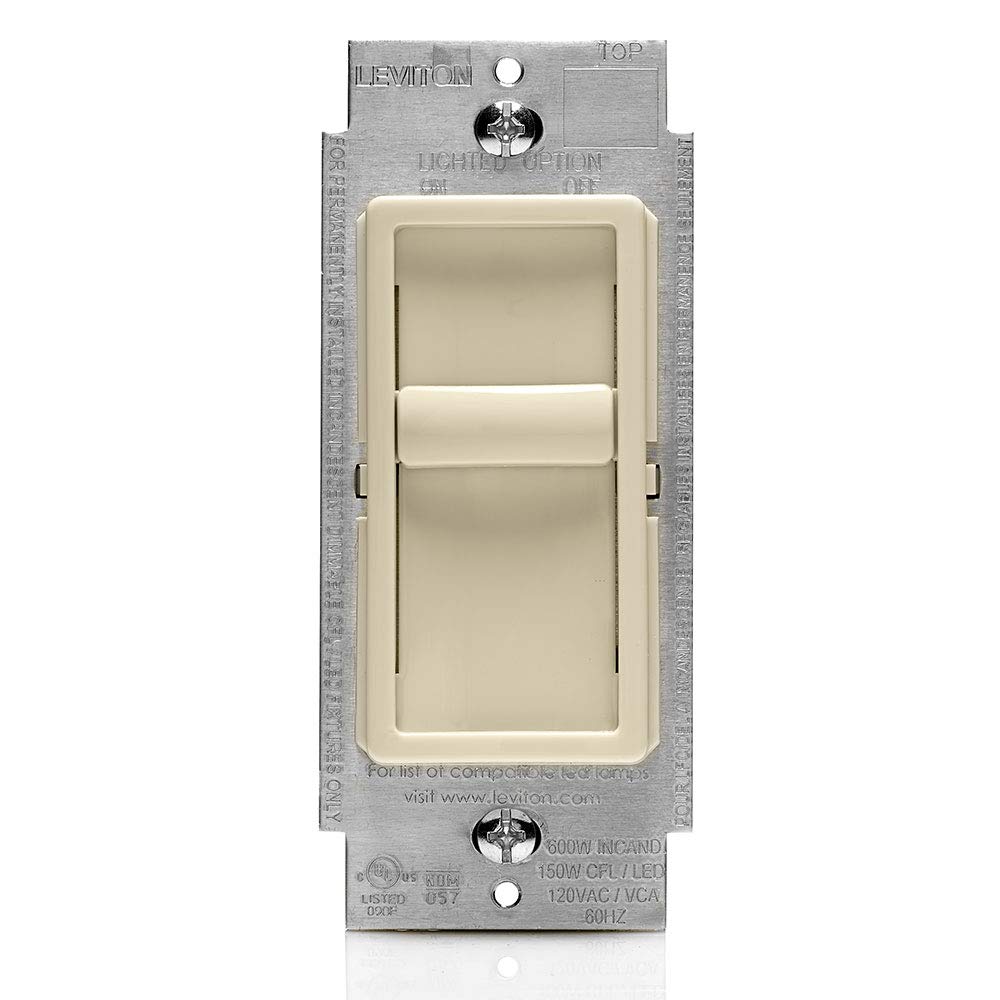
- EASY TO INSTALL - slim profile fits in most wallboxes. 150W LED,
- - designed to dim LED bulbs. To find out which LED bulbs pair best,
- SIMPLE - integrated slider for easy, precise dimming. Slide up to
- Dimensions of 1.73 x 0.93 x 4.12 inches engineered for optimal spatial fitting
Cons
- Requires verifying placement clearance for 1.73 x 0.93 x 4.12 inches prior to installation
Why LED Bulbs Need a Special Kind of Dimmer
Old incandescent and halogen bulbs drew a lot of power and behaved predictably, so almost any dimmer could smoothly ramp them up and down. LEDs are different. They sip only a fraction of the wattage, and their internal drivers respond to the electrical signal in ways that a legacy dimmer was never designed to handle. The result is the classic complaints: flicker at low levels, a narrow dimming range, audible humming, or bulbs that flash or “pop” when you turn them on.
The fix is a dimmer engineered specifically for low-wattage LED loads. These switches use smarter circuitry to deliver a clean signal, which is why you will see modern models marketed with “LED+” technology or explicit LED compatibility ratings. When you shop for the best dimmer switches for LED lights, this compatibility is the single most important box to check – everything else is secondary.
Watch the Minimum and Maximum Load
Every dimmer lists a wattage range. A dimmer rated for 150W of LED might comfortably handle incandescent up to 600W, but LEDs are the limiting factor. If you connect just one 9W LED bulb to a dimmer with a high minimum load, it may flicker because the circuit cannot “see” enough draw. Count the total wattage of all the bulbs on the switch and make sure it sits inside the LED-rated range. Purpose-built options like the Lutron Ariadni/Toggler LED+ and the Lutron Diva LED+ are designed to work reliably even with small LED loads.
Smart Dimmers vs. Manual Dimmers
The biggest fork in the road is whether you want a traditional wall dimmer or a smart one you can control with an app or voice assistant. Both categories have excellent LED options, so the right pick depends on how you live in the space.
Manual Dimmers: Simple, Reliable, Affordable
A manual dimmer does one job and does it well – you turn a dial, slide a paddle, or press a rocker to set the brightness. There is no hub, no Wi-Fi, no app to update, and nothing to break in a firmware cycle. For most rooms, a quality LED-rated manual dimmer is all you truly need, and it typically costs a fraction of a smart model.
These are ideal for dining rooms, hallways, bedrooms, and anywhere you set a comfortable level and rarely fuss with it. Well-regarded manual choices include the Lutron Maestro LED+ with its tap-and-hold interface, the toggle-friendly Lutron Skylark LED+, and the budget-conscious Leviton SureSlide. Each is built to dim LEDs smoothly without the flicker that plagues generic dimmers.
Smart Dimmers: Automation, Scenes, and Voice Control
Smart dimmers add a layer of convenience that manual switches simply cannot match. You can schedule lights to fade on at sunrise, dim to a movie-night level with a single voice command, or turn everything off from your phone as you leave the house. They integrate with ecosystems like Alexa, Google Home, and Apple Home, and many support multi-location control so you can operate the same light from several points.
There are two flavors of smart dimmer worth understanding. Hub-based systems, such as the Lutron Caseta and the newer Lutron Diva Smart, rely on a small bridge that plugs into your router. This adds a bit of setup but delivers rock-solid reliability and fast response. Wi-Fi models like the Kasa Smart Dimmer HS220 connect directly to your network with no hub at all, which keeps the initial cost and complexity down. Matter-ready options such as the Leviton Decora Smart aim to future-proof your setup across platforms.
Check Your Wiring: The Neutral Wire Question
Before you fall in love with any switch, look inside your existing wall box. Smart dimmers in particular often require a neutral wire (usually a bundle of white wires) to power their internal electronics continuously. Homes built in the last few decades usually have neutrals at the switch, but older houses frequently do not.
If your box lacks a neutral, you are not out of luck – some dimmers are engineered to work without one. Several Lutron Caseta models advertise “no neutral required,” which makes them a favorite for older homes. On the other hand, Wi-Fi dimmers like the Kasa HS220 and many Matter-based switches generally need that neutral present. Confirming this detail up front saves you a frustrating return trip and possibly a call to an electrician.
Single-Pole vs. 3-Way
Note whether the light is controlled from one switch (single-pole) or from two or more locations, such as the top and bottom of a staircase (3-way or multi-location). Most quality dimmers, including the Lutron LED+ line, support both configurations, but you often need a specific companion device or wiring approach for 3-way setups. Read the product description carefully to be sure the switch supports how your circuit is wired.
Matching the Right Dimmer to Each Room
You do not have to use the same switch everywhere. Thinking room by room helps you spend wisely and get the control you actually want.
- Living room and media spaces: A smart dimmer shines here. Scenes for movie night, reading, and entertaining make a real difference, so a hub-based or Wi-Fi model is worth the premium.
- Bedrooms: Gentle low-end dimming matters for winding down. Look for a dimmer with a wide range and a low minimum, whether smart or manual.
- Dining room: This is a classic candidate for a reliable manual LED+ dimmer – set the mood and forget it.
- Hallways and stairs: If controlled from two spots, prioritize a 3-way capable switch. Smart multi-location dimming adds convenience but is not essential.
- Kitchen and bathrooms: Bright, flicker-free performance is key. A dependable LED+ dimmer keeps task lighting clean.
Features That Separate Good Dimmers From Great Ones
Once compatibility is settled, a handful of features distinguish a merely functional dimmer from one you will genuinely enjoy using.
Adjustable Low-End Trim
Many premium LED dimmers let you calibrate the minimum brightness so your bulbs dim as low as possible without flickering or dropping out. This small adjustment eliminates the most common LED complaint and is worth seeking out if you want deep, moody lighting.
Interface Style
Dimmers come as sliders, toggles, rockers, and tap-to-set paddles. This is partly aesthetic and partly practical. A slider gives you fine visual control, a paddle with a small side slider looks clean and modern, and a toggler blends in with classic decor. Pick the feel that matches your home and your habits.
Fade Rates and Presets
Better dimmers offer a gentle fade-to-off so lights ease down rather than snapping dark, and many remember your last setting so a single tap returns to your preferred level. Smart models extend this with scheduled fades and geofencing that reacts to your phone’s location.
Reliability and Support
A dimmer is a long-term fixture in your wall, so brand track record counts. Established names in this space have spent years refining LED compatibility, and their higher review counts and consistent ratings reflect that maturity. Choosing a proven line reduces the odds of buzzing, premature failure, or compatibility headaches down the road.
Installation: What to Expect
Most dimmer switches install in the same footprint as a standard switch, and a confident DIYer can usually complete the swap in 15 to 30 minutes. The essentials are the same across brands: turn off the breaker, confirm the power is off with a tester, note how the existing wires are connected, and follow the included diagram. Smart dimmers add an app-based pairing step and, for hub systems, a one-time bridge setup.
That said, if you encounter aluminum wiring, no ground, a crowded box, or anything you are unsure about, hire a licensed electrician. Safe wiring is never the place to guess, and a professional install protects both your home and your new switch.
Common Mistakes to Avoid
- Ignoring the bulb’s dimmable rating: Not every LED bulb is dimmable. Even the best dimmer cannot smoothly dim a non-dimmable bulb, so check the packaging on your bulbs too.
- Overloading a small circuit: Adding up wattage prevents both flicker from too little load and overheating from too much.
- Assuming any smart switch fits any home: The neutral wire requirement trips up more buyers than any other single factor.
- Mismatching 3-way needs: Buying a single-pole dimmer for a two-location circuit leads to a return. Confirm your wiring first.
- Skipping the compatibility list: Many manufacturers publish LED bulb compatibility charts. A quick check can save hours of troubleshooting.
How to Make Your Final Choice
Boil it down to four questions. First, do you want app and voice control, or is a simple wall dial enough? That answer sends you toward smart or manual. Second, does your box have a neutral wire? That narrows the smart options dramatically. Third, is the light controlled from one location or several? That determines single-pole versus 3-way. Fourth, what is your budget per switch? Manual LED+ dimmers deliver excellent value, while smart models command more but pay you back in convenience and automation.
Answer those, and the field narrows quickly. For a hands-off, reliable upgrade in a single room, a manual LED+ dimmer like the Lutron Diva LED+ or the affordable Leviton SureSlide is hard to beat. For a connected home where scenes and scheduling matter, a hub-based system such as Lutron Caseta or a no-hub Wi-Fi option like the Kasa HS220 gives you that modern control. Whatever you choose, insisting on genuine LED compatibility is what separates a lighting upgrade you love from one you fight with.
Final Thoughts
The best dimmer switches for LED lights are the ones that match your bulbs, your wiring, and the way you live in each room – not simply the most expensive or the most feature-packed. Start with LED compatibility, confirm your neutral wire and pole configuration, then decide how much smart control you actually want. Get those fundamentals right and you will enjoy smooth, flicker-free dimming that makes every room feel exactly the way you want it. Use the shortlist above to compare current pricing and pick the switch that fits your home best.