 Ryan Delgado
 Choosing the best dimmer switches for your home is one of the simplest upgrades you can make, yet it has an outsized impact on comfort, mood, and even your energy bill. The right dimmer transforms a harsh, over-lit room into a warm, adjustable space that suits everything from a dinner party to a late-night movie. But with hundreds of models on the market – smart and standard, single-pole and three-way, neutral-required and no-neutral – picking the correct one can feel surprisingly complicated.
This guide walks you through everything you need to know before you buy. Instead of ranking products one by one, we focus on how to match a dimmer to your bulbs, your wiring, and your lifestyle, so you end up with a switch that works flawlessly on the first try.

Pros
- Handles up to 150 watts of dimmable LED or CFL load, or 600 watts of incandescent/halogen
- Works without a neutral wire, so it fits older home wiring that lacks one
- Single-pole or 3-way wiring configurations are both supported by the same switch
- Pairs with Alexa, Apple HomeKit, Google Assistant and Sonos once a hub is connected
- Optional Pico wireless remote, sold separately, adds control points without new wiring
Cons
- Full app, voice and scheduling features require the separate Caseta Smart Hub, not included with this switch
- 150-watt LED/CFL ceiling means several high-wattage smart bulbs on one circuit can exceed the limit
- White finish and wallplate only ship in this listing, with no alternate color bundled
This dimmer switch handles up to 600 watts of incandescent or halogen load, or 150 watts of dimmable LED or CFL load, and installs on single-pole or 3-way circuits. It works in homes of any age since it does not require a neutral wire at the switch box.
- 150W dimmable LED/CFL, 600W incandescent/halogen
- Single-pole and 3-way wiring supported
- No neutral wire required
- Included wallplate, white finish
Because the LED/CFL ceiling is lower than the incandescent wattage ceiling, adding up the wattage of all connected LED bulbs against the 150W limit avoids overloading the circuit.
Once paired with the separate Caseta Smart Hub, this switch unlocks app-based scheduling, geofencing, Smart Away random on/off patterns, and voice control through connected assistants. Without the hub, the switch still functions as a standard wall dimmer.
- App scheduling and geofencing (hub required)
- Smart Away random on/off simulation (hub required)
- Voice control via Alexa, Siri or Google Assistant (hub required)
- Functions as a manual dimmer without the hub
Because the hub is sold separately, first-time smart lighting buyers should factor its purchase into the setup before expecting app or voice features to work.
Caseta is built to connect with a wide range of smart home devices including Alexa, Apple HomeKit, Google Assistant, Serena shades and Sonos once the hub is in place. A wireless Pico remote, sold separately, extends control to a second location without running new wiring.
- Compatible with Alexa, Apple HomeKit, Google Assistant, Sonos
- Serena shades integration for whole-room control
- Optional Pico remote for wireless secondary control
- 1 switch controls multiple bulbs on its circuit
This breadth of compatibility suits households already invested in one or more of these ecosystems, since it avoids the compatibility gaps a single-brand-only smart switch may run into.

Pros
- Handles up to 150W of dimmable LED load or 600W of incandescent/halogen load from a single switch
- No neutral wire required, making it easier to retrofit into older homes than switches that demand one
- Works with Alexa, Apple Home, Google Assistant, Ring, Serena shades and Sonos once paired to a hub
- Smart Away randomizes on/off timing to simulate occupancy while the household is away
- Single-pole/3-way compatible, so it can replace either a standalone switch or one half of a 3-way circuit
Cons
- Requires a separate smart hub for smart features, the switch alone only provides local wall dimming without hub connectivity
- Not rated for low-voltage applications such as track or landscape lighting, limiting it to standard line-voltage fixtures
- Maximum 150W LED load caps how many bulbs or fixtures a single switch can control on higher-wattage LED setups
This dimmer handles up to 150W of dimmable LED load or 600W of incandescent and halogen load, but is explicitly not rated for low-voltage applications like track or landscape lighting. It works in single-pole or 3-way configurations, and does not require a neutral wire at the switch box.
- LED load: up to 150W
- Incandescent/halogen load: up to 600W
- Wiring: single-pole/3-way, no neutral wire required
Because it is rated for line-voltage fixtures only, anyone running low-voltage landscape or track lighting off the same circuit will need a different dimmer model rated for that specific load type.
Smart features on this switch depend on a separate smart hub, sold separately, which unlocks app control, voice integration and scheduling. Once connected, it works with Alexa, Apple Home, Google Assistant, Ring, Serena shades and Sonos, and supports a Smart Away mode that randomizes on/off timing to simulate an occupied home.
- Requires a smart hub for app and voice features
- Compatible platforms: Alexa, Apple Home, Google Assistant, Ring, Sonos
- Smart Away: randomized on/off simulation
Without the hub, the switch still functions as a standard wall dimmer using the soft-glow light bar and slider, but loses remote scheduling, voice control and the Smart Away simulation feature entirely.
Wiring flexibility is one of this switch's core features, it installs without a neutral wire and can replace either a standalone single-pole switch or one side of an existing 3-way dimmer circuit. Measuring 1.44 x 2.94 x 4.69 inches, it fits a standard wallplate, with a coordinating wallplate included in the box.
- Dimensions: 1.44 x 2.94 x 4.69 inches
- No neutral wire required
- Includes coordinating wallplate
A soft-glow light bar and slider provide manual dimming directly at the wall, useful as a fallback whenever the hub or app connection is unavailable, keeping basic lighting control independent of the smart system.

Pros
- Smart in-wall dimmer switch controls lighting via app or voice commands
- Matter certified for seamless integration across smart home ecosystems
- Connects directly to 2.4GHz Wi-Fi networks without requiring a hub
- Dimmable LED and incandescent bulb support provides smooth dimming
- Customizable preset schedules automate indoor lighting daily
Cons
- Requires neutral wire inside electrical wall box for installation
- Wiring installation requires shutting off main electrical circuit breakers
The Leviton Decora Smart Wi-Fi Dimmer Switch brings advanced smart lighting control to your home electrical system with native Matter protocol support. Connecting directly to your home 2.4GHz Wi-Fi network without an external bridge, it allows homeowners to control overhead lighting, set custom dimming levels, and automate schedules using the My Leviton app or major smart home platforms. You can dim lights for movie nights, set automated illumination schedules while traveling, or adjust lighting from anywhere using your smartphone, bringing effortless home automation to living rooms and bedrooms.
Pairing the smart dimmer switch with compatible voice assistants allows convenient hands-free lighting control using simple spoken commands. Engineered for smooth dimming performance, it provides full-range dimming control for dimmable LED, CFL, and incandescent light bulbs without annoying light flickering or buzzing noises. The classic Decora rocker switch design features a subtle side dimming bar for manual brightness adjustments at the wall, while built-in LED indicator lights display current dimming levels clearly, blending traditional wall switch operation with modern smart home technology.
Installing the in-wall dimmer switch requires basic electrical wiring experience and connecting to a neutral wire inside your electrical wall box. Turn off main circuit breaker power before removing your existing switch and connecting line, load, neutral, and ground wires to marked screw terminals. Clear installation instructions and mobile app setup prompts guide you through pairing the switch to your home Wi-Fi network. Placing smart dimmers in dining rooms or master bedrooms elevates lighting control across your living space for long-term daily convenience.

Pros
- Works with existing bulbs already installed, so there is no need to buy new smart bulbs to add dimming control
- No neutral wire required for installation, which suits many older homes with two-wire switch boxes
- Supports up to 600 watts of incandescent or halogen load, or 150 watts of dimmable LED or CFL bulbs
- The paired smart hub runs without relying on home Wi-Fi, so switch response stays fast even during router outages
Cons
- A separate smart hub is required for app control, scheduling, and voice assistant integration, it is not included with this switch
- A remote for wireless 3-way setups is sold separately, not bundled with the dimmer
- Wall plate is sold separately as well, so the switch ships without a finishing cover plate
This dimmer supports up to 600 watts of incandescent or halogen bulbs, or 150 watts of dimmable LED or CFL bulbs, and installs without requiring a neutral wire, which matters in older homes wired with only two conductors at the switch box. It measures 1.13 x 2.93 x 4.69 inches and is built with a metal and plastic housing.
- Load capacity: 600W incandescent/halogen or 150W dimmable LED/CFL
- No neutral wire required
- Configuration: single-pole or 3-way
- Dimensions: 1.13 x 2.93 x 4.69 inches
Because it works with the bulbs already in the fixture, switching to smart dimming does not require replacing existing incandescent, halogen, LED, or CFL bulbs with proprietary smart bulbs.
Full smart features, including app control, scheduling, and geofencing, require a separate smart hub, which is not included with this switch on its own. Once paired, the hub connects the switch to Alexa, Apple Home, Google Home, Ring, and Sonos, without depending on a stable Wi-Fi connection for basic switch response.
- Smart hub required for app and voice control (sold separately)
- Compatible with Alexa, Apple Home, Google Home, Ring, Sonos
- Hub-based connection stays responsive without relying on home Wi-Fi
A companion remote, sold separately, can add wireless 3-way switching to any location in a room without running new wiring, useful for lamps or secondary control points.
Beyond the dimmer switch itself, a few components are sold separately rather than bundled: the smart hub for app and voice control, a remote for wireless secondary switching, and a coordinating wall plate for a finished look.
- Smart hub: sold separately
- Wireless remote: sold separately
- Wall plate: sold separately
Anyone planning a full smart lighting setup across several rooms should plan for the hub as a one-time purchase that can then support additional switches added later, since a single hub connects multiple switches throughout a home.

Pros
- High-resolution outdoor video camera records clear perimeter footage
- Smart motion detection triggers instant push notifications to phone
- Infrared night vision illuminates dark yard perimeters in darkness
- Two-way audio microphone allows real-time communication via app
- Weather-resistant housing protects camera lens from rain and heat
Cons
- Ensure outdoor camera mounting spot has reliable wireless router signal
- Local video recording requires inserting a compatible micro SD memory card
Delivering 1080p high-definition video performance, this wireless outdoor security camera captures sharp property details across driveways, porches, and backyard yards. Onboard motion sensors identify movement within the camera field of view, sending instant push alerts to your smartphone. Built-in infrared night vision illuminates dark property perimeters up to 50 feet, ensuring crisp black-and-white monitoring after dark. Homeowners gain round-the-clock perimeter awareness to check package deliveries and monitor family arrivals remotely from anywhere during day or night across every season of the year.
An integrated microphone and speaker enable two-way voice communication with visitors or delivery drivers directly from your phone app. The weather-resistant camera housing prevents water ingress and lens fogging during rain, snow, or summer heat. Swiveling mounting brackets allow flexible angle adjustments to eliminate blind spots around entry doors and driveways, ensuring clear video capture through changing seasonal weather conditions and full home property security and peace of mind across all seasons of the year for your home and family safety.
Installing the wireless security camera involves securing the mounting bracket to an exterior wall or soffit and connecting the camera to your home Wi-Fi network using the companion app. Testing Wi-Fi signal strength at your intended outdoor location before drilling ensures smooth live video streaming. Inserting a micro SD card enables local event recording without requiring monthly cloud subscription fees, delivering a practical and reliable home security solution for total property safety and long-term security across your home environment and family living space.

Pros
- SET THE VIBE – Decora Slide Dimmer Switch delivers high-end design with
- FLICKER-FREE LED DIMMER – Delivers smooth, consistent lighting control
- EASY – Easy install dimmer switch requires no neutral wire and features
- Physical footprint measures 0.82 x 1.8 x 4.12 inches for spatial placement
- Crafted with Plastic materials
Cons
- Verifying dimensional clearance for Leviton Decora Slide L prior to setup is recommended
- Routine care preserves Plastic appearance for Leviton Decora Slide L over time
The Leviton Decora Slide LED Advanced Dimmer Switch for 150W delivers tailored functional performance engineered for modern user demands. SET THE VIBE – Decora Slide Dimmer Switch delivers high-end design with smooth, reliable lighting control to adjust overhead lights from bright task lighting to a soft ambient glow in any room. FLICKER-FREE LED DIMMER – Delivers smooth, consistent lighting control with superior performance with LED bulbs and fixtures. Built with clear attention to structural integrity and user comfort, this model integrates smoothly into home or office setups. Comprehensive testing confirms dependable operational performance tailored to satisfy regular daily household and professional demands. Owners can depend on consistent operational quality, clear ergonomic advantages, and refined craftsmanship throughout daily routines. Featuring overall dimensions of 0.82 x 1.8 x 4.12 inches, it allows for accurate room planning and straightforward placement.
Focusing on durability and functional efficiency, this model incorporates key attributes such as EASY – Easy install dimmer switch requires no neutral wire and features an ultra slim design that easily fits in standard wall boxes for a faster, hassle free installation. Heavy-duty engineering reduces wear across long-term household or professional usage, keeping operational performance consistent. Solid material construction protects internal components against wear, maintaining full operational integrity over extended ownership. Upholstered or framed in quality Plastic, the exterior provides strong wear resistance. Field observations confirm that Leviton Decora Slide LED Advan provides consistent functional reliability when operated according to standard setup guidelines.
Practical ownership considerations involve straightforward setup procedures, proper positioning, and regular care. – Fine tune minimum and maximum brightness, fade on rate and locator light. Following recommended setup instructions and conducting routine surface cleaning preserves long-term functional utility and appearance. Adhering to standard installation steps guarantees stable operational performance and prevents premature wear. Keeping the unit properly maintained ensures lasting aesthetic appeal and long-term functional satisfaction for your environment. Field observations confirm that Leviton Decora Slide LED Advan provides consistent functional reliability when operated according to standard setup guidelines.

Pros
- App-guided setup walks through wiring steps for a single-pole install with neutral wire
- Works with Amazon Alexa and Google Assistant for hands-free on/off and dimming control
- Gentle Off feature fades lights down gradually instead of cutting them off abruptly
- Away Mode randomly toggles lights to simulate occupancy while a home is empty
- UL Certified construction with a polycarbonate housing for standard wall installation
Cons
- Requires a neutral wire in the wall box, installation cannot be completed without one
- Single-pole wiring only, it does not support 3-way or multi-switch circuits
- 2.4GHz Wi-Fi only, so it will not connect to a 5GHz-only network without a dual-band router
Installing this switch replaces an existing wall dimmer or switch, with wiring requirements to check first.
- Requires a neutral wire in the wall box, installation cannot be completed without one
- Supports single pole wiring only, not compatible with 3-way switch setups
- The Kasa or Tapo app guides the wiring and setup process step by step
- Housing dimensions are 1.77 x 3.35 x 5.04 inches, with the switch itself measuring 4.13 x 1.71 x 1.74 inches without the wall plate
Because neutral-wire and single-pole requirements rule out some older homes and multi-switch circuits, confirming wiring type before purchase avoids a returned unit.
Once installed, the switch adds remote and voice control on top of standard dimming.
- Controls lights from anywhere via the Kasa app over a 2.4GHz Wi-Fi connection
- Works with Amazon Alexa and Google Assistant for voice-activated dimming
- Gentle Off fades lights out gradually, useful for a child's bedtime routine
- No hub is required, the switch connects directly to the home Wi-Fi network
Because the switch relies on 2.4GHz Wi-Fi specifically, homes running a 5GHz-only network segment will need to enable a 2.4GHz band for setup.
Beyond manual control, the switch supports automated schedules that run without any manual input.
- Advanced scheduling and timer functions turn lights on or off automatically at set times
- Away Mode randomly cycles lights on and off to suggest occupancy while nobody is home
- Grouping links the switch with other Kasa devices for combined control from a single app screen
- The switch is UL Certified, meeting standard safety testing for household electrical devices
Because scheduling and Away Mode both depend on an active Wi-Fi connection, a home internet outage will interrupt these automated features until connectivity returns.
Pros
- Handles up to 150W of dimmable LED/CFL bulbs or 600W of incandescent/halogen on one circuit
- Works in single-pole or 3-way wiring, so it controls lights from one or two switch locations
- No neutral wire required, which keeps installation compatible with older home wiring
- Offers over 250 distinct lighting levels through the slide control next to the toggle
- Metal construction with a compact 1.18 x 2.86 x 4.6-inch footprint fits standard wall boxes
Cons
- Coordinating wall plate is sold separately, so the switch alone ships without a faceplate
- 150W LED/CFL ceiling limits it to smaller fixture groups, since larger multi-bulb chandeliers may exceed that load
- White finish only in this listing, with no other color option included
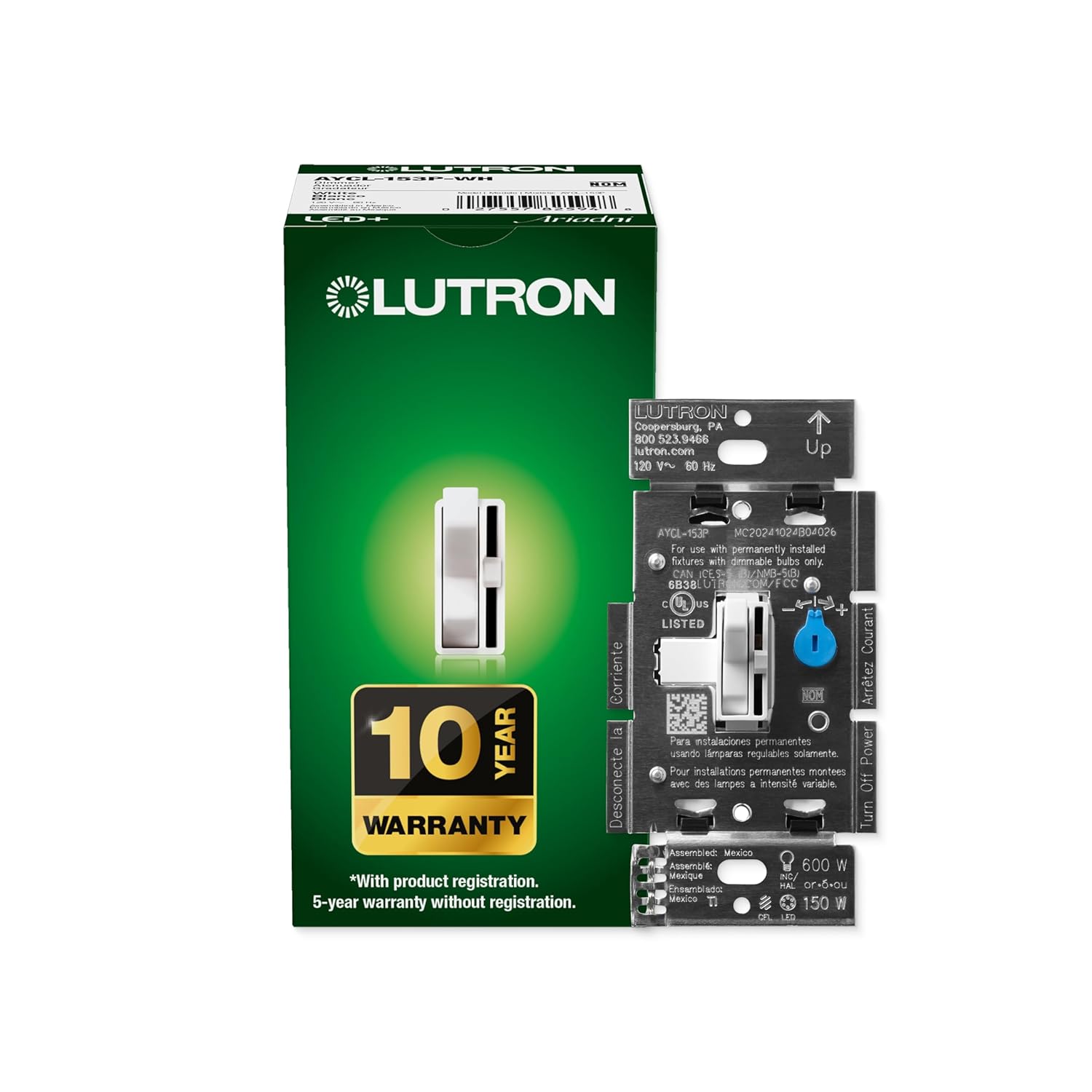
This Lutron Ariadni dimmer is rated for up to 150W of dimmable LED or CFL bulbs, or 600W of incandescent or halogen bulbs, on a single circuit. It supports both single-pole wiring, controlling lights from one switch location, and 3-way wiring, controlling the same fixture from two separate switches using a standard companion toggle.
No neutral wire is required for installation, which matters in older homes where the electrical box may only carry a hot and a switched-leg wire. The dimmer measures a compact 1.18 x 2.86 x 4.6 inches and is built with metal internal components rather than an all-plastic housing.
- 150W LED/CFL or 600W incandescent/halogen capacity
- Single-pole or 3-way wiring support
- No neutral wire required
Lutron states this switch installs in as little as 15 minutes in homes of most ages, since it does not require a neutral wire connection. The toggle turns the connected lights fully on or off at your last-used brightness, while a separate slide control next to the toggle adjusts brightness across more than 250 available levels.
For a 3-way setup, the dimmer pairs with a standard companion toggle switch at the second location rather than a second dimmer. A coordinating wall plate is not included and needs to be purchased separately to match your room's other switches. Always shut off power at the breaker before working on any wall switch wiring.
Given its 150W LED/CFL and 600W incandescent/halogen limits, this dimmer fits typical living rooms, dining rooms, kitchens and bedrooms where a handful of bulbs share one circuit, rather than rooms with a large multi-bulb chandelier that could exceed the wattage ceiling. The 3-way wiring option makes it useful in rooms with two entry points, such as a hallway-connected living room or a basement with stairs at both ends.
- Suited to standard-size rooms with moderate bulb counts
- 3-way compatibility fits rooms with two switch locations
- Not ideal alone for large chandeliers near the 150W LED ceiling
Because it works with a broad range of dimmable LED and CFL brands, it is a practical fit for anyone gradually converting a home to LED lighting room by room.

Pros
- Handles up to 150 watts of dimmable LED/CFL bulbs or 600 watts of incandescent/halogen on the same circuit
- Works in single-pole setups or 3-way configurations controlling one light from two switches
- Paddle switch plus a separate slide control lets you turn lights on/off and adjust brightness independently
- Advanced circuitry reduces flicker, buzz, and delay compared with basic dimmers on LED bulbs
- Compact 1.31 x 2.94 x 4.69-inch size fits a standard wall box without special wiring
Cons
- Coordinating Claro wall plate is sold separately, not included with the switch
- Almond finish only in this listing, so matching other paddle colors elsewhere in a home may take extra shopping
- Compatible bulb list is broad but not universal, so checking specific LED bulb compatibility beforehand avoids flicker issues
This dimmer is rated for up to 150 watts of dimmable LED or CFL bulbs, or up to 600 watts of incandescent or halogen bulbs, and can handle a mixed load of LED and halogen bulbs on the same circuit. LED+ technology is built specifically to reduce flicker and buzz on compatible LED bulbs.
- 150W maximum for dimmable LED/CFL bulbs
- 600W maximum for incandescent/halogen bulbs
- Supports mixed bulb-type loads on one circuit
Since not every LED bulb dims identically, checking a bulb's dimmer compatibility before installation helps avoid flicker or a limited dimming range, particularly with lower-wattage LED bulbs near the bottom of the dimming curve.
The switch supports both single-pole installations, where one switch controls the light, and 3-way setups, where the same light is controlled from two separate switch locations, such as opposite ends of a hallway or staircase.
- Single-pole wiring for one-switch control
- 3-way wiring for two-switch control of the same fixture
- Fits a standard wall box at 1.31 x 2.94 x 4.69 inches
Installation follows standard dimmer wiring practices, connecting to the existing electrical box, though anyone unfamiliar with home electrical wiring should shut off power at the breaker and confirm wiring configuration before starting, especially for 3-way setups involving a second switch location.
A large paddle switch handles turning the light fully on or off and returns it to the previously set brightness, while an adjacent slide control lets brightness be fine-tuned separately for different activities like reading, relaxing, or movie watching.
- Paddle switch for quick on/off with memory of prior brightness
- Separate slide control for precise brightness adjustment
- Suited for living rooms, bedrooms, kitchens, and other everyday spaces
Because the paddle style matches a widely used dimmer design, it fits alongside existing paddle switches elsewhere in a home for a consistent look throughout, though a matching wall plate needs to be ordered separately to complete the finished appearance.

Pros
- Works with up to 150W of dimmable LED/CFL bulbs or 600W of incandescent/halogen on one switch
- Tap on/off plus a separate rocker for dimming keeps quick toggling and fine adjustment on the same control
- No neutral wire is required, simplifying installation in older homes without one
- Expands to 3-way or multi-location setups for up to 10 locations with a companion switch
- Installs in as little as 15 minutes using standard tools
Cons
- Multi-location setups beyond a single switch require a separate MA-RR-XX companion switch, sold apart
- LED and CFL bulbs are capped at 150W, well below the 600W ceiling for incandescent or halogen bulbs
- Tested compatibility applies to specific bulb brands, so pairing with untested LED bulbs may need trial and error
A tap control turns the connected light fully on or off, while a separate rocker adjusts brightness up or down, keeping quick switching and fine dimming on one control rather than a single all-purpose slider. An LED indicator lights up to show the current dimming level at a glance.
- Delayed fade-to-off gives time to exit a room or settle into bed before lights fully switch off
- Preset light level programming sets a default brightness every time the switch turns on
- Low-end and high-end trim adjustments fine-tune the dimming range for specific bulbs
Because these settings are configured through button presses rather than an app, the initial setup takes a short walkthrough of the programming steps.
This dimmer installs in as little as 15 minutes using standard tools, and no neutral wire is required, which simplifies retrofitting into homes with older wiring. It supports single-pole use on its own or 3-way and multi-location setups covering up to 10 locations when paired with a companion switch.
- No-neutral wiring reduces the rewiring needed compared with some smart dimmer models
- A coordinating Claro wall plate is sold separately for a finished look
- Metal and plastic construction house the internal dimming electronics
For multi-location control, an MA-RR-XX companion dimmer is needed at each additional switch point, since that hardware is not bundled with this single switch.
The dimmer is tested across thousands of bulbs and dozens of brands, including Philips, Cree, GE, EcoSmart, and Lighting Science, to reduce flickering across a broad range of dimmable LED and CFL bulbs. Wattage limits sit at 150W for LED/CFL and 600W for incandescent or halogen bulbs on a single switch.
- Dimmable-labeled bulbs are required, since non-dimmable LED or CFL bulbs may flicker or buzz
- Mixing bulb brands on the same circuit can still affect dimming smoothness
- Button-press setup lets the switch calibrate to a bulb's optimum dim range after installation
Checking that a bulb is labeled dimmable before installation helps avoid the flickering that untested LED bulbs can cause on any dimmer switch.
Why Upgrade to a Dimmer Switch?
A standard on/off switch gives you exactly two options: fully bright or completely dark. A dimmer, on the other hand, unlocks the full range in between. That flexibility matters more than most people realize. Softer light in the evening supports better sleep, while brighter light helps with reading, cooking, or working. Dimming your lights even 20 percent can noticeably extend bulb life and reduce electricity use over time.
Beyond the practical benefits, dimmers simply make a home feel more finished. Layered, adjustable lighting is a hallmark of thoughtful interior design, and it costs far less than replacing fixtures. If you have never used quality dimming with modern LED bulbs, the difference in ambiance is immediate and hard to give up once you experience it.
How to Choose the Best Dimmer Switches for Your Home
Before you focus on brands or features, you need to understand a few technical details about your existing lighting and wiring. Getting these basics right is what separates a smooth installation from flickering bulbs and buzzing switches.
1. Check Your Bulb Type and Wattage
Modern homes are dominated by LED bulbs, and not every dimmer plays nicely with LEDs. Look for a dimmer specifically rated as “LED+” or “advanced” for dimmable LED, halogen, and incandescent bulbs. Most quality models today handle up to 150 watts of dimmable LED load, which is more than enough for a typical room. If you still use higher-wattage incandescent or halogen fixtures, confirm the wattage rating covers your total load. Using an LED bulb that is not labeled “dimmable” is the single most common cause of flicker, so always check the bulb packaging too.
2. Single-Pole vs. Three-Way Wiring
This is where many buyers get tripped up. A single-pole setup means one switch controls the light. A three-way setup means two switches control the same light, such as at the top and bottom of a staircase or at two entrances to a large room. The good news is that most well-designed dimmers support both single-pole and three-way applications, so you are covered either way. If you have three or more switches controlling one fixture (multi-location), verify the dimmer specifically supports that configuration.
3. Do You Have a Neutral Wire?
The neutral wire question is critical, especially for smart dimmers. Older homes often lack a neutral wire in the switch box, while newer construction almost always includes one. Some smart dimmers require a neutral wire to power their internal electronics, while others are engineered to work with no neutral required. If you are unsure and cannot easily identify a neutral wire, choose a no-neutral model to avoid a frustrating return. When in doubt, a quick photo of your switch box wiring can help an electrician confirm what you have.
4. Smart or Standard?
Your final major decision is whether you want a basic manual dimmer or a smart one. Standard dimmers are affordable, reliable, and installed in minutes – perfect if you just want a physical slider or toggle to set the mood. Smart dimmers add app control, voice commands, scheduling, and scenes, letting you adjust lights from your phone or automate them to follow the sunset. The trade-off is a higher price and, in some cases, the need for a hub or a stable Wi-Fi connection.
Standard Dimmer Switches: Simple and Reliable
If your priority is dependable dimming without the complexity of an app, a traditional dimmer is a fantastic choice. These switches are budget-friendly, work with most bulbs, and never depend on your internet connection. They are ideal for bedrooms, dining rooms, and hallways where you simply want to set a comfortable brightness and forget about it.
For a clean slide-style control, the Leviton SureSlide LED Dimmer and the Leviton Decora Slide LED Dimmer both offer smooth adjustment for 150W of dimmable LED, halogen, and incandescent loads at an approachable price. If you prefer a familiar toggle feel, the Lutron Ariadni Toggler pairs classic styling with modern LED+ compatibility. For a refined paddle-and-slider design, the Lutron Diva LED+ is a popular standard option that fits single-pole and three-way setups alike.
Who Should Buy a Standard Dimmer?
- Homeowners who want the lowest cost and easiest installation.
- Anyone who prefers a physical control over an app.
- Rooms where automation is unnecessary, like guest bedrooms or utility spaces.
- Households that want reliability without depending on Wi-Fi or a hub.
Smart Dimmer Switches: Control and Automation
Smart dimmers bring your lighting into the connected home era. With them, you can dim the lights by voice, set a gentle wake-up ramp in the morning, or create a “movie night” scene that dims every light at once. They work with popular platforms like Amazon Alexa, Google Assistant, and Apple Home, and many now support the Matter standard for broader compatibility.
There are two main smart approaches. Hub-based systems, such as the Lutron Caseta Smart Dimmer and the Lutron Diva Smart Dimmer, rely on a dedicated smart hub for rock-solid reliability and fast response, and they typically require no neutral wire – a big advantage in older homes. Wi-Fi models skip the hub entirely: the Kasa Smart Dimmer and the Leviton Decora Smart Dimmer connect directly to your 2.4GHz network, though they generally need a neutral wire to operate.
Hub-Based vs. Wi-Fi Smart Dimmers
Choosing between the two comes down to your priorities. Hub-based systems tend to be more responsive and stable, especially if you plan to install many switches, but you pay for the hub up front. Wi-Fi dimmers are simpler to start with and cost less initially, since there is no hub to buy, but a crowded network can occasionally affect performance. If you expect to build out a whole-home system over time, a hub-based ecosystem usually scales better.
Matching Dimmers to Each Room
Different rooms have different lighting needs, and the best dimmer switches are the ones matched to how you actually use each space.
Living Room and Media Spaces
These rooms benefit most from smart control and scenes. Being able to dim everything for a film or brighten up for guests with a single command is genuinely convenient. A multi-location smart dimmer like the Lutron Maestro LED+ works well where several entrances control the same lights.
Bedrooms
A gentle, warm glow before bed supports better sleep. Either a quality standard dimmer or a smart model with a scheduled fade works beautifully here. If you like reading in bed, prioritize smooth low-end dimming so the light can go very soft without flickering.
Kitchen and Dining
Kitchens need bright, functional light for cooking and softer light for dining. A three-way capable dimmer such as the Lutron Caseta PD-6WCL lets you control the same fixtures from multiple spots while keeping the flexibility to set the mood.
Hallways and Stairways
These are classic three-way locations. Choose a dimmer that explicitly supports three-way wiring, and consider a smart option so the lights can dim automatically at night for safe, low-glare navigation.
Installation Tips and Safety
Installing a dimmer is a manageable DIY project for many homeowners, but safety comes first. Always turn off power at the breaker before touching any wiring, and use a voltage tester to confirm the circuit is dead. Take a photo of the existing wiring before you disconnect anything so you have a reference. Match the wires carefully – line, load, ground, and neutral if required – and never exceed the dimmer’s rated wattage.
If your box is crowded, the wiring is unclear, or you are dealing with aluminum wiring or a complex multi-location setup, hiring a licensed electrician is money well spent. A proper installation prevents flicker, buzzing, and overheating, and it keeps your warranty intact.
Common Problems and How to Avoid Them
- Flickering lights: Almost always caused by non-dimmable bulbs or an incompatible dimmer. Use dimmable LEDs and an LED+ rated dimmer.
- Buzzing or humming: Often a wattage mismatch or a low-quality bulb. Stay within the rated load and choose reputable bulbs.
- Limited dimming range: Some cheaper dimmers cannot go very low. Advanced LED dimmers offer a wider, smoother range.
- Smart features not working: Confirm your network is 2.4GHz for Wi-Fi models, or that your hub is online for hub-based systems.
Frequently Asked Questions
Can I put a dimmer on any light?
Not quite. The bulbs must be dimmable, and the dimmer must be rated for your bulb type. LED bulbs in particular need both a dimmable bulb and an LED-compatible dimmer to perform well.
Do smart dimmers work without internet?
The physical switch always works manually, even if your internet is down. However, app control, voice commands, and remote access require a working connection or an online hub.
Is a neutral wire hard to add?
Adding a neutral wire usually means running new wiring, which can be costly. If your box lacks a neutral, a no-neutral dimmer is by far the easier path.
Final Thoughts
The best dimmer switches are the ones that fit your home’s wiring, your bulbs, and the way you live. Start by confirming your bulb type, wattage, and whether you have a neutral wire, then decide between the simplicity of a standard dimmer and the convenience of a smart one. Standard models deliver reliable, affordable dimming, while smart dimmers add scenes, scheduling, and voice control for a truly modern home.
Whichever direction you choose, upgrading to quality dimmers is a small investment that pays off every single evening in comfort and atmosphere. Use the product list above to compare current options, match the specs to your rooms, and enjoy lighting that finally does exactly what you want.